How Much a Beginner Should Spend on Tools in Year One?
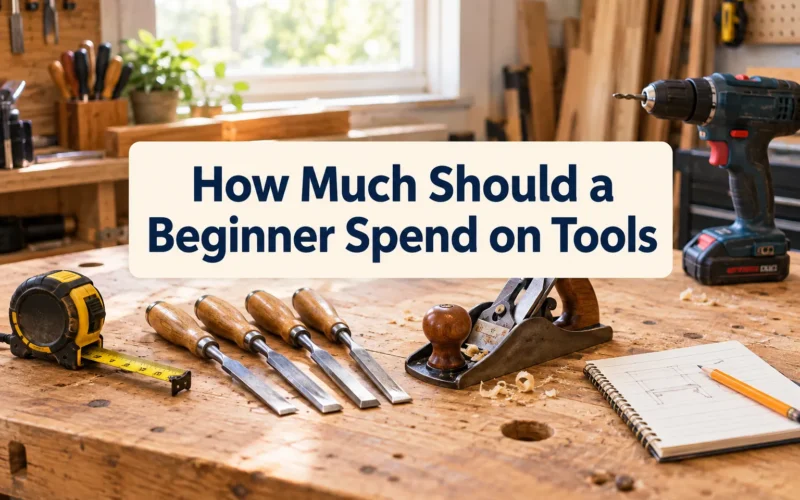
Most new woodworkers either spend too little and fight their tools for a year, or spend too much on gear they don’t understand yet. Neither approach builds skill. How much a beginner should spend on tools in year one comes down to a realistic range of $200 to $1,200, depending on whether the focus is on hand tools, power tools, or a full small shop setup.
That range is wide on purpose. A hobbyist building small boxes with hand tools on a kitchen table has very different needs than someone setting up a garage shop with a table saw and dust collection. The goal of this guide is to help you figure out where you fall on that spectrum and to spend money on the things that actually move your skills forward.
Find this useful? Add us as a preferred source on Google and more of what we publish will show up in your results.
Key Takeaways
- A reasonable starter budget for hand-tool-focused beginners is $200 to $500 for year one.
- Beginners adding core power tools (drill, circular saw, sander) should expect to spend $500 to $1,200 in year one.

- Buy mid-range tools over the cheapest or most expensive options; quality at both extremes creates problems for new woodworkers.
- Spreading purchases across several months and buying only what the current project needs prevents wasted money on unused gear.
- Skip premium stationary machinery in year one; rent, borrow, or use a local makerspace instead.
- The biggest beginner mistake is buying a large tool set before knowing which tools get used.
- Hand tools rarely need replacing if bought at mid-range quality; cheap power tools often need replacing within two to three years.
What Tools Do Beginners Actually Need in Year One
A first-year woodworker needs a measuring and marking set, a way to cut wood, a way to join pieces, and a way to smooth surfaces. Everything else is a nice-to-have until a specific project calls for it.
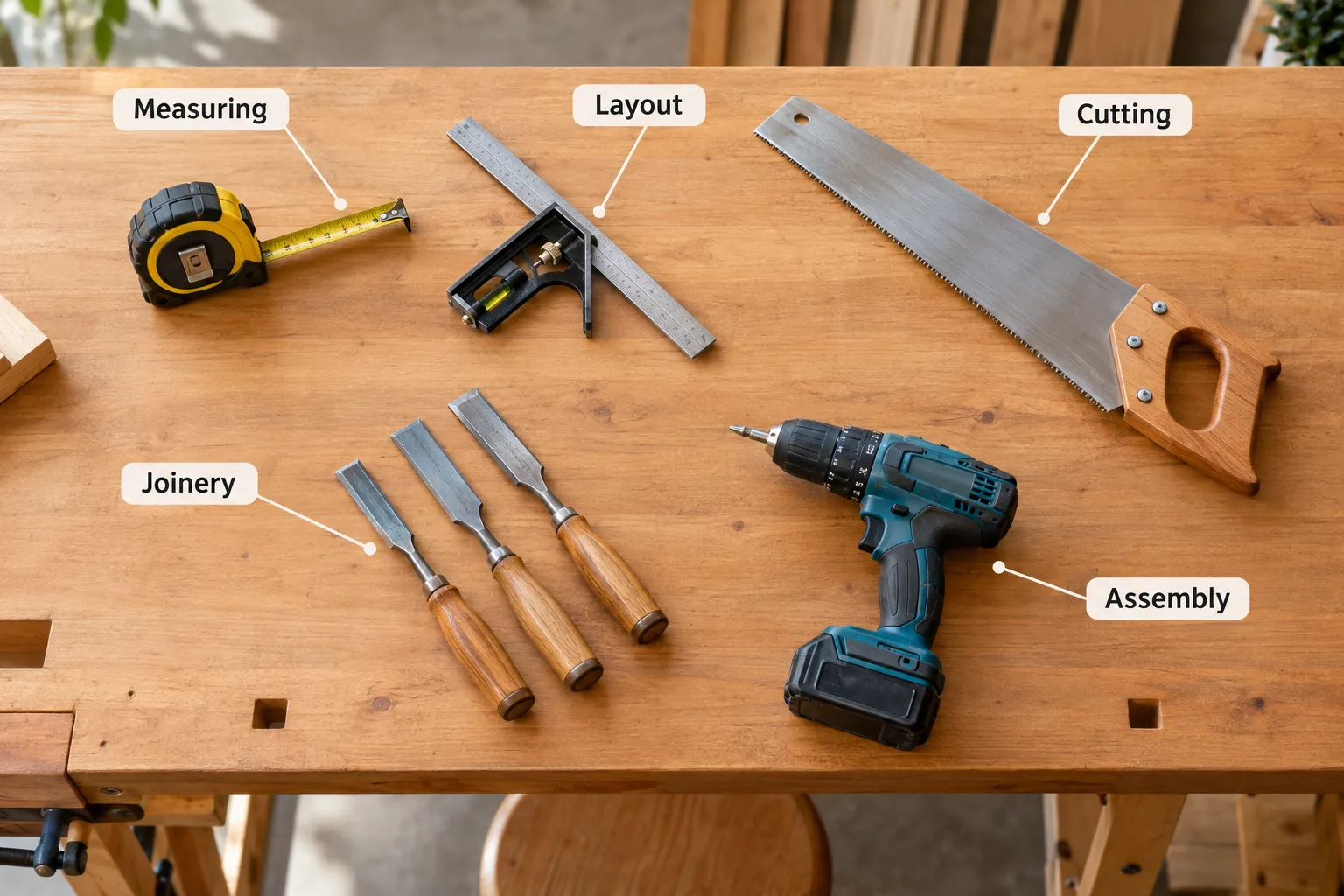
At minimum, that list looks like this:
- Tape measure, combination square, and marking gauge or pencil
- A hand saw, or a basic circular saw
- A chisel set and a mallet
- Sandpaper or a random orbit sander
- A cordless drill/driver
- Clamps (at least four to six)
This core kit handles the vast majority of beginner projects: shelves, boxes, small furniture, and simple joinery. For a full breakdown of what belongs in a starter kit and what can wait, the beginner hand tool woodworking kit guide walks through specific models and price points. The various tools used for woodworking guide is also useful for understanding what each tool actually does before buying it.
How Much Should a Beginner Spend on Tools in Year One?
Most beginners spend somewhere between $200 and $1,200 in year one, with the final number driven mostly by whether they lean toward hand tools or power tools. There’s no single “right” number, but there is a right question: what do your first three projects actually require?
Here’s a practical breakdown by approach:
| Approach | Typical Year-One Spend | What It Covers |
|---|---|---|
| Hand-tool only | $200, $500 | Measuring set, hand saw, chisels, mallet, clamps, sandpaper |
| Hybrid (hand + basic power) | $500, $900 | Core hand tools plus drill, circular saw, sander |
| Power-tool focused shop | $900, $1,200+ | Hybrid kit plus a jigsaw, router, and upgraded clamps |
These figures are general planning estimates based on typical retail pricing for entry- and mid-range tools, not a guaranteed cost for every region or brand. Budget-conscious beginners can land near the low end by buying tools only as projects demand them. For a deeper cost comparison, including whether woodworking as a hobby is as expensive as people assume, see is woodworking expensive to start?
Choose the hand-tool path if you’re working in a small space, prefer quiet work, or want to build fundamental skills before adding machinery. Choose the hybrid path if you want faster results on furniture-style projects and have a garage or shed to work in.
Should You Buy Cheap Tools or Expensive Ones When Starting Out
Neither extreme serves a beginner well. Cheap tools often have poor tolerances that make accurate cuts and joints harder to achieve, while top-tier professional tools cost more than a new woodworker can justify before knowing their preferences.
The smarter play is buying mid-range tools from established brands. Mid-range tools are accurate enough to teach good technique, durable enough to last several years, and affordable enough that a wrong purchase isn’t a financial disaster.
Expensive brands are worth it in a few specific cases:
- Tools used on every single project (a quality tape measure or combination square)
- Tools where precision directly affects joint quality (chisels, marking tools)
- Tools that are genuinely dangerous when poorly made (blade guards, safety gear)
Skip premium pricing on tools you’re still learning to use, like a router or a track saw, until you know how often you’ll reach for them.
Beginner vs. Professional Tool Quality: What Really Changes
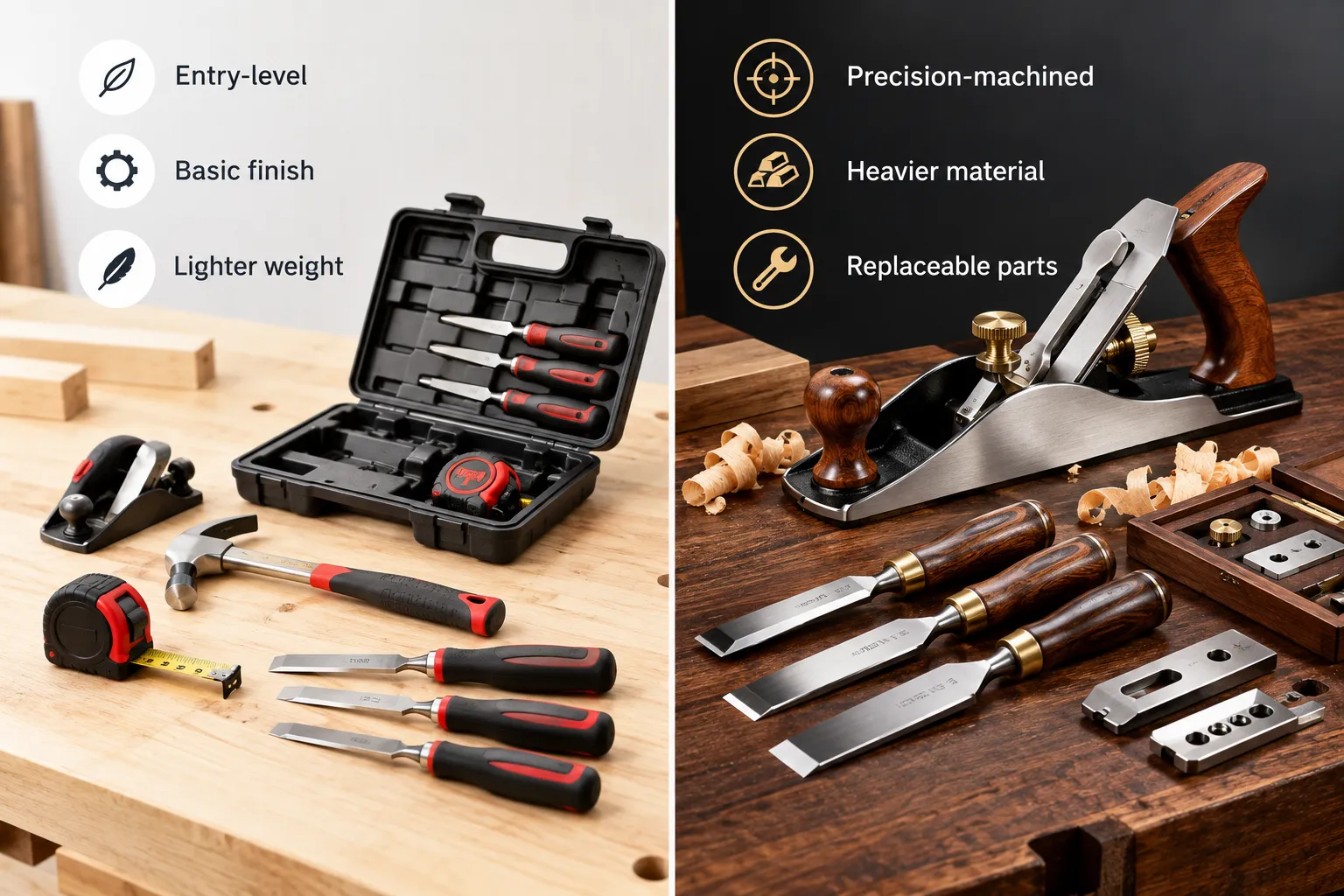
The difference between beginner and professional tool quality mostly comes down to materials, machining tolerance, and replaceable parts. Professional tools are built for daily, all-day use and forgive less operator error; beginner tools are built for occasional use and some margin of error.
A few concrete differences:
- Steel quality: Professional chisels hold an edge longer and are easier to resharpen flat.
- Machining tolerance: Professional squares and levels are accurate to tighter fractions, which matters more as projects get complex.
- Motor durability: Professional-grade power tools handle longer run times without overheating.
- Parts availability: Professional brands usually sell replacement parts; budget brands often don’t.
A beginner building a few boxes a year doesn’t need professional tolerances. A beginner building furniture for sale within two years will probably outgrow entry-level gear quickly, so it’s worth knowing that in advance rather than rebuying everything later.
Can You Start With a Few Basic Tools and Upgrade Later
Yes, and for most beginners, this is the smartest approach. Buying a small core kit first, then adding tools as specific projects demand them, prevents spending on gear that sits unused in a drawer.
A practical build-up sequence looks like this:
- Months 1 to 2: Measuring and marking tools, a saw, clamps, sandpaper
- Months 3 to 5: Chisels, mallet, cordless drill
- Months 6 to 9: Circular saw or jigsaw, a basic router
- Months 10 to 12: Upgrade one or two tools that got heavy use, add a sander if not already owned
You don’t need to buy everything at once, and spreading purchases out across the year has a real benefit beyond budgeting: each new tool gets learned properly before the next one arrives. The beginner woodworking tool kits guide has pre-built kit suggestions organized by project type if a phased approach still feels overwhelming to plan solo.
Which Tools Are Worth the Investment and Which to Skip
Spend more on tools you touch constantly and tools that determine accuracy. Spend less, or skip entirely, on specialty tools that only apply to a narrow range of projects.
Worth investing in:
- A quality combination square (used on nearly every project)
- Sharp, well-made chisels (directly affect joint fit)
- A reliable cordless drill/driver (used constantly)
- Good clamps (never regret having enough of them)
Worth skipping in year one:
- Stationary table saws and jointers (expensive, space-heavy, not needed for most beginner projects)
- Specialty jigs for techniques you haven’t attempted yet
- Multiple sizes of the same tool “just in case”
If a stationary machine feels necessary early on, a local makerspace or a small backyard shed workshop setup can bridge the gap until the budget and the skill level both justify the purchase. The essential woodworking machinery guide explains which machines actually earn their shelf space first.
How to Tell If a Tool Is Good Quality or a Waste of Money
A tool is worth the money if it holds its calibration, performs consistently across uses, and has available replacement parts or accessories. A tool is a waste of money if it needs frequent readjustment, flexes or wobbles under normal use, or has no support from the manufacturer.
Quick checks before buying:
- Look at the weight. Oddly light hand tools (chisels, planes) often use thinner, weaker steel.
- Check for play or wobble in moving parts like drill chucks or clamp mechanisms.
- Read reviews specifically mentioning long-term use, not just unboxing impressions.
- Confirm the brand sells replacement blades, batteries, or parts.
Common mistake: assuming a higher price always means higher quality. Some mid-priced tools from lesser-known brands outperform expensive tools from brands charging mostly for the name.
Common Mistakes Beginners Make When Buying Tools
The most common mistake is buying a large all-in-one tool set before knowing which tools actually get used. These kits often bundle low-quality accessories with one or two decent core tools, leading beginners to overpay for items that end up unused.
Other frequent mistakes:
- Buying stationary machinery before a dedicated, properly wired workspace exists (see how to wire a workshop shed for power tools if planning ahead for this)
- Skipping clamps to save money, then struggling with every glue-up
- Buying dull, pre-sharpened “beginner” chisels and assuming the tool is defective rather than learning to sharpen
- Choosing tools based on brand reputation alone, without checking if the specific model suits beginner use
Minimum Budget, Tool Sets vs Individual Tools, and Replacement Timeline
The realistic minimum budget to get started with decent, mid-range tools is around $150 to $200 for a hand-tool-only approach focused on small projects. Below that range, tool quality typically drops enough to make basic tasks noticeably harder.
Should you buy a tool set or individual tools?
Buy individual tools if you already know your project type, since sets often include filler items you won’t use. Buy a curated beginner set if you’re unsure where to start, as long as the set comes from a reviewed source rather than a generic bargain bundle. The best beginner woodworking tool kits guide compares several sets built around realistic small-project use.
How often do beginners need to replace starter tools
Hand tools bought at mid-range quality rarely need replacing; a decent chisel set or hand plane can last decades with basic maintenance and sharpening, as covered in the best hand planes for beginners guide. Cheap cordless power tools, on the other hand, often wear out or lose battery capacity within two to three years of regular hobby use, which is one more reason to spend slightly more on tools used constantly.
Frequently Asked Questions
Do I really need $1,000 to start woodworking?
No. A focused hand-tool kit can get a beginner building real projects for $200 to $300. The higher end of the budget applies mainly to those adding power tools and a dedicated workspace.
What if I buy a tool and it turns out I never use it?
That’s a normal part of learning. Buying gradually, project by project, keeps those mistakes small and cheap rather than expensive.
Is it better to borrow or rent tools before buying?
Yes, for anything stationary or expensive, like a table saw or planer. Renting or using a makerspace first helps confirm the tool fits your project style before committing money.
Should I buy all my hand tools from one brand?
Not necessarily. Mixing brands by category, a trusted brand for measuring tools, another for chisels, often gives better overall value than brand loyalty across the board.
How do I know when I’ve outgrown beginner tools?
Usually when a tool’s limitations start showing up in finished work, like squares that aren’t quite true or saws that wander off the line despite careful technique.
Does project type change the budget?
Yes, significantly. Furniture-focused beginners need more clamps, a wider saw, and eventually a router, while small-box or carving-focused beginners can stay almost entirely in the $200 to $400 range.
Conclusion
The honest answer to how much a beginner should spend on tools in year one is: less than most people assume, as long as purchases follow project needs instead of impulse. Start with a core kit under $500, add power tools only when a project genuinely calls for them, and resist the pull toward either bargain-bin tools or professional-grade gear before you know your own habits. Review your first three projects, list exactly what each one requires, and buy only that. The skill comes from use, not from the size of the toolbox.
Products, Tools, and Resources Worth Exploring
For readers ready to build out a starter kit with more guidance, a few resources are worth bookmarking:
- The beginner woodworking tools and equipment guide breaks down categories in more depth than a single shopping list can.
- The home woodshop setup planning guide helps match tool choices to available space, which matters more than people expect.
- For hands-on learning alongside tool purchases, the woodworking online training guide pairs well with a phased tool-buying plan.
- Once core tools are in place, the step-by-step woodworking projects for beginners guide gives practical ways to put that first-year kit to work right away.