How Long Does It Take to Learn Woodworking?
Ask ten woodworking instructors how long it takes to learn woodworking, and you’ll get ten different answers. But most agree on one thing: progress depends on hours of hands-on practice, not months on a calendar. A hobbyist who works in the shop two evenings a week will hit beginner milestones far more slowly than someone building something every single day.
For most beginners, basic competence (safe tool handling, square cuts, simple joinery) takes roughly 50 to 100 hours of practice, which works out to about two to four months of consistent weekend work. Comfortable intermediate skills, including furniture-grade joinery and finishing, typically take 300 to 500 hours, or around one to two years of regular practice. How long does it take to learn woodworking ultimately depends on how often someone shows up to the shop, not how many birthdays pass.
Find this useful? Add us as a preferred source on Google and more of what we publish will show up in your results.
Key Takeaways
- Basic woodworking competence usually takes 50 to 100 hours of focused practice, roughly two to four months for a weekend hobbyist.
- Comfortable intermediate skill, including tight joinery and clean finishes, generally requires 300 to 500 hours over one to two years.

- Consistency matters more than raw talent. Three short sessions a week beat one long session a month.
- Beginners can start learning core safety and measuring skills without a dedicated workshop.
- Most people can learn woodworking without prior experience; it is more forgiving than metalworking or welding.
- Selling finished pieces for steady income typically takes one to three years of skill-building plus business groundwork.
- The biggest beginner mistakes are rushing measurements, skipping practice cuts, and buying too many tools too soon.
How Long Does It Take to Learn Woodworking Basics?
Learning the basics of woodworking, safe tool use, straight cuts, and simple joints, generally takes 50 to 100 hours of practice. That translates to about two to four months if someone practices three to five hours a week.
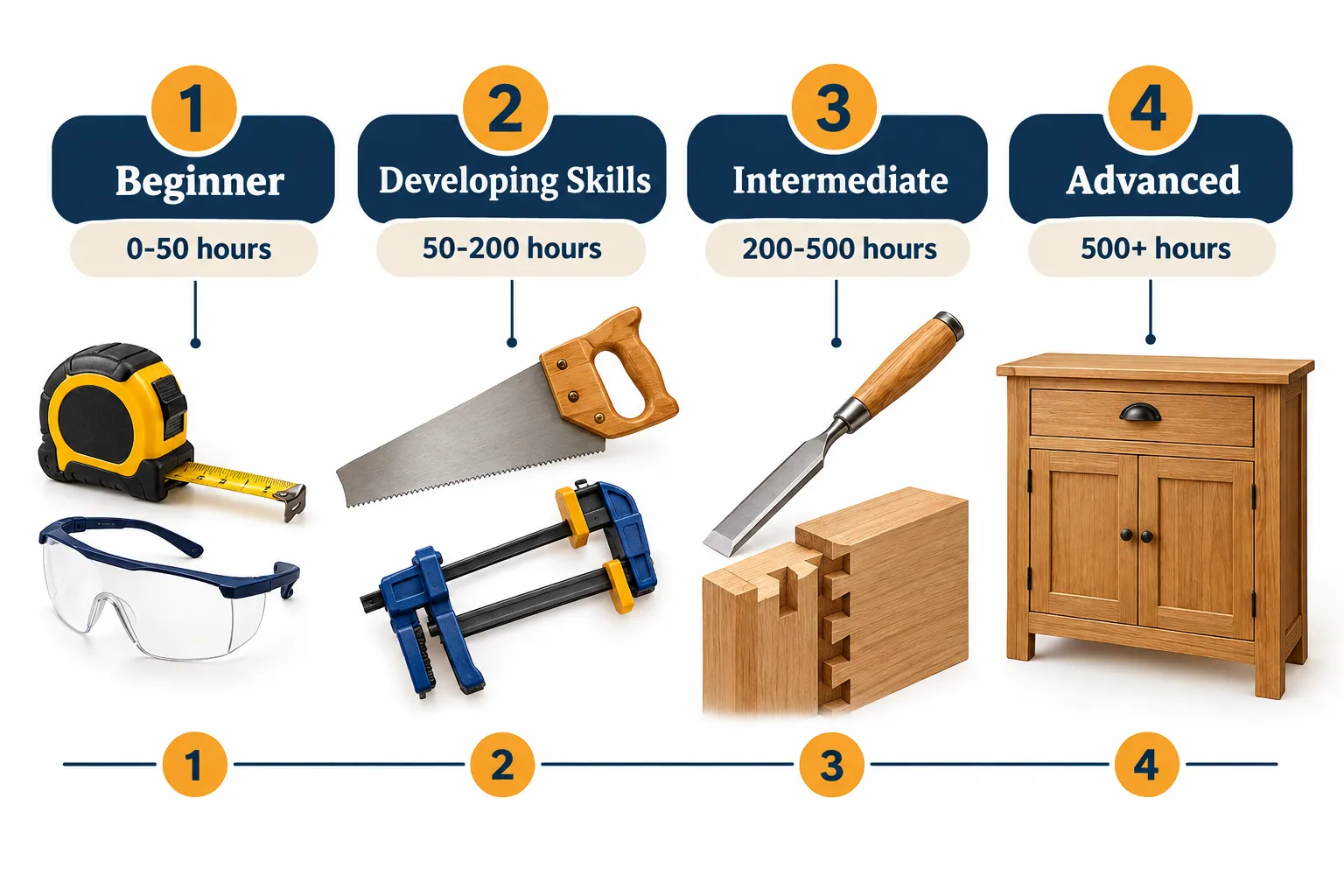
Becoming genuinely skilled, able to design and build furniture without constant guidance, takes longer. Most dedicated hobbyists reach that point after 300 to 500 hours, often spread across one to two years. A few factors speed this up or slow it down:
- Session frequency: Three 90-minute sessions weekly build skills faster than one long Saturday marathon.
- Project variety: Building different project types (boxes, shelves, tables) teaches more than repeating the same plan.
- Feedback quality: Working alongside an experienced woodworker or following structured lessons shortens the learning curve noticeably.
Choose a slower, deliberate pace if accuracy matters more to you than speed. Choose a faster, project-driven pace if you learn best by building and troubleshooting on the fly. The beginner woodworking guide on tools, projects, and tips is a practical place to start mapping out those first 100 hours.
How Many Hours of Practice Do You Need to Learn Woodworking?
Most woodworkers need an estimated 50 to 100 hours to reach basic safety and competence, and 300 to 500 hours to reach a comfortable intermediate level. These numbers are practical estimates based on common hobbyist pacing, not a fixed rule.
A rough breakdown looks like this:
| Skill level | Estimated hours | What you can typically do |
|---|---|---|
| Beginner | 50-100 | Safe tool use, square cuts, basic butt and screw joints |
| Developing | 100-200 | Simple furniture plans, basic sanding and finishing |
| Intermediate | 300-500 | Dovetails, mortise and tenon, flat panel doors |
| Advanced | 500+ | Original designs, hand-cut joinery, fine finishing |
Common mistake: counting “shop time” that includes cleanup, tool shopping, and video watching as practice hours. Only hands-on cutting, joining, and finishing time builds real skill.
Can You Learn Woodworking in 3 Months?
Yes, in three months of consistent practice (roughly 50 to 80 hours), most beginners can learn safe tool operation, accurate measuring, and basic joinery well enough to build simple projects like shelves or boxes. Three months will not produce furniture-grade craftsmanship, but it will build a real foundation.
What changes the outcome:
- Practicing four or more times a week compresses the beginner phase into roughly 10 to 12 weeks.
- Following structured lessons instead of random videos cuts out wasted trial and error.
- Starting with small projects (a step stool, a tool tote) builds confidence faster than jumping straight to a dining table.
Choose a three-month sprint if you have a specific small project goal and can dedicate several hours weekly. If your schedule only allows a few hours a month, plan on six to nine months for the same beginner milestones instead.
What’s the Difference Between Beginner and Intermediate Woodworking Skills?
Beginner woodworkers can safely operate basic tools and cut reasonably straight lines, while intermediate woodworkers can execute precise joinery, read and adapt plans, and finish pieces to a professional-looking standard. The gap between the two is mostly about repetition and problem-solving experience.
| Area | Beginner | Intermediate |
|---|---|---|
| Measuring | Occasional small errors | Consistently accurate to 1/32 inch |
| Joinery | Screws, pocket holes, butt joints | Dovetails, mortise and tenon |
| Tool use | Needs guidance on settings | Adjusts tools independently |
| Finishing | Uneven stain or blotching | Even, controlled results |
A beginner builds a project by following instructions step by step. An intermediate woodworker can troubleshoot when a board isn’t flat or a joint doesn’t quite fit, which is the real marker of growth. The complete guide to joinery and techniques is a good benchmark for seeing what intermediate-level joints actually require.
Is Woodworking Hard to Learn for Beginners?
Woodworking is not especially hard to learn for beginners, but it does require patience with measuring, tool setup, and material behavior. Most of the early difficulty comes from unfamiliarity with tools, not a lack of natural ability.
Beginners who struggle most usually share one pattern: they skip practice cuts and jump straight into a finished project, then get frustrated when gaps or wobbles show up. Beginners who progress smoothly tend to practice individual skills (a straight rip cut, a square crosscut, a simple joint) before combining them into a full project.
Is Woodworking Easier Than Other Crafts to Learn?
Woodworking is generally considered more forgiving to learn than crafts like welding or upholstery, because mistakes in wood can often be sanded, patched, or re-cut rather than scrapped entirely. It is comparable in difficulty to ceramics or sewing in terms of the learning curve, though it requires more upfront tool investment.
Choose woodworking over metalworking if you want a lower barrier to entry and more forgiving materials. Choose metalworking or welding if your end goal is structural strength rather than furniture or decorative pieces.
Woodworking Skills You Should Learn First
The first skills every beginner should learn are measuring and marking accurately, safe table saw or circular saw operation, and one reliable joint like the pocket screw or butt joint. These three skills form the backbone of almost every early project.
A practical learning order:
- Measuring and marking (tape measure, square, marking gauge)
- Safe operation of one primary cutting tool
- One strong beginner joint (pocket hole or glued butt joint)
- Sanding and basic finishing
- Reading a simple plan end to end
Skipping step 1 is the most common beginner mistake; sloppy measuring causes problems that show up two or three steps later and are hard to trace back. The guide to reading and using woodworking plans and a reference like the ultimate woodworking joints guide both pair well with this early stage.
Best Woodworking Courses for Learning Fast
Structured courses that combine video instruction with guided practice projects tend to produce faster progress than unstructured YouTube browsing, because they sequence skills logically instead of leaving the order up to chance. The fastest learning path usually blends online instruction with physical practice time in the shop the same week.
Look for a course that includes:
- Clear beginner-to-intermediate project sequencing
- Safety instruction before tool-specific lessons
- Feedback mechanisms, even informal ones like community forums
The complete beginner’s guide to woodworking online training walks through how to evaluate course options without wasting money on courses that are too advanced too soon.
Can You Learn Woodworking Without a Workshop?
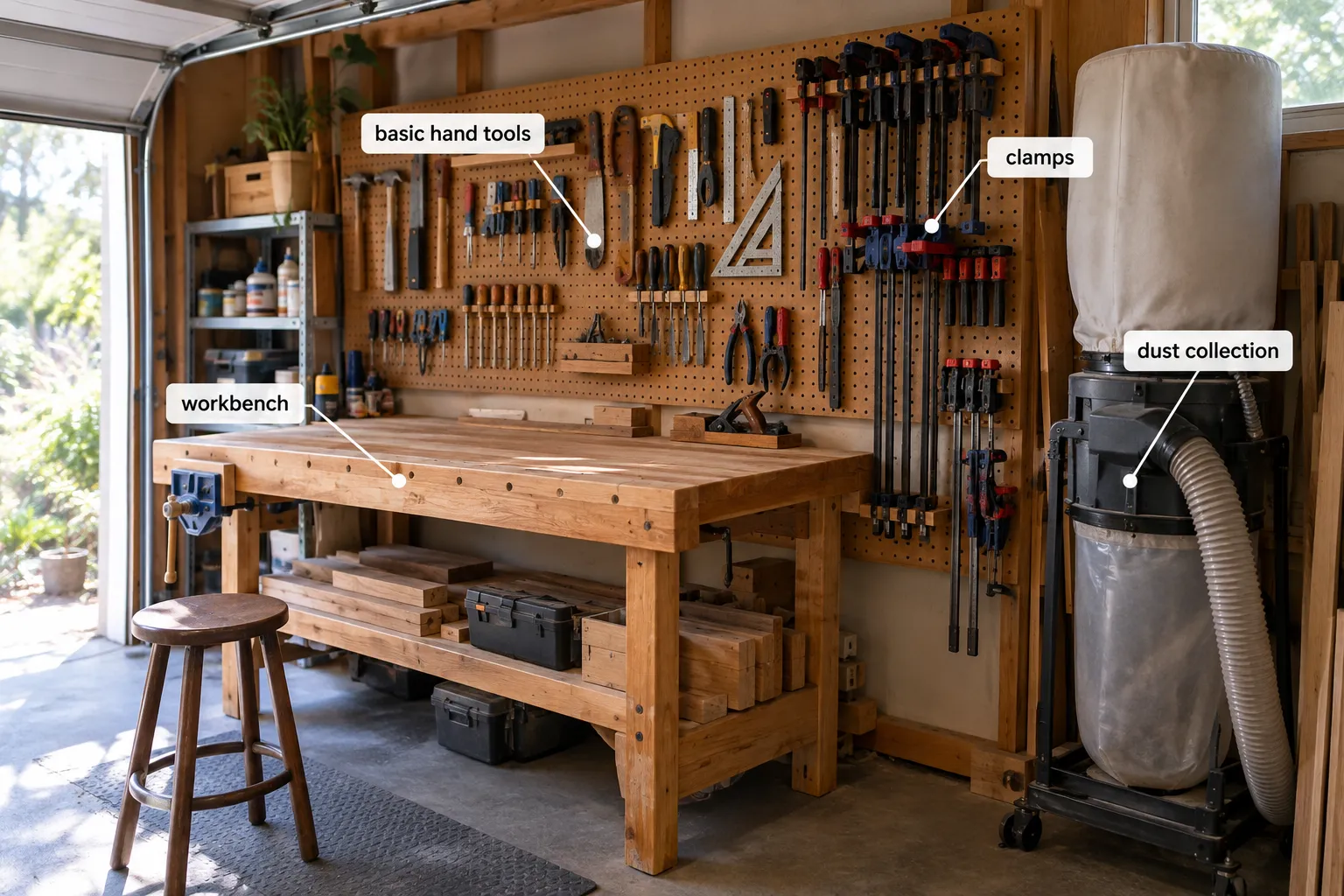
Yes, a dedicated workshop is not required to start learning woodworking. Many beginners learn core skills using a portable workbench, hand tools, and a garage, patio, or balcony with good ventilation.
What a no-workshop setup typically needs:
- A sturdy, clampable work surface (a portable workbench or even a sheet of plywood on sawhorses)
- Hand tools or one compact power tool (jigsaw, cordless drill)
- A safe, well-ventilated space for cutting and finishing
Edge case: loud power tools and finishing fumes are harder to manage without a dedicated space, so apartment dwellers often lean toward hand-tool projects first. Once skills and space allow, the home woodshop setup planning guide covers how to grow into a permanent setup.
How Much Does It Cost to Learn Woodworking?
Learning basic woodworking typically costs a few hundred dollars for an entry-level hand tool kit, or more if power tools are added early. Costs scale with the tools chosen, not with how fast someone learns.
A realistic beginner budget breaks down into three categories: measuring and marking tools (low cost), a primary cutting tool (moderate to significant cost depending on hand versus power tools), and clamps plus sandpaper and finish (ongoing, low cost). The real cost breakdown for starting woodworking walks through specific price ranges for different starting setups.
Common mistake: buying a full table saw, planer, and jointer before finishing a single project. Most beginners get more value learning with a smaller tool set and upgrading once they know what they actually use.
How Long Before You Can Make Money Woodworking?
Most hobbyists need roughly one to three years of consistent skill-building before producing work good enough to sell reliably, and longer to turn it into steady income. Selling occasional pieces at craft fairs can start earlier, but consistent paying clients usually require both strong technical skill and basic business groundwork.
Choose to start selling small, simple items (cutting boards, shelves) earlier if you want income sooner. Hold off on custom furniture commissions until your joinery and finishing are consistently reliable, since furniture mistakes are expensive and harder to hide. The guide to starting and growing a woodworking business from home covers the transition from hobby to income in more detail.
What Mistakes Do Beginners Make When Learning Woodworking?
The most common beginner mistakes are skipping measurement checks, buying too many tools too early, and rushing glue-up or finishing steps. Each of these slows progress far more than a lack of natural skill.
- Measuring once instead of twice leads to compounding errors across a project.
- Over-buying tools creates clutter and decision fatigue instead of speeding up learning.
- Rushing finishing: Uneven stain and rough sanding are usually the result of impatience, not lack of ability.
- Ignoring wood movement: Using the wrong joint or wood type for a project’s environment, as covered well in a wood types and material selection guide.
What Age Is Best to Start Learning Woodworking?
There is no single best age to start learning woodworking; children as young as eight or nine can learn basic hand-tool skills under supervision, while adults of any age can start with power tools once they understand safety procedures. What matters more than age is patience and a willingness to practice basic skills before tackling complex projects.
Choose hand-tool-first learning for younger beginners or anyone new to power equipment. Choose a faster power-tool track for adults with steady hands and prior experience with machinery in other contexts.
How Do You Know When You’ve Mastered Woodworking?
Mastery in woodworking shows up as consistency, not perfection: the ability to repeat precise joints, predict how a design will behave, and fix mistakes without starting over. There is no formal test or certificate that marks the finish line for most hobbyists.
Signs of mastery include designing original projects without relying on a plan, correcting tool or material problems mid-project without panic, and producing finishes that look even and intentional every time, not just occasionally. Many experienced woodworkers describe mastery as an ongoing process rather than a destination, since new joinery techniques and wood species keep presenting fresh challenges.
Frequently Asked Questions
Do I need to be good at math to learn woodworking?
Basic arithmetic and fractions are enough. Most measuring involves simple addition, subtraction, and reading a tape measure accurately.
Can I learn woodworking just from videos?
Videos help with technique demonstration, but hands-on practice is what actually builds skill. Pair video instruction with real shop time for faster progress.
How often should I practice to learn quickly?
Three to five short sessions a week tend to build skill faster than one long session, because frequent repetition reinforces muscle memory.
Is it normal to feel slow at first?
Yes. Most beginners feel awkward with measuring and cutting for the first 20 to 30 hours. This phase is temporary and passes with repetition.
Should I start with hand tools or power tools?
Either works. Hand tools teach more about wood behavior and are cheaper to start with; power tools are faster but require stricter safety habits upfront.
What’s a realistic first project?
A simple shelf, small box, or step stool. These projects use basic joinery and measuring without requiring advanced skills.
Do I need a garage to start learning?
No. A portable workbench or sturdy table in a ventilated space is enough for early hand-tool projects.
How do I know if I’m ready for harder joinery like dovetails?
If basic butt joints and pocket screws come out consistently square and tight, it’s a good time to try dovetails or mortise and tenon joints.
Conclusion
How long it takes to learn woodworking comes down to hours practiced, not years waited. Most beginners reach basic competence in 50 to 100 hours, and comfortable intermediate skill in 300 to 500 hours spread across one to two years. The woodworkers who progress fastest are rarely the most naturally talented; they’re the ones who show up consistently, practice individual skills before combining them, and learn from their mistakes instead of avoiding them.
Start small. Pick one simple project, like a shelf or a tool tote, and focus on measuring and one reliable joint before adding complexity. Track your hours loosely, not to rush the process, but to notice real progress over time.
Products, Tools, and Resources Worth Knowing
A few resources make the early learning curve noticeably smoother:
- The beginner woodworking tools and equipment guide helps avoid overspending on a first tool kit.
- The step-by-step guide to beginner woodworking projects offers a practical project sequence instead of random plan-hopping.
- The beginner woodworking tool kits guide compares starter kits for small projects and furniture.
- The hardwoods for beginners guide helps new woodworkers choose forgiving, easy-to-work wood species for early projects.
- DFY comprehensive collection of woodworking plans (detailed plans for over 16, 000 projects)
- DFY collection of 12, 000 shed plans with different styles and designs.
- WOOD® magazine is the world’s most trusted woodworking resource
None of these replace actual shop time, but they shorten the trial-and-error phase considerably, which is often the biggest time-saver for anyone wondering how long it really takes to learn woodworking.