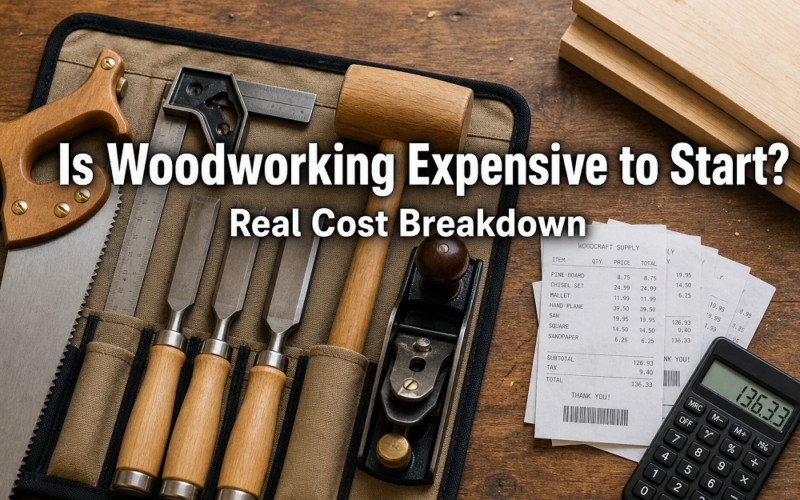
Is Woodworking Expensive to Start? Woodworking is not expensive to start. A functional beginner kit built around hand tools costs between $130 and $300, and most people can complete real, satisfying projects within that budget. The reputation for high cost comes from advanced hobbyists and professional shops, not from the actual entry point most beginners face.
Find this useful? Add us as a preferred source on Google and more of what we publish will show up in your results.
A minimum hand-tool starter kit runs roughly $130 to $255, covering everything needed for beginner projects like cutting boards, boxes, and picture frames.
Adding one power tool (a circular saw or cordless drill) brings total first-year spending to around $250 to $500.
Lumber for early practice projects typically costs $15 to $40 per session, making it one of the smallest recurring expenses.
Expensive machines like table saws, planers, and jointers are not necessary to learn the craft’s core skills.
You can start woodworking without a dedicated workshop, using a garage, backyard, or even a small apartment workspace.
Buying tools gradually, as specific project needs arise, is smarter than front-loading a large equipment purchase.
Cheap tools are not always a bargain. Mid-range tools from brands like Stanley, Irwin, or DeWalt typically offer the best value for beginners.
Woodworking compares favorably in cost to hobbies like golf, cycling, or photography, where entry-level gear routinely exceeds $500 to $1,000.
The most common beginner spending mistake is buying specialty power tools before developing foundational hand-tool skills.
Woodworking can become a source of income over time, which changes the cost-to-value calculation significantly.
What Does It Cost to Start Woodworking as a Hobby?
Starting woodworking as a hobby costs between $130 and $600 in the first year, depending on how many tools you buy and how much lumber you use for practice. The wide range reflects different approaches, not different skill levels.
Here is a realistic breakdown of what that first-year spending looks like across three entry paths:
Approach
Estimated First-Year Cost
Hand tools only
$150 to $300
Hand tools plus one power tool
$250 to $500
Hand tools, power tool, and practice lumber
$300 to $600
According to HobbyStack’s woodworking cost guide, the average beginner spends around $300 to $500 getting started, with ongoing monthly costs of $50 to $150 once the initial tool investment is made. That ongoing cost is almost entirely lumber and consumables like sandpaper and finishing supplies.
The key insight is that tools are a one-time investment. Lumber is the recurring cost, and for small beginner projects, it stays low.
A Minimum Viable Hand-Tool Kit: What You Actually Need
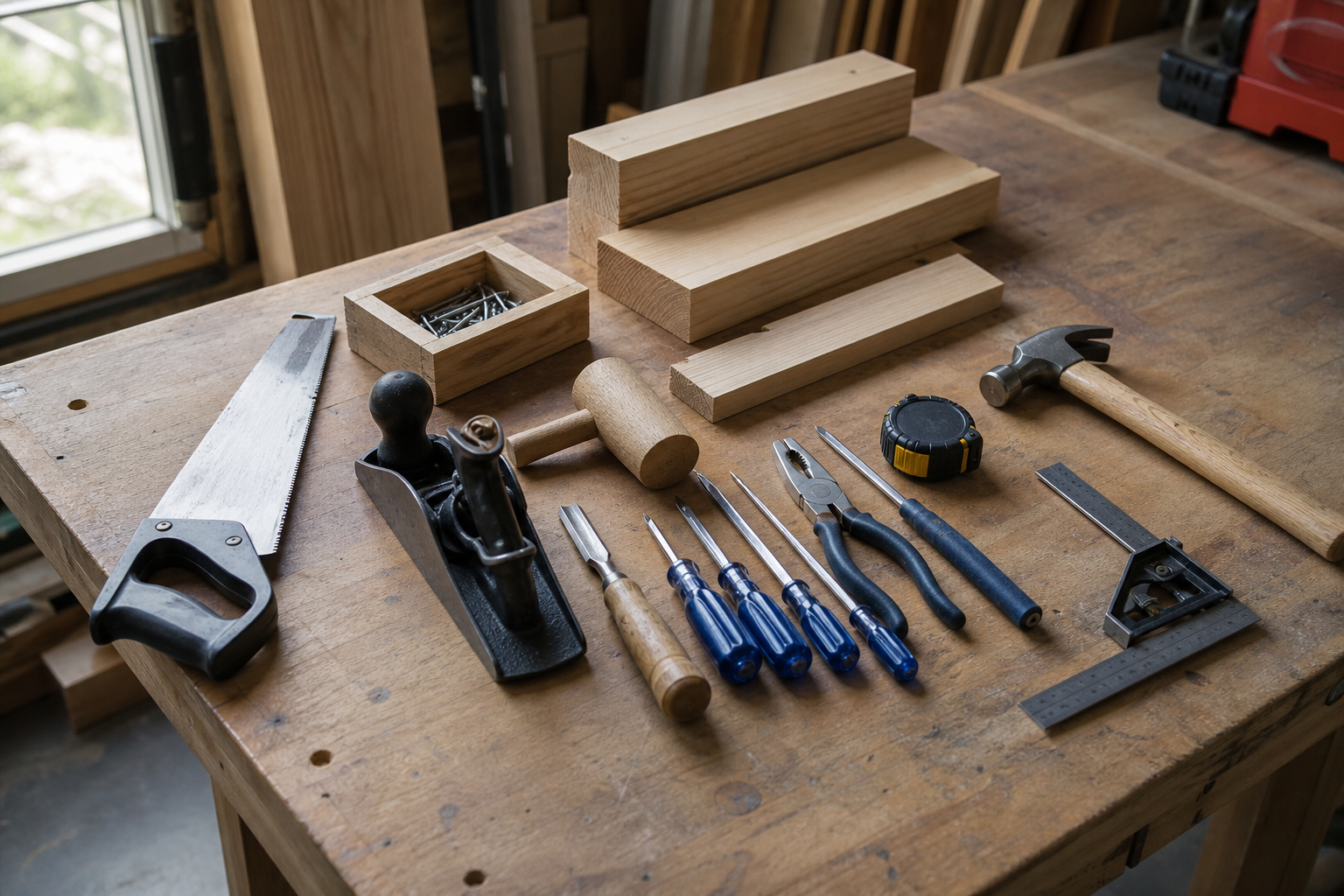
A beginner can start woodworking with six to seven basic hand tools, all of which are widely available and inexpensive. This is not a compromised setup. It is genuinely sufficient for cutting boards, simple boxes, picture frames, and the joinery exercises that build real skill.
Tool
Approximate Cost
Tape measure and combination square
$20 to $40
Basic chisel set (3 to 4 pieces)
$30 to $60
Hand saw
$20 to $40
Clamps (4 to 6 basic clamps)
$40 to $80
Sandpaper assortment
$10 to $20
Safety glasses
$10 to $15
Total
$130 to $255
Each of these tools teaches something specific. A combination square teaches you to measure and mark accurately, which matters more in woodworking than almost anything else. Chisels teach you how wood grain behaves under pressure. Clamps teach you about glue-up timing and surface contact. None of that learning happens faster with a $1,200 table saw.
For a deeper look at how these tools function together, the beginner tools setup guide at Woodworking Guru covers the full tool-buying sequence with project context.
Common mistake: Beginners often skip the combination square because it seems redundant next to a tape measure. It is not. Inaccurate marking is the root cause of most failed cuts, and a quality combination square fixes that problem for under $25.
Can You Start Woodworking With Hand Tools Only?
Yes, and for most beginners, starting with hand tools only is actually the better approach. Hand tools force you to understand how wood behaves, how grain direction affects a cut, and how much pressure is too much. Power tools speed up those same actions but do not teach the underlying judgment.
Projects you can complete with a hand-tool-only kit include:
Small wooden boxes with simple butt joints or mitered corners
Picture frames using a miter box and hand saw
Wooden shelves with basic dado joints cut by chisel
Serving trays and small decorative items
The Slightly Crooked Workshop recommends a similar seven-tool starting list for exactly this reason: hand tools keep the feedback loop direct and the cost low while skills develop.
Once you have completed three to five projects with hand tools, you will know exactly which power tool would actually speed up your specific workflow. That knowledge prevents expensive, unused purchases.
Adding Your First Power Tool: What to Buy and When
One quality power tool, chosen to match a real project need, expands what you can build without requiring a full workshop investment. The two best first power tools for most beginners are a cordless drill/driver combo or a circular saw, both available in the $80 to $200 range.
Choose a cordless drill if your early projects involve assembling pre-cut lumber, driving screws, or drilling pocket holes. It is the most versatile single power tool a beginner can own.
Choose a circular saw if you are working with sheet goods (plywood, MDF) or need to break down longer boards that a hand saw makes tedious. A circular saw with a straightedge guide produces clean, accurate cuts at a fraction of the cost of a table saw.
A jigsaw is a strong third option for beginners interested in curved cuts or decorative shapes. You can explore the full range of power tools and woodworking machinery options to match your project goals before buying.
The rule is simple: buy the next tool when a specific project makes the case for it, not before.
Can You Do Woodworking on a Budget?
Woodworking on a budget is entirely practical, and many experienced woodworkers deliberately maintain a hand-tool-focused shop to keep costs controlled. Budget woodworking is not about cutting corners. It is about sequencing purchases intelligently.
Practical ways to keep costs low:
Buy used tools. Hand tools, in particular, hold up well over decades. Estate sales, Facebook Marketplace, and Craigslist regularly list quality chisels, hand saws, and clamps at 30 to 70 percent below retail. Woodwork Hubby’s cost breakdown notes that a used hand-tool kit can often be assembled for under $100.
Start with construction lumber. Pine and Douglas fir from a home improvement store cost a fraction of hardwood prices and are perfectly suitable for learning cuts, joints, and finishing techniques.
Use poplar for early hardwood projects. Poplar is one of the most beginner-friendly hardwoods available, typically running $2 to $4 per board foot, and it machines and finishes cleanly. See the wood types and material selection guide for a full comparison of beginner-friendly species.
Borrow or rent before buying. Many makerspaces and community workshops offer tool access for a monthly membership fee, which can delay or eliminate the need to purchase larger equipment.
Maker Cube’s budget workshop guide makes the point that a functional beginner shop can be assembled for under $500 total, including a workbench setup, if used tools are prioritized.
What Is the Difference Between Cheap and Expensive Woodworking Tools?
The difference between cheap and expensive tools is not always quality. It is often precision, durability under heavy use, and ergonomics over long sessions. For a beginner working an hour or two at a time, mid-range tools are the practical choice.
Here is how to think about the spectrum:
Budget tools (under $15 per item): Acceptable for sandpaper, safety glasses, and basic clamps. Avoid budget chisels and hand saws, where poor steel holds an edge poorly and makes accurate work harder.
Mid-range tools ($20 to $80 per item): The best value for beginners. Brands like Stanley, Irwin, Bahco, and DeWalt offer reliable performance at prices that do not require a large upfront commitment. Most of the tools in the starter kit above fall here.
Premium tools ($100 and above per item): Worth considering for chisels and hand planes once you know you will use them regularly. Brands like Lie-Nielsen, Veritas, and Narex hold edges longer and are more pleasant to use. These are not beginner purchases.
Woodworking Online’s beginner budget guide reinforces this middle-ground approach, noting that beginners rarely push tools hard enough to notice the difference between mid-range and premium, but they absolutely notice the difference between budget and mid-range.
How Much Should I Spend on My First Woodworking Tools?
Spend between $150 and $300 on your first tool set, and resist the urge to go higher until you have completed at least three projects. That budget covers a complete hand-tool kit with room for one mid-range upgrade.
A sensible first purchase sequence:
Tape measure and combination square ($25 to $40)
Hand saw ($25 to $40)
Chisel set, 3 to 4 pieces ($35 to $60)
Clamps, 4 to 6 pieces ($40 to $80)
Sandpaper assortment ($10 to $20)
Safety glasses ($10 to $15)
After completing your first two or three projects, you will have a clear sense of what is slowing you down. That friction points to the next tool worth buying. This approach, described in detail in the beginner woodworking hub, prevents the most common beginner mistake: buying a full shop before knowing what you actually need.
Do I Need to Buy Everything at Once, or Can I Build Up Tools Gradually?
You do not need to buy everything at once. Gradual tool acquisition is not just acceptable, it is the smarter strategy for most beginners. Each tool purchase should be motivated by a specific project need, not by a theoretical future use.
The practical sequence most experienced woodworkers recommend:
Month 1 to 3: Hand-tool kit only. Complete two to three small projects.
Month 3 to 6: Add one power tool based on what your projects actually require.
Month 6 to 12: Add a workbench or dedicated workspace if you are working regularly.
Year 2 and beyond: Consider stationary power tools (a bandsaw, a thickness planer) only if your project scale justifies the cost.
This pacing keeps total first-year spending in the $300 to $600 range rather than the $2,000 to $5,000 range that a fully equipped shop represents. Wally’s Woodworking Plans makes the case that most hobbyists never actually need the full shop setup, because their projects never scale to require it.
What Actually Gets Expensive (And Why You Don’t Need It Yet)
Stationary power tools are where woodworking costs climb sharply. Table saws, jointers, thickness planers, and specialty joinery machines (biscuit joiners, Festool Domino joiners) each run from $300 to well over $1,500. None of them are necessary for a beginner.
Here is what these tools actually do, and when they become relevant:
Table saw: Rips long boards to width efficiently. Useful once you are building furniture with custom-dimensioned lumber. Not needed for projects using pre-dimensioned stock.
Thickness planer: Flattens and thickens rough lumber to a consistent dimension. Relevant only if you are buying rough-sawn lumber from a sawmill, which beginners rarely do.
Jointer: Straightens the face and edge of a board before planing. Works alongside a thickness planer. Again, a furniture-building tool, not a beginner tool.
Biscuit joiner or Domino joiner: Speeds up alignment in panel glue-ups. Useful for production work. Entirely replaceable with clamps and careful technique at the beginner level.
The deeper problem with buying these tools early is not just the cost. It is that machines are designed to speed up skills you already have, not to replace the need to develop them. Buying a table saw before you can make an accurate hand-saw cut means you skip the feedback that teaches you why accuracy matters.
For context on how these tools fit into a more advanced setup, the woodworking machinery overview covers the full equipment landscape with clear guidance on sequencing.
Can I Start Woodworking Without a Workshop?
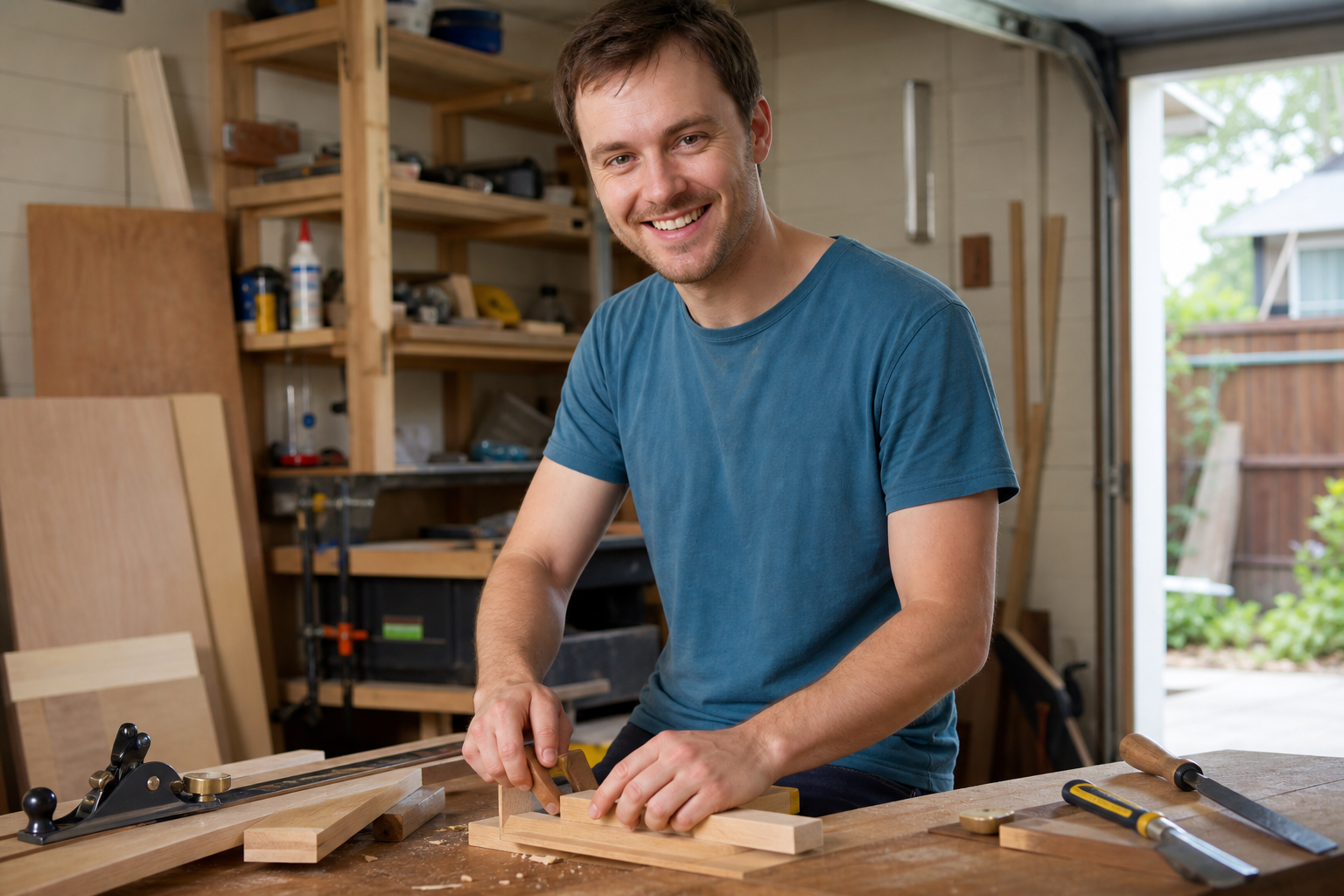
Yes. A dedicated workshop is convenient but not required to start. Many beginners work productively in a garage, on a back patio, in a basement, or even in a small apartment with the right project choices.
What you actually need for a functional beginner workspace:
A stable surface at working height (a folding workbench, a solid table, or two sawhorses with a sheet of plywood across them)
Enough floor space to move around your material (roughly 6 by 8 feet for small projects)
Adequate lighting
Dust management (a shop vacuum or even a household vacuum with a fine-dust bag)
Workshop costs become relevant later. A basic workbench can be built from construction lumber for $50 to $150, and that project itself teaches useful skills. A full dedicated shop buildout, including lighting, dust collection, and storage, runs $500 to $2,000 or more, but that is a year-two or year-three consideration, not a day-one requirement.
Is Woodworking More Expensive Than Other Hobbies?
Woodworking is less expensive to start than most people assume, and it compares favorably to many popular hobbies. Golf, cycling, photography, and home brewing all have entry costs that routinely exceed $500 to $1,000 for a functional beginner setup.
A rough comparison:
Hobby
Typical Beginner Entry Cost
Golf (clubs, bag, shoes, lessons)
$500 to $1,500
Road cycling (entry-level bike, gear)
$600 to $1,200
Photography (DSLR or mirrorless kit)
$600 to $1,500
Home brewing (starter kit, ingredients)
$150 to $300
Woodworking (hand-tool kit)
$130 to $300
Woodworking also has a practical advantage most hobbies lack: the things you build have real-world value. A cutting board, a bookshelf, or a set of kitchen shelves offsets the cost of the tools that made them. At scale, woodworking can become a business, though that is a separate conversation from the hobby entry point.
Common Mistakes Beginners Make Spending Money on Woodworking
Most beginner overspending follows a predictable pattern. Knowing these mistakes in advance saves real money.
Buying a table saw first. It feels like the “real” woodworking tool, but it is one of the most dangerous tools in a shop and requires significant skill to use safely and accurately. A circular saw with a guide rail does most of what a table saw does for beginners, at a fraction of the cost.
Buying cheap chisels. Budget chisels dull quickly, require constant resharpening, and make clean joinery genuinely difficult. Spending $35 to $60 on a mid-range set from a brand like Narex or Buck Brothers is worth it.
Ignoring clamps. New woodworkers consistently underestimate how many clamps a project requires. Four clamps is a starting point, not a final number. Add clamps before adding power tools.
Buying lumber at a craft store. Hobby stores like Hobby Lobby or Michaels sell small wood pieces at dramatically inflated prices per board foot. A local lumber yard, home improvement store, or hardwood dealer is almost always cheaper for any meaningful quantity.
Skipping safety equipment. Safety glasses cost $10 to $15. A trip to urgent care does not. This is the only category where buying cheap is genuinely not worth it.
Is Woodworking Worth the Investment?
For most people who stick with it, woodworking is worth the investment. The tools last decades with basic maintenance. The skills compound over time. And the projects you build have tangible, lasting value in a way that most hobby spending does not.
The honest caveat is that woodworking requires patience in the early months. The first few projects will have gaps, tear-out, and joints that do not close perfectly. That is normal, and it is part of the process. The people who find woodworking worth the investment are those who treat those early imperfections as information rather than failure.
Starting with beginner-friendly projects that match your current tool set keeps the learning curve manageable and the cost proportional to your actual engagement.
If you eventually want to sell what you make, CostHelper’s woodworking cost overview notes that hobbyists who transition to selling typically recoup their tool investment within the first year of consistent sales.
Where Can I Find Affordable Woodworking Equipment?
Affordable woodworking tools are available through several channels that most beginners overlook.
Facebook Marketplace and Craigslist: The best source for used hand tools, clamps, and mid-size power tools. Quality chisels and hand saws from estate sales often sell for $5 to $20.
Harbor Freight: Acceptable for clamps, safety equipment, and basic measuring tools. Avoid their cutting tools (chisels, saw blades) where quality matters more.
Home improvement stores (Home Depot, Lowe’s): Carry a solid range of mid-range power tools and construction lumber. Prices are competitive, and returns are straightforward.
Local hardwood dealers: Significantly cheaper per board foot than craft stores or big-box retailers for hardwood species. Many will cut boards to rough length at no charge.
Makerspace memberships: Community workshops in most mid-size cities offer access to a full range of stationary power tools for $50 to $150 per month, which is often cheaper than buying and storing the equipment yourself.
Online retailers (Amazon, Woodcraft, Rockler): Good for consumables, specialty items, and tools not stocked locally. Woodcraft and Rockler also offer beginner-focused tool bundles that represent reasonable value.
For a curated look at popular woodworking products worth considering at the beginner stage, the Woodworking Guru product guides filter by skill level and project type.
How Much Does It Cost to Set Up a Small Home Woodworking Shop?
A small home woodworking shop, meaning a functional space with a workbench, basic hand tools, one or two power tools, and adequate storage, costs between $500 and $1,500 to set up from scratch. That range assumes new mid-range tools and a modest workbench build.
A realistic phased budget:
Phase 1 (Month 1): Core hand-tool kit
$130 to $255, as outlined above.
Phase 2 (Month 2 to 6): First power tool and workbench
A cordless drill or circular saw adds $80 to $200. A DIY workbench built from construction lumber adds $50 to $150. Total phase cost: $130 to $350.
Phase 3 (Month 6 to 12): Storage, lighting, dust management
A shop vacuum runs $60 to $150. Basic wall storage (pegboard, shelving) runs $30 to $80. Improved lighting adds $40 to $100. Total phase cost: $130 to $330.
Full setup total (end of year one): $390 to $935, with most people landing around $500 to $700.
This is a genuinely functional shop for furniture projects, home repairs, and hobby builds. Scaling beyond this, into dedicated stationary power tools and a full dust collection system, is a year-two decision based on how much you are actually using the space.
FAQ: Is Woodworking Expensive to Start?
Is woodworking an expensive hobby to start?
No. A hand-tool starter kit costs $130 to $255, and most beginners complete real projects within a $300 total first-year budget. The expensive reputation comes from advanced shops, not from the entry point.
What is the cheapest way to start woodworking?
Buy a basic hand-tool kit (tape measure, combination square, hand saw, chisels, clamps, sandpaper, safety glasses) for $130 to $255. Start with construction lumber from a home improvement store. Add tools only when a specific project requires them.
Do I need a table saw to start woodworking?
No. A table saw is useful for furniture-scale production work, but it is not necessary for beginner projects. A circular saw with a straightedge guide handles most beginner cutting tasks at a fraction of the cost and risk.
Can I learn woodworking with just hand tools?
Yes, and many experienced woodworkers argue it is the better way to start. Hand tools teach grain direction, cut feedback, and joint-making in ways that power tools bypass. The skills transfer directly to power tool use later.
How much does lumber cost for beginner projects?
Expect to spend $15 to $40 per project on lumber for small beginner builds. Construction-grade pine is the cheapest option. Poplar is the most beginner-friendly hardwood at roughly $2 to $4 per board foot.
Should I buy cheap tools to start?
For most tools, mid-range is the right choice. Budget chisels and hand saws make accurate work genuinely harder and often cost more in frustration than the price difference saves. Mid-range clamps, measuring tools, and safety equipment are perfectly adequate.
How long before woodworking pays for itself?
For hobbyists who sell their work, tool costs are often recouped within the first year of consistent sales. For pure hobbyists, the value comes from the projects themselves, which have real utility and often retail value if you chose to sell them.
Can I start woodworking in a small apartment?
Yes, with the right project choices. Hand-tool-only projects produce minimal noise and dust. A folding workbench and a shop vacuum make apartment woodworking practical for small items like boxes, cutting boards, and small shelves.
What is the single best first tool to buy?
A combination square. It costs $15 to $25, and accurate marking is the foundation of every cut, joint, and assembly in woodworking. Most beginner errors trace back to inaccurate layout, not bad tools or bad technique.
Is buying used woodworking tools a good idea?
Yes, especially for hand tools. Chisels, hand saws, and clamps from estate sales or online marketplaces often sell at 30 to 70 percent below retail and perform just as well with basic cleaning and sharpening.
How does woodworking compare in cost to other hobbies?
Woodworking has a lower entry cost than golf, cycling, or photography, all of which typically require $500 to $1,500 to start at a functional level. Woodworking also produces tangible, useful objects, which most hobbies do not.
When should I invest in a full workshop setup?
After completing at least five to ten projects and confirming that woodworking is a consistent part of your routine. A full home shop setup runs $500 to $1,500. It is worth it for regular woodworkers and premature for casual beginners.
Conclusion
Woodworking is not the expensive hobby its reputation suggests, at least not at the start. A $130 to $255 hand-tool kit is genuinely sufficient to learn the craft’s fundamentals and complete real projects. Adding one power tool and some practice lumber keeps total first-year spending under $600 for most beginners, and under $350 for those who start lean and build gradually.
The cost curve only climbs when you let it, usually by buying stationary power tools before your skill level and project scale actually require them. Resist that pull for the first year, and woodworking stays one of the more accessible hands-on hobbies available.
Start with the hand-tool kit. Build something. Then decide what to buy next.
For next steps, the beginner woodworking hub covers the full tool-buying sequence, first project recommendations, and skill-building exercises in one place.
Products, Tools, and Resources
These are the categories and specific items worth considering as a beginner, based on the cost tiers and use cases covered above.
Starter hand tools worth buying new:
Stanley FatMax combination square ($20 to $30), Narex 4-piece chisel set ($35 to $50), Irwin 15-inch hand saw ($25 to $35). These are mid-range tools that perform reliably without requiring a large investment.
First power tool options:
DeWalt 20V MAX cordless drill/driver combo ($100 to $160) or a Skil or Ridgid circular saw ($80 to $130). Both are widely available, have good parts and battery ecosystems, and are appropriate for beginner use.
Lumber starting point:
Construction-grade pine or Douglas fir from Home Depot or Lowe’s for practice cuts. Poplar from a local hardwood dealer for first finished projects. Both are affordable and forgiving for beginners.
Online learning resources: Woodworking online training covers foundational techniques in a structured format, which is useful for beginners who want guided instruction alongside hands-on practice.
Project plans to get started: Beginner woodworking project guides and woodworking plans provide step-by-step instructions matched to beginner skill levels, so your first projects are set up to succeed rather than frustrate.
Joinery and technique reference:
Once you move past the first few projects, woodworking joinery and techniques covers the joint types and methods that separate functional builds from furniture-quality work.