
Woodworking Online Training: The Complete Beginner’s Guide

Hey there! Some links on this page may be affiliate links, which means that if you choose to make a purchase, I may earn a commission at no extra cost to you. I greatly appreciate your support!
Woodworking online training refers to structured courses delivered via the internet that teach woodworking techniques, tool use, project planning, and design, without requiring attendance at a physical school. These programs suit beginners and hobbyists who want to build foundational skills at their own pace, from home. Quality paid courses cover everything from basic joinery to furniture construction, and many include video demonstrations, downloadable plans, and community forums.
Key Takeaways
- Woodworking online training covers techniques, tool use, design patterns, joinery, and project planning through video lessons and downloadable resources.
- Beginners with zero experience can start with online courses before ever picking up a chisel, because theory and visual demonstration build a strong mental framework first.

- Paid courses consistently offer more structured content than free alternatives, though several reputable free resources exist for absolute beginners.
- Online training does not replace hands-on practice, but it dramatically reduces the trial-and-error period when you do get into the workshop.
- Course costs range from free to several hundred dollars, depending on depth, platform, and whether certification is included.
- A basic starter toolkit (hand saw, chisels, mallet, measuring tools, sandpaper) is enough to follow most beginner online courses.
- Limited space is not a barrier. Many beginner courses are specifically designed around small workshops or apartment setups.
- Certification from online woodworking courses has limited formal value but carries personal credibility and can support a small business or freelance career.
What Is Woodworking Online Training and How Does It Work?
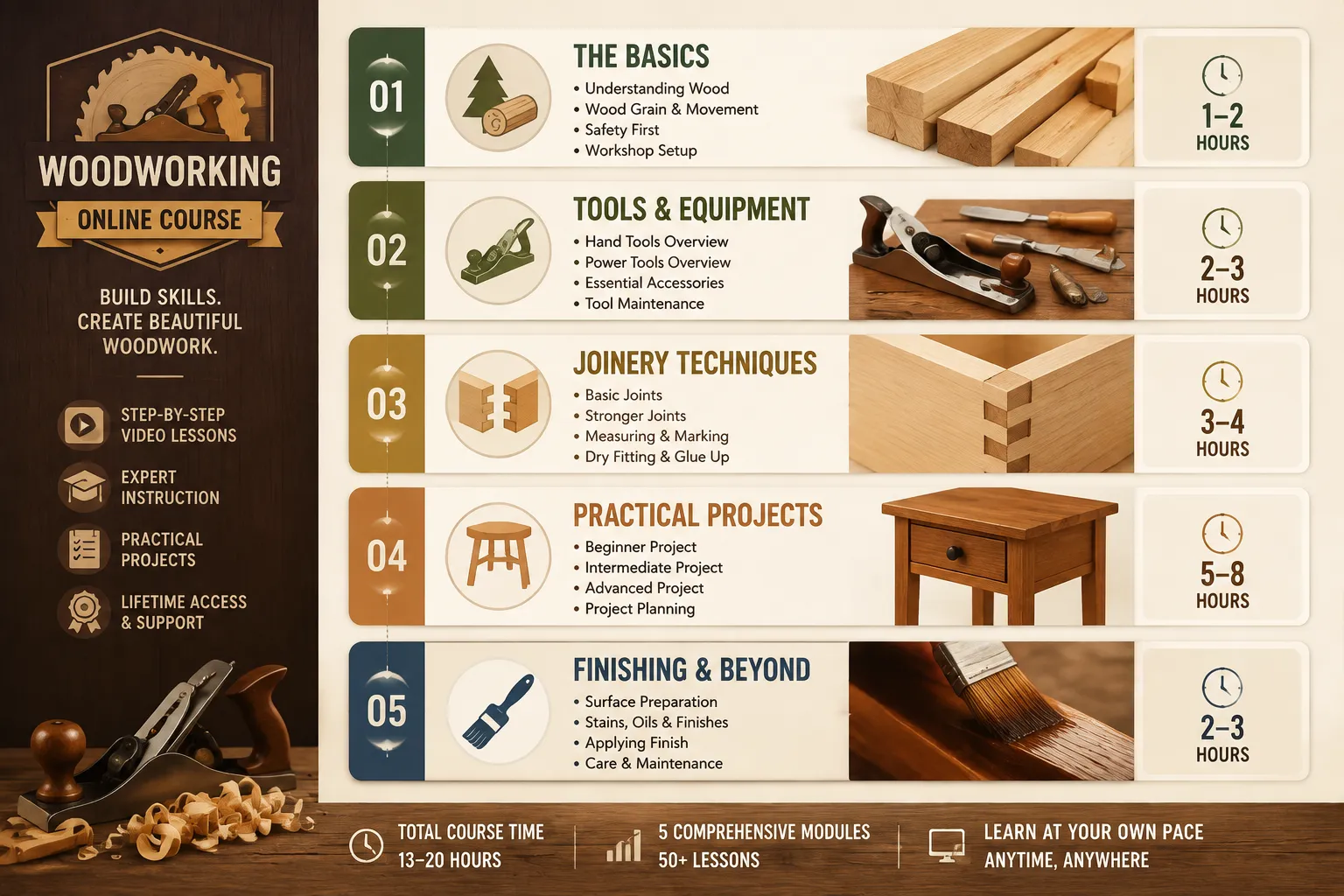
Woodworking online training is a structured educational format where learners access video lessons, written guides, project plans, and tool tutorials through a website or learning platform. Students enroll, create an account, and progress through modules at their own pace, pausing and rewinding demonstrations as needed.
Most platforms organize content into sequential modules. A typical beginner course might follow this structure:
- Module 1: Introduction to wood types, grain, and selection
- Module 2: Essential hand tools and their correct use
- Module 3: Measuring, marking, and cutting techniques
- Module 4: Basic joinery (butt joints, dado joints, mortise and tenon)
- Module 5: Sanding, finishing, and wood treatment
- Module 6: First project build (a simple box, shelf, or stool)
Learners watch demonstrations, then apply what they have seen in their own workspace. Some platforms include quizzes, community forums, or instructor Q&A sessions. Others are entirely self-directed. The key advantage is flexibility: a lesson can be watched at 10 p.m. on a Tuesday, paused mid-cut, and rewatched three times without anyone noticing.
Woodworking online training works best when learners treat it as preparation for hands-on practice, not a replacement for it. The theory absorbed online directly accelerates what happens at the workbench.
Best Woodworking Online Courses for Beginners
The best beginner woodworking online courses combine clear video instruction, downloadable project plans, and a logical skill progression. For hobbyists starting from scratch, the following platforms are consistently well-regarded:
Skillshare offers a wide range of beginner woodworking classes taught by working craftspeople. Lessons tend to be project-based, which keeps motivation high. A subscription model means access to multiple courses for one monthly fee.
Udemy hosts individual courses on specific woodworking topics, often at steep discounts. Beginner courses on furniture joinery, hand tool woodworking, and small project builds are widely available and frequently updated.
Woodworkers Guild of America (WWGOA) is one of the most recognized dedicated woodworking platforms. It offers structured courses for beginners through advanced makers, with a focus on both hand tools and power tools.
YouTube should not be dismissed. Channels like Paul Sellers (hand tool woodworking), Steve Ramsey of Woodworking for Mere Mortals, and April Wilkerson offer free, high-quality instruction. These are excellent starting points before committing to a paid course.
For those interested in building furniture specifically, pairing any course with access to woodworking plans gives beginners a concrete project framework to work from immediately.
Choose a course based on:
- Your available tools (hand tool courses vs. power tool courses differ significantly)
- Your end goal (hobby projects vs. furniture making vs. starting a small business)
- Your learning style (video-heavy vs. text and diagram-based)
Woodworking Online Training vs. In-Person Classes: Which Is Better?
Neither format is universally better. The right choice depends on your goals, schedule, and access to local instruction.
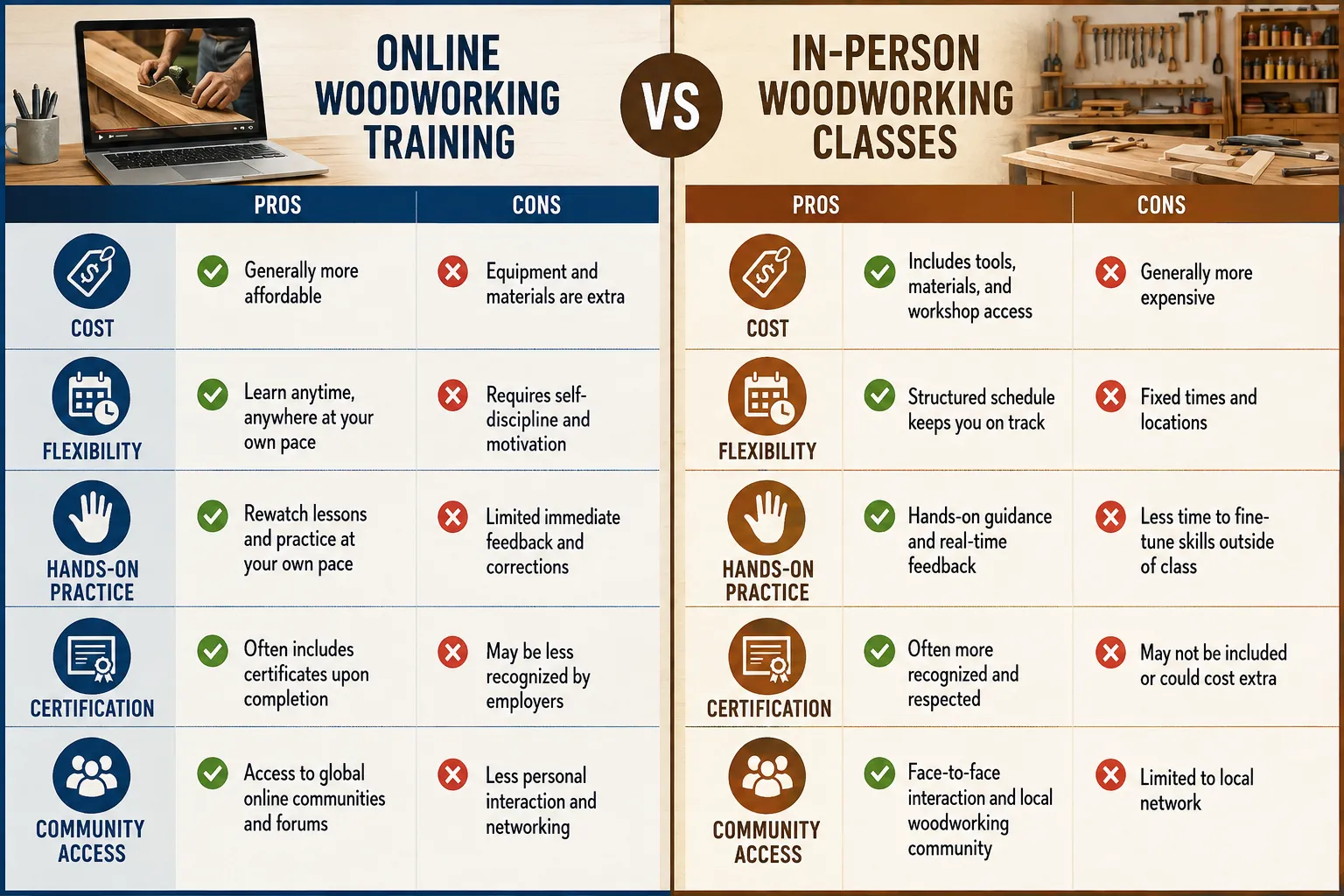
Online training wins on: flexibility, cost, repeatability (rewatching lessons), and access to global instructors regardless of location. For someone in a rural area with no local woodworking school, online training is often the only practical option.
In-person classes win on: immediate feedback, hands-on correction of technique, access to professional equipment, and the social energy of a shared workshop. A skilled instructor can spot a grip problem or a misaligned cut in seconds, something no video can replicate.
A practical middle path: use woodworking online training to build foundational knowledge, then attend a local workshop or community college class to refine hands-on technique. Many experienced woodworkers describe this combination as the most efficient learning path available.
Common mistake: beginners who jump straight to in-person classes without any prior study often spend the first session overwhelmed by terminology and tool names. Online training eliminates that friction.
How Much Does Woodworking Online Training Cost?
Woodworking online training ranges from completely free to around $500 for comprehensive, multi-module programs. Here is a realistic breakdown:
- Free: YouTube channels, some platform trial content, and basic PDF guides. Quality varies widely.
- $10 to $50: Individual Udemy courses, often covering one specific skill or project type.
- $50 to $150 per year: Subscription platforms like Skillshare or WWGOA, which provide access to an entire library.
- $200 to $500+: Dedicated woodworking schools with structured curricula, instructor feedback, and sometimes certification.
Free courses are a reasonable starting point, but they typically lack structure, skip important safety content, and assume more prior knowledge than a true beginner has. Paid courses at the $50 to $150 range represent the best value for most hobbyists.
One cost that beginners often overlook: the tools themselves. A basic hand tool starter kit can run $100 to $300. Understanding various tools used for woodworking before purchasing anything prevents expensive and unnecessary buying mistakes.
Can You Really Learn Woodworking Online Without a Workshop?
Yes, with an important clarification. Theoretical woodworking knowledge, including wood species, grain behavior, joint types, tool selection, design principles, and finishing techniques, can be learned entirely online. Actual woodworking skill requires physical practice.
Think of it this way: a surgeon studies anatomy from textbooks before ever entering an operating room. The book knowledge does not make them a surgeon, but it makes their first practical session dramatically more productive.
For learners without a dedicated workshop, options include:
- A garage, basement, or even a large outdoor space for hand tool work
- Community makerspaces and tool libraries (available in most mid-sized cities)
- Renting time at a local woodworking studio
- Starting with small, hand-tool-only projects that require minimal space
Many beginner online courses are specifically designed around hand tool woodworking, which requires no power tools, no dust collection systems, and very little space. A workbench, a set of chisels, a hand saw, and a mallet are enough to complete most introductory projects.
Woodworking Online Training for People With No Experience
Woodworking online training is genuinely well-suited to complete beginners, provided the course is designed for that audience. The best beginner courses assume no prior knowledge and start with fundamentals: wood anatomy, grain direction, how to hold and use basic tools safely, and how to read a simple project plan.
For someone with zero experience, the recommended starting sequence is:
- Watch free beginner content on YouTube (Paul Sellers and Steve Ramsey are both excellent) to get a feel for the craft.
- Enroll in one structured beginner course that covers tool use, safety, and a first project.
- Purchase a small set of hand tools and attempt the course project.
- Join an online woodworking community (Reddit’s r/woodworking is active and welcoming) to ask questions and share progress.
- Gradually expand tool inventory and project complexity based on interest.
Exploring popular woodworking projects early on helps beginners identify what they actually want to build, which makes course selection much more focused and motivating.
What Tools Do You Need to Start Woodworking Online Training?
To follow along with most beginner woodworking online courses, a minimal hand tool kit is sufficient. Power tools are not required at the beginner stage and can be added as skills develop.
Essential starter tools:
- Tape measure and marking gauge
- Combination square
- Hand saw (a crosscut saw and a tenon saw cover most beginner cuts)
- Set of bench chisels (a basic 4-piece set works fine)
- Wooden or rubber mallet
- Smoothing plane (a No. 4 bench plane is the standard starting point)
- Sandpaper in multiple grits (80, 120, 180, 220)
- Clamps (at least 4 bar clamps or F-clamps)
- Safety glasses and hearing protection
For learners who want to incorporate power tools early, a jigsaw and a random orbital sander are the most versatile entry-level additions. Understanding woodworking jigs and woodworking machinery becomes relevant once basic hand skills are established.
Avoid buying large power tools (table saws, band saws, planers) before completing at least one beginner course. Most beginners who purchase them early either use them incorrectly or discover they prefer hand tool work entirely.
Is Woodworking Online Training Worth It?
For most beginners and hobbyists, yes. Woodworking online training is worth the investment of time and money when chosen carefully. The caveat is that the value depends almost entirely on whether the learner follows through with hands-on practice.
Feedback from hobbyist communities (including r/woodworking on Reddit) consistently reflects a few patterns:
- Learners who combined online courses with immediate project work reported the fastest skill development.
- Those who watched hours of content without building anything felt they had learned little in practice.
- Paid courses were rated more useful than free alternatives for structured beginners, primarily because of better organization and safety coverage.
- The biggest complaint about online woodworking training is the absence of real-time feedback on technique.
The honest answer: woodworking online training is worth it as a foundation, not as a complete education. It reduces beginner mistakes, builds vocabulary, and creates a mental model of the craft before tools are ever picked up. That preparation has genuine value.
Woodworking Online Training Courses With Certifications
Most woodworking online training programs do not offer formal certifications recognized by employers or trade bodies. However, some platforms do issue completion certificates, which carry informal credibility.
Platforms that provide certificates of completion include Udemy (for individual courses), Coursera (for any woodworking-adjacent design or fabrication courses), and some dedicated woodworking schools with professional programs.
For hobbyists, certification matters very little. For someone looking to run a woodworking business, a portfolio of completed projects carries far more weight than any online certificate. Clients and buyers evaluate work, not credentials.
If formal trade qualifications are the goal, apprenticeship programs, community college carpentry courses, or vocational training through recognized trade organizations are the appropriate path.
Common Mistakes Beginners Make in Online Woodworking Classes
Beginners in woodworking online training tend to repeat the same handful of errors. Recognizing them early saves significant frustration.
Skipping the safety modules. Many beginners fast-forward through safety content to get to the “interesting” parts. This is a serious mistake. Woodworking tools cause injuries when used incorrectly, and safety habits are far easier to build from the start than to correct later.
Buying tools before finishing the introductory modules. Enthusiasm leads to premature purchasing. A beginner who watches two lessons and immediately buys a table saw has skipped the foundational knowledge that would have told them a hand saw and a workbench are better starting points.
Watching without doing. Passive consumption of woodworking content creates the illusion of competence. Skill only develops through physical repetition. Every lesson should be followed by an attempt to apply it, even imperfectly.
Choosing overly complex first projects. A beginner who decides their first project will be a dovetailed jewelry box is setting themselves up for discouragement. Start with simple woodworking projects that build foundational skills before attempting complex joinery.
Ignoring wood selection. Online courses sometimes gloss over wood species and quality. Using the wrong wood for a project (too hard, too soft, too green) creates problems that have nothing to do with technique. Learn to identify and select appropriate lumber early.
Not measuring twice. It sounds clichéd because it is universally true. Measurement errors are the single most common source of wasted material for beginners.
Woodworking Online Training for Furniture Making Specifically
Furniture making is one of the most popular specializations within woodworking online training, and dedicated courses exist for this focus. Furniture-specific courses go deeper into joinery techniques, wood movement, structural integrity, and finishing than general woodworking courses.
Key topics covered in furniture-focused online training include:
- Mortise and tenon joinery
- Dovetail joints (hand-cut and router-assisted)
- Wood movement and how to account for it in design
- Furniture proportion and classical design principles
- Surface preparation and finishing (staining, oiling, lacquering)
- Hardware selection and installation
For learners interested in furniture making, studying woodworking patterns alongside a structured course provides a visual library of design references that accelerates both skill and creativity. Access to furniture building plans gives beginners a concrete project to work toward from day one.
Platforms like WWGOA and Fine Woodworking’s online content are particularly strong for furniture-focused learners.
How Long Does It Take to Learn Woodworking Online?
The honest answer is that “learning woodworking” is an ongoing process with no defined endpoint, but meaningful beginner competence is achievable within a few months of consistent effort.
A realistic timeline for a committed beginner:
- Weeks 1 to 4: Complete an introductory online course. Understand tool names, basic cuts, wood types, and safety fundamentals.
- Months 2 to 3: Build two or three simple projects (a box, a small shelf, a stool). Expect imperfect results. That is normal and necessary.
- Months 4 to 6: Attempt a more complex project involving joinery. Notice how much faster mistakes are identified and corrected compared to month one.
- Year 1 and beyond: Develop a personal style, expand tool inventory, and begin tackling furniture-scale projects.
The variable that matters most is not how many hours of online content are consumed. It is how many hours are spent actually working with wood. Online training accelerates the learning curve; it does not replace the curve.
Woodworking Online Training If You Have Limited Space
Limited space is not a barrier to learning woodworking, especially at the beginner level. Hand tool woodworking in particular is well-suited to small apartments, spare bedrooms, or compact garage setups.
Practical strategies for small-space woodworkers:
- Use a portable workbench (Workmate-style folding benches are widely available and take up minimal storage space).
- Focus on hand tools, which produce far less noise and dust than power tools.
- Work with smaller lumber dimensions and smaller project scales initially.
- Use a shop vacuum with a fine-dust filter to manage sawdust in enclosed spaces.
- Store tools in a wall-mounted rack or a portable tool roll to minimize floor footprint.
Many woodworking online training courses now include a “small space” module or are specifically designed for apartment woodworkers. Searching for “hand tool woodworking” or “apartment woodworking” courses filters for content that assumes a compact workspace.
Best Woodworking Online Instructors and Platforms
The quality of online woodworking instruction varies enormously. The instructors and platforms listed below are consistently recognized within the woodworking community for accuracy, clarity, and practical value.
Paul Sellers (YouTube and Masterclasses): Widely regarded as one of the best hand tool woodworking instructors available online. His teaching style is methodical and deeply practical. Excellent for beginners who want to learn traditional techniques.
Steve Ramsey (Woodworking for Mere Mortals): Specifically designed for hobbyists and beginners. Ramsey’s approach is approachable, project-focused, and honest about the learning curve. His free YouTube content is a genuine starting point.
Woodworkers Guild of America (WWGOA): A subscription-based platform with a large library of structured courses. Covers hand tools, power tools, furniture making, finishing, and more. Well-organized for progressive skill development.
Fine Woodworking: A long-established publication that has expanded into online video content. Particularly strong for furniture making and advanced joinery. Better suited to intermediate learners than absolute beginners.
Skillshare and Udemy: Marketplace platforms where individual instructors publish courses. Quality varies, so reading reviews carefully before enrolling is important. Look for courses with a high number of reviews and recent updates.
Frequently Asked Questions
Do I need any experience to start woodworking online training?
No prior experience is needed. The best beginner courses assume zero knowledge and start with wood types, basic tool use, and safety fundamentals before moving to any cutting or building.
Will woodworking online training give me a certificate?
Some platforms issue completion certificates, but these are not formally recognized by trade bodies or employers. For hobbyists, a certificate has limited practical value. A portfolio of finished projects is more meaningful.
Can I learn woodworking online if I don’t have a workshop?
Yes. Theoretical knowledge, design principles, and tool familiarity can all be learned online. For hands-on practice, community makerspaces, rented studio time, or a small hand-tool setup in a spare room are all viable alternatives.
How much should I spend on a beginner woodworking online course?
For most beginners, a course in the $30 to $100 range offers the best balance of quality and value. Free YouTube content is a good supplement, but a paid course provides the structure that free content typically lacks.
Is woodworking online training suitable for children or teenagers?
Some platforms offer youth-oriented content, but most courses are designed for adults. Younger learners benefit most from supervised in-person instruction where tool safety can be monitored directly.
What is the difference between a woodworking online course and a woodworking tutorial?
A course is a structured, sequential program covering multiple skills and usually including projects, assessments, and a defined learning path. A tutorial is typically a single video or guide covering one specific technique or project. Courses are better for systematic learning; tutorials are better for solving a specific problem.
Can woodworking online training help me start a woodworking business?
It provides a foundation, but running a woodworking business requires hands-on skill, business knowledge, and portfolio development beyond what any online course delivers alone. Dedicated resources on the business side are a necessary complement.
How do I choose between hand tool and power tool woodworking courses?
Choose hand tool courses if you have limited space, a smaller budget for tools, or an interest in traditional techniques. Choose power tool courses if you have access to a larger workspace and want to work faster on larger projects. Many experienced woodworkers eventually use both.
Are woodworking online training courses updated regularly?
On platforms like Udemy and Skillshare, course update frequency varies by instructor. Check the “last updated” date on any course before purchasing. Courses more than three years old may reference outdated tools or techniques.
What is the biggest limitation of woodworking online training?
The absence of real-time feedback on physical technique is the most significant limitation. An online instructor cannot see that a chisel is being held at the wrong angle or that a saw is drifting off the line. This gap is best addressed by combining online learning with occasional in-person instruction or community workshop sessions.
Can online woodworking training cover furniture-making specifically?
Yes. Several platforms offer furniture-specific courses covering joinery, wood movement, finishing, and design. These courses go deeper than general woodworking content and are appropriate once basic tool skills are established.
Is woodworking online training worth it for someone who just wants a casual hobby?
Absolutely. Even a single well-chosen beginner course saves hours of frustration, prevents common tool misuse, and makes the first few projects far more enjoyable. The investment is modest relative to the time and material it saves.
Conclusion
Woodworking online training is a genuinely useful entry point for beginners and hobbyists who want to learn the craft without committing to a formal school or a rigid class schedule. It builds the theoretical foundation, the vocabulary, and the visual understanding of technique that makes hands-on practice more productive from the very first session.
The key is choosing a course matched to your current skill level, pairing it with immediate hands-on practice, and resisting the temptation to watch endlessly without building anything. The wood teaches the rest.
Start with a free resource to confirm the interest is real, invest in a structured beginner course once it is, pick up a basic hand tool kit, and build something simple. That sequence works. Everything else follows from it.
Recommended Tools and Resources
For learning:
- Woodworking plans and project guides to pair with any online course and give structured build targets.
- Woodworking projects for beginners for practical ideas matched to entry-level skills.
- Equipment used in woodworking for a thorough overview of what tools do what before making any purchases.
For tools:
A basic hand tool starter kit from a reputable brand (Narex chisels, Veritas or Stanley planes, and a quality crosscut saw) covers the majority of beginner course requirements without overspending. Avoid buying complete tool sets from unknown brands; individual quality tools outlast cheap bundles by years.
For going further:
Once foundational skills are in place, exploring woodworking online training resources and dedicated furniture-building content opens up a much wider range of project possibilities. The craft rewards patience and consistent practice more than any other single factor.