
Various Tools Used For Woodworking: The Complete Beginner’s Guide

Hey there! Some links on this page may be affiliate links, which means that if you choose to make a purchase, I may earn a commission at no extra cost to you. I greatly appreciate your support!
The various tools used for woodworking fall into two broad categories: hand tools (saws, chisels, hammers, planes, measuring tools) and power tools (drills, sanders, jigsaws, routers). Beginners can build a functional starter kit for roughly $150 to $400, depending on quality and brand. You do not need every tool at once. Start with measuring, cutting, and joining tools, then expand as your projects demand more.
Key Takeaways
- A basic woodworking toolkit covers five functions: measuring and marking, cutting, shaping, joining, and finishing.
- Hand tools are cheaper, quieter, and better for small spaces. Power tools are faster and better for larger or repeated cuts.

- Beginners should prioritize a quality tape measure, a crosscut saw or circular saw, a set of chisels, a drill/driver, and a random orbital sander before anything else.
- A budget starter set of hand tools can cost as little as $100 to $200. A mixed hand-and-power setup typically runs $300 to $600.
- “Nice to have” tools (routers, band saws, planers) add capability but are not necessary until you outgrow your basics.
- Safety gear is non-negotiable: safety glasses, hearing protection, and a dust mask belong in every toolkit from day one.
- Cordless tools offer more flexibility for hobbyists and small shops. Corded tools are better for sustained, heavy use.
- Proper tool maintenance (sharpening, cleaning, storage) extends tool life significantly and improves cut quality.
- Furniture making and general carpentry share many tools but diverge when it comes to joinery and detail work.
- Buying individual tools as needed usually beats buying a complete set for most beginners.
What Are the Basic Woodworking Tools You Need to Get Started?
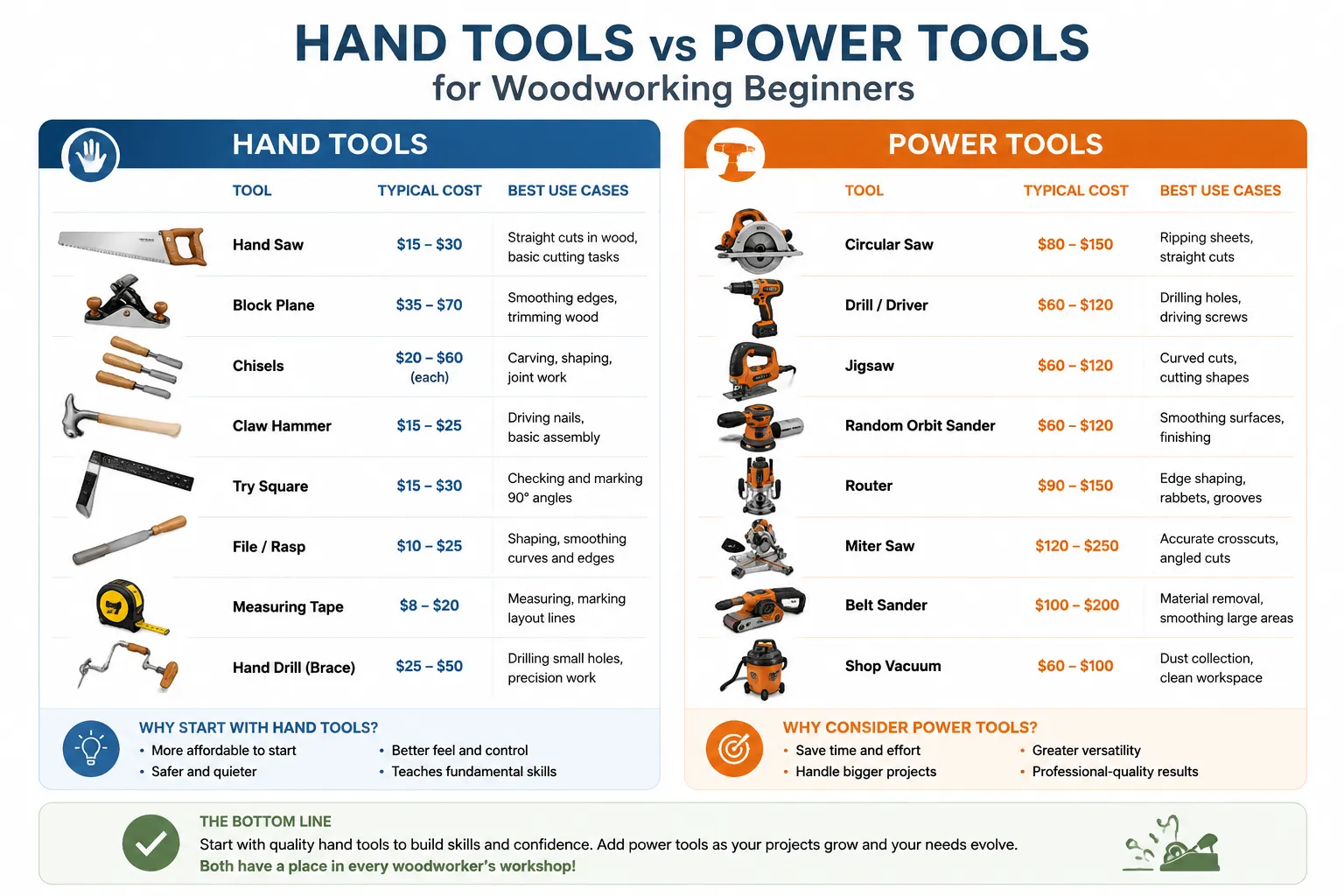
Every beginner needs tools that cover five core functions: measuring and marking, cutting, shaping, joining, and finishing. That’s the framework. Everything else builds on top of it.
Here is a practical starter list organized by function:
Measuring and Marking
- Tape measure (25 ft is the most versatile length)
- Combination square (for marking 90-degree and 45-degree angles)
- Marking gauge (for scribing lines parallel to an edge)
- Marking knife or carpenter’s pencil
Cutting
- Crosscut handsaw or a circular saw (choose based on your space and budget)
- Utility knife (for scoring and trimming)
- Coping saw or jigsaw for curved cuts
Shaping and Smoothing
- Set of bench chisels (1/4 inch, 1/2 inch, 3/4 inch, and 1 inch are the most used sizes)
- Block plane or No. 4 bench plane
- Rasp or wood file
Joining
- Claw hammer (16 oz is the standard weight for general work)
- Cordless drill/driver with a basic bit set
- Clamps (at least four bar clamps or F-clamps to start)
Finishing
- Random orbital sander with assorted sandpaper grits (80, 120, 180, 220)
- Paintbrushes and foam rollers for applying stain, varnish, or paint
If you’re planning your first project, check out these beginner-friendly woodworking projects to match your tool list to something you’ll actually build.
What Is the Difference Between Hand Tools and Power Tools for Woodworking?
Hand tools are manually operated and require physical effort to use. Power tools use electricity (or battery power) to do the heavy work. Both have a place in a beginner’s shop, and most woodworkers use a mix of both.
Hand tools are generally:
- Less expensive to buy and maintain
- Quieter, which matters in apartments or shared spaces
- Better for precision joinery, detail work, and learning technique
- Slower, which is actually an advantage when you’re still developing accuracy
Power tools are generally:
- Faster for repetitive cuts and large stock removal
- More consistent for tasks like sanding, drilling, and routing
- Louder and require more safety awareness
- A larger upfront investment, though cordless platforms have become very affordable
A common mistake beginners make is assuming power tools are always better. A sharp handsaw and a well-tuned plane can produce results that match or exceed power tool output for many furniture-making tasks. The skill is in knowing which tool fits the job. For a deeper look at the full range of equipment used in woodworking, it helps to understand both categories before spending money.
What Are the Best Woodworking Tools for Beginners on a Budget?
Beginners on a budget should prioritize versatility over specialization. The goal is to own fewer tools that each do more, rather than a large collection of single-purpose items.
Best budget-friendly picks by category:
- Tape measure: Stanley FatMax or Komelon Self-Lock (around $10 to $20). These are durable, accurate, and widely available.
- Combination square: Empire or Swanson models offer solid accuracy for under $20.
- Handsaw: A Japanese pull saw (ryoba style) cuts on the pull stroke, requires less force, and costs $20 to $40. It’s an excellent first saw.
- Chisels: Narex or Buck Bros sets offer good steel quality for $30 to $60 for a four-piece set.
- Cordless drill/driver: The Ryobi 18V ONE+ system offers a starter kit with battery and charger for around $80 to $100. The battery platform also works with other Ryobi tools, which saves money long-term.
- Random orbital sander: Dewalt or Ridgid 5-inch sanders run $40 to $60 and handle most finishing tasks.
- Clamps: Harbor Freight bar clamps are inexpensive and functional for a beginner’s needs.
A reasonable starter kit using budget-tier tools costs between $150 and $300 total. That is enough to complete most entry-level woodworking plans without overspending before you know what you actually enjoy building.
How Much Does a Complete Woodworking Tool Set Cost?
The cost depends heavily on whether you’re buying hand tools, power tools, or both, and at what quality level. Here’s a realistic breakdown:
| Setup Type | Estimated Cost Range | Best For |
|---|---|---|
| Basic hand tool starter kit | $100 to $250 | Apartment woodworkers, beginners testing the hobby |
| Mixed hand and power tool kit | $300 to $600 | Hobbyists with a garage or dedicated workspace |
| Intermediate power tool setup | $800 to $1,500 | Serious hobbyists building furniture regularly |
| Full shop with stationary machines | $3,000 to $10,000+ | Home shop owners, semi-professional makers |
These are estimates based on mid-range consumer brands (Ryobi, Ridgid, Dewalt, Stanley). Professional-grade tools (Festool, Lie-Nielsen, Veritas) cost significantly more but also last decades with proper care.
One practical rule: buy the best quality you can afford in the tools you’ll use daily (tape measure, chisels, drill), and save money on tools you’ll use rarely.
What Woodworking Tools Do I Actually Need vs. Nice to Have?
This is the question most beginners get wrong, often because online tool lists include everything a professional shop owns. Here is an honest breakdown:
You actually need:
- Tape measure and combination square
- Saw (hand or circular)
- Drill/driver
- Chisels (basic set)
- Clamps (at least four)
- Sandpaper or random orbital sander
- Hammer
Nice to have (useful but not urgent):
- Router and router table
- Jigsaw
- Hand plane (though a No. 4 bench plane is worth getting early if you enjoy hand tool work)
- Miter saw (a crosscut sled on a circular saw can substitute early on)
- Band saw
Wait until you need them:
- Thickness planer
- Jointer
- Lathe
- Scroll saw
- Pocket hole jig (useful for certain joinery but not essential from day one)
The honest answer is that most beginner projects, including small furniture, boxes, shelves, and frames, can be completed with the “actually need” list above. Add tools when a specific project demands them, not before.
Woodworking Tools for Small Spaces and Apartments
Limited space does not mean you can’t do real woodworking. It means you need to be more deliberate about which tools you choose.
Hand tools are the natural fit for small spaces. They require no dedicated floor space, produce less noise, and generate far less dust than power tools. A workbench can be as simple as a folding table with a vise clamped to the edge.
If you want some power tools in a small space, these are the most practical options:
- Cordless drill/driver: Takes up almost no space and handles drilling, driving, and even light sanding with the right attachments.
- Jigsaw: Compact, versatile, and far more apartment-friendly than a table saw or band saw.
- Random orbital sander: Small footprint, and a dust bag or shop vac connection keeps the mess manageable.
- Compact miter saw: A 7.25-inch sliding miter saw is significantly smaller than a 12-inch model and handles most hobby-scale cuts.
Dust management matters more in small spaces. A shop vac connected directly to your sander or saw is worth the investment early. It protects your lungs and keeps your workspace usable.
How to Choose Between Cordless and Corded Power Tools
For most beginners and hobbyists, cordless tools are the better starting point. Battery technology has improved dramatically, and modern 18V or 20V lithium-ion platforms deliver power that rivals corded tools for most tasks.
Choose cordless if:
- You work in a garage, basement, or outdoor space without convenient outlets
- You want flexibility to move between workstations
- You’re building a tool collection gradually (one battery platform powers multiple tools)
- Your projects are hobby-scale rather than production-level
Choose corded if:
- You run tools for extended periods without breaks (corded tools don’t fatigue)
- You need maximum power for heavy stock removal (corded routers and circular saws still have an edge here)
- You’re on a very tight budget (corded tools are often cheaper than their cordless equivalents)
One practical tip: if you go cordless, commit to one brand’s battery platform early. Mixing brands means buying multiple chargers and batteries, which adds cost and clutter. Ryobi, Dewalt, and Milwaukee all offer strong ecosystems with tools at various price points.
Common Mistakes Beginners Make With Woodworking Tools
Knowing what not to do saves time, money, and frustration. These are the most common errors beginners make:
1. Skipping the measuring step. Cutting before measuring accurately is the single biggest source of wasted wood. Measure twice, mark clearly, then cut.
2. Using dull tools. A dull chisel or saw requires more force, produces rougher results, and is actually more dangerous because it’s harder to control. Sharpen tools regularly.
3. Buying too many tools too soon. Most beginners overbuy before they know what they actually need. Start small, build a project, then identify the gaps.
4. Ignoring clamps. Clamps are not optional. They hold pieces steady during glue-ups and keep your work from moving during cuts. Four clamps is a minimum; eight is better.
5. Skipping safety gear. Safety glasses and hearing protection are not optional. Sawdust is a real respiratory hazard, and a single splinter to the eye can cause permanent damage.
6. Working with warped or wet wood. Green or improperly dried lumber moves as it dries. Always use kiln-dried lumber for furniture projects and let it acclimate to your shop for at least 48 hours before cutting.
7. Rushing the finish. Sanding through the grits (80, 120, 180, 220) takes time but produces a dramatically better surface. Skipping grits leaves scratches that show through stain and varnish.
Woodworking Tools for Furniture Making vs. Carpentry
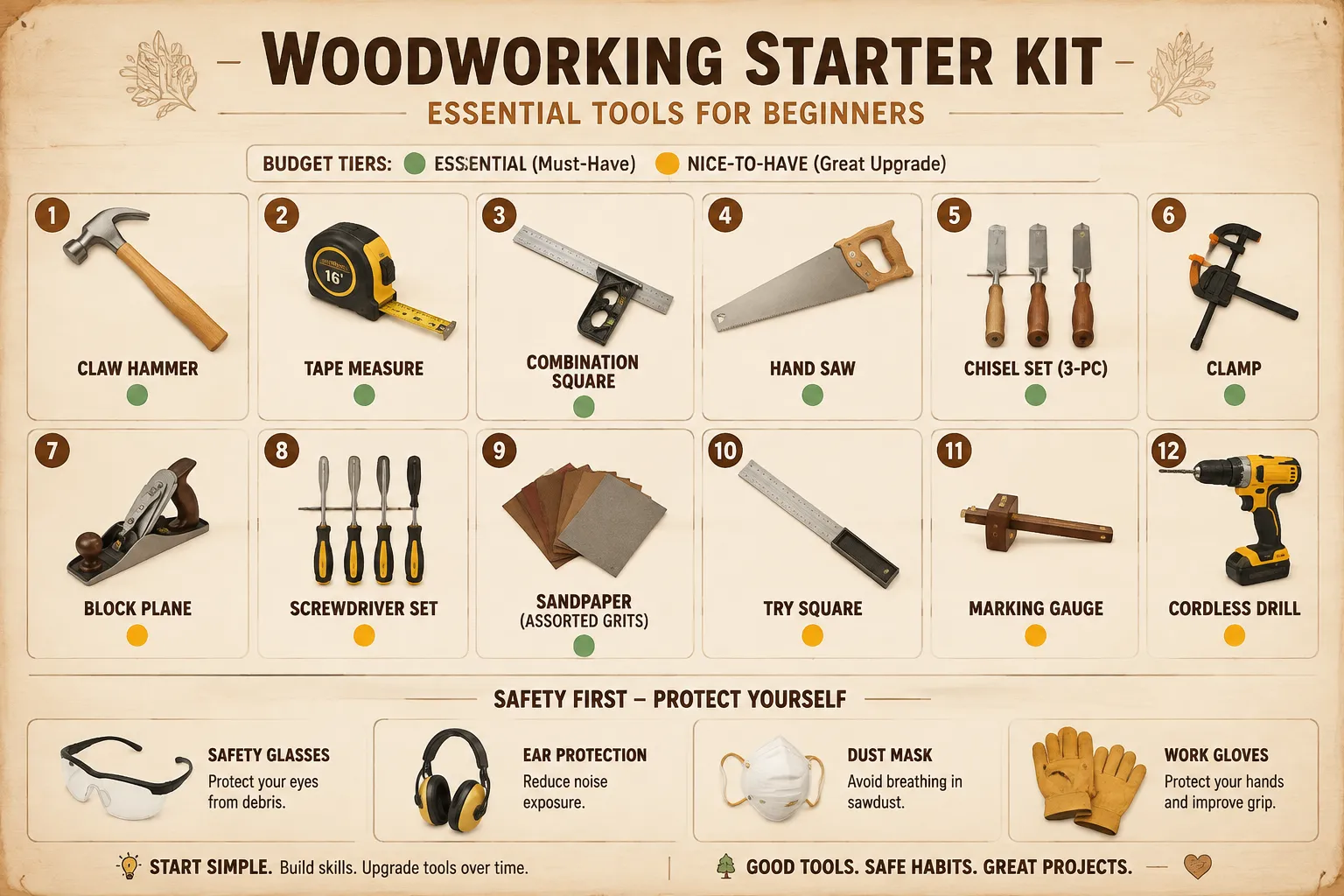
Furniture making and carpentry share a foundation of common tools but diverge in the details. Understanding the difference helps you buy the right tools for your actual goals.
Shared tools: tape measure, square, saw, drill, hammer, sandpaper, clamps.
Furniture making tends to require:
- Chisels and mallets for joinery work (mortise and tenon, dovetails)
- Hand planes for surface preparation and fitting joints
- Marking gauges and marking knives for precision layout
- Router for decorative edges, dados, and rabbets
- Card scrapers for final surface preparation before finishing
Carpentry (framing, trim, installation) tends to require:
- Framing hammer (heavier, 20 to 28 oz)
- Circular saw and miter saw for repetitive dimensional cuts
- Nail gun (framing nailer or finish nailer depending on the work)
- Level and plumb bob
- Speed square for quick angle checks
If your goal is building furniture, the hand tool side of the list matters more than most beginners expect. Learning to use a sharp chisel and a well-set plane produces joinery that power tools alone can’t easily replicate. Exploring popular woodworking techniques can help you decide which direction fits your interests.
What Safety Equipment Do You Need With Woodworking Tools?
Safety equipment is not optional. Every woodworker, regardless of experience level, needs basic protective gear before picking up a tool.
Non-negotiable safety gear:
- Safety glasses or goggles: Flying chips and sawdust are a constant hazard. Standard prescription glasses do not provide adequate protection.
- Hearing protection: Prolonged exposure to power tools causes cumulative hearing damage. Foam earplugs (NRR 29+) or earmuffs work well.
- Dust mask or respirator: A basic N95 mask handles general sanding dust. For MDF, plywood, or finishing products, a half-face respirator with P100 filters is a better choice.
- Push sticks and featherboards: Essential for table saw and router table work, keeping fingers away from blades.
Recommended additions:
- Leather work gloves (for handling rough lumber, not for operating rotating tools)
- First aid kit in the shop
- Fire extinguisher (finishing products are flammable)
- Adequate lighting (poor visibility causes mistakes)
A common misconception is that hand tools are inherently safe. A sharp chisel moving toward your hand is just as dangerous as a power tool if you’re not paying attention. Always cut away from your body and keep tools sharp.
Best Woodworking Tools for Detail Work and Carving
Detail work and carving require a different set of tools than general woodworking. The focus shifts from cutting large stock to controlled, precise removal of small amounts of material.
Essential carving and detail tools:
- Carving chisels and gouges: A basic set of 6 to 12 pieces covers most beginner carving needs. Pfeil (Swiss Made) and Flexcut are well-regarded brands.
- V-tools (veining tools): Used for outlining and adding texture. A 60-degree and a 90-degree V-tool cover most applications.
- Carving knife: A simple sloyd knife or a Mora carving knife handles whittling and chip carving. They cost $20 to $40 and last years with basic care.
- Mallet: A round carving mallet (lignum vitae or polyurethane) is easier to use than a standard hammer for driving chisels.
- Rotary tool (Dremel): Useful for small inlays, engraving, and detail sanding in tight spots.
For inlay work (wood, metal, or shell inlays), you’ll also need a router with a small straight bit, sharp chisels for cleanup, and cyanoacrylate glue or epoxy for setting the inlay material. This is an advanced technique, but the tools overlap significantly with standard furniture-making tools.
How to Maintain and Care for Woodworking Tools
Well-maintained tools last decades and perform better than neglected ones. Tool care is not complicated, but it does require consistency.
For hand tools:
- Keep cutting edges sharp. A dull chisel or plane iron requires more force and produces worse results. Learn to use a sharpening stone (water stone or oil stone) and a leather strop.
- Wipe metal surfaces with a lightly oiled rag after use to prevent rust. Camellia oil or 3-in-1 oil works well.
- Store chisels and plane irons with edge protectors (leather rolls or plastic guards) to prevent damage.
- Keep wooden handles clean and occasionally treat them with linseed oil to prevent cracking.
For power tools:
- Clean dust from vents and motors regularly. Compressed air works well for this.
- Check and replace worn blades, bits, and sandpaper before they affect cut quality.
- Inspect cords for damage (on corded tools) and battery contacts for corrosion (on cordless tools).
- Lubricate moving parts (saw tables, drill chuck threads) with appropriate lubricants per the manufacturer’s guidance.
For saw blades specifically:
- A dull blade burns wood and requires more force. Most carbide-tipped blades can be resharpened two to three times before replacement.
- Clean pitch and resin buildup from blades using a dedicated blade cleaner or Simple Green.
Proper storage matters too. A wall-mounted tool rack or a dedicated tool chest keeps tools organized, accessible, and protected. Tossing tools into a pile is one of the fastest ways to damage edges and create hazards. For more guidance on setting up your workspace, woodworking jigs and shop organization can make a real difference in how efficiently you work.
Should I Buy Individual Tools or a Complete Set?
For most beginners, buying individual tools as needed is the smarter approach. Complete sets look appealing because the per-tool cost appears lower, but they often include tools you won’t use for years (if ever), and the quality of bundled tools is frequently lower than buying individual pieces from a better brand.
Buy a complete set if:
- You’re buying chisels or screwdrivers (sets make sense here because you genuinely use multiple sizes)
- The set is from a reputable brand and the per-tool price is genuinely competitive
- You’re equipping a shop from scratch and need a broad foundation quickly
Buy individual tools if:
- You’re adding to an existing collection
- You need a specific tool for a specific project
- Quality matters more than coverage (a single excellent hand plane beats a set of mediocre ones)
One approach that works well for beginners: buy a basic chisel set and a basic screwdriver set to start, then buy everything else individually as projects demand it. This keeps costs manageable and ensures every tool you own gets used.
If you’re eventually thinking about turning your hobby into something more, understanding the business side of woodworking can help you plan tool investments more strategically.
FAQ: Various Tools Used For Woodworking
What is the single most important woodworking tool for a beginner?
A quality tape measure and combination square. Accuracy in measuring and marking determines the quality of every cut you make. No other tool compensates for poor layout work.
Can I do woodworking without power tools?
Yes. Hand tool woodworking is a fully capable approach. Many fine furniture makers work almost exclusively with hand tools. It requires more time and physical effort but produces excellent results and is quieter and more apartment-friendly.
How many clamps do I actually need?
Start with four bar clamps or F-clamps in the 24-inch size. Add more as your projects grow. Most experienced woodworkers say they never have enough clamps, and that’s not an exaggeration.
Is a table saw necessary for beginners?
No. A circular saw with a good straightedge guide can make the same cuts a table saw makes, with more safety for beginners. A table saw becomes valuable when you’re doing a lot of ripping (cutting boards lengthwise) regularly.
What type of saw should a beginner buy first?
A Japanese pull saw for hand tool work, or a circular saw for power tool work. Both are versatile, affordable, and handle the majority of cuts beginners need to make.
How do I know when a chisel needs sharpening?
If you need to push hard to pare wood, or if the chisel is tearing rather than slicing, it needs sharpening. A sharp chisel should slice end grain with light hand pressure.
What wood is best for beginners to practice on?
Pine and poplar are soft, inexpensive, and widely available. They’re forgiving to cut and shape. Hardwoods like oak and maple are better for finished furniture but are harder to work with dull tools or beginner techniques.
Do I need a workbench to do woodworking?
A dedicated workbench is helpful but not required to start. A solid folding table with a clamped-on vise or bench dogs can substitute. Build or buy a proper workbench once you know you’re committed to the hobby.
What is the difference between a marking gauge and a marking knife?
A marking gauge scribes lines parallel to an edge at a set distance (used for joinery layout). A marking knife scores a precise cut line across the grain. Both are used in layout, but they serve different purposes.
Are cheap tools worth buying for beginners?
For some tools, yes. Tape measures, squares, and clamps from budget brands are often adequate. For cutting tools (chisels, plane irons, saw blades), cheap steel dulls faster and performs worse. Spend more on tools with cutting edges.
How long does it take to learn basic woodworking?
Most beginners can complete a simple project (a small box, a shelf, a stool) within a few weekends of practice. Developing consistent technique takes months. Mastery takes years. The learning curve is part of what makes the craft rewarding.
Where can I learn woodworking skills online?
Structured woodworking online training covers everything from tool use to joinery techniques and is a practical option for beginners who don’t have access to local classes.
Conclusion
The various tools used for woodworking don’t have to be overwhelming. At its core, the craft comes down to five functions: measure, cut, shape, join, and finish. Build your toolkit around those functions, start with quality basics, and add tools as your projects demand them.
Hand tools and power tools each have strengths. Safety gear is not optional. Maintenance extends tool life and improves results. And buying individual tools as needed almost always beats buying a complete set for beginners.
The most important thing is to start. Pick a simple project, buy the tools it requires, and build something. The experience you gain from a single finished project teaches you more than any tool list can.
Recommended Tools and Resources
These are practical recommendations based on common beginner needs, not paid placements:
Starter Hand Tools
- Stanley FatMax Tape Measure (25 ft): Durable, accurate, and widely available for under $20.
- Swanson Speed Square: A reliable combination square for layout work, around $15 to $20.
- Suizan Japanese Pull Saw: One of the best entry-level saws available, around $30 to $40.
- Narex 4-Piece Bench Chisel Set: Good steel, comfortable handles, and a fair price at $50 to $70.
Starter Power Tools
- Ryobi 18V ONE+ Drill/Driver Kit: An affordable entry point into a broad cordless tool platform.
- Dewalt 5-Inch Random Orbital Sander: Reliable, well-balanced, and compatible with standard 5-inch sanding discs.
- Ridgid 7.25-Inch Circular Saw: A solid mid-range option for beginners who want corded reliability.
Learning Resources
- Woodworking plans for beginners provide structured project guidance that helps you apply tools in context.
- Woodworking patterns are useful for decorative and detail work once you have the basics down.
- Woodworking machinery guides help when you’re ready to consider stationary shop equipment.
The best tool is the one you actually use. Start simple, build consistently, and the right toolkit will take shape on its own.