
Essential Equipment Used in Woodworking for Perfect Furniture
Hey there! Some links on this page may be affiliate links, which means that if you choose to make a purchase, I may earn a commission at no extra cost to you. I greatly appreciate your support!
The essential equipment used in woodworking includes drills, jigsaws, sanders, nail guns, wood routers, biscuit joiners, and chainsaws, among others. Beginners can start with a small core set of hand and power tools for under $500, then expand as their skills grow. You do not need a full workshop or expensive machinery to build real, satisfying projects from day one.
Key Takeaways
- A drill, jigsaw, and sander form the practical foundation for most beginner woodworking projects.

- Power tools speed up the work; hand tools build precision and technique. Both matter.
- You can set up a functional beginner workshop in a garage, spare room, or even outdoors with portable tools.
- A basic starter tool kit costs between $300 and $600. A mid-range shop setup runs $1,500 to $3,000.
- The most dangerous woodworking tools are table saws, chainsaws, and nail guns. Each requires specific safety habits.
- Tools like routers, quality chisels, and well-maintained hand planes hold their value exceptionally well over time.
- Buying mid-range tools from reputable brands beats buying cheap and replacing them within a year.
- Maintenance is simple: keep blades sharp, store tools dry, and clean after every session.
What Are the Basic Woodworking Tools Every Beginner Needs?
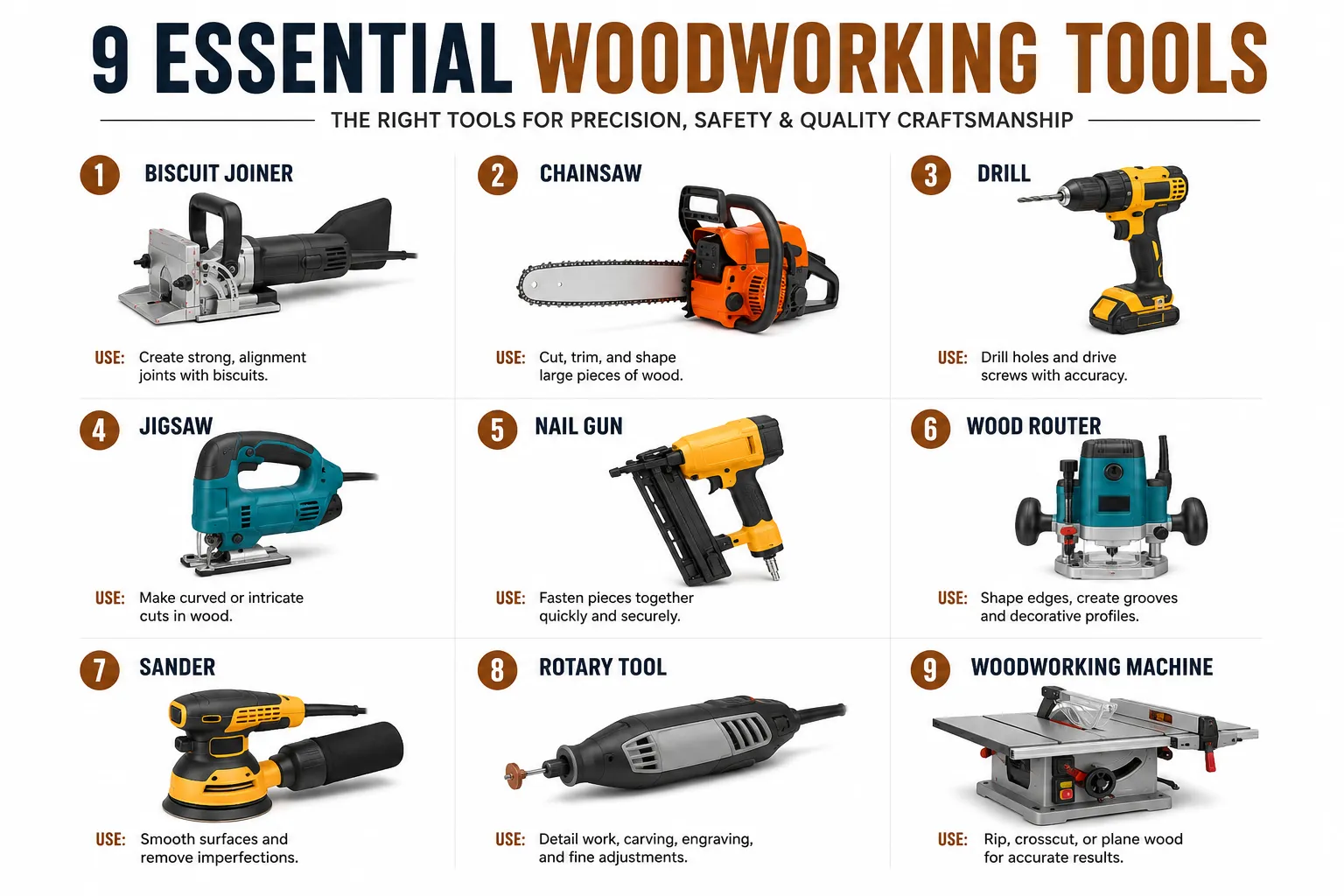
Every beginner needs a small, focused set of tools that covers cutting, joining, shaping, and finishing. You do not need everything at once. Start with the tools that unlock the most project types, then add as your work demands it.
According to essential woodworking tool guides for beginners, the following tools cover the vast majority of starter projects:
Cutting tools:
- Jigsaw (for curved and freehand cuts)
- Circular saw or handsaw (for straight cuts in boards and sheet goods)
- Utility knife (for marking, scoring, and fine trimming)
Joining and fastening tools:
- Drill and driver (the single most-used tool in any woodworker’s kit)
- Nail gun or hammer (for framing, trim, and assembly)
- Biscuit joiner (for clean, strong edge-to-edge joins)
Shaping and finishing tools:
- Random orbital sander (for smooth, swirl-free surfaces)
- Wood router (for edges, grooves, and decorative profiles)
- Chisels and a mallet (for joinery and fine fitting)
If you had to pick just three tools to start, a cordless drill, a jigsaw, and a random orbital sander will get you through most beginner woodworking projects without breaking the bank.
What Is the Difference Between Hand Tools and Power Tools for Woodworking?
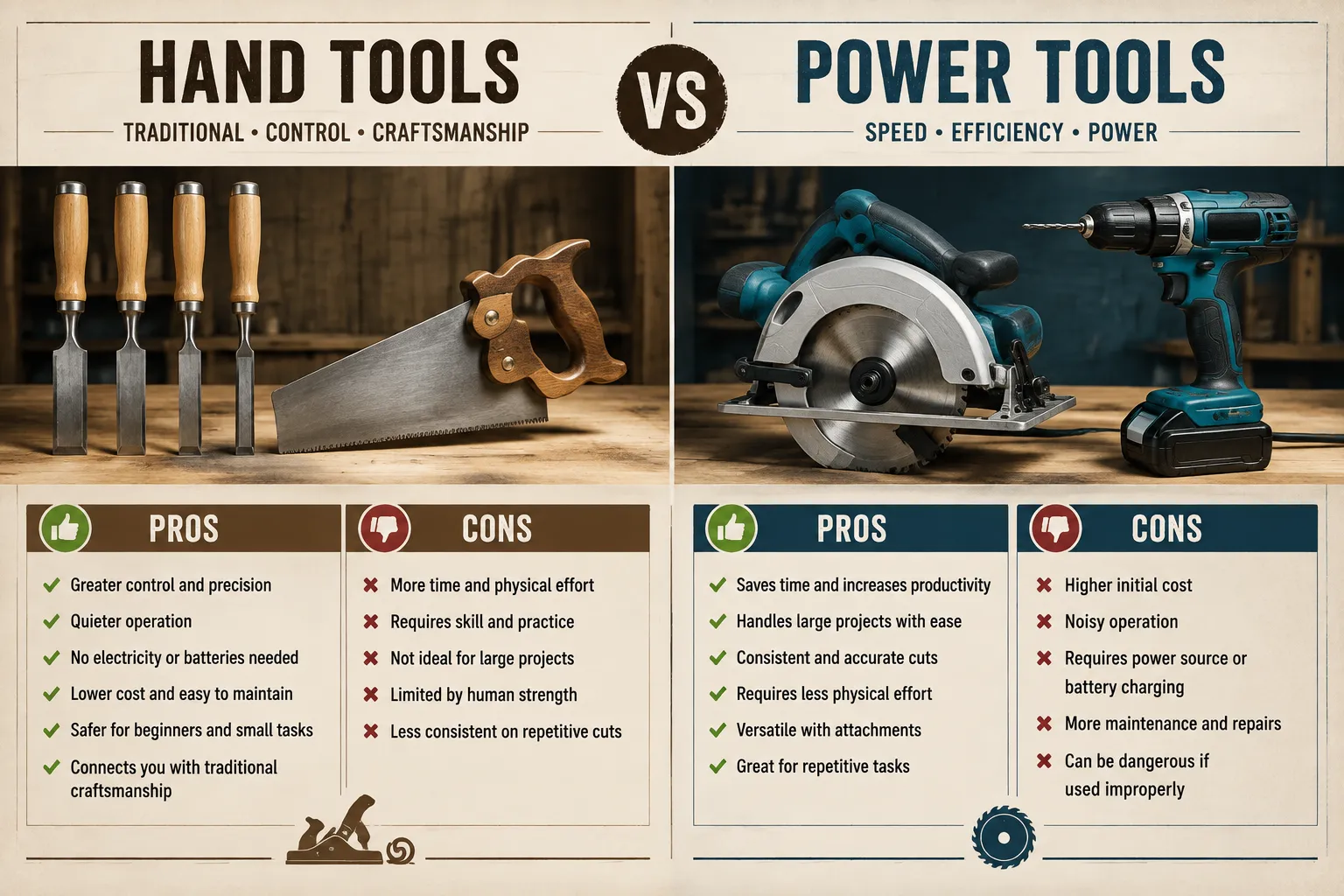
Hand tools are manually operated and give the woodworker direct control over the cut or shape. Power tools are motor-driven and work faster, but they require more safety awareness and setup time. Both have a place in a well-rounded shop, and most experienced woodworkers use them together.
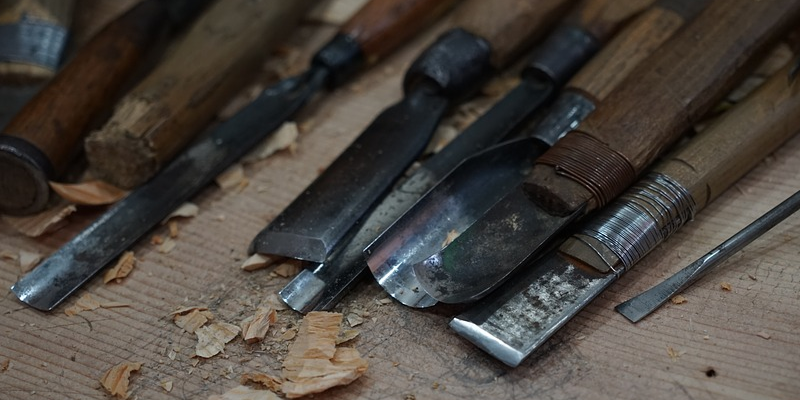
Hand tools include chisels, hand planes, hand saws, mallets, marking gauges, and spoke shaves. They are quieter, portable, and ideal for fine detail work, joinery fitting, and situations where a power tool would be overkill. They also teach you to read wood grain and develop feel, which makes you a better woodworker overall.
Power tools include drills, jigsaws, circular saws, routers, sanders, and table saws. They remove material faster, produce consistent results at scale, and are essential for larger projects or production work.
A practical rule: use power tools to get close to your final dimension, then use hand tools to fit and finish. This combination produces cleaner results than relying on either category alone. You can explore the full range of various tools used for woodworking to understand where each fits in your workflow.
A Closer Look at the Core Equipment Used in Woodworking
Understanding what each tool actually does, and when to reach for it, is more useful than a simple list. Here is a breakdown of the most common equipment used in woodworking, written for beginners who want practical context alongside the basics.
Woodworking Machines
Stationary woodworking machines, such as table saws, band saws, drill presses, and jointers, are the backbone of a production-level shop. They are powered by electric motors and designed for repetitive, high-volume work. A table saw, for example, can rip hundreds of boards to consistent width in the time it would take to do a dozen by hand.
For beginners, stationary machines are not a day-one purchase. They require dedicated space, proper safety training, and a meaningful upfront investment. That said, if you plan to run a woodworking business or produce furniture at volume, they become indispensable. You can learn more about the options available through a dedicated guide to woodworking machinery.
Biscuit Joiner
A biscuit joiner (also called a plate joiner) cuts a small, oval-shaped slot into two mating pieces of wood. A compressed wood biscuit is glued into both slots, and when the joint is clamped, the biscuit swells slightly and creates a strong, aligned bond.
The blade is typically 100mm in diameter and cuts a semi-circular recess in the wood or composite panel. Biscuit joiners are especially useful for edge-joining boards into tabletops or panels, where alignment matters as much as strength. They are not the only way to join wood, but they are fast and beginner-friendly.
Chainsaw
A chainsaw is a portable, motorized saw with a toothed chain running around a guide bar. It is the primary tool for felling trees, bucking logs into manageable lengths, limbing branches, and harvesting firewood. For woodworkers who source their own lumber from raw logs, a chainsaw is essential.
It is worth noting that chainsaws are not typically used for fine woodworking inside a shop. Their role is upstream: turning a tree or large log into rough lumber that can then be milled and dried. If you are building furniture from dimensional lumber bought at a hardware store, you will rarely need one.
Drill
The drill is arguably the most versatile piece of equipment used in woodworking. It bores holes for screws, dowels, and hardware, and with the right bit, it can drive fasteners, mix finishes, and even sand small areas. Cordless drills have largely replaced corded models for most shop tasks, offering enough power for all but the most demanding applications.
Types worth knowing about:
- Cordless drill/driver: The everyday workhorse. Good for driving screws and boring holes up to about 1 inch in diameter.
- Hammer drill: Adds a percussive action for drilling into masonry or concrete, useful if your project involves anchoring wood to a wall or floor.
- Drill press: A stationary version that drills perfectly perpendicular holes every time, ideal for joinery and hardware installation.
Jigsaw
A jigsaw cuts curves, shapes, and irregular lines that a circular saw or table saw cannot handle. The blade moves up and down rapidly, and the tool itself can be guided freehand or along a template. Most carpenters and woodworkers keep one in their kit for cutting around outlets in countertops, shaping decorative edges, or following a woodworking pattern.
For fine curved cuts, choose a jigsaw with an orbital action setting and a fine-tooth blade. Slower, more deliberate movement produces cleaner edges than rushing.
Nail Gun
A nail gun drives nails faster and more consistently than a hammer, and it keeps your other hand free to hold the workpiece. Modern nail guns are powered by compressed air (pneumatic), rechargeable batteries, or in some models, combustible gas cartridges using propane or butane.
Common types include:
- Brad nailer: For trim, molding, and light assembly work.
- Finish nailer: For heavier trim, cabinet face frames, and furniture assembly.
- Framing nailer: For structural work, decking, and rough framing.
The nail gun has become standard equipment for professional carpenters and builders because it reduces fatigue and speeds up repetitive fastening. For beginners, a cordless brad nailer is a practical first choice.
Wood Router
A wood router hollows out material from a workpiece to create grooves, dadoes, rabbets, decorative edge profiles, and joinery. Modern handheld electric routers have largely replaced older spindle tools for most shop applications. They accept a wide range of interchangeable bits, making them one of the most versatile pieces of equipment used in woodworking.
Routers are used for:
- Edge profiling (roundovers, chamfers, ogees)
- Cutting dadoes and grooves for shelves and drawer bottoms
- Creating mortise and tenon joints
- Template routing for repeated shapes
A fixed-base router suits beginners well. A plunge router adds versatility for stopped cuts and inlay work, but it has a steeper learning curve.
Sander
Sanding is the step between raw-cut wood and a finish-ready surface. A random orbital sander is the most practical choice for beginners: it moves in a random elliptical pattern that prevents the circular scratches left by older disc sanders. Most are powered by electric motors and accept hook-and-loop sanding discs in various grits.
Work through grits progressively: start coarse (80 grit) to remove mill marks or tool marks, then move through 120, 150, and 180 grit before applying any finish. Skipping grits leaves scratches that show up clearly under stain or varnish.
Rotary Tool
A rotary tool (the Dremel being the most recognized brand) is a compact, handheld power tool that accepts dozens of interchangeable bits and attachments. It operates at high RPM with low torque, making it safe for freehand detail work. Common uses include carving, engraving, cutting small pieces, polishing metal hardware, and cleaning up tight corners that a larger tool cannot reach.
Because of its low torque, a rotary tool is forgiving for beginners doing detail or inlay work. It is not a replacement for larger tools, but it fills a gap that nothing else covers as neatly.
What Is the Difference Between a Table Saw and a Circular Saw?
A table saw is a stationary machine with a fixed blade that rises through a table surface. A circular saw is a handheld tool with a spinning blade that you guide across the material. Both cut wood, but they serve different purposes and suit different setups.
Table saw: Best for ripping long boards to consistent width, crosscutting sheet goods with a sled, and repetitive cuts where precision and speed matter. It requires dedicated floor space and is the most statistically dangerous tool in a woodworking shop, according to HSE woodworking machinery safety guidance.
Circular saw: Best for breaking down sheet goods (plywood, MDF), making rough crosscuts on dimensional lumber, and working on-site or in small spaces. With a good straightedge guide, it can produce surprisingly accurate cuts.
Choose a table saw if you are building furniture regularly and have the space. Choose a circular saw if you are working in a small space, on a budget, or need portability.
Best Woodworking Equipment for Small Spaces
You can do serious woodworking in a one-car garage, a basement, or even outdoors. The key is choosing compact, portable, or dual-purpose tools that do not require a permanent footprint.
The best equipment for small-space woodworking includes:
- Cordless drill and driver: No cord, no compressor, no dedicated space needed.
- Track saw or circular saw with a guide rail: Replaces a table saw for most sheet goods work in a fraction of the footprint.
- Benchtop drill press: Sits on a workbench and folds away when not in use.
- Random orbital sander: Compact and easy to store.
- Folding workbench (such as a Workmate): Provides a stable work surface without a permanent bench.
- Router with a simple table insert: A router table can be built into a fold-down bench or stored flat.
Wall-mounted tool storage and a rolling cart for power tools make a small space dramatically more functional. The goal is to keep the floor clear and bring tools to the work rather than moving the work to fixed machines.
How Much Does a Complete Woodworking Shop Setup Cost?
A beginner woodworking setup costs between $300 and $600 for a practical starter kit. A mid-range shop with stationary machines runs $1,500 to $3,000. A fully equipped professional shop can exceed $10,000, though most hobbyists never need to spend anywhere near that amount.
Here is a rough breakdown by tier:
Starter kit ($300 to $600):
- Cordless drill/driver
- Jigsaw
- Random orbital sander
- Basic hand tools (chisels, mallet, marking tools)
- Safety gear (eye protection, hearing protection, dust mask)
Intermediate shop ($1,500 to $3,000):
- Everything above, plus:
- Circular saw or track saw
- Router and basic bit set
- Nail gun (brad or finish)
- Workbench or solid work surface
- Clamps (you will always need more clamps)
Advanced or semi-professional shop ($5,000 and up):
- Table saw or cabinet saw
- Band saw
- Jointer and planer
- Dust collection system
- Full router table setup
Buying used tools from reputable brands is one of the smartest moves a beginner can make. A used DeWalt or Makita drill bought secondhand for $60 will outperform a new no-name tool at the same price every time.
Do You Need Expensive Equipment to Start Woodworking?
No. You can build functional, attractive furniture and home goods with a modest tool investment. Many experienced woodworkers argue that skill matters far more than equipment, especially in the early stages.
According to Blacktail Studio’s guide to essential woodworking tools, a beginner can accomplish a remarkable range of projects with just a handful of well-chosen tools. The temptation to buy everything at once is real, but it often leads to tools sitting unused while you figure out what you actually need.
A better approach: start with one project, buy only the tools that project requires, and build your kit organically. This keeps costs low, prevents overwhelm, and ensures every tool you own gets used.
Woodworking Tools for Someone With a Limited Budget
Budget woodworking is entirely possible. The key is prioritizing tools with the widest range of uses and being patient about adding specialty items.
Best value tools for budget beginners:
- A mid-range cordless drill (Ryobi, Skil, or a used DeWalt) covers drilling and driving.
- A corded jigsaw costs less than a cordless version and performs just as well for most tasks.
- A corded random orbital sander is one of the cheapest tools to buy and one of the most used.
- Hand tools (chisels, a hand plane, a marking gauge) are inexpensive and last decades with basic care.
- Clamps can be bought gradually. Start with four to six medium F-clamps and add as projects demand.
Avoid buying the cheapest possible versions of blade-based tools. A low-quality saw blade or router bit produces poor results and can be genuinely dangerous. Spend a little more on cutting edges and save on storage, workbenches, and accessories.
What Woodworking Tools Are Most Dangerous and How to Use Them Safely?
The most dangerous equipment used in woodworking includes table saws, chainsaws, nail guns, and routers. Each causes a specific category of injury when used incorrectly.
According to general safety rules for hand and power tool use, the majority of woodworking injuries are preventable with consistent safety habits.
Table saw: Kickback (where the wood is thrown back at the operator) is the primary hazard. Always use a riving knife or splitter, keep the blade guard in place, and never stand directly behind the blade.
Chainsaw: Requires full protective gear including chainsaw chaps, a helmet with face shield, gloves, and steel-toed boots. Never cut above shoulder height, and always maintain two-point contact with the saw.
Nail gun: Accidental discharge is the main risk. Keep your finger off the trigger until the nose is pressed against the workpiece. Never point a nail gun at another person, even when it appears unloaded.
Router: Climb cutting (moving the router in the wrong direction) can cause the tool to grab and kick. Always move the router against the direction of bit rotation, and make deep cuts in multiple shallow passes.
Universal safety rules that apply to all equipment used in woodworking:
- Wear eye and hearing protection every session, without exception.
- Keep blades and bits sharp. Dull cutting edges require more force and are more likely to slip or bind.
- Secure your workpiece before cutting. A workpiece that moves mid-cut is dangerous.
- Never use power tools when tired, distracted, or under the influence of any substance.
- Disconnect power before changing blades, bits, or accessories.
Best Woodworking Equipment for Detailed or Fine Work
Fine and detail work requires tools that offer precision, control, and the ability to work in tight spaces. The best equipment for this category includes routers with small bits, rotary tools, chisels, hand planes, and card scrapers.
For detailed joinery, a quality set of bench chisels and a sharp marking gauge will serve you better than any power tool. For decorative work such as carving, inlay, or engraving, a rotary tool with carving bits is hard to beat. For smooth, glass-like surfaces, a well-tuned hand plane or a card scraper removes material more cleanly than sandpaper alone.
If you are working from detailed woodworking plans that require precise joinery, consider adding a router table and a good set of router bits. A router table gives you far more control than a handheld router for small, intricate cuts.
Can You Do Woodworking Without a Workshop?
Yes, and many beginners do exactly that. A dedicated workshop is convenient but not a requirement. Portable tools, a folding workbench, and good organization make it possible to work in a driveway, backyard, apartment balcony, or shared garage.
The main challenges of working without a dedicated shop are dust management, noise (relevant if you have neighbors), and tool storage. A shop vacuum, a dust mask rated N95 or better, and hearing protection address the first two. A rolling tool cart or a dedicated cabinet handles storage.
For apartment or condo woodworkers, hand tools and battery-powered tools are the most practical choice. They produce less noise and dust than stationary machines, and they can be used on a kitchen table or balcony with a drop cloth underneath.
Woodworking Tools for Outdoor vs. Indoor Projects
The distinction matters more than most beginners expect. Outdoor projects (decks, garden furniture, fences, raised beds) require tools and materials that can handle moisture, rough lumber, and structural loads. Indoor projects (furniture, cabinets, shelving) prioritize precision, finish quality, and joinery strength.
For outdoor projects, prioritize:
- A circular saw or reciprocating saw for cutting treated lumber and rough stock
- A framing nail gun for structural assembly
- A drill with long, corrosion-resistant bits
- Exterior-rated fasteners and adhesives (not a tool, but critical)
For indoor projects, prioritize:
- A jigsaw and router for shaping and profiling
- A random orbital sander for finish-ready surfaces
- A biscuit joiner or pocket hole jig for clean panel joins
- A drill press for precise hardware installation
Many tools serve both categories well. The drill, jigsaw, and sander are equally at home on a deck project and a dining table build. The difference is usually in the blades, bits, and fasteners you choose rather than the tools themselves.
How to Maintain and Care for Woodworking Tools
Well-maintained tools last decades and perform better than neglected ones. The basics are simple and take only a few minutes after each session.
Routine maintenance habits:
- Wipe down metal surfaces with a lightly oiled rag after use to prevent rust.
- Keep saw blades and router bits clean. Resin buildup dulls cutting edges faster than use does. A blade cleaning solution and a soft brush handle this quickly.
- Store chisels and plane irons with edge protectors or in a roll to prevent nicking.
- Check power tool cords for cuts or fraying before each use.
- Lubricate moving parts (saw blade guards, drill chuck, router collet) with a dry lubricant or light machine oil as needed.
- Sharpen hand tool edges regularly. A dull chisel or plane iron requires more force and produces worse results.
Battery-powered tools have their own maintenance needs. Store lithium-ion batteries at partial charge (around 40 to 60 percent) if they will sit unused for more than a few weeks. Avoid storing them in extreme heat or cold, which degrades cell capacity over time.
Common Mistakes Beginners Make With Woodworking Equipment
Most beginner mistakes fall into a small number of predictable categories. Knowing them in advance saves time, money, and frustration.
Buying too many tools before knowing what you need. Start with a project, buy what that project requires, and build from there.
Using dull blades and bits. A dull blade tears wood rather than cutting it, produces dangerous kickback, and makes every cut harder than it needs to be. Replace or sharpen cutting edges regularly.
Skipping measurements. “Measure twice, cut once” is a cliché because it is true. A few seconds of double-checking saves a ruined board and a wasted trip to the lumber yard.
Not securing the workpiece. Clamps and bench dogs exist for a reason. A workpiece that shifts mid-cut produces an inaccurate cut at best and a dangerous situation at worst.
Ignoring grain direction. Routing, planing, or sanding against the grain tears wood fibers and leaves a rough surface. Always read the grain before making a pass.
Rushing the finish. Sanding through grits too quickly, applying finish over dust, or not allowing adequate dry time between coats produces a finish that looks worse than bare wood. Take your time at the end of a project.
Which Woodworking Equipment Holds Its Value Best?
Quality hand tools and mid-range power tools from established brands hold their value exceptionally well. Some vintage hand tools, particularly Stanley hand planes and quality chisels, actually appreciate over time if kept in good condition.
Among power tools, routers, quality cordless drill sets, and track saws retain strong resale value because they are versatile, widely used, and long-lasting. Brand matters here: DeWalt, Festool, Makita, and Lie-Nielsen (for hand tools) consistently command strong secondhand prices.
Cheap tools from unknown brands depreciate immediately and are often difficult to resell at any price. Buying quality once is almost always more economical than buying budget tools twice.
If you are just starting out and want to explore popular woodworking styles and projects before committing to a full tool investment, consider renting or borrowing specialty tools for your first few builds. Many makerspaces and community woodworking shops offer tool access for a monthly membership fee, which is a practical way to try equipment before buying it.
FAQ: Equipment Used in Woodworking
What is the single most important tool for a beginner woodworker?
A cordless drill/driver. It handles drilling, driving screws, and basic assembly, and it is used in nearly every woodworking project regardless of style or complexity.
Can I start woodworking with just hand tools?
Yes. Hand tools alone are sufficient for furniture making, joinery, and most hobby projects. Many traditional woodworkers work exclusively with hand tools and produce exceptional results. The learning curve is steeper, but the skill development is deeper.
What is a biscuit joiner used for in woodworking?
A biscuit joiner cuts matching oval slots in two pieces of wood. A compressed wood biscuit is glued into both slots, aligning and strengthening the joint. It is most commonly used for edge-joining boards into panels or tabletops.
Is a jigsaw or a circular saw better for beginners?
A jigsaw is generally safer and more forgiving for beginners. It cuts curves and straight lines, is easier to control freehand, and is less likely to cause kickback than a circular saw. Start with a jigsaw and add a circular saw when you need it.
How loud are woodworking power tools?
Most power tools operate between 85 and 110 decibels. Sustained exposure above 85 dB causes hearing damage over time. Always wear hearing protection (rated NRR 25 or higher) when using power tools, even for short sessions.
What is a wood router used for?
A wood router shapes edges, cuts grooves and dadoes, creates decorative profiles, and produces joinery such as mortises and rabbets. It is one of the most versatile tools in a woodworking shop and is used in both furniture making and cabinetry.
Do I need a dust collection system?
Not immediately, but fine wood dust is a genuine health hazard with prolonged exposure. A shop vacuum connected to your sander and router is a practical starting point. A dedicated dust collector becomes worthwhile once you are using a table saw or planer regularly.
What is the difference between a nail gun and a brad nailer?
A brad nailer is a type of nail gun that fires thin 18-gauge brad nails. It is designed for light assembly, trim, and molding work where a larger nail would split the wood. A standard finish nailer fires heavier 15 or 16-gauge nails for more structural applications.
How do I know when a saw blade needs replacing?
Signs include burning or scorching on the cut edge, increased resistance when cutting, tear-out on the underside of the cut, and visible missing or damaged teeth. A blade that requires noticeably more force to push through wood is ready to be sharpened or replaced.
Can a rotary tool replace a router?
For light carving and detail work, yes. For structural cuts, edge profiling on full boards, or any application requiring depth and consistency, no. A rotary tool and a router are complementary rather than interchangeable.
What safety gear do I need for woodworking?
At minimum: safety glasses or goggles, hearing protection, and a dust mask rated N95 or better. For chainsaw use, add chainsaw chaps, a helmet with face shield, and cut-resistant gloves. For any grinding or turning operation, a full face shield is safer than glasses alone.
Where can I learn woodworking skills online?
Structured online courses are a practical way to build foundational skills before investing in tools. A good starting point is woodworking online training that covers both tool use and project planning in a logical sequence.
Conclusion
The equipment used in woodworking ranges from a simple hand chisel to a fully motorized table saw, and the right starting point depends entirely on what you want to build, how much space you have, and what your budget allows. You do not need a full shop to get started. A drill, a jigsaw, a sander, and a basic set of hand tools will take a complete beginner through dozens of satisfying projects.
Buy quality where it counts (blades, bits, and the tools you will use every session), learn safety habits before you learn speed, and let your tool collection grow with your skills rather than ahead of them. Woodworking rewards patience. The projects you build in your first year will look better than you expect, and the tools you choose carefully will still be in your shop decades from now.
Products, Tools, and Resources
These are practical starting points based on what actually gets used in a beginner’s shop, not the most expensive options or the cheapest.
Recommended starter tools:
- Cordless drill/driver: DeWalt DCD777 or Makita XFD131 (both offer reliable performance at a reasonable price point for beginners)
- Jigsaw: Bosch JS470E (corded, consistent, and widely recommended for beginners by experienced woodworkers)
- Random orbital sander: DeWalt DWE6423K (5-inch, dust-sealed, and widely available)
- Wood router: Bosch 1617EVS (fixed and plunge base combo, excellent value for the range of tasks it covers)
- Brad Nailer: Ryobi PCL100B (cordless, beginner-friendly, and compatible with the Ryobi ONE+ battery system)
Learning resources:
- Woodworking online training for structured skill-building from beginner to intermediate level
- Woodworking jigs for improving accuracy without expensive machinery
- Woodworking plans for project-based learning that build tool skills naturally
Where to buy used tools:
Facebook Marketplace, Craigslist, and estate sales are consistently the best sources for quality used tools at fair prices. Search by brand name (Stanley, DeWalt, Makita, Lie-Nielsen) rather than by tool type for better results.
References
- Complete Woodworking Tools Lists for All Skill Levels, Ronix Tools
- Essential Woodworking Tools List for Beginners (2026 Guide), Wood Trimmer
- Complete Woodworking Tools List: Essential Guide 2025, Wood Guide
- 10 Essential Woodworking Tools To Start Your Shop, Blacktail Studio
- Safe Use of Woodworking Machinery, Health and Safety Executive (HSE)
- General Safety Rules for Machine and Woodworking Shops, University of Tennessee EHS
- The Top 20 Game-Changing Woodworking Tools of 2025, 731 Woodworks
- Ultimate Woodworking Tools Guide 2025, The Woodwork Starter