Best Popular Woodworking Products for Home Improvement
Hey there! Some links on this page may be affiliate links, which means that if you choose to make a purchase, I may earn a commission at no extra cost to you. I greatly appreciate your support!
The best popular woodworking products for home improvement include teak cabinets, solid wood dining sets, carved sideboards, antique doors, and decorative wooden statues. For beginners, pre-made or kit-based versions of these products offer the most value without requiring advanced skills or a full tool setup. Choosing the right product depends on your space, budget, and whether you plan to buy finished pieces or build them yourself.
Find this useful? Add us as a preferred source on Google and more of what we publish will show up in your results.
Key Takeaways
- Teak wood remains one of the most reliable choices for cabinets and furniture because of its natural water resistance and hardness
- Dining room sets are the single most impactful woodworking product you can add to a home, both for daily use and resale value

- Beginners should start with simpler projects like curtain rods, small shelves, or decorative statues before attempting full furniture builds
- Pre-made woodworking products save time; DIY kits save money but require basic tools and patience
- Quality woodworking products (mid-range and above) typically outlast budget alternatives by a wide margin, making them more cost-effective over time
- Outdoor woodworking products need weather-treated or naturally durable wood species like teak, cedar, or redwood
- Common beginner mistakes include buying the wrong wood species, skipping proper finishing, and underestimating the tools needed
- Woodworking products like built-in cabinets and hardwood dining sets consistently add measurable resale value to a home
- Small-space homeowners benefit most from multi-functional pieces: sideboards with storage, wall-mounted shelves, and compact dining sets
- You do not need expensive professional-grade tools to get started; a basic beginner toolkit covers most entry-level projects
What Are the Most Popular Woodworking Products for Beginners?
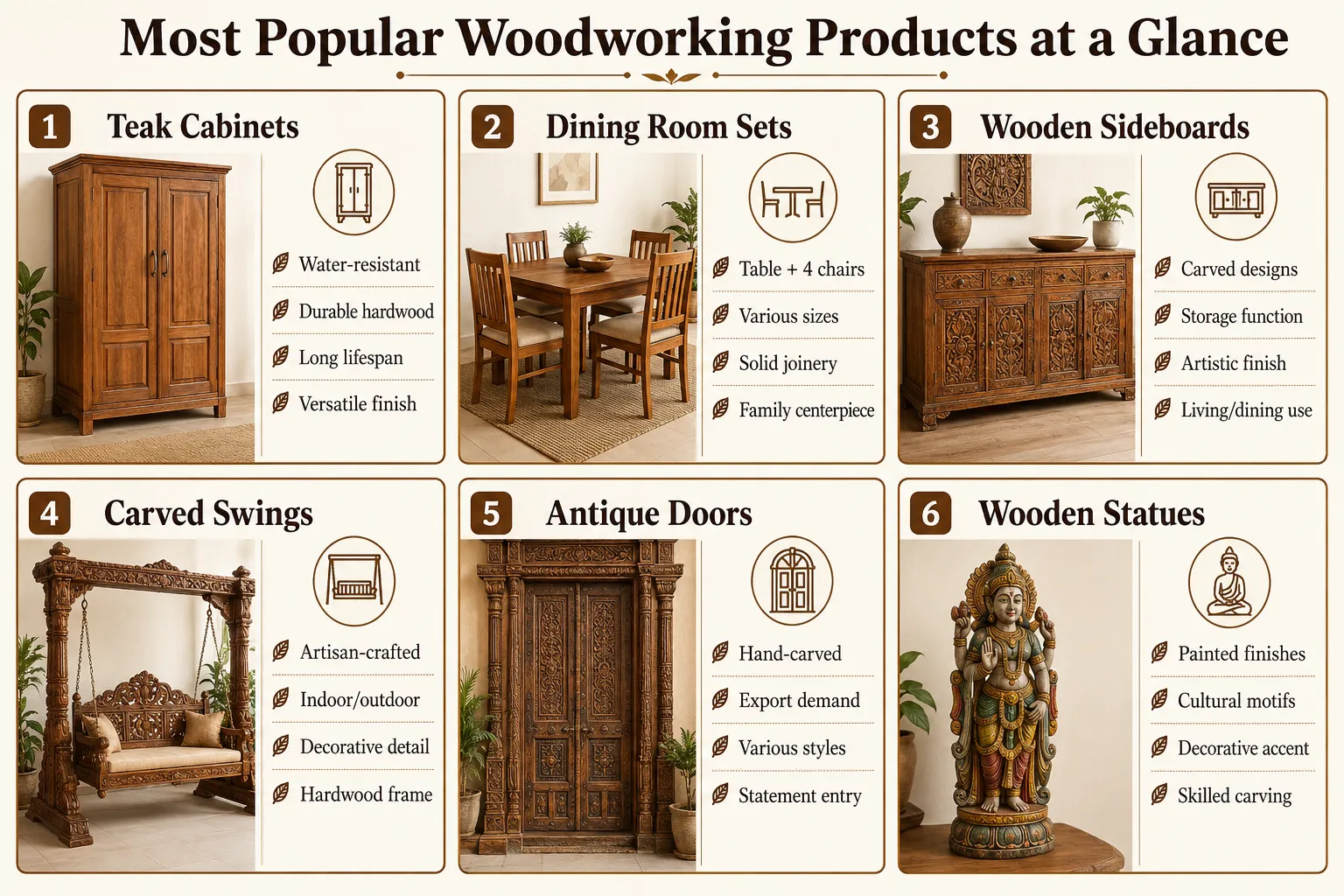
The most popular woodworking products for beginners are items that combine visual impact with manageable construction: wooden cabinets, dining sets, decorative statues, curtain rods, and carved sideboards. These products appear consistently across home improvement guides because they serve real functional needs while showcasing the natural beauty of wood.
For someone just getting into woodworking, the appeal is obvious. Wood is forgiving to work with at a basic level, finished pieces look genuinely impressive, and the range of popular woodworking projects means there is always something suited to your current skill level.
Here is a practical breakdown of where to start:
- Cabinets: One of the most requested woodworking products in any home. Teak and oak cabinets are especially popular because they are durable, visually striking, and hold their value well. If you are buying rather than building, teak cabinets are worth the investment.
- Dining room sets: A table and four chairs remain the centerpiece of most family homes. Solid wood sets in oak, pine, or walnut are widely available as both finished products and DIY flat-pack kits.
- Wooden sideboards: These serve double duty as storage and decor. Carved designs on sideboards can transform a plain dining or living room without requiring a full renovation.
- Curtain rods: A surprisingly effective starting project for beginners who want to try woodworking without committing to large furniture builds.
- Decorative wooden statues: Low-risk, high-reward pieces that add character to any room and require no structural woodworking knowledge to display.
If you are building rather than buying, start with the curtain rods and small shelves before attempting cabinet construction. The joinery skills you develop on smaller pieces transfer directly to larger furniture projects.
What Woodworking Products Do I Actually Need to Get Started?
You do not need a full workshop to get started with woodworking products for home improvement. The honest answer is that most beginners need three things: one or two anchor furniture pieces, a small set of hand tools, and a clear sense of what their space actually requires.
Start by identifying the rooms that need the most attention. A dining room without a proper table, a living room with no storage, or a bedroom with bare walls are all problems that woodworking products solve directly and affordably.
For building your own pieces, a basic starter toolkit should include:
- A quality hand saw or circular saw
- A cordless drill and driver
- Chisels (a basic set of three to four sizes)
- Sandpaper in multiple grits (80, 120, and 220 are a solid starting range)
- Wood glue and clamps
- A tape measure and marking tools
For a deeper look at what equipment matters most, the guide on equipment used in woodworking covers the essentials without overwhelming beginners with professional-grade options.
If you are buying finished woodworking products rather than building them, your “toolkit” is simpler: a clear budget, measurements of your space, and an understanding of which wood species suit your climate and lifestyle.
Best Woodworking Tools for Home Improvement Projects
The best woodworking tools for home improvement depend on the scale of your project. For most beginners working on furniture assembly, decoration, or small builds, hand tools and a cordless drill cover the majority of tasks. Power tools become necessary when you are cutting large panels, shaping joints, or working with hardwoods like teak or oak.
Here is a tiered breakdown:
Entry-level (under $200 total investment):
- Cordless drill and driver
- Hand saw
- Mallet and two to three chisels
- Measuring and marking tools
- Sandpaper and a sanding block
Mid-range (for more serious DIY projects):
- Circular saw or jigsaw
- Random orbital sander
- Router (for edge profiles and joinery)
- Basic woodworking jigs for repeatable cuts and drilling
Advanced (for furniture building from scratch):
- Table saw
- Planer and jointer
- Band saw
- Full set of woodworking machinery for production-level work
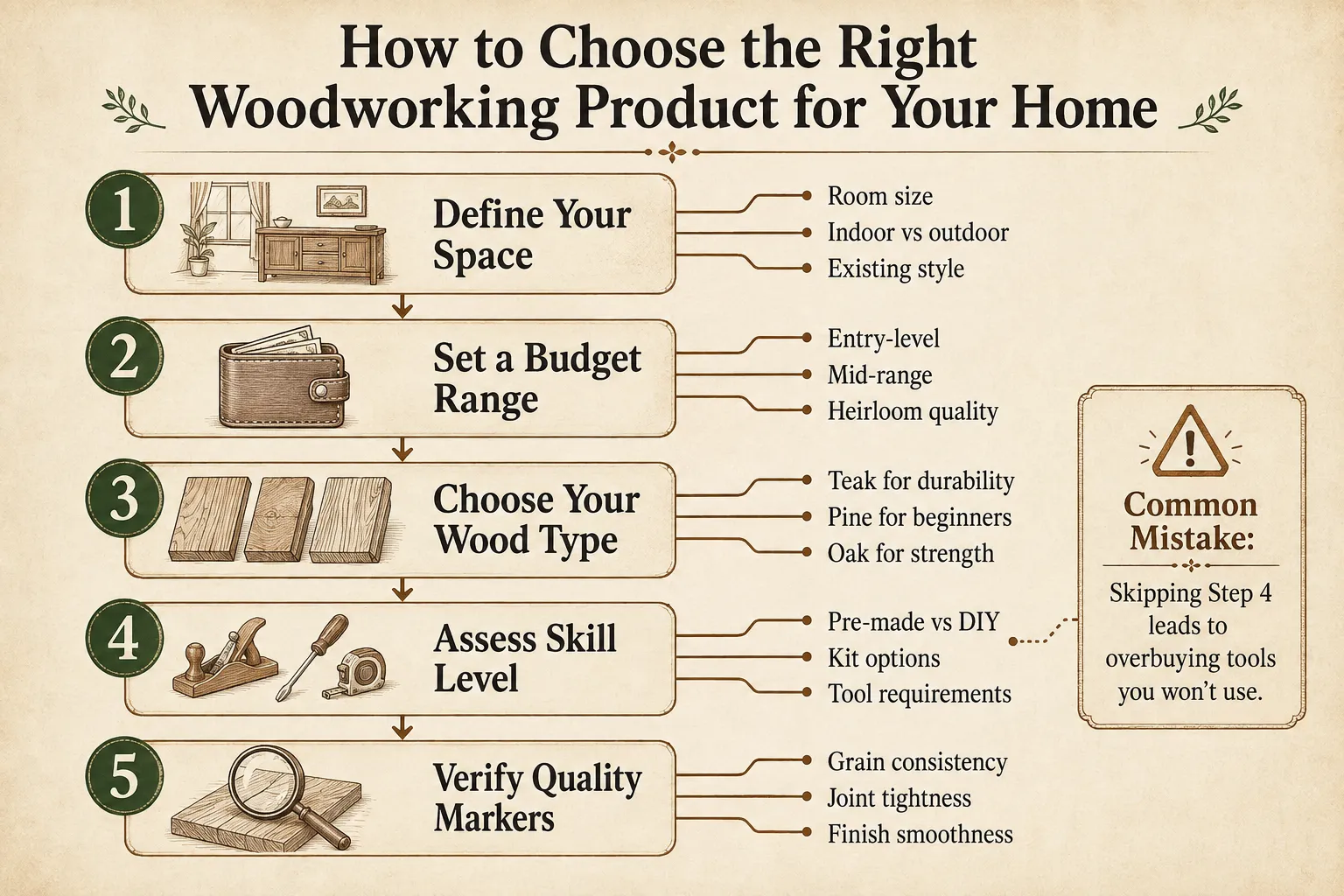
The most common beginner mistake here is buying too many tools upfront. Start with the entry-level set and add tools only when a specific project demands them. Most home improvement woodworking projects, including cabinet installation, dining set assembly, and decorative carving, are achievable with the basics.
How Much Do Quality Woodworking Products Cost?
Quality woodworking products span a wide price range, and the cost depends on wood species, construction method, and whether the piece is mass-produced or handcrafted. Here is a realistic overview for 2026:
- Teak cabinets: Entry-level pre-made units typically start around $300 to $600 per piece. Custom or artisan-built teak cabinets can run $1,200 or more depending on size and carving detail.
- Solid wood dining sets (table plus four chairs): Expect to pay $500 to $1,500 for mid-range solid wood sets. Budget flat-pack options exist below $300, but longevity is often compromised.
- Wooden sideboards: Carved hardwood sideboards generally range from $400 to $1,000 for retail pieces. Artisan versions with hand-carved detailing can exceed that significantly.
- Antique-style carved doors: These are among the more expensive woodworking products, often priced between $800 and $3,000 per door depending on the carving complexity and wood type.
- Decorative wooden statues and curtain rods: These are the most accessible entry points, with quality pieces available from $30 to $300 depending on size and craftsmanship.
Choose budget options if: you are furnishing a rental property, testing a style before committing, or working on a short-term project.
Choose mid-range to premium if: you are furnishing a long-term home, want pieces that age well, or are buying teak and hardwood items where durability directly affects value.
Woodworking Products vs. Hiring a Professional Carpenter
Buying finished woodworking products is faster and often more predictable in cost. Hiring a professional carpenter gives you custom sizing and design but adds significant labor costs. For most homeowners, the right answer depends on how specific your requirements are.
If a standard cabinet fits your space and style, buying a finished product is almost always more cost-effective. If you need a built-in unit that fits an awkward alcove or matches a specific architectural detail, a carpenter earns their fee.
DIY woodworking sits in the middle: lower cost than hiring out, more flexibility than buying pre-made, but it requires time, tools, and a willingness to learn. For beginners interested in developing those skills, woodworking online training resources can dramatically shorten the learning curve.
A practical decision framework:
- Buy finished products when standard sizes fit, budget is limited, and time is short
- Hire a carpenter when custom dimensions are required or the project involves structural work
- DIY when you have the time to learn, want to develop a skill, and are working on non-structural decorative pieces
Are Expensive Woodworking Products Worth It, or Can I Use Budget Brands?
Expensive woodworking products are worth it when the quality difference is in the wood itself, not just the branding. Solid teak, oak, or walnut furniture genuinely outlasts budget MDF or softwood alternatives by years, sometimes decades. The value equation changes when you are comparing two solid hardwood products at different price points; at that stage, the premium often comes from craftsmanship details that matter less to everyday users.
Budget woodworking products make sense for:
- Decorative pieces that do not bear weight or heavy use (curtain rods, small statues)
- Temporary furnishings in rental properties or staging situations
- Beginner DIY projects where you are learning technique on inexpensive material
Mid-range products (solid wood, factory-finished, standard joinery) are the sweet spot for most homeowners. They offer genuine durability without the premium markup of artisan or custom pieces.
One thing worth noting: the finish matters as much as the wood. A well-finished pine cabinet will outlast a poorly finished oak one. Always inspect or ask about the finishing process before buying, especially for pieces that will see moisture exposure in kitchens or bathrooms.
Woodworking Products That Add the Most Home Value
Certain woodworking products consistently increase a home’s perceived and actual resale value. Built-in cabinets, hardwood dining sets, and quality interior doors are the three categories that real estate professionals and home stagers reference most often.
Here is why each category matters:
Built-in and freestanding cabinets: Storage is one of the top priorities for home buyers. Well-made teak or hardwood cabinets signal quality construction throughout the home and are often cited as a selling point in listings.
Hardwood dining sets: A solid wood dining table is a statement piece. It anchors the dining room and communicates that the home has been furnished with intention rather than convenience.
Antique-style carved doors: Interior and exterior doors with carved detailing are among the most visually striking woodworking products available. They add architectural character that is difficult to replicate with modern alternatives and are in consistent demand in international markets for renovation projects.
Wooden sideboards and storage pieces: Multi-functional furniture that doubles as art is increasingly valued in the current market, particularly in homes where open-plan living means furniture is always visible.
For homeowners thinking about resale, investing in quality woodworking products for the dining room, kitchen, and entryway delivers the most visible return.
Best Woodworking Products for Small Spaces and Apartments
Small-space homeowners need woodworking products that work harder. The best choices are multi-functional, vertically oriented, or custom-fitted to avoid wasting floor space.
Practical options for apartments and compact rooms:
- Wall-mounted shelving: Keeps floor space clear while adding substantial storage and visual interest
- Compact dining sets: A two-person or fold-down wooden dining table paired with stackable chairs solves the dining room problem without dominating the room
- Narrow sideboards: A slimline sideboard (under 14 inches deep) provides storage and a display surface without projecting far into the room
- Vertical cabinets: Tall, narrow cabinets use ceiling height rather than floor area, making them ideal for kitchens and hallways
- Decorative wooden statues and carved accents: These add warmth and personality to small spaces without taking up functional room
The key principle for small spaces is choosing pieces that serve at least two purposes: a sideboard that stores linens and displays decor, a cabinet that holds kitchen items and acts as a room divider, or a dining bench with internal storage.
Common Mistakes People Make When Buying Woodworking Products
The most common mistake is buying for appearance without checking construction quality. A beautifully finished cabinet made from MDF or low-grade particleboard will look identical to a solid wood version in a showroom photograph but will behave very differently over five years of use.
Other frequent mistakes include:
- Ignoring wood species: Softwoods like pine are fine for decorative pieces but will dent and scratch under heavy daily use. For high-traffic furniture, choose hardwoods.
- Skipping measurements: Furniture that is even two inches too wide for a space creates a cramped, cluttered feel. Always measure twice before purchasing.
- Overlooking the finish: A poor finish will crack, peel, or discolor within a year. Ask specifically whether the finish is oil-based, lacquer, or wax, and whether it is appropriate for the intended environment.
- Buying too many tools at once: For DIY beginners, the impulse to buy a complete workshop setup before completing a single project is expensive and often discouraging. Start small.
- Choosing style over function: An antique carved door is stunning, but if it does not fit the door frame or swing clearance of your home, it becomes an expensive storage problem.
A useful reference for avoiding tool-related mistakes is the overview of various tools used for woodworking, which helps beginners understand what each tool actually does before investing.
Woodworking Products for Outdoor vs. Indoor Projects
Outdoor and indoor woodworking products have fundamentally different requirements. Wood used outdoors must resist moisture, UV exposure, temperature fluctuation, and insects. Wood used indoors primarily needs to handle wear, humidity variation, and aesthetic aging.
Best wood species for outdoor woodworking products:
- Teak: Naturally oil-rich, highly resistant to water and insects, minimal maintenance required
- Cedar: Lightweight, naturally aromatic, good rot resistance
- Redwood: Stable and attractive, good natural resistance to decay
- Pressure-treated pine: Affordable and widely available, suitable for structural outdoor use
Best wood species for indoor woodworking products:
- Oak: Hard, durable, takes stain and finish beautifully
- Walnut: Rich color, excellent for decorative furniture and carved pieces
- Maple: Hard and consistent grain, excellent for dining tables and cabinets
- Pine: Softer but affordable, good for painted furniture and decorative items
The carved wooden swings mentioned in many woodworking product guides fall into a category that bridges both environments. If a swing is intended for outdoor use, it must be made from teak or cedar and finished with an exterior-grade oil or sealant. Indoor carved swings used as decorative or functional seating can use a wider range of hardwoods.
How to Choose Between Different Woodworking Product Brands
Choose woodworking product brands based on the wood source, construction method, and finish quality rather than marketing claims. Brand reputation matters most in tools; for finished furniture products, the individual piece’s construction tells you more than the label.
When evaluating any woodworking product brand or supplier:
- Ask whether the wood is solid or engineered (MDF, plywood, or particleboard core)
- Check the joinery: dovetail and mortise-and-tenon joints indicate quality construction; staples and dowels alone suggest budget construction
- Look at the finish under direct light: bubbles, brush marks, or uneven sheen indicate rushed finishing
- For artisan or carved pieces, ask about the artisans’ background and whether the carving is hand-done or machine-routed
For those interested in building rather than buying, exploring woodworking plans from reputable sources gives you a quality benchmark that no brand can fake: you see exactly how the piece is constructed before you start.
Woodworking Products That Save the Most Time on DIY Projects
Pre-cut kits, pre-drilled components, and modular systems save the most time for DIY woodworkers. The time savings come from eliminating the measuring, marking, and cutting stages, which account for a large portion of any furniture build.
The most time-efficient woodworking products for DIY home improvement:
- Flat-pack solid wood furniture kits: Pre-cut and pre-drilled, requiring only assembly. Quality varies widely, so check for solid wood (not MDF) construction.
- Pre-hung door units: Antique-style doors that come pre-hung in their frame eliminate the most technically demanding part of door installation.
- Cabinet carcass kits: Pre-made cabinet boxes that accept custom doors and hardware let you achieve a custom look without custom build time.
- Modular shelving systems in solid wood: These assemble in hours and can be reconfigured as your space changes.
For those who want to build from scratch but still save time, using woodworking patterns reduces the design and layout time significantly, letting you focus on the actual construction.
FAQ
What is the best wood for beginners to work with?
Pine is the most beginner-friendly wood because it is soft, easy to cut and sand, widely available, and inexpensive. It is ideal for practice projects and painted furniture. For stained or natural-finish pieces, poplar is a good step up before moving to hardwoods like oak or maple.
Can I build a dining table without professional woodworking experience?
Yes, with the right plan and basic tools. A simple farmhouse-style dining table with straight cuts and basic joinery is one of the most achievable beginner furniture projects. Use a pre-made woodworking plan with cut lists and step-by-step instructions to reduce guesswork.
Is teak wood really worth the higher price?
For furniture that will see moisture exposure (outdoor pieces, kitchen cabinets, bathroom storage), yes. Teak’s natural oils make it genuinely resistant to water and insects without requiring annual treatment. For dry indoor decorative pieces, the price premium is harder to justify over oak or walnut.
How do I know if a wooden cabinet is solid wood or MDF?
Lift one corner of the piece. Solid wood is noticeably heavier than MDF or particleboard for the same volume. Also check the edges: solid wood shows continuous grain on cut edges, while MDF shows a smooth, uniform gray-brown core material.
What woodworking products should I avoid as a complete beginner?
Avoid complex carved pieces, large built-in cabinet systems, and structural outdoor furniture as first projects. These require precise joinery, finishing knowledge, and often specialized tools. Start with shelves, small decorative items, or simple box constructions before attempting anything structural.
Do antique-style carved doors require special installation?
They can. Heavily carved doors are often heavier than standard interior doors, which means the hinges, frame, and sometimes the structural support behind the frame need to be assessed before installation. Always check the door’s weight and dimensions against your existing frame before purchasing.
How long do quality wooden furniture pieces last?
Well-made solid hardwood furniture (teak, oak, walnut) can last 50 years or more with basic care. Mid-range solid wood pieces typically last 15 to 30 years. Budget MDF or particleboard furniture generally shows significant wear within 5 to 10 years under normal use.
What is the easiest woodworking product to make at home?
A simple wooden shelf with two brackets is the most accessible starting project. It requires only a saw, drill, sandpaper, and basic finishing supplies. The skills you develop (measuring, cutting square, drilling clean holes, finishing) apply directly to every more complex project that follows.
Are wooden carved swings safe for children?
Quality hardwood swings made by skilled artisans and properly installed are safe for children. The key factors are the wood species (hardwood only, no softwood for load-bearing swings), the joinery at stress points, and the mounting hardware. Always verify the weight rating before use.
Can woodworking products be used to increase home resale value?
Yes. Built-in cabinets, solid hardwood flooring, quality interior doors, and hardwood dining sets are consistently cited by real estate professionals as features that positively influence buyer perception and, in many cases, appraised value.
Conclusion
The best popular woodworking products for home improvement are not just furniture choices; they are long-term investments in how your home looks, functions, and holds its value. Teak cabinets bring durability and elegance to any room. Solid wood dining sets become the center of daily family life. Carved sideboards, antique doors, and decorative wooden statues add the kind of character that mass-produced furniture simply cannot replicate.
For beginners, the path forward is straightforward: start with one or two anchor pieces that your home genuinely needs, learn the basics of wood species and finish quality, and build your skills (and your toolkit) incrementally. You do not need to spend a fortune or build a full workshop to get real results.
The most important thing is to choose products built from solid wood with quality joinery and proper finishing. Everything else, style, size, species, price point, follows from that foundation.
Products, Tools, and Resources
These are resources and product categories worth exploring as you build out your woodworking knowledge and your home:
For learning and planning:
- Woodworking online training resources are genuinely useful for beginners who want structured guidance rather than scattered YouTube tutorials. A good course covers safety, tool use, and joinery in a logical sequence.
- Woodworking plans with detailed cut lists and step-by-step instructions remove most of the guesswork from furniture building, especially for dining tables, cabinets, and shelving.
For tools:
- A cordless drill, a quality hand saw, and a random orbital sander cover the majority of beginner and intermediate home improvement projects. Buy mid-range from established tool brands (Bosch, DeWalt, Makita) rather than the cheapest option available.
- Woodworking jigs are worth adding once you are making repeated cuts or drilling patterns; they save time and dramatically improve consistency.
For finished products:
- Teak and solid oak furniture from reputable importers or local craftspeople remains the most reliable choice for cabinets, dining sets, and sideboards. Look for pieces where the seller can confirm solid wood construction and describe the finishing process.
- Carved decorative pieces (statues, antique-style doors, wooden swings) are widely available from artisan suppliers and online marketplaces. When buying carved pieces, prioritize sellers who can describe the wood species and the artisan’s process.