
Home Woodshop Setup: The Complete Planning Guide

A survey by the Woodworking Network found that the number of hobbyist woodworkers in North America has grown steadily over the past decade, with most beginners citing one major obstacle before ever making their first cut: they had no idea how to set up a workspace. Getting the shop right from the start saves money, prevents injuries, and makes every project more enjoyable. This Home Woodshop Setup: The Complete Planning Guide covers everything a beginner or hobbyist needs to know, from choosing a space and buying first tools to managing dust, noise, and safety, so the focus stays on building, not troubleshooting the shop itself.
Key Takeaways
- A single-car garage (roughly 10×20 feet) is enough space to start a functional home woodshop for most beginners.

- Budget between $500 and $1,500 for a solid starter setup using a mix of hand tools and portable power tools.
- Dust collection and ventilation are not optional extras; they are health essentials that should be planned before the first tool is purchased.
- A table saw is not required to start woodworking; many skilled hobbyists begin exclusively with hand tools or a circular saw and a track.
- Tool organization and shop layout directly affect both safety and productivity. Plan the layout before moving equipment in.
- Noise management matters for neighbors and family; simple acoustic strategies can reduce conflict significantly.
- The most common beginner mistake is buying too many tools too soon before understanding what projects actually require.
- Safety gear, hearing protection, eye protection, and a dust mask rated N95 or better, should be purchased before any power tool.
What Do You Actually Need to Start a Home Woodshop?
The honest answer: less than most people think. A beginner woodshop needs a solid workbench, a few reliable hand tools, one or two portable power tools, and a safe, organized space to use them. That’s it for day one.
Before buying anything, get clear on what kind of woodworking is actually planned. Building furniture requires different tools than making small decorative pieces or doing home repairs. The Beginner Woodworking Guide: Tools, Projects & Tips To Start Today is a good starting point for clarifying that direction.
The true essentials for a beginner home woodshop:
- A workbench or sturdy work surface (even a solid folding table works early on)
- Measuring and marking tools: tape measure, combination square, marking knife or pencil
- Hand tools: chisels, a hand saw, a block plane, and a mallet
- A cordless drill/driver
- A circular saw or jigsaw
- Clamps, more than you think you’ll need
- Basic safety gear: safety glasses, hearing protection, N95 dust mask
Everything else, the table saw, the bandsaw, the router table, comes later, as specific projects demand it. Starting lean keeps the learning curve manageable and the budget in check.
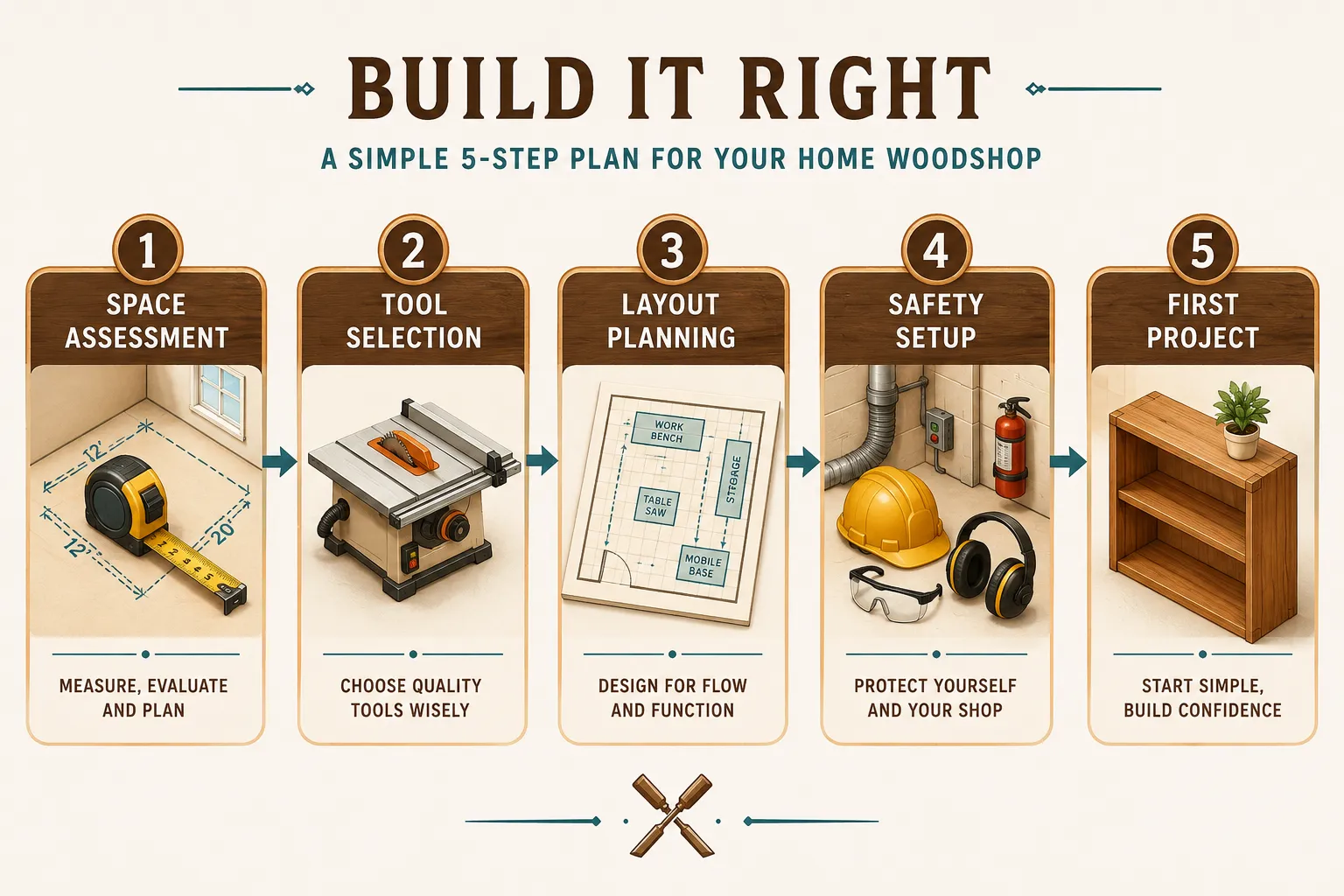
How Much Space Do You Need for a Home Woodshop?
A functional home woodshop can fit in as little as 100 to 150 square feet, which is roughly the footprint of a single-car garage or a large garden shed. More space is always better, but limited space should not stop anyone from starting.
The real question isn’t total square footage, it’s how the space is used. A 10×20-foot single-car garage can hold a workbench, a few stationary tools, and adequate storage if the layout is planned carefully. A two-car garage (roughly 20×20 feet) gives comfortable room for a table saw, assembly area, and dedicated storage.
Space guidelines by shop type:
- Apartment or small room (under 100 sq ft): Hand tools and a portable workbench only; power tools are very limited
- Single-car garage (150-200 sq ft): Workbench, portable power tools, and one or two compact stationary tools
- Two-car garage (400 sq ft): Full hobbyist setup with table saw, bandsaw, and dedicated assembly space
- Dedicated shed or outbuilding: Highly customizable; see the Best Shed Size For Suburban Lots: Complete Comparison Guide for sizing guidance
One often-overlooked factor: material handling. Long boards need room to feed through a table saw safely, which means clear space on both the infeed and outfeed sides, typically 8 feet in each direction. Plan for that before placing any stationary tool.
Home Woodshop Setup Cost for Beginners
A beginner can build a genuinely useful home woodshop for between $500 and $1,500. A more capable hobbyist setup with stationary power tools runs $2,000 to $5,000. Professional-grade shops can exceed $10,000, but that level is not necessary for most home woodworkers.
The biggest cost variable is whether to start with hand tools, portable power tools, or stationary machines. Hand tools have a lower entry cost and teach fundamentals more effectively. Power tools speed up production but cost more upfront.
| Setup Level | Estimated Cost (2026) | What’s Included |
|---|---|---|
| Hand Tool Starter | $300, $600 | Chisels, hand saws, planes, marking tools, workbench |
| Power Tool Beginner | $800, $1,500 | Drill, circular saw, jigsaw, random orbit sander, clamps |
| Hobbyist Shop | $2,000, $4,000 | Table saw, bandsaw, router, dust collector, full hand tool set |
| Advanced Home Shop | $5,000, $10,000+ | Jointer, planer, drill press, full stationary machine lineup |
Buying used tools is one of the smartest moves a beginner can make. Older American-made tools, particularly hand planes and chisels, often outperform new budget imports. Check estate sales, Facebook Marketplace, and Craigslist before buying new.
Do You Need a Table Saw, or Can You Start With Hand Tools?
No, a table saw is not required to start woodworking. Many accomplished woodworkers build furniture and cabinetry using only hand tools or a circular saw with a straightedge guide. A table saw is a productivity tool, not a beginner prerequisite.
That said, a table saw does make ripping lumber and cutting sheet goods faster and more accurate once skills develop. The decision comes down to budget, space, and project goals.
- Choose hand tools if: budget is under $600, space is tight, projects are small, or learning traditional joinery is a priority
- Choose a circular saw first if: projects involve sheet goods (plywood, MDF), budget allows $100,$200 for a decent saw, and a straightedge guide is added
- Add a table saw when: projects consistently require ripping solid lumber to width, and the budget and space support it
For a thorough look at what tools actually do what, the guide to Various Tools Used For Woodworking: The Complete Beginner’s Guide breaks down every category clearly.
Woodshop Layout Ideas for a Garage
A good garage woodshop layout puts the workbench against a wall with natural light, keeps the table saw (if present) centered with clearance on all four sides, and groups storage along the perimeter. The goal is a triangle of efficiency: material storage, cutting area, and assembly area should be close but not crowded.
Practical layout principles:
- Place the workbench near a window or under direct lighting, good visibility prevents mistakes
- Keep the table saw at least 8 feet from any wall on the infeed and outfeed sides
- Store lumber vertically or on wall-mounted horizontal racks to save floor space
- Group finishing (sanding, staining) away from cutting to reduce dust contamination
- Leave a clear path to the exit, never block the door with equipment
For those considering a dedicated outbuilding rather than a garage conversion, The Complete Guide To Building Your Own Backyard Shed covers the full planning and construction process.
How to Set Up Dust Collection in a Small Shop
Dust collection in a small home woodshop starts with a shop vacuum connected directly to each power tool, then graduates to a dedicated dust collector as the tool count grows. Even a single-stage dust collector (around $200,$400) dramatically reduces airborne particles compared to no collection at all.
Wood dust, especially from hardwoods like oak, walnut, and cherry, is a known respiratory hazard. The U.S. National Institute for Occupational Safety and Health (NIOSH) classifies wood dust as a potential carcinogen with prolonged exposure.
Dust collection setup by shop size:
- Small shop (hand tools + 1-2 power tools): Shop vac with a dust separator (cyclone lid) is sufficient
- Mid-size shop (3-5 power tools): Single-stage dust collector (1.5-2 HP) with 4-inch flex hose drops
- Larger shop: Two-stage dust collector plus a ceiling-mounted ambient air filtration unit
Always wear a properly fitted N95 respirator or better when sanding or cutting, regardless of how good the dust collection system is. Dust collectors capture large chips; fine particles still become airborne.
Woodshop Ventilation and Air Quality Setup
Good ventilation in a home woodshop means fresh air in, stale dust-laden air out. At minimum, this requires a window or door that can be opened, plus a box fan positioned to exhaust air outward. A proper setup adds an ambient air filtration unit hanging from the ceiling.
For finishing work, applying stains, lacquers, or oil finishes, ventilation becomes a safety issue, not just a comfort one. Many finishing products produce flammable vapors. A well-ventilated shop with no open flames or sparks is essential during and after finishing.
Key ventilation steps:
- Install a box fan in a window or wall opening to exhaust air outside
- Create cross-ventilation by opening a second window or door on the opposite side
- Hang a ceiling-mounted ambient air filtration unit rated for the shop’s cubic footage
- Use a respirator rated for organic vapors (not just dust) when applying finishes
What Safety Equipment Is Essential in a Woodshop?
Safety gear is non-negotiable in any woodshop, regardless of skill level. The three absolute essentials are eye protection, hearing protection, and respiratory protection. Everything else builds from there.
Core safety equipment checklist:
- Safety glasses or face shield (ANSI Z87.1 rated)
- Hearing protection: earplugs (NRR 29+) or earmuffs (NRR 25+) for all power tool use
- N95 respirator for dust; organic vapor respirator for finishing
- Push sticks and featherboards for table saw and router table use
- A fire extinguisher rated for Class A and B fires, mounted near the exit
- First aid kit with wound closure strips (woodworking cuts happen)
- Proper footwear: closed-toe shoes, ideally with a steel toe
Never wear loose clothing, dangling jewelry, or gloves near spinning blades or bits. Keep hair tied back. These are not suggestions; they are the habits that prevent serious injuries.
Can You Have a Woodshop in an Apartment or Small Space?
Yes, a functional woodshop can exist in an apartment or very small space, but it requires focusing entirely on hand tools and accepting real limitations around noise, dust, and material storage. Power tools in an apartment are generally impractical due to noise, vibration, and dust.
A hand-tool-only setup, a quality bench vise clamped to a table, chisels, hand saws, planes, and marking tools, can produce impressive work in a surprisingly small footprint. Many traditional Japanese and European woodworking styles were developed in small urban workshops.
Practical tips for small-space woodworking:
- Use a portable workbench (like a Workmate-style folding bench) that stores flat
- Work with pre-dimensioned lumber to eliminate the need for ripping and planing
- Sand outside or in a hallway with a shop vac attached directly to the sander
- Store tools in a rolling cabinet that doubles as a workbench
For those interested in eventually moving to a dedicated space, exploring woodworking online training is a great way to build skills before the bigger shop comes together.
How to Organize Tools in a Home Woodshop
The best tool organization system is the one that gets used consistently. For most home woodshops, a combination of a pegboard wall for frequently used hand tools, a French cleat system for flexibility, and a rolling cabinet for power tools and accessories works well.
Organizational principles that actually hold up:
- Store tools at the point of use; the tools used at the workbench live near the workbench
- Use outlines or silhouettes on pegboards so missing tools are immediately obvious
- Keep blades, bits, and router profiles in labeled cases or drawers, not loose
- Mount a power strip at workbench height to avoid cord clutter on the floor
- Label every drawer and bin, it seems obvious, but most beginners skip this step
How to Deal With Noise in a Home Woodshop
Noise from a home woodshop is a real concern for neighbors and family members. A table saw or router can produce 100-110 decibels, which is loud enough to cause hearing damage and neighbor complaints. Managing noise requires a combination of timing, physical barriers, and equipment choices.
Practical noise reduction strategies:
- Set shop hours during daytime on weekdays or mid-morning on weekends, avoid early mornings and evenings
- Add mass to walls: a layer of drywall over existing garage walls significantly reduces transmission
- Use rubber anti-vibration mats under stationary machines to reduce structure-borne noise
- Choose hand tools for tasks where power tools aren’t strictly necessary
- A solid-core door between the shop and living space makes a noticeable difference
Communicating with neighbors before starting a project is also worth doing. Most people are far more tolerant of noise when they know it’s temporary and when they’ve been asked rather than surprised.
Common Mistakes People Make Setting Up Home Workshops
The most common mistake beginners make is buying tools before understanding the workflow. The second most common is underestimating the importance of dust collection and lighting. Both are fixable, but they cost time and money to redo.
Mistakes to avoid from the start:
- Buying too many tools upfront: Start with what the first three projects actually require, then add tools as specific needs arise
- Skipping the workbench: A proper work surface is more valuable than most power tools; don’t skip it
- Poor lighting: Overhead fluorescent or LED shop lights are cheap and essential, shadows cause mistakes
- No dedicated electrical circuit: Running multiple power tools on a single household circuit trips breakers and is a fire risk; consider adding a 20-amp dedicated circuit
- Ignoring fire hazards: Oily rags (from linseed or tung oil finishes) can spontaneously combust, store them in a sealed metal container with water, or spread them flat outdoors to dry
Understanding wood behavior also matters early. Knowing how different species react to cutting and finishing prevents a lot of frustration. The guide to Wood Types and Material Selection: Choose the Right Lumber for Any Project is worth reading before the first lumber purchase.
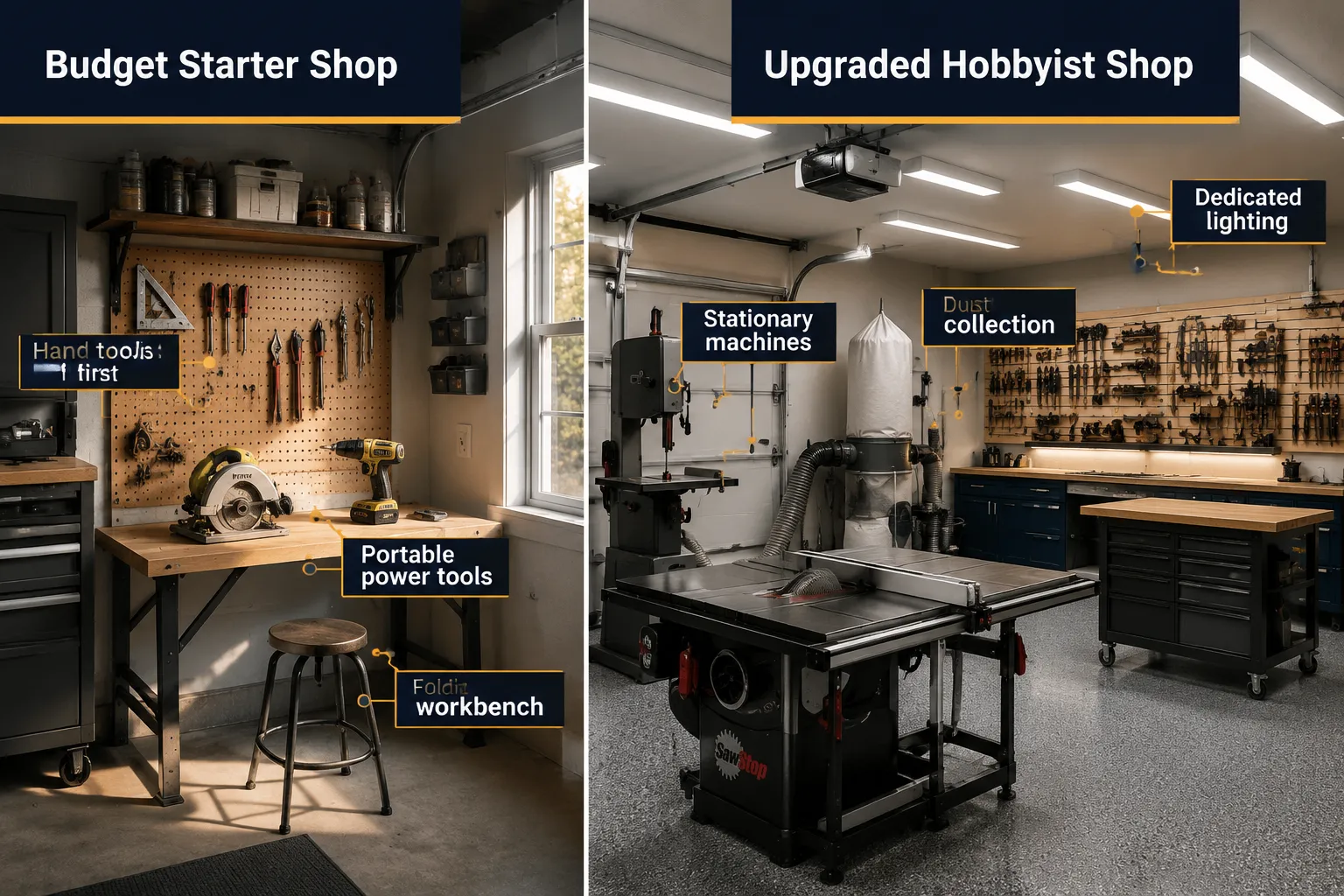
Budget Woodshop Setup vs. Professional-Grade Tools
A budget woodshop setup uses mid-range or entry-level tools from brands like Ryobi, WEN, or Ridgid. A professional-grade setup uses tools from brands like Festool, SawStop, Powermatic, or Lie-Nielsen. For a hobbyist, the budget setup is almost always the right starting point.
The performance gap between budget and professional tools is real but rarely matters at the beginner level. Technique and sharp edges matter far more than brand name. A $40 chisel sharpened properly outperforms a $200 chisel used dull.
When to invest in better tools:
- When a specific tool is used daily and the limitations are genuinely slowing down work
- When safety is a concern (a SawStop table saw, for example, has a blade-braking system worth the premium for some woodworkers)
- When the quality of the finished product is being limited by the tool, not the skill
Start with the budget option, learn it thoroughly, and upgrade selectively. That approach builds better woodworkers than buying professional gear from day one.
Frequently Asked Questions
What’s the minimum space I need to start woodworking at home?
A 10×10-foot space is workable for hand tools and a compact workbench. For power tools, 150 square feet or more gives enough room to work safely and move material around.
How much should a beginner spend on their first woodshop setup?
A practical beginner setup costs between $500 and $1,500 depending on whether the focus is hand tools or power tools. Buying quality used tools can cut that figure significantly.
Do I need a dust collector before I start?
A shop vacuum with a dust separator is sufficient for a beginner. A dedicated dust collector becomes important once three or more stationary power tools are in use. Either way, always wear a dust mask.
Can I use a regular household vacuum for wood dust?
No. Standard household vacuums are not designed for fine wood dust and can clog, overheat, or blow fine particles back into the air. Use a shop vacuum rated for fine dust, or add a cyclone separator.
What’s the best first project for a new home woodshop?
A simple box or small shelf is ideal, it uses basic measuring, cutting, and assembly skills without requiring complex joinery. Check out the Step-by-Step Guide to Woodworking Projects for Beginners for well-matched starting points.
Is a woodshop in a garage bad for the car?
Sawdust can settle on a car’s paint and get into engine air intakes. If the garage is shared, use a dust curtain between the work area and the parking area, and vacuum the space after each session.
How do I learn to read woodworking plans as a beginner?
Start with the How to Read & Use Woodworking Plans: Beginner’s Complete Guide, it covers symbols, dimensions, cut lists, and how to translate a plan into actual cuts.
What electrical setup does a home woodshop need?
At minimum, two 20-amp dedicated circuits, one for the table saw and one for other tools. A dust collector and air compressor should also have their own circuits. Consult a licensed electrician before adding circuits.
Are cordless tools good enough for a home woodshop?
For most beginner and hobbyist tasks, yes. Modern 20V and 40V brushless cordless tools from major brands deliver performance close to corded equivalents for drilling, driving, and cutting. Corded tools still have the edge for sustained heavy use.
What’s the single most important safety habit in a woodshop?
Never bypass or remove blade guards, and always use push sticks when feeding material past a spinning blade. Most serious woodshop injuries happen during brief moments of inattention with unguarded tools.
Conclusion
Setting up a home woodshop doesn’t require a massive budget or a dedicated building. It requires clear thinking about space, a disciplined approach to tool selection, and a genuine commitment to safety from the very first day. The best woodshops aren’t the ones with the most tools, they’re the ones that are organized, safe, and actually used.
Start small. Build one project. Identify what the shop actually needs, then add to it. That cycle of project-driven growth produces better woodworkers and better shops than any single shopping spree ever will.
Actionable next steps:
- Measure the available space and sketch a rough layout before buying anything
- Decide on the first two or three projects to determine which tools are actually needed
- Buy safety gear first, glasses, hearing protection, and a dust mask, before any power tool
- Set up a workbench or solid work surface as the first major investment
- Start with one project, complete it, and let the experience guide the next tool purchase
Products, Tools, and Resources
Building a home woodshop is a process, and having the right resources alongside the right tools makes a real difference. A few recommendations worth considering:
For tool selection, The Various Tools Used For Woodworking: The Complete Beginner’s Guide is one of the most practical references available for understanding what each tool does and when to buy it.
For project ideas: Once the shop is set up, Best Popular Woodworking Products For Home Improvement offers a solid selection of project types that are well-suited to a home shop environment.
For skill building: If formal instruction appeals, Woodworking Online Training: The Complete Beginner’s Guide covers how to find and evaluate online courses that actually teach the fundamentals well.
Recommended starter tools (2026):
- Workbench: A solid hardwood bench with a front vise, or a quality portable option like the Sjobergs Smart Bench
- Circular saw: DeWalt DCS570 (cordless) or Skilsaw SPT67WL-01 (corded) are both well-regarded beginner choices
- Cordless drill: DeWalt 20V MAX or Milwaukee M18, either platform is reliable and widely supported
- Dust collection: Oneida Dust Deputy cyclone separator paired with a quality shop vac is a strong budget-conscious starting point
- Safety: 3M Peltor earmuffs, DeWalt safety glasses, and a 3M 8511 N95 respirator cover the basics well
The shop will evolve. Every experienced woodworker looks back at their first setup and laughs a little. That’s part of the process. What matters is getting started with a safe, functional space and letting the work teach the rest.