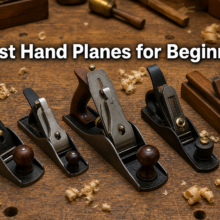
Best Hand Tools for Fine Furniture Detail Work

A sharp chisel in a skilled hand can accomplish what no router bit ever will, a perfectly fitted dovetail joint, a crisp mortise wall, a carved chamfer that catches the light just right. That’s the quiet truth experienced furniture makers understand, and it’s why the best hand tools for fine furniture detail work remain essential even in workshops full of power equipment. Whether you’re just starting out or deepening your craft as a hobbyist, the right hand tools don’t just make detail work possible, they make it satisfying.
This guide covers every tool category you need, how to choose quality without overspending, and the mistakes that trip up beginners before they find their rhythm.
Key Takeaways
- The core hand tool kit for furniture detail work includes bench chisels, hand planes, marking tools, card scrapers, and rasps or files.

- Sharp tools are safer and more effective than dull ones, sharpening skill matters as much as the tools themselves.
- Mid-range tools from reputable brands outperform cheap sets and are a practical starting point for most beginners.
- Power tools handle bulk material removal; hand tools handle precision, fit, and surface quality.
- Proper maintenance, cleaning, honing, and light oiling, extends tool life significantly.
- Inlay and marquetry work requires specialized tools: marking knives, router planes, and fine chisels.
- Buying a few quality tools is better than buying a large set of poor-quality ones.
- Furniture restoration benefits from the same core kit, with the addition of scratch stocks and specialty scrapers.
Find this useful? Add us as a preferred source on Google and more of what we publish will show up in your results.
What Are the Best Hand Tools for Fine Furniture Detail Work?
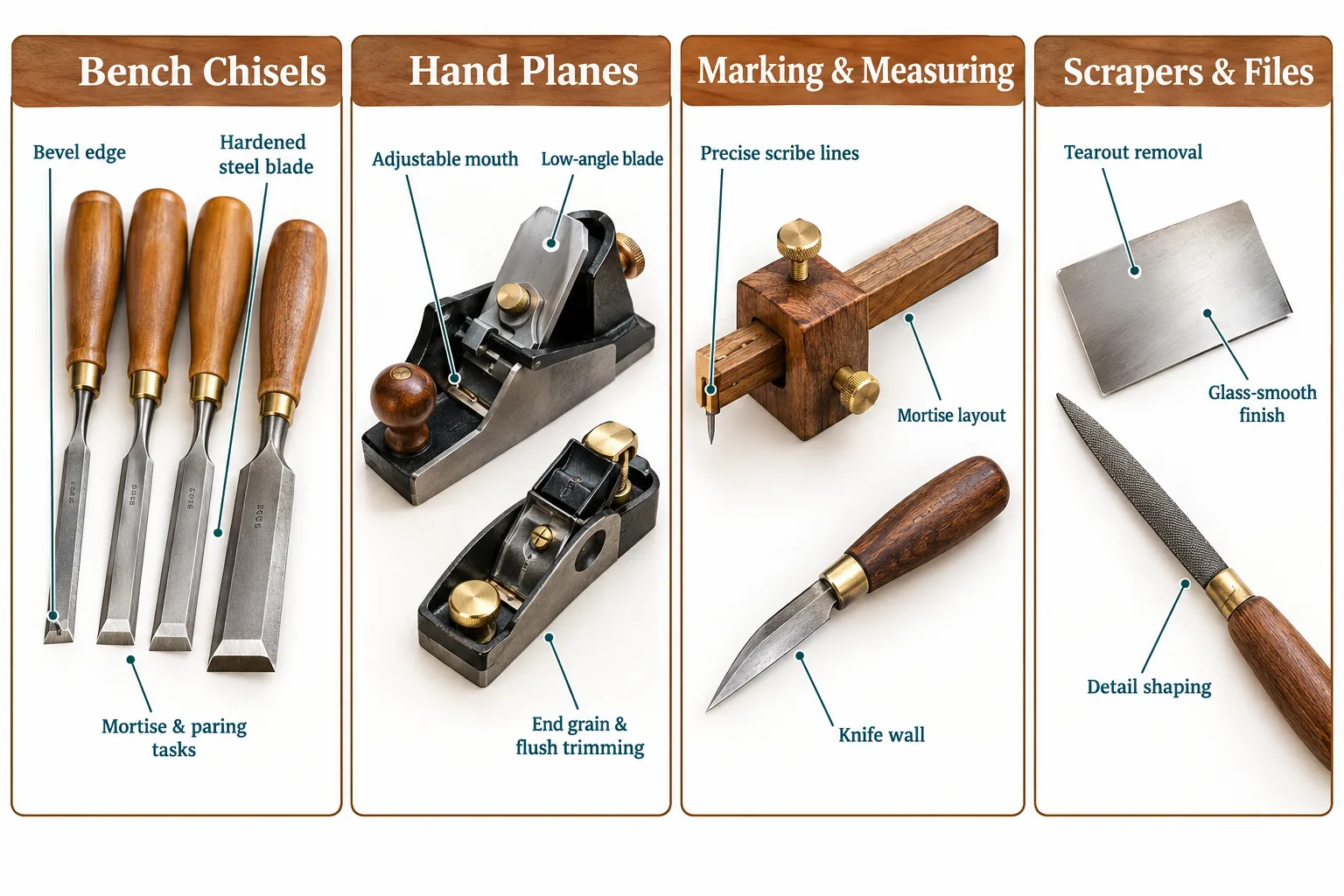
The best hand tools for fine furniture detail work fall into five core categories: chisels, hand planes, marking and measuring tools, scrapers, and shaping tools like rasps and files. Together, these tools handle everything from cutting precise joinery to achieving a glass-smooth surface finish.
For beginners, a focused starter kit might include:
- A set of 4-6 bevel-edge bench chisels (6mm, 12mm, 19mm, 25mm)
- A block plane and a No. 4 or No. 4½ smoothing plane
- A marking gauge and a quality marking knife
- A card scraper set (flat and curved profiles)
- A half-round rasp and a set of needle files
That’s a manageable, affordable foundation. You can add specialty tools, shoulder planes, router planes, carving gouges, as specific projects demand them.
For a broader look at what tools belong in a beginner’s workshop, the Beginner Woodworking Tools and Equipment: What You Need and Why guide is a solid reference point.
Hand Tools vs. Power Tools for Furniture Detail Work
Hand tools and power tools serve different purposes, they’re not competitors. Power tools remove material quickly and efficiently; hand tools refine, fit, and finish with a level of control that machines simply can’t match.
Here’s a practical way to think about it:
- A router cuts a rabbet fast. A shoulder plane fits it perfectly.
- A bandsaw rough-cuts a curve. A spokeshave or rasp refines it.
- A thickness planer flattens a board. A hand plane brings it to final dimension with no tearout.
For detail work specifically, fitting joints, trimming proud tenons, cleaning up inside corners, creating decorative chamfers, hand tools are the right choice. They give you feedback through your hands, allow micro-adjustments, and work quietly without setup time.
Power tools are still valuable for furniture making. But for the fine detail that separates a good piece from a great one, hand tools do the work that matters. See the Essential Equipment Used in Woodworking for Perfect Furniture overview for how both categories fit together.
Best Chisels for Fine Furniture Work
Bevel-edge bench chisels are the single most important hand tool for furniture detail work. They cut mortises, pare joints to a precise fit, clean up dovetail waste, and handle dozens of other tasks that require edge control.
What to look for in a furniture chisel:
- Steel quality: High-carbon steel (O1) or A2 tool steel holds an edge longer. Japanese chisels use harder steel (often 60-65 HRC) that takes a finer edge but can be more brittle.
- Handle comfort: Oval or octagonal handles resist rolling off the bench. Wood handles (ash, hornbeam, or boxwood) absorb mallet blows better than plastic.
- Back flatness: The flat back must be truly flat, this is what registers against your layout lines. Check it on a flat stone before trusting a new chisel.
Recommended starting set: A set of four to six bevel-edge chisels in common widths (6mm, 12mm, 19mm, 25mm) covers the majority of furniture joinery tasks.
Common mistake: Buying a large set of cheap chisels. Four quality chisels from a brand like Narex, Two Cherries, or Ashley Iles will outperform a 20-piece budget set every time.
For mortise work and heavier chopping, a dedicated mortise chisel (with thicker blade and stout handle) is worth adding once you’re comfortable with basic bench chisels.
Hand Plane Types for Detailed Wood Finishing
Hand planes are essential for fine furniture work, and different plane types handle different tasks. The three most useful planes for detail work are the block plane, the smoothing plane, and the shoulder plane.
- Block plane (low-angle): Trims end grain, fits joints, eases sharp edges. The most versatile plane for quick detail tasks. A low-angle block plane (12° bed angle) handles difficult grain better than standard versions.
- No. 4 smoothing plane: Brings surfaces to final flatness and smoothness before finishing. A well-tuned No. 4 leaves a surface that needs no sanding.
- Shoulder plane: Trims tenon shoulders and rabbets to a precise fit. Indispensable for joinery that must be square and gap-free.
The Best Hand Planes for Beginners: Top Picks and Setup Tips guide covers setup and selection in more detail.
Router plane: Often overlooked, the router plane is one of the most useful tools for furniture detail work. It cuts dadoes, housings, and inlay recesses to a consistent, controllable depth, something that’s genuinely difficult to achieve with power tools alone.
How to Sharpen Hand Tools for Precision Work
Sharp tools are the foundation of fine furniture detail work. A dull chisel or plane iron tears wood fibers instead of cutting them, produces ragged edges, and requires far more force, which reduces control and increases the risk of mistakes.
A basic sharpening system for beginners:
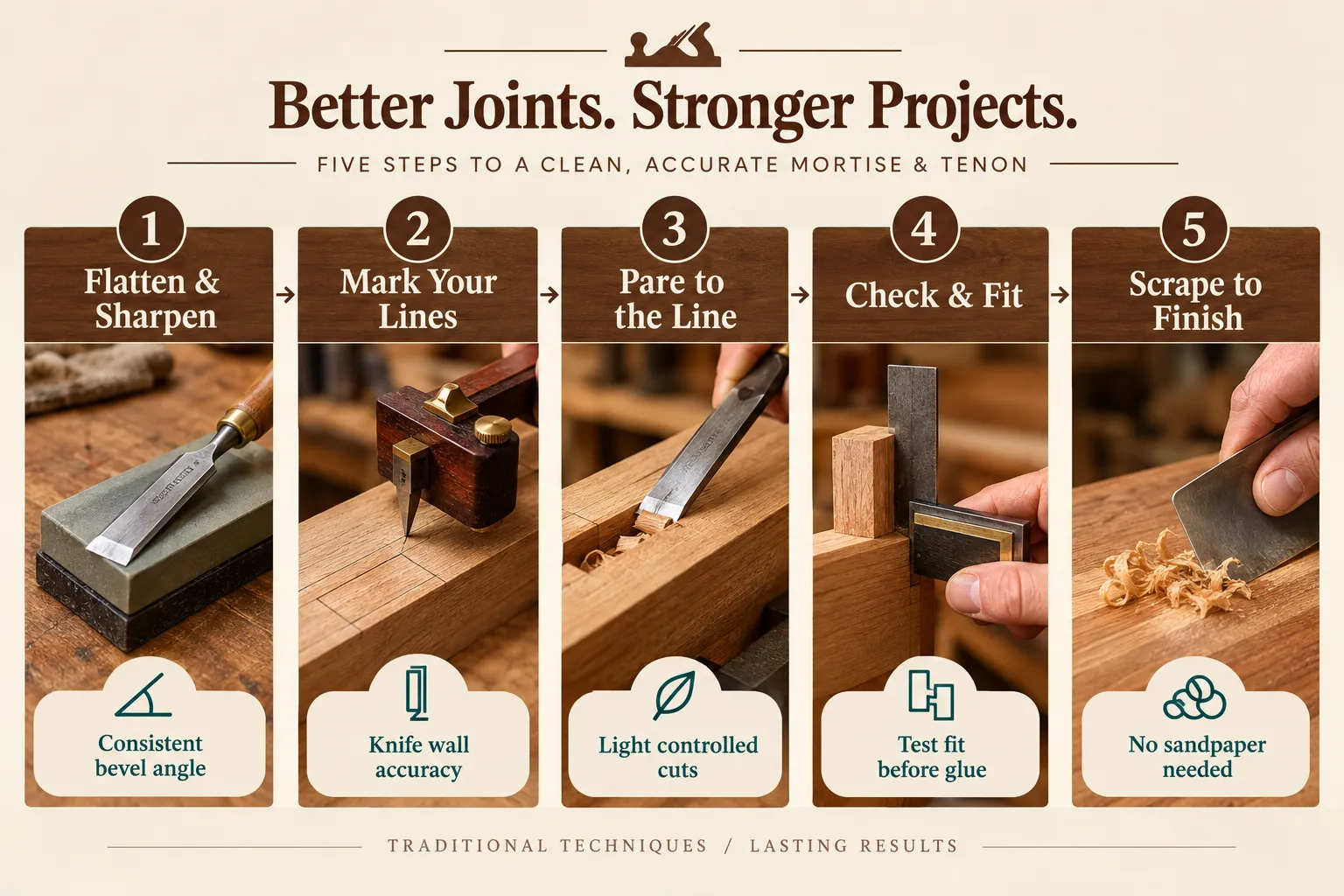
- Flatten the back of a new chisel or plane iron on a coarse stone (120-220 grit) until the entire back is polished near the edge.
- Establish the bevel at the correct angle (25° for chisels, 25-30° for plane irons) using a honing guide if needed.
- Progress through grits: 220 → 1000 → 4000 → 8000 (or equivalent water stones, oil stones, or diamond plates).
- Strop on leather with honing compound to remove the wire edge and polish the bevel.
The goal is a mirror-polished bevel and a flat, polished back that meet at a razor-sharp apex. Test sharpness by slicing end grain, a sharp tool should pare cleanly with almost no pressure.
Sharpening frequency: For active furniture work, touch up on a strop every 15-20 minutes of use. Full re-honing every hour or two of cutting keeps tools performing at their best.
How Much Should You Spend on Quality Hand Tools for Furniture?
Most beginners can build a capable hand tool kit for fine furniture detail work for roughly $200,$400 USD. That’s enough to buy mid-range quality tools that will last years and perform well on real projects.
Here’s a practical budget breakdown (approximate ranges, not exact prices):
| Tool | Budget Range | Recommended Starting Point |
|---|---|---|
| Bench chisel set (4-6 pcs) | $40,$120 | Narex, Two Cherries |
| Block plane | $35,$90 | Stanley, WoodRiver |
| No. 4 smoothing plane | $50,$150 | WoodRiver, Quangsheng |
| Marking gauge | $20,$60 | Crown, Veritas |
| Card scrapers (set) | $10,$25 | Bahco, Veritas |
| Sharpening stones (set) | $30,$80 | King, Shapton |
Do expensive hand tools perform better? Premium tools from Lie-Nielsen or Veritas are genuinely excellent, better fit, better steel, better out-of-the-box performance. But mid-range tools, properly sharpened and tuned, produce results that are nearly identical for most furniture work. Start mid-range, learn to sharpen well, and upgrade specific tools as your skills grow.
For a realistic look at overall woodworking startup costs, Is Woodworking Expensive to Start? Real Cost Breakdown gives an honest perspective.
Hand Tools for Inlay and Marquetry Work
Inlay and marquetry require the most precise hand tools in furniture making. Small errors in layout or cutting translate directly into visible gaps, so tool quality and sharpness matter more here than anywhere else.
Essential tools for inlay work:
- Marking knife with a thin, stiff blade: Scribes layout lines that are accurate to fractions of a millimeter. A Japanese-style kiridashi or a dedicated marking knife with a single-bevel blade is ideal.
- Router plane: Cuts inlay recesses to a consistent, controllable depth. A small router plane (with a narrow iron) is the right tool for most inlay work.
- Narrow bench chisels and paring chisels: 3mm and 6mm chisels clean corners and pare to the scribed line.
- Veneer saw or jeweler’s saw: Cuts marquetry pieces cleanly without splintering thin veneer.
- Scratch stock: A shop-made tool that cuts custom molding profiles and small grooves for stringing and banding.
Key principle: In inlay work, cut to a knife wall, a scribed line that the chisel registers against, rather than to a pencil line. This produces clean, gap-free edges that fit tightly without filler.
Hand Tools for Curved and Intricate Details
Curved and shaped details require a different set of tools than flat joinery work. Spokeshaves, rasps, carving gouges, and files are the primary tools for shaping curves, profiles, and decorative elements.
- Spokeshave: Shapes convex and concave curves on chair legs, curved rails, and shaped edges. A flat-sole spokeshave handles convex curves; a round-sole version handles concave ones.
- Cabinet rasp (half-round): Removes material quickly on curved surfaces and shapes profiles. A quality hand-cut rasp (Liogier, Auriou) cuts faster and smoother than machine-cut versions.
- Carving gouges: Cut coves, flutes, and decorative relief details. A basic set of 3-5 gouges (sweep numbers 3, 5, and 7 in 6mm and 12mm) covers most furniture carving tasks.
- Needle files and riffler rasps: Refine small curved details and inside corners that larger tools can’t reach.
Choosing the right wood matters too. Tight-grained hardwoods like cherry, walnut, and maple respond beautifully to hand tool shaping. For help selecting the right material for your project, see Best Wood for Furniture Making: A Comparison Guide.
What Hand Tools Do Professional Furniture Makers Use?
Professional furniture makers use many of the same tools as beginners, they just have more of them, use them more skillfully, and keep them sharper. The core kit remains chisels, planes, marking tools, and scrapers.
Beyond the basics, professionals typically add:
- Shoulder plane and bullnose plane for precise joinery fitting
- Router plane for consistent depth cuts in dadoes, housings, and inlay
- Combination square and sliding bevel for layout accuracy
- Marking gauge and mortise gauge (separate tools for different tasks)
- Cabinet scraper and scraper plane for final surface preparation
- Mallet for driving chisels, a quality wooden or lignum vitae mallet gives better feedback than a rubber mallet
The Best Woodworking Mallets 2026: Top Buyer’s Guide for Beginners and Pros covers mallet selection in detail.
What separates professional work isn’t a secret collection of exotic tools, it’s consistent sharpness, careful layout, and the patience to work to the line rather than approximate it.
Best Hand Tools for Someone Just Starting Woodworking
For a complete beginner, the best hand tools for fine furniture detail work are the ones that teach fundamental skills while producing real results. Start narrow and build outward.
A beginner’s starter kit (in priority order):
- A set of 4 bevel-edge bench chisels (6mm, 12mm, 19mm, 25mm)
- A low-angle block plane
- A marking gauge (wheel-type is easiest to use accurately)
- A quality marking knife
- A card scraper (flat, rectangular)
- A sharpening system (combination stone or two-stone setup)
This kit handles joinery layout, fitting, and surface finishing. Add a No. 4 smoothing plane and a shoulder plane once you’re comfortable with the basics.
The Step-by-Step Guide to Woodworking Projects for Beginners is a good companion resource for putting these tools to work on real projects right away.
Avoid: Buying comprehensive tool sets before you know what you need. Most of the tools in a large set will sit unused while you reach for the same four or five tools on every project.
Common Mistakes When Doing Detailed Furniture Work by Hand
Even with quality tools, a few consistent mistakes hold beginners back from clean, professional-looking results.
The most common ones:
- Working with dull tools. This is the single biggest mistake. Dull chisels and planes require more force, produce torn grain, and make accurate work nearly impossible. Sharpen before every session.
- Skipping the layout step. Rushing to cut without scribing accurate layout lines leads to joints that don’t fit. Invest time in marking, it pays back every time.
- Cutting to a pencil line instead of a knife wall. Pencil lines are wide and imprecise. A scribed knife line gives the chisel a wall to register against, producing cleaner, tighter results.
- Using the wrong chisel angle. Paring (low-angle, light pressure) and chopping (vertical, mallet-driven) are different techniques. Using a paring grip for chopping, or vice versa, produces poor results and can damage the tool.
- Ignoring grain direction. Planing or paring against the grain tears the surface. Always work with the grain, or at a slight diagonal, for clean cuts.
- Skipping the test fit. Always dry-fit joints before applying glue. Small adjustments are easy before assembly; impossible after.
Hand Tool Maintenance for Fine Furniture Projects
Consistent maintenance keeps hand tools performing at their best and extends their working life significantly. The routine is simple and takes only a few minutes per session.
After each use:
- Wipe blades and metal surfaces with a clean, dry cloth to remove sawdust and moisture.
- Apply a very light coat of camellia oil, paste wax, or tool oil to prevent rust on bare metal surfaces.
- Store chisels with edge guards or in a roll to protect cutting edges.
Regular maintenance tasks:
- Hone chisels and plane irons before each use. A few passes on a fine stone and strop takes under two minutes and makes a real difference.
- Check and adjust plane mouth settings if shavings are tearing or the plane is chattering.
- Inspect handles for cracks or looseness. A chisel handle that’s loose on the blade affects accuracy and can be dangerous.
- Flatten sharpening stones regularly. A dished stone produces a convex bevel, the opposite of what you want.
For a broader look at how all your tools fit into an organized, efficient workspace, the Various Tools Used for Woodworking: The Complete Beginner’s Guide covers setup and organization well.
Best Hand Tools for Furniture Restoration and Repair
Furniture restoration uses the same core hand tool kit as new furniture making, with a few additions suited to working on existing pieces. The goal is precision repair without damaging surrounding surfaces.
Core restoration tools:
- Narrow chisels (3mm, 6mm): For cleaning old glue from joints, removing damaged wood, and fitting replacement pieces in tight spaces.
- Card scrapers and cabinet scrapers: Remove old finish, level patches, and clean up surfaces without aggressive sanding that can alter profiles.
- Scratch stock: A simple shop-made tool that reproduces period molding profiles for patching damaged sections.
- Router plane: Levels inlay repairs and patch pieces to flush with the surrounding surface.
- Shoulder plane: Trims replacement tenons and fits new joints to existing mortises.
Key difference from new work: In restoration, preserving the original surface and patina is often as important as the structural repair. Hand tools allow the controlled, localized cuts that power tools can’t manage safely near fragile original surfaces.
Choosing the right wood species for repairs, matching grain, color, and hardness, is equally important. The Best Hardwoods for Beginners to Work With guide helps with species selection.
Frequently Asked Questions
What is the most important hand tool for furniture detail work?
A sharp bench chisel is the single most important hand tool for furniture detail work. It handles joinery cutting, fitting, and cleaning up inside corners, tasks that come up on virtually every furniture project.
Can I do fine furniture work with just hand tools?
Yes. Many professional furniture makers work almost entirely with hand tools. A core kit of chisels, planes, marking tools, and scrapers is sufficient for building high-quality furniture from scratch.
How do I know when my chisels need sharpening?
A sharp chisel pares end grain cleanly with minimal pressure and leaves a smooth, shiny surface. When you notice tearing, rough surfaces, or the need to push harder than usual, it’s time to sharpen.
Are Japanese chisels better than Western chisels?
Neither is objectively better, they’re different. Japanese chisels use harder steel that takes a finer edge but requires more care. Western chisels are more forgiving and easier to sharpen for beginners. Both produce excellent results when properly maintained.
What’s the difference between a card scraper and sandpaper?
A card scraper cuts wood fibers cleanly, leaving a smooth surface without the scratches that sandpaper leaves. For fine furniture work, a well-tuned scraper produces a better surface than sandpaper and doesn’t clog the grain with abrasive particles.
Do I need a mallet, or can I use a hammer?
A woodworking mallet is strongly preferred over a hammer for driving chisels. A mallet’s larger striking face gives better control, and a wooden or rawhide mallet won’t damage chisel handles the way a metal hammer can.
How long does it take to learn to use hand tools well?
Basic competency with chisels and planes develops within a few projects, typically a few weeks of regular practice. Mastery takes years, but you can produce good results on real furniture projects quite early in the learning curve.
Is it worth buying vintage hand tools?
Often, yes. Vintage Stanley planes and older chisels can be excellent tools at low cost, provided they’re in good condition and properly tuned. The main requirement is patience, vintage tools almost always need flattening, sharpening, and sometimes light restoration before use.
What hand tools do I need for dovetail joints?
Dovetail joinery requires a dovetail saw, a set of bench chisels, a marking gauge, a marking knife, and a sliding bevel or dovetail marker. A sharp coping saw for removing waste is also helpful. See the Dovetail vs Box Joints: Strength, Use and Comparison Guide for more on joinery choices.
Can I use budget hand tools for fine furniture work?
Budget tools can work, but they require more preparation, flattening backs, tuning blades, and replacing handles. A small set of mid-range quality tools is a better investment than a large set of cheap ones.
Conclusion
The best hand tools for fine furniture detail work aren’t complicated to identify, chisels, planes, marking tools, scrapers, and shaping tools form a kit that covers nearly every detail task a furniture project demands. What matters more than the brand on the handle is the edge on the blade and the skill of the person holding it.
Start with a focused set of quality mid-range tools, learn to sharpen them properly, and build your collection as specific projects call for it. That approach produces better results faster than buying everything at once and feeling overwhelmed.
Fine furniture detail work is where woodworking becomes genuinely satisfying. The quiet sound of a sharp plane taking a thin shaving, a joint that fits without a gap, a surface so smooth it reflects light, those moments come from the right tools, properly maintained, used with patience and intention.
Actionable next steps:
- Start with four bench chisels, a block plane, a marking gauge, and a sharpening system.
- Practice sharpening before you practice cutting, it’s the skill that makes every other skill possible.
- Work through a beginner project that uses basic joinery to put your tools to real use.
- Add specialty tools (shoulder plane, router plane, spokeshave) as your projects demand them.
For more guidance on building your skills and your shop, explore the Beginner Woodworking Guide: Tools, Projects and Tips to Start Today, a comprehensive starting point for anyone serious about learning the craft.