How Woodworking Differs from Carpentry
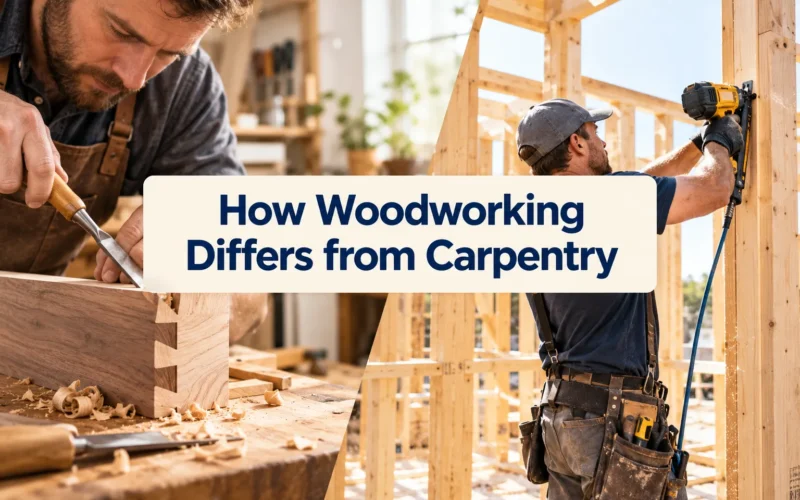
Nearly every trade school brochure and hobby forum uses “woodworker” and “carpenter” as if they’re interchangeable. They aren’t. Understanding how woodworking differs from carpentry matters the moment you decide whether to build a jewelry box or frame a garage, because the tools, the training, and even the mindset split in different directions from there.
Woodworking is the broad craft of shaping wood into furniture, art, and small functional objects, usually with an emphasis on joinery, finish, and detail. Carpentry is a construction trade focused on building and repairing structures: framing, trim, doors, decks, and the bones of a house. Woodworking is often done in a shop with hand tools and precision machinery, while carpentry happens mostly on job sites with power tools built for speed and structural strength. One is a craft you can grow into as a hobby; the other is typically a licensed, paid trade with code requirements attached.
Find this useful? Add us as a preferred source on Google and more of what we publish will show up in your results.
Key Takeaways
- Woodworking centers on furniture, cabinetry, and decorative pieces; carpentry centers on structural building work like framing and trim.
- Carpentry is a recognized construction trade, often requiring licensing or apprenticeship hours in many U.S. states; woodworking generally does not.

- Woodworkers prioritize joinery precision and finish quality; carpenters prioritize speed, structural integrity, and code compliance.
- A carpenter can absolutely build furniture, but fine joinery and finishing usually take extra, separate skill-building.
- Woodworking tool kits lean toward chisels, planes, and tight-tolerance jigs; carpentry kits lean toward saws, nail guns, and measuring tools.
- Hobbyists usually find woodworking a gentler, lower-pressure entry point than carpentry, which demands job-site speed from day one.
- Woodworkers often work with hardwoods, veneers, and specialty finishes; carpenters mostly use dimensional lumber, plywood, and engineered framing materials.
What’s the Main Difference Between Woodworking and Carpentry?
The main difference is purpose: woodworking shapes wood into standalone objects like tables and cabinets, while carpentry builds and repairs structures like walls, roofs, and stairs. Woodworking is a craft discipline; carpentry is a construction trade.
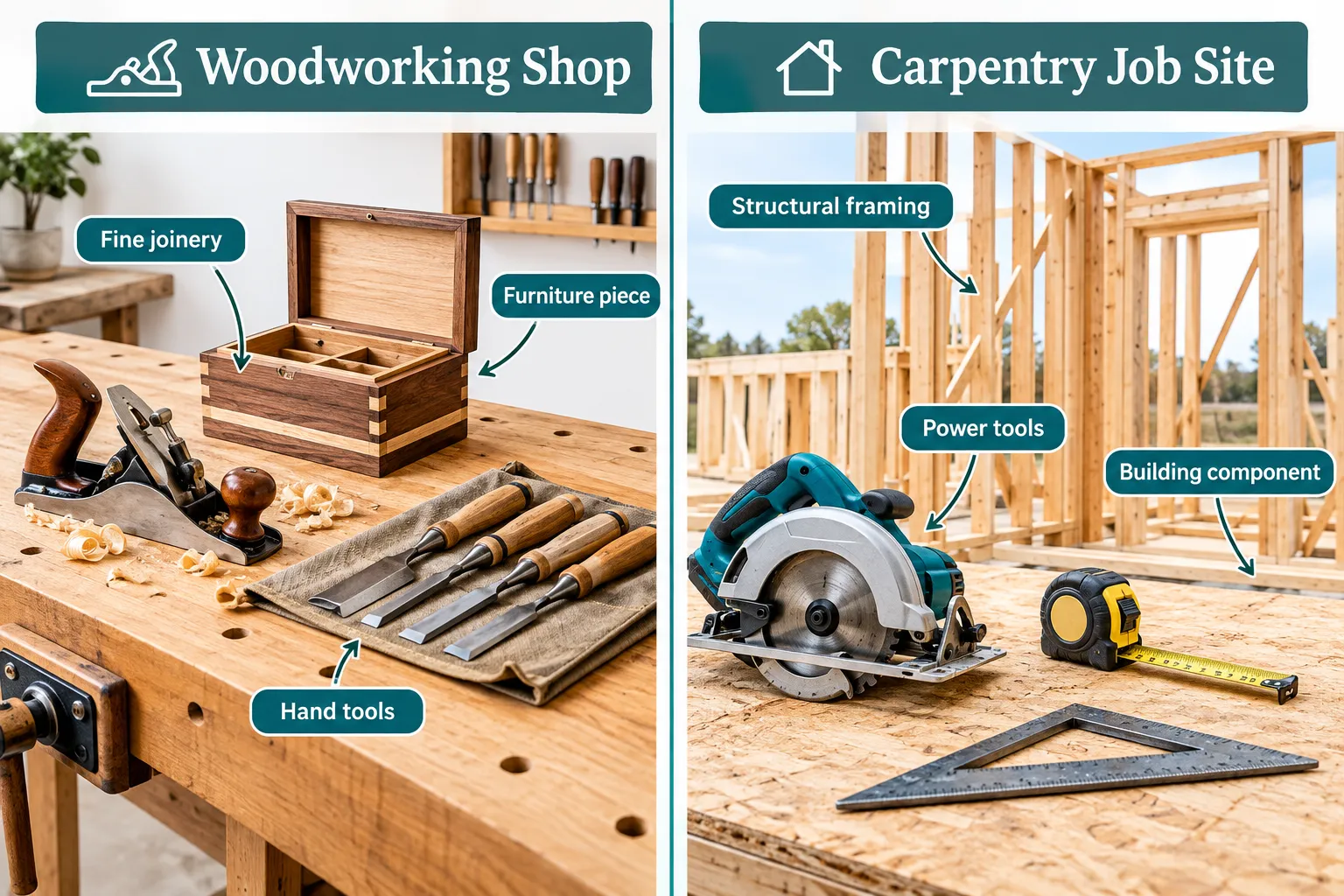
That distinction shows up in nearly every part of the work. A woodworker spends hours fitting a drawer so it glides without a rattle. A carpenter spends hours making sure a load-bearing wall meets building code and stays square under weight. Woodworking tolerances are often measured in fractions of a millimeter for a clean glue joint. Carpentry tolerances allow a little more give because lumber moves, framing settles, and speed matters on a job with a deadline.
Is Carpentry Considered a Type of Woodworking?
Not really, though the two overlap at the edges. Carpentry is classified as a construction trade, while woodworking is classified as a craft or hobby skill, carpenters do cut and shape wood, but their goal is structural, not decorative or furniture-based.
Some trade schools group “carpentry and woodworking” together in course catalogs, which fuels the confusion. In practice:
- A finish carpenter installing crown molding is doing carpentry, even though it requires careful cuts and a trained eye.
- A hobbyist building a hand-cut dovetail box is doing woodworking, even without any construction license.
- The overlap zone is cabinetmaking and trim work, where both skill sets blend.
Woodworking vs Carpentry: Which Pays More?
Carpentry generally pays a steadier, more predictable wage because it’s a recognized trade with union pay scales, apprenticeship pipelines, and year-round construction demand. Woodworking income varies widely and depends on whether it stays a hobby or becomes a furniture-making business.
Carpenters working on residential or commercial construction crews typically earn hourly wages that rise with experience and licensing. The U.S. Bureau of Labor Statistics tracks carpentry as a distinct construction occupation with formal apprenticeship routes, which is part of why wages tend to be more standardized across regions. Woodworkers, by contrast, might earn nothing from the craft at all if it stays a weekend hobby, or they could build a profitable custom furniture business, but that income depends on marketing, pricing skill, and client demand rather than a fixed trade wage. If you’re weighing the craft as a potential income source, our guide on starting and growing a woodworking business from home walks through what that transition actually looks like.
What Skills Do You Need for Woodworking vs Carpentry?
Woodworking skills center on joinery, measuring for fit (not just fit for code), finishing, and patience with slow, detail-heavy tasks. Carpentry skills center on framing math, structural awareness, reading blueprints, and working efficiently under job-site time pressure.
| Skill area | Woodworking | Carpentry |
|---|---|---|
| Core focus | Joinery, fit, finish | Structural framing, code compliance |
| Math used | Proportions, angles for joints | Linear measurements, load calculations |
| Pace | Slow, iterative, detail-driven | Fast, deadline-driven |
| Typical training | Self-taught, classes, mentorship | Apprenticeship, trade school, licensing |
| Physical demand | Moderate, shop-based | High, often outdoors or on scaffolding |
A woodworker who can’t read a tape measure to the sixteenth of an inch will struggle with a dovetail joint. A carpenter who can’t frame a square wall on the first try will fall behind on a job site. Both require precision, just in different places and at different speeds.
Can a Carpenter Do Woodworking Projects?
Yes, a carpenter can build woodworking projects, and many do as a creative outlet or side income. Their construction background gives them a head start on measuring, cutting, and material selection, but fine furniture work still requires additional practice in joinery and finishing that job-site carpentry doesn’t typically demand.
Framing a house rarely calls for a hand-cut dovetail or a hidden mortise-and-tenon joint. So a carpenter moving into furniture-grade woodworking usually needs to slow down, learn new joinery methods, and get comfortable with finer tools. Our guide to woodworking joinery and techniques is a solid next step for anyone making that jump.
Choose woodworking first if: your goal is building furniture, decorative pieces, or small functional items for yourself or to sell.
Choose carpentry first if: your goal is construction, home building, or a trade career with structured licensing.
Woodworking Tools vs Carpentry Tools: What’s Different?
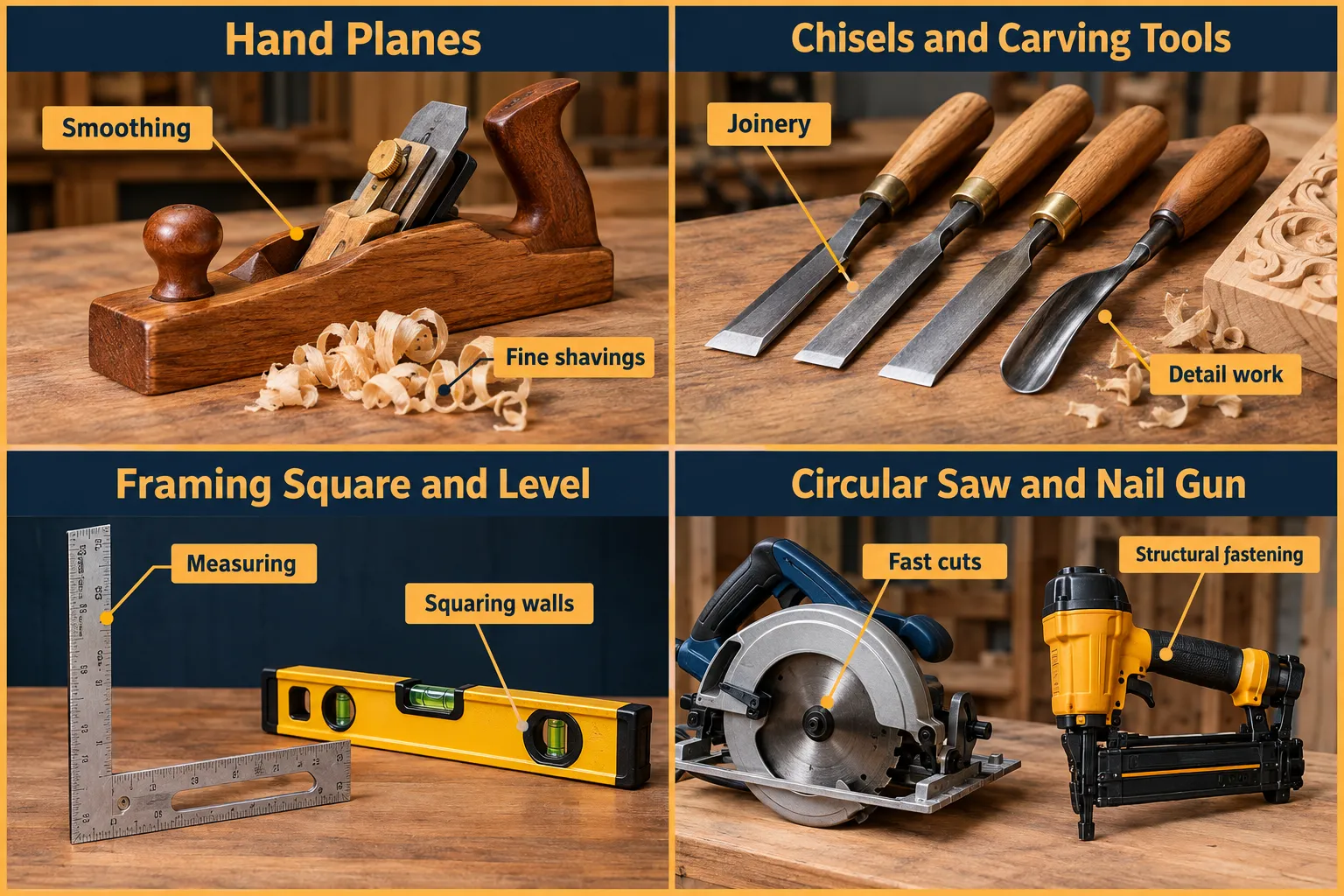
Woodworking tools are built for precision and detail, chisels, hand planes, and fine-tooth saws. Carpentry tools are built for speed and structural strength, framing squares, circular saws, and nail guns.
A woodworker’s bench might hold:
- Hand planes and chisels for smoothing and shaping joints
- A table saw or router with fine-tolerance jigs
- Clamps, glue, and finishing supplies
A carpenter’s truck or tool belt usually holds:
- A circular saw or miter saw for fast, repeated cuts
- A framing square, level, and chalk line for structural accuracy
- A nail gun or impact driver for rapid fastening
If you’re assembling a starter kit, our breakdowns of beginner woodworking tools and equipment and the full range of tools used in woodworking cover what’s actually worth buying first, without the overwhelm of a full carpentry truck inventory.
Is Woodworking Harder Than Carpentry?
Neither is harder overall, they’re difficult in different ways. Woodworking demands patience and fine motor precision for joinery and finishing, while carpentry demands physical stamina, fast decision-making, and structural knowledge under time pressure.
A beginner woodworker’s biggest struggle is usually getting a joint to fit cleanly without gaps. A beginner carpenter’s biggest struggle is usually working fast and accurately at the same time, often outdoors, sometimes at height. One mistake in woodworking might ruin a board. One mistake in carpentry can affect the safety of a structure. That’s a meaningful difference in stakes, even if the learning curve for basic competence is comparable in both.
Woodworking for Beginners vs Carpentry: Which Should You Start With?
Start with woodworking if you want a low-pressure hobby you can build slowly in a garage or spare room. Start with carpentry if you’re aiming for a construction career and want to move toward licensing and paid trade work.
Choose woodworking if:
- You want to build things for your own home or as gifts
- You’re working with a small space and modest tool budget
- You enjoy slow, detail-focused projects
Choose carpentry if:
- You want steady trade income and apprenticeship pathways
- You’re comfortable with physical labor and job-site conditions
- You want formal licensing and career advancement
For a realistic look at what hobby woodworking actually costs to start, see our cost breakdown of getting into woodworking, and our full beginner woodworking guide for a structured first-month plan.
Common Mistakes People Make Confusing Woodworking and Carpentry
The most common mistake is assuming the two trades use the same tools, timeline, and skill set. They don’t, and treating them as identical leads to frustration fast.
- Buying a carpentry-grade circular saw and framing square for furniture work, then struggling with joinery precision.
- Expecting a weekend carpentry class to teach fine furniture-making skills.
- Assuming a carpentry license qualifies someone to sell handmade furniture commercially (it generally doesn’t; furniture sales fall under different business rules).
- Underestimating how much slower woodworking projects move compared to framing work.
Edge case: trim carpentry and cabinetmaking sit right in the overlap, so some professionals genuinely do need both skill sets and tool kits.
What Kind of Projects Do Woodworkers Make vs Carpenters?
Woodworkers typically build furniture, boxes, cutting boards, and decorative pieces. Carpenters typically build or repair structural elements: wall framing, decks, staircases, doors, and trim.
A woodworking project list often includes bookshelves, tables, jewelry boxes, and cabinets. Browse our step-by-step beginner woodworking projects for examples that fit a first few months in the shop. A carpentry project list looks more like framed walls, roof trusses, porch decking, and door installation, work tied to a building’s structure rather than a standalone object.
What Materials Do Woodworkers Use That Carpenters Don’t?
Woodworkers frequently use hardwoods, veneers, and specialty finishes that carpenters rarely touch, because furniture-grade work prioritizes appearance and grain over raw structural load capacity.
- Hardwoods like walnut, cherry, and maple for furniture and fine joinery
- Veneers and inlays for decorative detail
- Oil, varnish, and specialty wood finishes for appearance and protection
Carpenters mostly work with dimensional lumber (like 2x4s), plywood, and engineered framing materials chosen for strength and cost, not appearance.
Do You Need a License for Woodworking or Carpentry?
Woodworking as a hobby or small business generally doesn’t require a license. Carpentry, especially structural or commercial work, often requires licensing, certification, or apprenticeship hours depending on the state or country.
Requirements vary by location, so always check local regulations before taking on paid carpentry work. Selling handmade furniture as a woodworker usually involves business registration rather than trade licensing, our guide on choosing the right business structure for a woodworking venture covers that side of things.
How Long Does It Take to Learn Woodworking vs Carpentry?
Basic woodworking skills can be learned in a few months of consistent practice, while competent, employable carpentry skills typically take a multi-year apprenticeship to reach a licensed or journeyman level.
A beginner can build a simple shelf or box within weeks using basic hand tools. Reaching confident joinery and finishing work usually takes a year or more of regular practice. Carpentry apprenticeships in many trades run several years and combine paid on-the-job hours with classroom instruction, because the stakes (structural safety, code compliance) are higher and the learning is more regulated.
Woodworking as a Hobby vs Carpentry as a Career
Woodworking works well as a lifelong hobby that can optionally grow into a side business, while carpentry is typically pursued as a full career path with structured advancement and trade income from early on.
Hobbyist woodworkers often start with a small home shop. If you’re setting one up, our home woodshop setup planning guide covers space, dust collection, and layout basics. Carpenters, meanwhile, usually enter the field expecting steady paid work from the apprenticeship stage onward, with clear steps toward licensed, higher-paying roles.
Frequently Asked Questions
So is a carpenter basically a woodworker with a hammer?
Not quite. A carpenter focuses on structural building work, while a woodworker focuses on furniture and decorative pieces. The tools and goals genuinely differ, even though both work with wood.
Could I just learn carpentry and pick up woodworking skills along the way?
Some skills transfer, like measuring and cutting accuracy, but fine joinery and finishing are separate skills carpentry doesn’t usually teach. You’d still need dedicated practice.
Why does everyone lump these two trades together?
Probably because both involve wood and overlapping tools like saws and drills. The underlying goals and training paths are different enough that treating them as one trade causes real confusion for beginners.
Do I need expensive tools to start woodworking?
No. Many beginners start with a modest hand tool kit and grow from there as skills and project ambitions expand.
Is cabinetmaking woodworking or carpentry?
It’s genuinely both, cabinetmaking blends fine joinery (woodworking) with built-in structural installation (carpentry), which is why it’s often treated as its own specialty.
Can I turn a woodworking hobby into carpentry work later?
Yes, but you’d likely need separate training or apprenticeship hours for structural carpentry, since the skill sets and safety requirements differ.
Which one has lower startup costs?
Woodworking as a hobby usually has lower startup costs since you can begin with hand tools in a small space, while carpentry tools and safety gear for job-site work tend to add up faster.
Conclusion
Woodworking and carpentry both start with the same raw material, but they split into different disciplines from there. Woodworking is the craft of shaping wood into furniture and decorative objects with careful joinery and finish work. Carpentry is the trade of building and repairing structures, bound by code requirements and job-site speed. Neither is “better”, they serve different goals, different lifestyles, and often different paychecks.
If your interest leans toward building things for your own home, gifting handmade pieces, or eventually selling furniture, start with woodworking fundamentals: joinery basics, a small hand tool kit, and a few beginner projects to build confidence. If you’re aiming for a construction career with structured advancement, carpentry’s apprenticeship path is the more direct route. Either way, understanding how woodworking differs from carpentry before you invest in tools or training will save you money, time, and a fair amount of frustration down the road.
Products, Tools, and Resources Worth Exploring
For anyone starting on the woodworking side of this comparison, a few resources make the first few months smoother:
- A basic hand tool kit (chisels, a block plane, a marking gauge, and a quality tape measure) covers most early joinery practice without a big upfront investment. See our beginner hand tool woodworking kit breakdown for specifics on what to buy first.
- A dedicated, even small, workspace matters more than people expect. Our home woodshop setup guide covers layout and dust control for tight spaces.
- If finishing and joint strength are proving tricky, the ultimate woodworking joints guide is worth bookmarking as a reference while you practice.
- Anyone considering the leap from hobby to paid work should read through the realistic planning steps for growing a woodworking business from home before buying commercial-grade equipment.