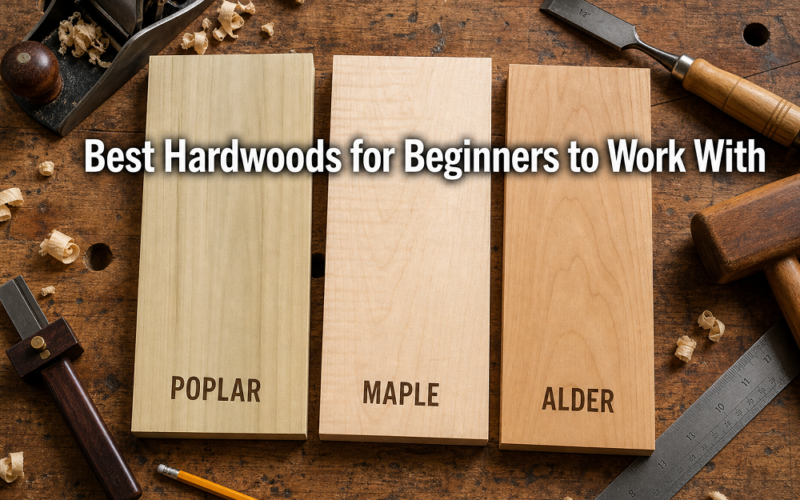
Best Hardwoods for Beginners to Work With
A beginner-friendly hardwood is one that cuts cleanly, holds joinery well, and doesn’t punish small errors in technique or tool sharpness. Three factors matter most: workability, cost, and finishing behavior.
Workability refers to how a wood responds to both hand tools and power tools. Species with a lower Janka hardness rating (a standardized measure of wood density and resistance to denting) are generally easier to cut, plane, and shape. Poplar sits around 540 lbf on the Janka scale. Soft maple lands around 700 to 950 lbf depending on species. Compare that to hard maple at 1,450 lbf or hickory at 1,820 lbf, and the difference in effort becomes immediately clear.
Cost matters because beginners make more mistakes, and mistakes mean wasted material. A miscut board of poplar at $3 per board foot stings far less than a miscut piece of walnut at $12 to $18 per board foot.
Finishing behavior is often overlooked. Some woods blotch badly under stain (cherry and pine are notorious for this). Others take finish evenly right off the surface. For a beginner still learning how to prep and apply finish, a wood that cooperates makes the learning curve much shorter.
According to Woodworkers Source, the best beginner hardwoods share a combination of moderate density, straight grain, and predictable finishing behavior. Those three qualities together are what separate a forgiving species from a frustrating one.
The softest, most workable hardwoods for beginners are poplar, alder, and soft maple. All three fall well below the 1,000 lbf Janka threshold that generally marks the point where hand-tooling becomes noticeably more demanding.
Here is a practical comparison of the most beginner-friendly species:
Poplar is the gentlest entry point. It cuts almost like a softwood, which means your chisels, hand planes, and router bits stay sharper longer and leave cleaner edges even when your technique isn’t perfect yet. Alder is similarly soft and has a fine, consistent grain that responds well to both sharp hand tools and standard power tools. Soft maple sits slightly higher on the hardness scale but is still far more manageable than hard maple, and it gives you a much more authentic hardwood experience than poplar alone.
Poplar is the most practical first hardwood for beginners, and most experienced woodworkers recommend it for exactly that reason. It’s inexpensive, widely available, and cuts cleanly with almost any tool setup.
The one honest downside is appearance. Poplar frequently has greenish, gray, or purple streaking in the heartwood that looks uneven and difficult to work with under a clear or stained finish. Most builders paint poplar rather than leave it natural, which makes it ideal for:
If your goal is to build something that will be stained or left with a natural finish, poplar is not the right choice. But for learning woodworking joinery and technique on painted projects, it’s genuinely hard to beat. You get real hardwood behavior at softwood prices, and mistakes cost almost nothing.
Soft maple is the right next step after poplar for beginners who want to work with a wood that looks and behaves more like a traditional furniture hardwood. It machines cleanly, holds detail well, and accepts both paint and light stain finishes without major problems.
It’s worth clarifying the naming confusion here. “Soft maple” is not one single species but a group that includes silver maple (Acer saccharinum) and red maple (Acer rubrum), among others. These are meaningfully different from “hard maple” (Acer saccharum), which is the species used for cutting boards, butcher blocks, and hardwood flooring. Hard maple is genuinely difficult to hand-tool and will punish a dull blade or chisel with tear-out almost immediately. Soft maple behaves nothing like that.
For beginner furniture projects, soft maple is appropriate for:
Woodshop Master notes that soft maple is one of the most underrated beginner species precisely because it sits in this middle ground: real hardwood workability, without the difficulty or cost of premium furniture-grade species.
Alder is the best hardwood for beginners who want to practice staining and finishing technique. It takes stain more evenly than almost any other domestic hardwood, including maple, which tends to blotch without careful pre-conditioning.
Alder is soft (around 590 lbf Janka), light in color, and has a fine, relatively uniform grain. That combination means stain absorbs consistently across the surface without the splotchy, uneven result that frustrates beginners working with denser or more porous species. It’s used extensively in mid-range furniture manufacturing for exactly this reason: it finishes predictably, it works easily, and it’s cost-effective.
For a beginner who wants to:
Alder is the most forgiving option. According to Baird Brothers, alder is one of the most consistently workable domestic hardwoods available, and its finishing behavior makes it particularly well-suited to beginners still developing their surface prep technique.
For beginners, soft maple is generally the better choice over oak. Oak is harder, heavier, and has a more pronounced open grain that requires grain filler for smooth painted finishes. Soft maple is easier to cut, easier to finish, and more forgiving at the bench.
That said, oak deserves a fair look. Red oak sits around 1,290 lbf on the Janka scale, which is noticeably harder than soft maple but still workable with sharp tools and standard power tools. It’s widely available, relatively affordable (typically $4 to $8 per board foot), and produces beautiful furniture with a strong, visible grain character. White oak is slightly harder still and has become one of the most popular furniture species in the current market, partly because of its warm color and tight grain.
The honest comparison looks like this:
Timber Tool Shed’s guide to oak vs. walnut vs. maple provides a detailed breakdown of how each species behaves under tools and finish, and it’s worth reading before you commit to a species for your first furniture build.
For hand tool woodworking, poplar and alder are the most forgiving beginner species. For power tool woodworking, soft maple and red oak also become viable options because the machine does most of the heavy lifting.
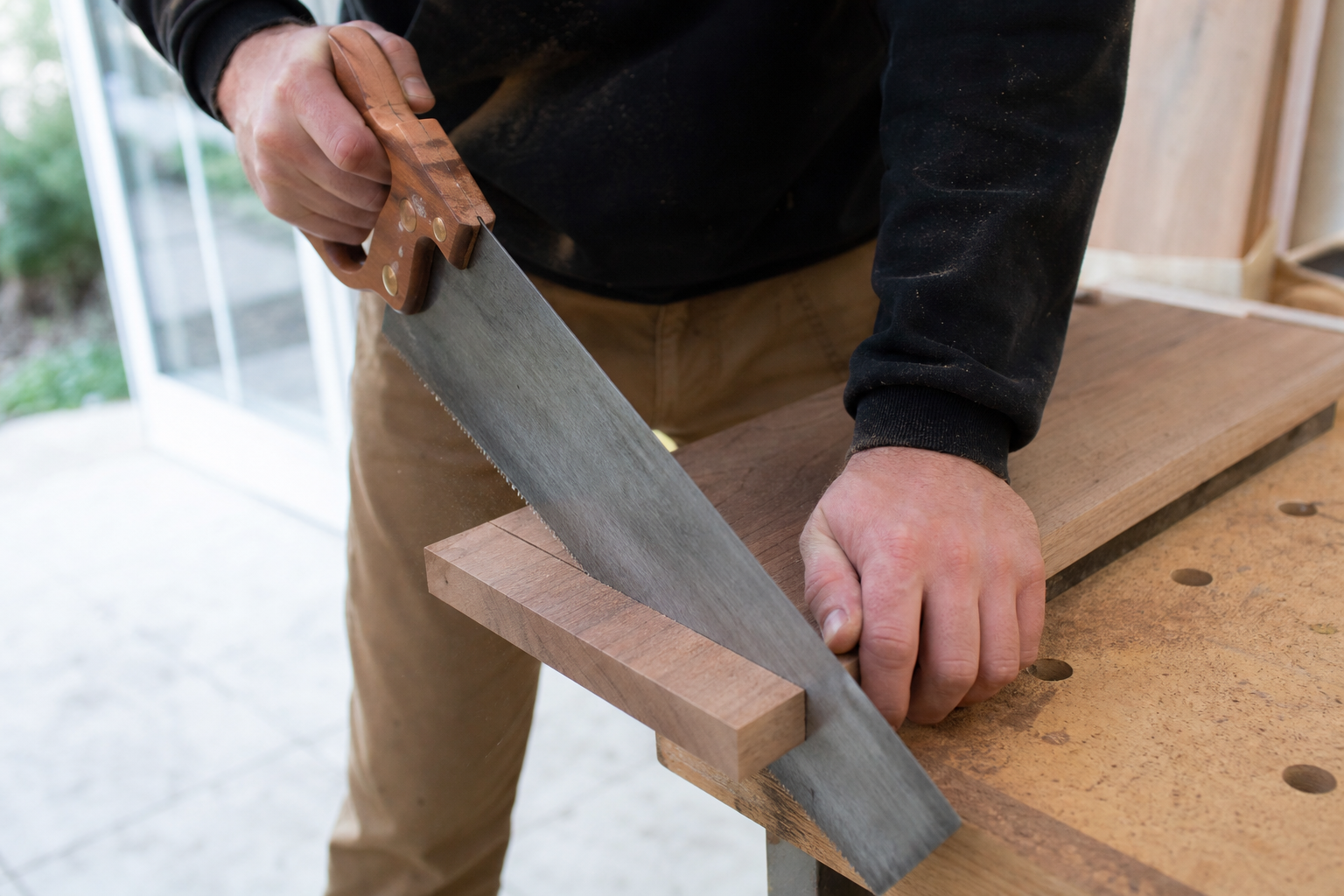
This distinction matters more than most beginners realize. Hand tools require you to read grain direction carefully and maintain sharp edges consistently. A dense, interlocked grain (like hard maple or hickory) will fight a hand plane and produce tear-out even with a sharp iron if you’re not yet reading the wood correctly. Softer species with straight, consistent grain forgive minor errors in angle and pressure.
Power tools change the equation somewhat. A router, table saw, or jointer can process harder species more easily than a hand plane or chisel can, which is why many power tool woodworkers work comfortably with red oak or soft maple from early in their learning. The key caveat: even with power tools, dull blades and bits cause burning, tear-out, and rough surfaces in harder species. Sharp tooling matters regardless of whether you’re using hand tools or machines.
If you’re still building your woodworking tools and equipment setup, start with softer species until your tool maintenance habits (especially sharpening) are consistent. Then move up in hardness as your setup improves.
Poplar, alder, and soft maple are the most forgiving hardwoods for beginners because they’re easy to re-cut, re-sand, and re-fit without wasting expensive material.
“Forgiving” means a few specific things in practice:
One practical example: if you’re cutting your first set of dovetails and the fit is slightly off, re-cutting a poplar tail board costs you maybe $2 in material and 20 minutes of time. Re-cutting the same joint in walnut might cost $15 in material. The lesson is the same either way, but the financial pressure is completely different.
For a structured path through your first woodworking projects, starting on forgiving species removes one major source of frustration and lets you focus on the skill itself.
Beginners should avoid hard maple, black walnut, and exotic species like purpleheart, padauk, or teak until their cutting, joinery, and finishing technique are consistent. These woods are not bad, but they amplify the cost of mistakes in ways that slow down learning.
Here is why each is problematic early on:
Hard maple (Acer saccharum, Janka ~1,450 lbf) is genuinely difficult to hand-tool. It dulls edges quickly, produces tear-out when grain direction changes, and requires careful technique to finish without blotching. It’s excellent for cutting boards and workbench tops once you have the skills, but it’s a frustrating first species.
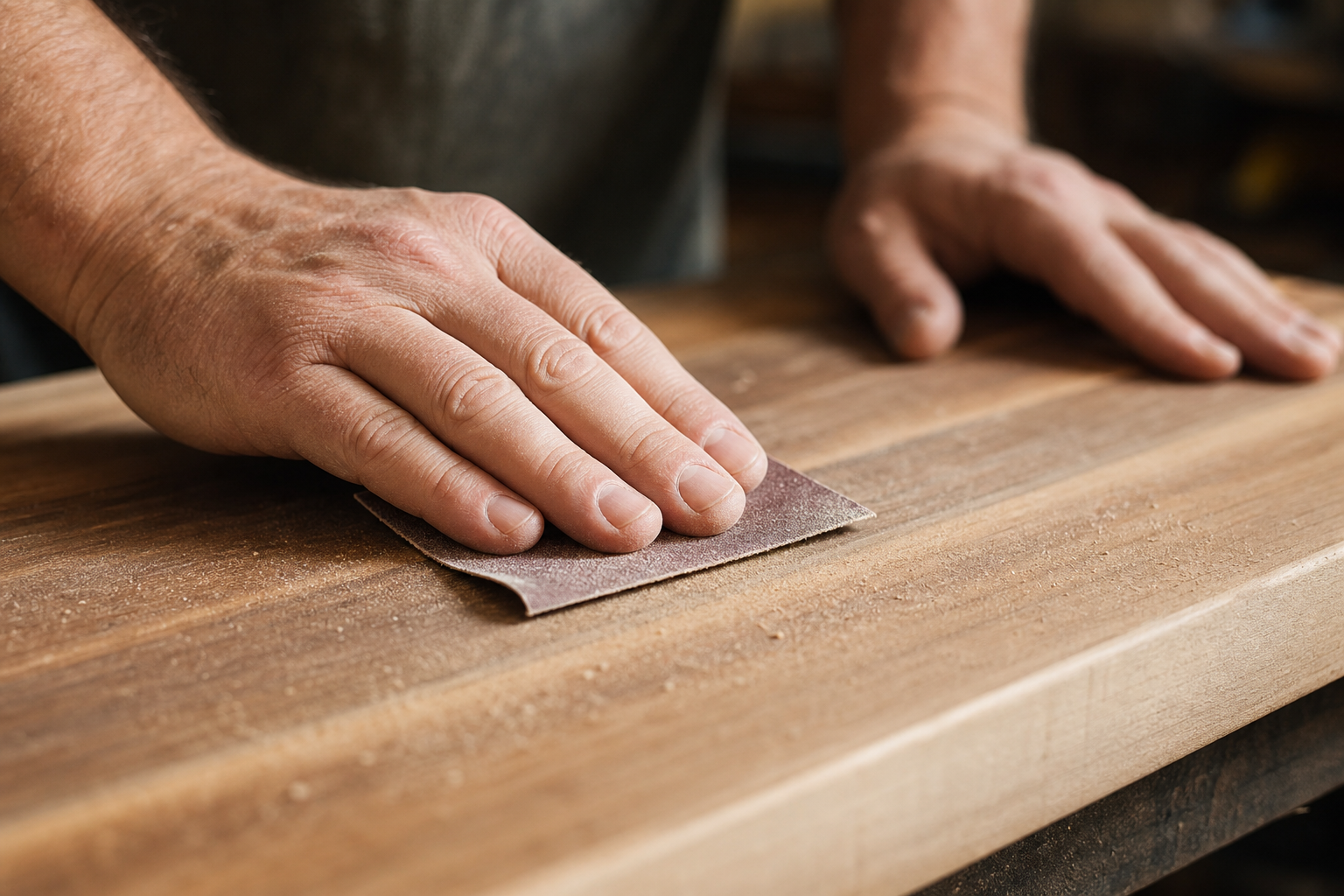
Black walnut (Janka ~1,010 lbf) is actually workable in terms of hardness, but its premium price ($12 to $20-plus per board foot) makes early mistakes expensive. Walnut also has a tendency to show tool marks and surface prep errors under an oil or wipe-on finish, which punishes inconsistent sanding.
Exotic species (purpleheart, padauk, teak, ebony) combine high hardness, high cost, and sometimes toxic dust with unpredictable finishing behavior. Some exotics contain natural oils that prevent adhesive and finish from bonding properly, which adds a layer of complexity that beginners don’t need.
The principle from Woodwork Wizardry’s beginner wood guide applies here: save expensive and difficult species for builds you’re confident will turn out well. That confidence comes from repetition on forgiving, inexpensive wood first.
The Janka hardness rating is the most reliable indicator. As a general rule, beginners working primarily with hand tools should stay below 1,000 lbf. Power tool woodworkers can work comfortably up to around 1,200 to 1,300 lbf with sharp tooling.
Beyond the number, there are practical tests you can apply at the lumber yard or in your shop:
If you’re unsure about a species, check its Janka rating before buying. Most lumber dealers and wood types and material selection resources list hardness data alongside species descriptions.
Yes, softwoods like pine, cedar, and Douglas fir are perfectly valid starting materials, but they teach slightly different skills than hardwoods and have some limitations worth knowing about.
Softwoods are:
The main argument for starting on hardwood (even a soft hardwood like poplar) rather than pine is that hardwoods teach more transferable technique. The feedback from a sharp chisel or hand plane on poplar is cleaner and more instructive than the same cut on pine, which tends to compress and fuzz rather than shear. That said, pine is a completely reasonable choice for a very first project, especially if cost is a concern.
Woodworkers Source makes a strong case that even the softest hardwoods are better teaching materials than pine for this reason: the cut quality is more consistent, the joinery fits more precisely, and the finished project holds up better over time.
Beginner-friendly hardwoods typically cost between $3 and $7 per board foot at a local hardwood dealer. Big-box store pricing for dimensional softwood lumber is often lower, but the selection and quality of hardwood at specialty dealers is generally much better.
Rough price ranges for common beginner species (as of 2026, U.S. domestic market):
A small beginner project (a simple box, a small shelf, or a practice joint set) typically uses 4 to 8 board feet of material. At poplar prices, that’s $12 to $40 in lumber. At walnut prices, the same project costs $48 to $160 or more. The skill-building is identical. The financial risk is not.
Note that prices vary by region, supplier, and whether you’re buying rough-sawn or surfaced lumber. Surfaced lumber (S2S or S4S) costs more but requires less equipment to use. If you don’t have a jointer or planer yet, buying surfaced lumber is the practical choice.
Local hardwood dealers and specialty lumber yards are the best source for beginner hardwood. They carry a wider selection than big-box stores, the staff can answer species questions, and you can hand-select boards rather than buying whatever is on the shelf.
Good options for finding hardwood as a beginner:
One practical tip: when you’re buying your first few boards, bring a straightedge or hold boards up to the light to check for bow, cup, and twist before you buy. Even beginner-friendly species can be difficult to work if the board has significant movement.
You don’t need different tools for harder hardwoods, but you do need sharper tools. The single biggest variable in whether a hard wood works easily or fights you is edge sharpness, not the tool itself.
A sharp chisel will cut hard maple cleanly. A dull chisel will crush and tear it. The same is true for hand planes, router bits, and saw blades. This is why beginners benefit from starting on softer species: the margin for dull tooling is much wider. Poplar will still cut reasonably well with a slightly dull blade. Hard maple will not.
If you’re moving up to harder species, the practical checklist is:
For a full overview of what tools are worth having at each stage of your woodworking development, the beginner tools setup guide covers the essentials without pushing you toward unnecessary purchases.
For furniture making, poplar, soft maple, and alder are the best beginner choices. For carving, basswood is the standard recommendation because it’s exceptionally soft, consistent, and easy to cut with carving gouges and knives.
This distinction matters because furniture making and carving place different demands on wood:
Furniture making needs wood that:
Poplar, alder, and soft maple all meet these criteria at beginner-friendly prices. Red oak and cherry are good next steps once your technique is solid.
Carving needs wood that:
Basswood (Janka ~410 lbf) is the standard carving wood for beginners, followed by butternut. Neither is particularly useful for furniture, but both are excellent for learning carving technique. If you want to explore both disciplines, keep poplar for furniture practice and a separate piece of basswood for carving.
For furniture building plans that are scaled for beginner skill levels, working through a few structured projects in poplar or soft maple before moving to premium species is the most efficient path.
The most effective learning path moves from soft and inexpensive to hard and premium, adding one variable at a time. Here is a straightforward three-stage progression:
Stage 1: Foundation (first 3 to 6 months)
Stage 2: Finishing and refinement (months 4 to 12)
Stage 3: Premium species (after consistent results in Stage 2)
This progression is consistent with what most experienced woodworkers recommend. Woodwork Wizardry and Woodshop Master both emphasize that the goal of beginner species isn’t to stay on them forever but to build the skills that make premium species worth buying.
For structured project ideas at each stage, the beginner woodworking hub has project plans organized by skill level.
Is poplar a good wood for beginners?
Yes. Poplar is soft, inexpensive (typically $3 to $5 per board foot), and cuts cleanly with both hand tools and power tools. Its main limitation is appearance: it often has greenish or purple streaking that doesn’t look good under a clear finish. Most beginners paint poplar rather than stain it, which makes it ideal for practice projects and painted furniture builds.
What is the easiest hardwood to stain evenly?
Alder. It has a fine, consistent grain that absorbs stain uniformly without the blotching that affects maple, cherry, and pine. For beginners learning finishing technique, alder is the most cooperative domestic hardwood available.
Should beginners avoid hard maple and walnut?
Not permanently, but yes for the first several months. Hard maple requires sharp tools and careful technique to avoid tear-out. Walnut’s premium price ($12 to $20-plus per board foot) makes early mistakes costly. Both are excellent species once your fundamentals are solid.
What is the Janka hardness scale and why does it matter?
The Janka hardness scale measures the force required to embed a steel ball halfway into a wood sample, expressed in pounds-force (lbf). It’s the most widely used indicator of how hard a wood is to cut, dent, and work. Beginners working with hand tools should generally stay below 1,000 lbf. Power tool woodworkers can work comfortably up to around 1,200 to 1,300 lbf with sharp tooling.
Can I use pine instead of hardwood as a beginner?
Yes, pine is a valid starting material and is widely available at big-box stores. The downside is that pine is softer and less consistent under hand tools than even the softest hardwoods, and it dents easily in finished furniture. Poplar is a better choice than pine for most beginner projects because it cuts more cleanly and produces more transferable technique.
How many board feet do I need for a beginner project?
Most small beginner projects (a simple box, a small shelf, a set of practice joints) use 4 to 8 board feet of material. A small side table might use 10 to 15 board feet. When calculating, add 20 to 30 percent for waste from cuts, defects, and mistakes.
What is the difference between soft maple and hard maple?
Soft maple refers to species like silver maple (Acer saccharinum) and red maple (Acer rubrum), with a Janka hardness of roughly 700 to 950 lbf. Hard maple (Acer saccharum) is the species used for cutting boards and hardwood flooring, with a Janka hardness of around 1,450 lbf. They look similar but behave very differently under tools. Soft maple is appropriate for beginners; hard maple is not.
Is red oak good for beginners?
Red oak is workable for beginners who are comfortable with power tools. It’s harder than poplar, alder, or soft maple (around 1,290 lbf Janka), but it’s widely available, affordable, and produces beautiful furniture. The main challenge is finishing: oak’s open grain requires grain filler for a smooth painted finish, and it can look uneven under stain without careful prep.
Where is the best place to buy hardwood as a beginner?
A local hardwood dealer or specialty lumber yard is the best option. You can hand-select boards, ask species questions, and often buy in smaller quantities than online retailers require. Woodcraft and Rockler stores are good alternatives if you don’t have a local dealer. Big-box stores carry poplar and sometimes oak, but selection and board quality are inconsistent.
Do I need a planer and jointer to work with hardwood?
Not necessarily. Buying surfaced lumber (S2S or S4S) eliminates the need for a jointer and planer for most beginner projects. Surfaced lumber costs slightly more per board foot but arrives flat and ready to cut. As your shop grows, a benchtop planer and a jointer become valuable additions, but they’re not required to start.
What hardwood is best for a first furniture project?
Poplar for a painted piece, alder for a stained piece. Both are inexpensive, easy to work, and widely available. A simple shelf, small cabinet, or side table in either species is a practical first furniture build that teaches real technique without expensive material risk.
How do I know if a board is good quality before I buy it?
Hold the board up and sight down its length to check for bow and twist. Lay it on a flat surface to check for cup. Look for knots, checks (small cracks), and wild grain that might cause problems during cutting. For beginner projects, choose straight-grained, clear boards without large knots. A little character grain is fine; significant defects are not worth the trouble early on.
The best hardwoods for beginners to work with are the ones that let you focus on building skill rather than managing expensive mistakes. Poplar, alder, and soft maple cover the full range of beginner needs: painted projects, stained projects, hand tool practice, and power tool builds. They’re affordable, widely available, and forgiving in ways that premium species simply are not.
The goal isn’t to stay on beginner species forever. It’s to build the cutting, joinery, and finishing technique that makes hard maple, walnut, and cherry worth buying. That progression takes time, but it’s the most efficient path to producing work you’re genuinely proud of.
Start simple. Work clean. Move up when your results are consistent.
A few honest recommendations based on what actually helps beginners get started on hardwood:
For buying lumber: Woodworkers Source is one of the most reliable online hardwood retailers for domestic species. Their beginner hardwood guide is worth reading before your first purchase. For in-person buying, Woodcraft and Rockler stores carry small quantities of poplar, alder, and soft maple in most locations.
For sharpening: A basic sharpening setup (a combination waterstone in 1,000 and 6,000 grit, plus a leather strop) is the single most important investment for anyone working with hardwood. Sharp tools are the difference between a clean cut and a frustrating one, regardless of species.
For learning joinery: The woodworking joinery and techniques section covers the foundational joints (mortise-and-tenon, dovetail, box joint) with step-by-step guidance suited to beginner skill levels.
For project plans: The beginner woodworking projects library has plans organized by skill level, with material lists that specify appropriate species for each build.
For online learning: If you want structured video instruction alongside hands-on practice, the woodworking online training resources page lists courses and tutorials that complement working through your first hardwood projects.
Key Takeaways

What Makes a Hardwood Good for Beginners?
What Hardwoods Are Softer and Easier to Work With?
Wood
Janka Hardness
Avg. Cost Per Board Foot
Best For
Poplar
~540 lbf
$3 to $5
Painted projects, practice joinery
Alder
~590 lbf
$4 to $6
Stained projects, furniture
Soft Maple
~700 to 950 lbf
$4 to $7
Furniture, light finishing
Hard Maple
~1,450 lbf
$7 to $12
Cutting boards, flooring (not for beginners)
Black Walnut
~1,010 lbf
$12 to $20+
Premium furniture (not for beginners)
Poplar: The Best Starting Wood for Most Beginners
Soft Maple: The Best Middle-Ground Hardwood
Alder: The Easiest Hardwood to Stain Evenly
Oak vs. Maple for Woodworking Beginners: Which Is Better?
Best Hardwoods for Hand Tools vs. Power Tools
Hardwoods That Are Forgiving for Mistakes
What Hardwood Should You Avoid as a Beginner?
How to Tell If a Hardwood Is Too Hard to Work With
Can You Use Softwood Instead of Hardwood as a Beginner?
How Much Does Beginner Hardwood Cost?
Where to Buy Beginner-Friendly Hardwood
Do You Need Special Tools for Harder Hardwoods?
Best Hardwoods for Furniture Making vs. Carving
A Practical Progression for Beginner Hardwood Woodworkers
Frequently Asked Questions
Conclusion
Products, Tools, and Resources
References