Cheapest Way to Get Started with Woodworking Tools: Budget Tips for Beginners
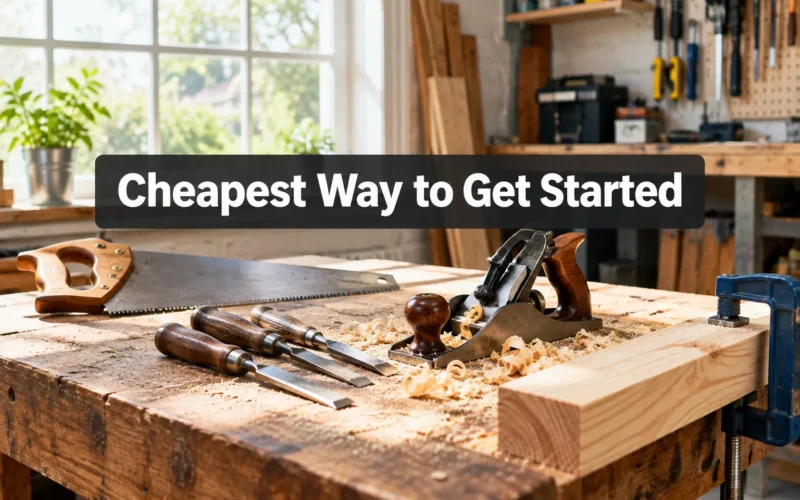
A sharp chisel and a twelve-dollar hand saw will teach you more about wood than an untouched table saw gathering dust in a garage. That’s the part most buying guides skip over when they push beginners toward expensive tool walls at the bibig-boxtore. The cheapest way to get started with woodworking tools is to buy a small set of hand tools first, borrow or thrift what you can, and add power tools only when a specific project demands one.
Most people can build their first few projects, a cutting board, a small shelf, a simple box, for under 150 dollars in tools, assuming they already own basics like a tape measure. That number depends entirely on whether you buy new, used, or borrowed, and on how disciplined you are about resisting tools you don’t need yet.
Find this useful? Add us as a preferred source on Google and more of what we publish will show up in your results.
Key Takeaways
- A basic hand tool starter kit (saw, chisel set, block plane, combination square, clamps) typically costs 60 to 150 dollars new.
- Buying used tools from estate sales, flea markets, and online marketplaces can cut that cost by half or more.

- Individual tool purchases usually beat cheap “all-in-one” kits in long-term value and quality.
- A dedicated workshop is not required, many beginners start on a kitchen table or a Workmate-style folding bench.
- Cheap versions are acceptable for clamps and sandpaper holders, but risky for chisels, saw blades, and measuring tools.
- Free or low-cost online tutorials can replace a formal class for most beginner skills.
- Projects like cutting boards, picture frames, and birdhouses need almost no power tools at all.
What Are the Essential Woodworking Tools You Actually Need as a Beginner
A true beginner needs far fewer tools than most retail displays suggest. Six items cover the vast majority of early projects: a tape measure, a combination square, a hand saw, a set of two or three chisels, a block plane, and a pair of clamps.
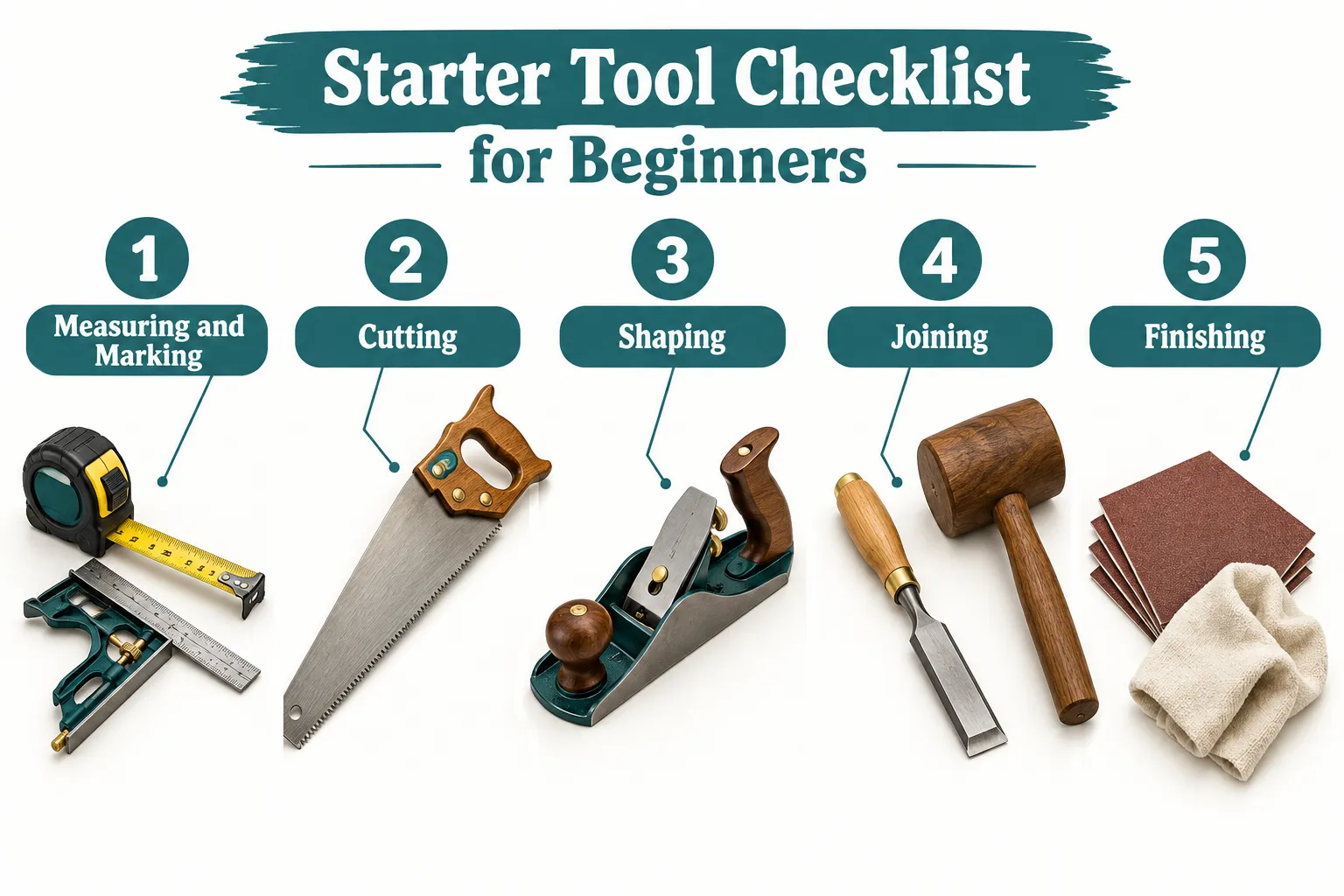
Here’s why each one matters and what it replaces:
- Tape measure and combination square, accuracy here prevents nearly every beginner mistake downstream.
- Hand saw (crosscut style), handles straight cuts without electricity or a workshop.
- Chisel set (2-3 sizes), covers joinery, cleanup, and detail work.
- Block plane, smooths edges and fits boards together without sanding for an hour.
- Bar or F-style clamps (at least two), holds glue-ups and workpieces steady; this is the tool beginners underbuy most often.
Choose this exact list if your goal is small furniture, boxes, or cutting boards. Skip the router, table saw, and planer until a project genuinely calls for one. For a deeper breakdown of what each tool does and why it earns a spot in a starter kit, see this guide to beginner woodworking tools and equipment.
How Much Does It Cost to Start Woodworking from Scratch
Starting completely from zero, with no tools and no scrap wood, generally runs between 100 and 300 dollars for a functional hand tool setup, or 400 to 800 dollars if a basic power sander, drill, and jigsaw get added.
The spread depends on three choices: new versus used tools, name-brand versus budget-brand, and how many projects get built before upgrading. A realistic first-month budget looks like this:
- Hand tools (new, budget brands): 60-150 dollars
- Wood for first 2-3 small projects: 20-50 dollars
- Sandpaper, glue, finish: 15-30 dollars
- Safety gear (glasses, dust mask): 10-20 dollars
That puts a reasonable starting point around 100-250 dollars total, which lines up with the breakdown in this real cost analysis of starting woodworking. Anyone buying a cordless drill, a circular saw, and a random orbital sander right away should expect that number closer to 500-700 dollars.
What Are the Best Budget Woodworking Tools That Don’t Sacrifice Quality
The best budget tools come from mid-tier brands that focus on hand tools and basic power tools rather than flagship innovation, think Stanley, Irwin, WEN, and Narex for chisels. These brands consistently deliver usable accuracy without the premium pricing of boutique toolmakers.
| Tool | Budget Option Example | Why It Works for Beginners |
|---|---|---|
| Chisels | Narex or Stanley sets | Holds an edge long enough to learn sharpening basics |
| Hand saw | Irwin or Stanley crosscut | Replaceable blades avoid full re-sharpening costs |
| Drill | WEN or Black+Decker cordless | Enough torque for pilot holes and basic assembly |
| Clamps | Irwin Quick-Grip | Fast one-handed operation, durable enough for daily use |
Choose mid-tier brands if the tool touches the wood directly (saw blades, chisels, plane irons). Choose the cheapest available option for support tools like clamps, sawhorses, and dust masks, since quality there affects convenience, not cut quality.
Should You Buy a Tool Set or Individual Tools When Starting Out
Individual tools almost always beat bundled kits for beginners, because kits pad their box count with low-use items like extra screwdriver bits or a cheap level nobody reaches for twice. A kit looks like a deal on the shelf but often includes two or three pieces that end up in a drawer.
That said, kits make sense in one specific case: when the kit is built around a single tool category, such as a chisel set or a socket set, rather than a “100-piece household tool kit.” The beginner woodworking tool kit guide breaks down which bundles are actually worth the money versus which ones just inflate a piece count.
Buy individually if the goal is long-term quality. Buy a focused kit if the goal is a single gift-ready starter set for a first project.
Where Can You Find Used Woodworking Tools Cheap
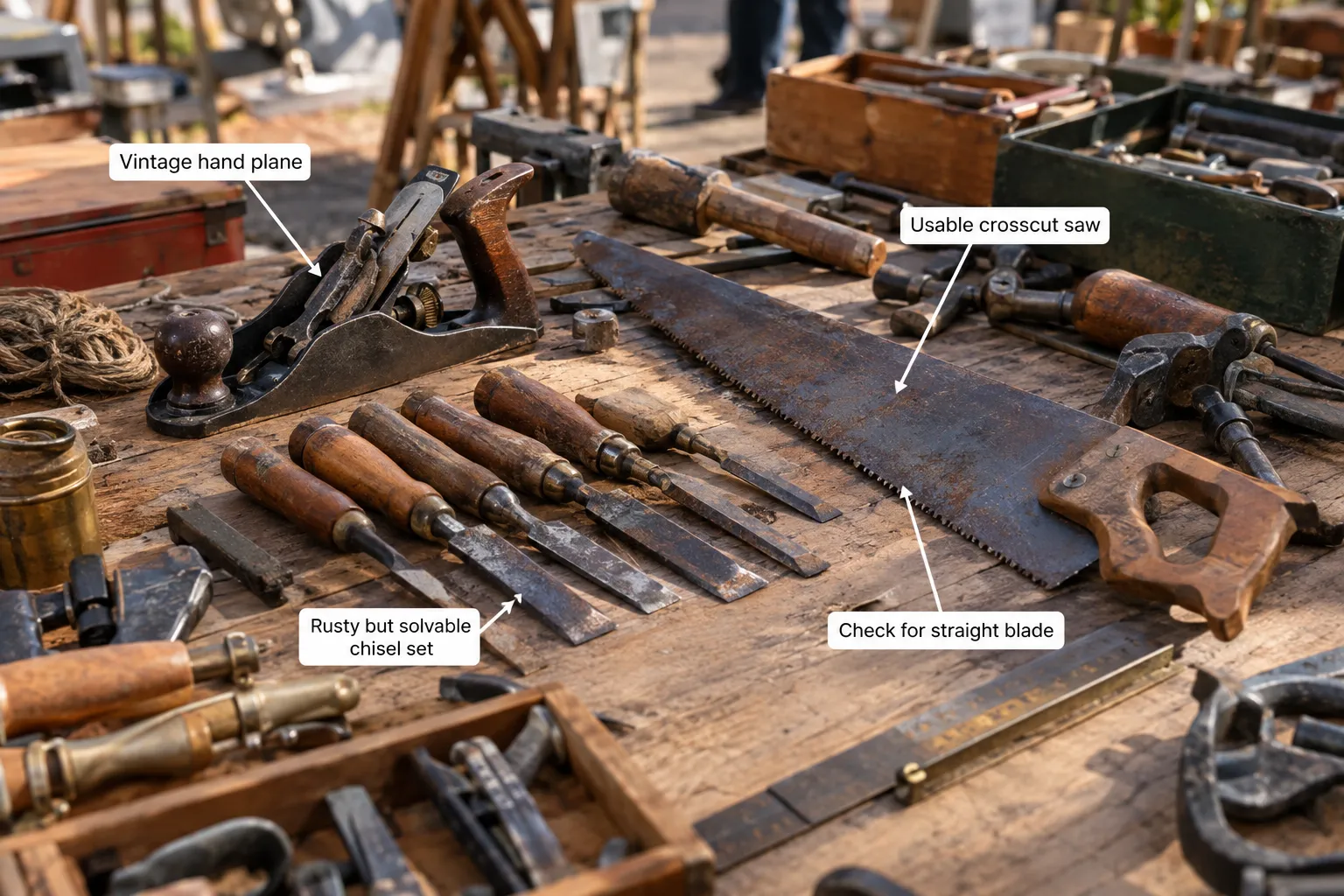
Estate sales, Facebook Marketplace, and local classifieds consistently turn up the best deals on used woodworking tools, often 40-70 percent below retail for items in good working condition. Hand tools especially hold up well secondhand because older saws, planes, and chisels were frequently built from thicker, better steel than many current budget lines.
Practical sourcing order, from most to least reliable:
- Estate sales, often run by families unaware of resale value; best prices on quality vintage tools.
- Facebook Marketplace and Craigslist, search “woodworking tools” and “garage sale” weekly; negotiate in person.
- Pawn shops, good for power tools with working warranties still visible.
- Habitat for Humanity ReStores, donated tools, modest prices, proceeds support a cause.
- Online auction sites, wider selection, but factor in shipping cost before bidding.
Edge case: avoid used power tool batteries unless they’re included at a steep discount, since a replacement battery can cost more than the tool itself.
Can You Teach Yourself Woodworking with Basic Hand Tools Only
Yes. Hand tool woodworking is how the craft existed for centuries, and a beginner can learn joinery, measuring, cutting, and finishing entirely with hand tools before ever touching a power saw. This approach is slower, but it builds a stronger understanding of wood grain and technique than jumping straight to machines.
Self-taught hand tool woodworking works best for anyone who is:
- Working in an apartment, condo, or shared space without room for power tool noise or dust
- Building small projects (boxes, cutting boards, picture frames, simple shelves)
- More interested in the craft itself than in speed or production volume
The beginner hand tool woodworking kit guide walks through exactly what to buy and in what order for a self-taught hand-tool path.
What’s the Difference Between Cheap and Quality Woodworking Tools
The real difference isn’t always price, it’s steel quality, tolerance, and how well a tool holds calibration over repeated use. A cheap chisel might look identical to a quality one but will dull faster, chip more easily, and resist sharpening to a fine edge.
Three signs separate quality from cheap, regardless of brand name:
- Steel hardness, quality chisels and plane irons hold an edge through several projects; cheap steel needs resharpening every session.
- Flatness and tolerance, a quality combination square stays accurate after being dropped once; a cheap one can throw off every measurement after that.
- Fit and finish, quality clamps close smoothly and hold pressure evenly; cheap clamps slip or rack under load.
Common mistake: assuming higher price always means higher quality. Some premium-branded tools are overpriced for hobbyist use, while some budget brands (Narex chisels, for example) outperform their price point significantly.
Do I Need a Workshop Space to Get Started with Woodworking
No. A workshop is not required to start woodworking, a folding workbench, a kitchen table protected with a cutting mat, or a garage corner is enough for most beginner hand tool projects. Dust and noise are the real constraints, not square footage.
What actually matters more than space size:
- A stable, flat surface that won’t wobble during sawing or chiseling
- Decent lighting (a clamp lamp solves this cheaply)
- Ventilation if using finishes or glue indoors
Anyone planning to grow into power tools eventually should still start small and expand only once projects demand it. For planning a dedicated space later, the home woodshop setup guide covers layout and electrical basics once that stage arrives.
Common Mistakes Beginners Make When Buying Their First Tools
The most expensive mistake beginners make is buying power tools before they’ve finished a single hand-tool project, which leads to machines sitting unused while skills stay undeveloped. Tool purchases should follow project needs, not the other way around.
Other frequent mistakes:
- Buying a large “starter bundle” instead of a few quality individual tools
- Skipping measuring tools to save money, which causes every later cut to compound in error
- Underbuying clamps, most beginners need at least double what they initially think
- Choosing the cheapest possible saw blade, which makes every cut harder and less accurate
Decision rule: if a tool purchase isn’t tied to a specific project within the next two weeks, it can probably wait.
Is It Worth Buying Cheap Power Tools or Should You Wait and Save
Buying a cheap power tool is worth it for low-stress, low-precision tasks like drilling pilot holes or rough sanding. It is not worth it for tools where precision drives the outcome, such as a table saw or router, where a wobbling fence or inaccurate cut can ruin material and discourage a beginner early on.
Choose cheap power tools if:
- The task is drilling, basic sanding, or light cutting on softwood
- The tool will see occasional use, not daily production
Save and buy mid-range if:
- The tool involves a spinning blade near fingers (table saw, router, circular saw)
- Accuracy directly affects whether a joint fits
What Woodworking Projects Can You Do with Minimal Tools
Dozens of satisfying beginner projects need nothing beyond a saw, chisel, square, and clamps. A cutting board, a floating shelf, a picture frame, a small tool tray, and a simple step stool all fall into this category.
Good minimal-tool starter projects:
- Cutting board, teaches flattening, sanding, and finishing
- Picture frame, teaches precise 45-degree cuts and miter joints
- Small shelf with brackets, teaches basic joinery and wall-mounting
- Wooden box with hand-cut joints, teaches chisel work and glue-ups
For project ideas matched to tool level, see this step-by-step guide to beginner woodworking projects.
How to Build a Woodworking Tool Collection Over Time on a Budget
The most budget-friendly approach is buying one new tool only after a current project exposes a real gap, rather than stocking up in advance. This keeps spending tied to actual skill growth instead of speculative future needs.
A practical sequence most hobbyists follow:
- Hand tool basics (saw, chisels, square, clamps)
- A quality block plane or hand plane, see this guide to the best hand planes for beginners
- A cordless drill once repeated drilling becomes tedious by hand
- A random orbital sander once hand-sanding starts slowing projects down
- A circular saw or jigsaw once straight hand-sawing limits project size
Are Online Courses or Classes Worth the Cost When Learning Woodworking
For most beginners, free or low-cost online tutorials cover enough ground to start building confidently, making a paid class optional rather than required. Paid courses earn their cost when a learner wants structured feedback, safety coaching on power tools, or access to shared shop equipment they don’t own yet.
Choose free resources if the goal is general hand tool skills and simple projects. Choose a paid class or community woodshop membership if the goal involves power tools, since in-person safety instruction carries real value there. The guide to online woodworking training options compares free versus paid learning paths in more depth.
What Tools Should You Avoid Buying Cheap Versions Of
Avoid cheap saw blades, cheap chisels, and cheap measuring tools, because inaccuracy or dullness in these three categories compounds into every single project that follows. A dull blade doesn’t just cut slower, it tears grain and increases the chance of kickback or slipping.
Tools worth spending slightly more on:
- Combination square, the foundation of every accurate cut
- Chisels, cheap steel won’t hold an edge long enough to be useful
- Saw blades, dull or poorly set teeth make every cut harder and less safe
- Safety glasses, the one place cost should never be the deciding factor
Tools safe to buy cheap: clamps, sawhorses, pencils, sandpaper, and shop rags.
Conclusion
The cheapest way to get started with woodworking tools comes down to sequencing, not just shopping. Buy a small set of quality hand tools first, source what’s used or secondhand whenever possible, and let actual projects, not wish lists, decide when a new power tool earns its spot in the shop. Someone starting today with a saw, a few chisels, a square, and a couple of clamps already has everything needed to build something real within a weekend.
Next steps worth taking this week:
- Make a list of the six core hand tools and check local marketplaces before buying new
- Pick one small project (a cutting board or picture frame) to build within the next two weeks
- Hold off on any power tool purchase until a project specifically requires it
Products, Tools, and Resources Worth Exploring
A few resources consistently help beginners avoid overspending while still building real skill:
- Narex or Stanley chisel set, reliable steel quality at a fair price for anyone just starting hand-tool work.
- Irwin Quick-Grip clamps are inexpensive, durable, and useful well beyond the beginner stage.
- A folding Workmate-style bench solves the “no workshop” problem without a major investment.
- The complete guide to various woodworking tools for anyone still mapping out what each tool actually does before buying.
- The essential equipment guide for building furniture for when projects grow beyond small boxes and shelves.
Frequently Asked Questions
Do I really need a table saw to start woodworking?
No. A hand saw and a few hand tools can complete most beginner projects. A table saw becomes useful later, once projects require repeated, precise straight cuts at volume.
What’s the single cheapest tool I should buy first?
A combination square. It costs little but prevents the most common and costly beginner mistake: inaccurate measuring.
Can I start woodworking with tools from a dollar store?
Some items (pencils, sandpaper) work fine from a dollar store. Chisels, saw blades, and squares should come from a proper hardware brand, since accuracy and edge quality matter there.
Is it cheaper to buy wood or use scrap?
Scrap wood and pallet wood cost less than lumber yard boards, but quality varies. Beginners should budget for at least one project’s worth of clean lumber to avoid fighting bad material while still learning.
How long until my tool collection feels “complete”?
Most hobbyists reach a comfortable, well-rounded kit within 12-18 months of steady, project-driven buying, adding one or two tools per completed project rather than buying in bulk upfront.
Should I buy leftovers from a woodworker who’s quitting or downsizing?
Yes, this is often the single best source of quality used tools at low prices, since sellers usually just want the tools gone rather than maximizing resale value.