Essential Woodworking Terminology: A Glossary for Beginners
Most new woodworkers quit a project not because the cut went wrong, but because they didn’t understand the instructions in the first place. A plan that says “rip the stock to width, then cut a mortise for the stile” might as well be written in another language if you’ve never picked up a chisel. This Essential Woodworking Terminology: A Glossary for Beginners guide exists to close that gap, translating the words you’ll hear at the lumber yard, in online tutorials, and on the back of every plan you buy.
Learning the vocabulary first is not busywork. It’s the difference between confidently following a cut list and guessing your way through a ruined board.
Find this useful? Add us as a preferred source on Google and more of what we publish will show up in your results.
Key Takeaways
- Grain direction controls how wood cuts, splits, and holds strength, and reading it wrong is the most common beginner error.
- A rip cut runs parallel to the wood grain; a crosscut runs across it, and each requires a different blade and technique.

- Mortise and tenon joints remain one of the strongest, most traditional ways to join two pieces of wood at an angle.
- Hardwood and softwood refer to the tree type, not actual hardness, so some softwoods are tougher than some hardwoods.
- Seasoning means drying lumber to a stable moisture level before you build, which prevents warping and cracking later.
- Kerf is the width of material a saw blade removes, and ignoring it throws off measurements on tight joinery.
- Finishing protects wood and brings out its color and grain, ranging from simple oil to film finishes like polyurethane.
- Beginners only need 25 to 30 core terms to start building confidently; the rest can be learned as projects demand them.
What Does Grain Mean in Woodworking
Grain refers to the direction, texture, and pattern created by the wood’s fibers as the tree grew. It determines how a board looks, how easily it splits, and how strong a finished piece will be.
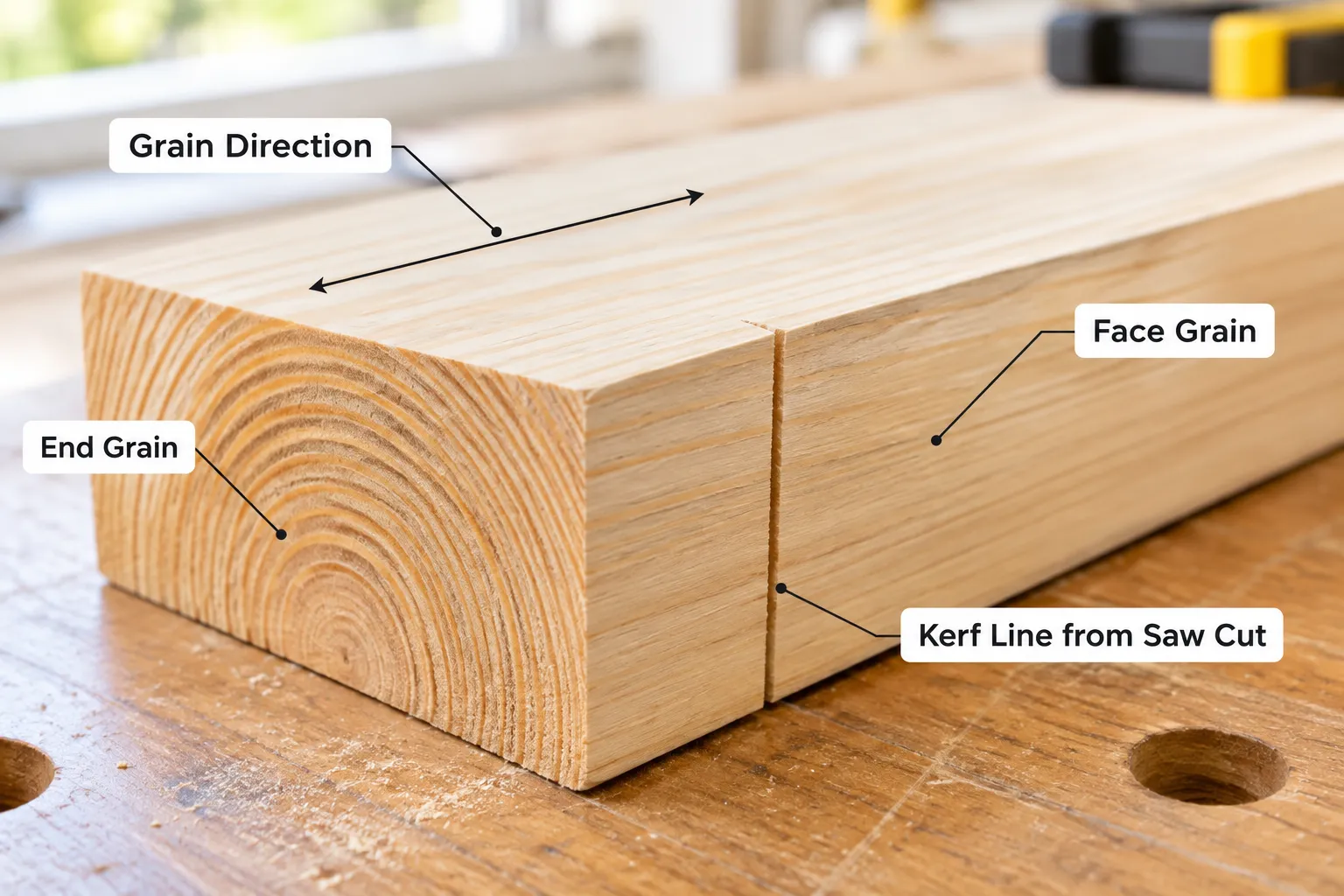
Every board has a grain direction, usually running the length of the piece. Cutting, planing, or sanding with the grain produces smooth results. Working against it tears the fibers and leaves a rough, fuzzy surface.
Three grain-related terms come up constantly:
- Face grain: the pattern visible on the wide, flat surface of a board.
- End grain: the exposed tips of the wood fibers, visible at the ends of a board; it absorbs finish differently and is harder to cut cleanly.
- Grain runout: when the grain angles out of a board rather than running straight through, weakening that section.
Why Understanding Wood Grain Matters for Beginners
Reading grain correctly prevents tear-out, splitting, and weak joints, which are the three most common frustrations new woodworkers report. Choose a board orientation that follows grain direction whenever strength or appearance matters, such as table legs or drawer fronts.
A quick example: if you’re planing a board and the surface starts tearing out in ragged patches, you’re likely working against the grain. Flip the board or reverse your tool direction, and the surface should clean up immediately.
Rip Cut vs. Crosscut: What’s the Difference
A rip cut runs parallel to the wood grain, usually along the length of a board, while a crosscut runs perpendicular to the grain, across its width. The blade, feed rate, and even the type of saw blade teeth differ between the two.
| Feature | Rip Cut | Crosscut |
|---|---|---|
| Direction | Parallel to grain | Perpendicular to grain |
| Common tool | Table saw with rip blade, circular saw | Miter saw, crosscut blade |
| Blade teeth | Fewer, larger teeth for fast fiber removal | More, smaller teeth for clean edges |
| Typical use | Cutting boards to width | Cutting boards to length |
| Common mistake | Using a crosscut blade, causing burning | Feeding too fast, causing splintering |
Choose a rip cut setup if you’re narrowing a wide board for a tabletop or shelf. Choose a crosscut setup when you’re trimming a board to its final length, such as cutting legs to size. Mixing up the blades won’t ruin your saw, but it will leave rough, burnt edges that take extra sanding to fix.
What Is a Mortise and Tenon Joint
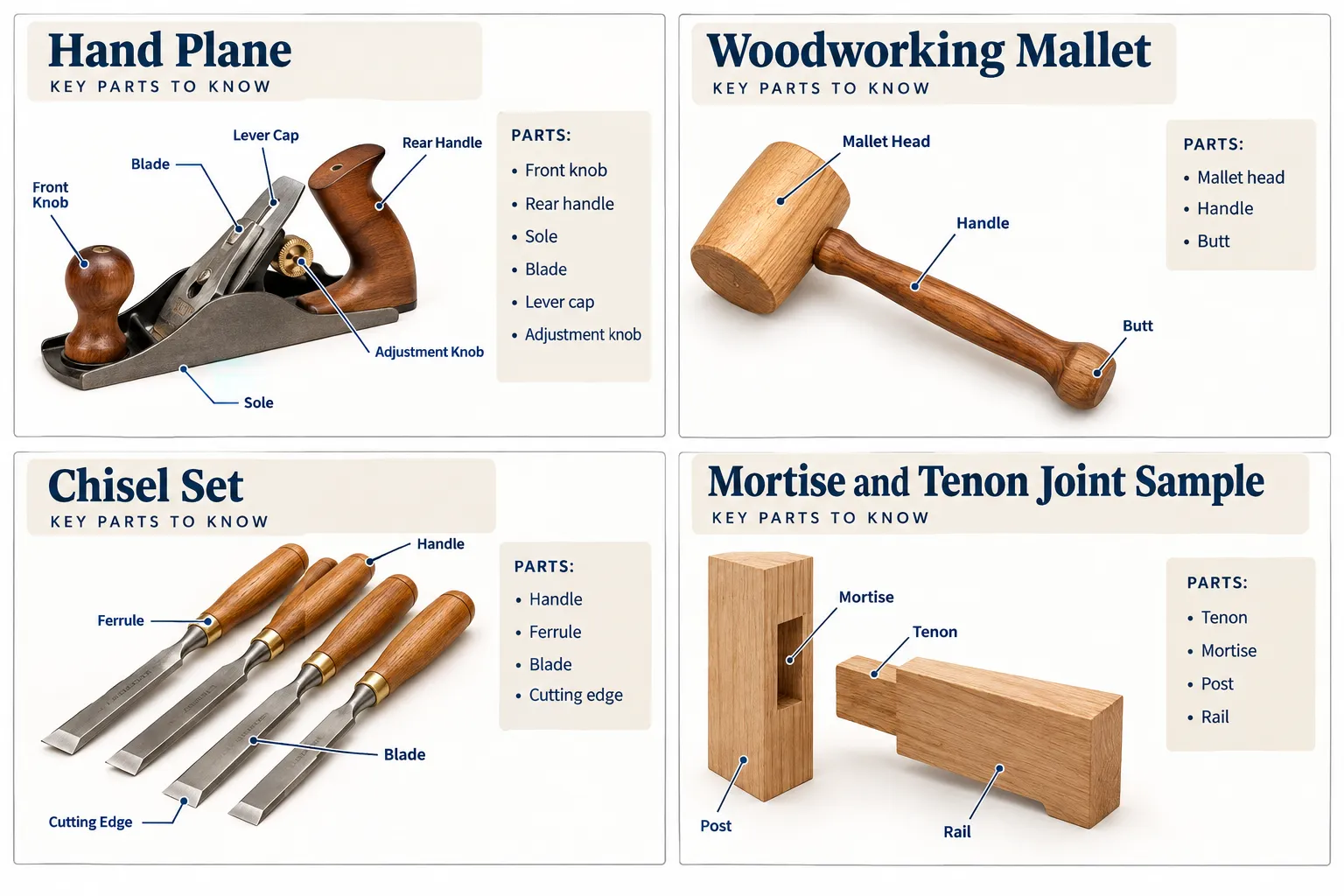
A mortise and tenon joint connects two pieces of wood by inserting a projecting tongue (the tenon) cut on one piece into a matching cavity (the mortise) cut into the other. It’s one of the oldest and strongest joinery methods in woodworking, still used in furniture, doors, and frames today.
The mortise is the hole or slot; the tenon is the tab that fits into it, usually secured with glue, a wooden peg called a dowel, or both. Beginners often meet this joint first in chair and table construction, where it resists the racking forces of daily use far better than screws alone.
If you’re choosing joinery for a project that needs to hold weight over years of use, mortise and tenon is a strong default choice. For a deeper comparison of joint types and when to use each, see this ultimate woodworking joints guide, which breaks down strength, difficulty, and appropriate applications side by side.
Hardwood vs. Softwood: What’s the Difference
Hardwood comes from deciduous trees (ones that lose their leaves), such as oak, maple, and walnut. Softwood comes from coniferous trees, such as pine, cedar, and fir. The terms describe the tree family, not the actual hardness of the wood.
This distinction trips up almost every new woodworker, because some softwoods, like southern yellow pine, are actually denser than certain hardwoods, like basswood. What matters more for project planning is the wood’s density, grain pattern, and how it responds to cutting and finishing.
- Choose hardwood if you’re building furniture that needs to resist dents and scratches, such as dining tables or cutting boards.
- Choose softwood if you’re building outdoor structures, sheds, or practice projects where cost matters more than durability.
For a closer look at species that are forgiving for new builders, check out this guide to the best hardwoods for beginners to work with.
What Does Wood Seasoning Mean
Wood seasoning is the process of reducing a board’s moisture content to a stable level before it’s used in construction or furniture. Freshly cut, or “green,” lumber holds far too much water to build with safely.
Seasoning happens two main ways: air-drying (stacking lumber outdoors or in a shed for months or years) and kiln-drying (using controlled heat to dry wood in days or weeks). Most lumber sold at home centers is already kiln-dried to around 6 to 8 percent moisture content, which is suitable for indoor furniture.
Skipping this concept causes a classic beginner mistake: building with unseasoned wood, then watching joints crack or boards cup as the wood continues to dry and shrink after the project is finished. If a board feels unusually heavy or cool to the touch, it may still be holding excess moisture.
What Does Kerf Mean and Why Does It Matter
Kerf is the width of the groove a saw blade cuts, created as the blade removes material in the form of sawdust. A standard table saw blade typically has a kerf between 1/8 and 3/16 inch, though this varies by blade.
Kerf matters because it eats into your measurements. If you’re cutting a board in half and ignore kerf, your two pieces will be slightly smaller than expected, and tight-fitting joinery can end up loose. Experienced woodworkers account for kerf by marking the waste side of a cut line, not the finished side, before sawing.
A common edge case: when cutting multiple pieces to identical length using a stop block, kerf accumulation can throw off the final piece if you don’t reset your measurement reference point each time.
What Does Finishing Mean in Woodworking
Finishing is the final stage of a project where a protective or decorative coating is applied to the wood’s surface. It shields the wood from moisture, UV light, and daily wear while often enhancing color and grain contrast.
Common finishing terms beginners encounter include:
- Stain: adds color without much surface protection on its own.
- Film finish: polyurethane, lacquer, or varnish that sits on top of the wood as a protective layer.
- Penetrating finish: oil-based products like tung oil or Danish oil that soak into the wood fibers.
- Grain raising: when water-based finishes cause wood fibers to swell and roughen slightly, requiring light sanding between coats.
Choose a penetrating oil finish if you want a natural look with easy touch-ups. Choose a film finish if the piece will face heavy daily use, like a kitchen table, since it offers stronger surface protection.
Woodworking Terminology for Tools: What Beginners Need to Know
Beginners need to recognize the names of roughly a dozen core hand and power tools before they can follow most plans or tutorials without confusion. Knowing a tool’s name also makes shopping, borrowing, and asking for advice far easier.
Priority tools to learn by name include:
- Chisel, cuts and shapes wood by hand, often paired with a mallet.
- Hand plane, shaves thin layers of wood to smooth or flatten a surface.
- Mallet, a soft-faced hammer used to drive chisels without damaging the handle.
- Try square, checks that two surfaces meet at a true 90-degree angle.
- Marking gauge, scores a line parallel to an edge for consistent cuts.
- Clamp, holds pieces together during glue-up or cutting.
- Router, a power tool that cuts grooves, edges, and decorative profiles.
- Table saw, the workshop’s primary tool for rip and crosscuts.
For hands-on setup advice, this breakdown of various tools used for woodworking explains what each tool does and when you’ll actually reach for it. If you’re specifically shopping for a smoothing plane, this guide to the best hand planes for beginners and setup tips covers sizing and setup.
How Do You Pronounce Woodworking Terms Correctly
Most woodworking terms follow straightforward English pronunciation, but a few trip up beginners because they come from older trade language. Getting them right matters mostly for confidence when talking with other woodworkers or watching tutorials.
A few commonly mispronounced terms:
- Dado, pronounced “DAY-doh,” not “DAH-doh”; a groove cut across the grain.
- Chamfer, pronounced “CHAM-fer”; a beveled edge cut at an angle.
- Rabbet, pronounced like “rabbit”; an L-shaped groove cut along an edge.
- Kerf, pronounced “kurf,” rhymes with “surf.”
If you’re unsure how a term sounds, watching a few minutes of a video tutorial where the term is spoken aloud is faster and more reliable than guessing from spelling alone.
How to Learn Woodworking Vocabulary Fast Using a Woodworking Terminology: A Glossary for Beginners
The fastest way to build vocabulary is to learn terms in the context of an actual project rather than memorizing a list in isolation. Pair every new term with a picture, a tool, or a cut you’ve actually made.
Practical ways to speed this up:
- Keep a small notebook or phone note where you jot down unfamiliar terms the moment you hit them in a plan or video.
- Watch beginner build videos with captions on, since narrators naturally repeat key terms while demonstrating them.
- Work through a structured course that introduces terminology step by step rather than all at once; this complete beginner’s guide to woodworking online training is a solid starting point for structured learning.
- Start with a simple, well-documented build, since following a step-by-step guide to woodworking projects for beginners naturally repeats key terms in context.
Avoid trying to memorize an entire glossary before touching wood. Vocabulary sticks far better once it’s attached to something you’ve physically cut, glued, or sanded.
Common Mistakes Beginners Make With Woodworking Terminology
The most frequent mistake is confusing terms that sound similar but describe different things, such as mixing up “dado” and “rabbet,” or “jointing” and “joinery.” These mix-ups lead to the wrong cut or the wrong tool being used.
Other recurring mistakes:
- Assuming “hardwood” always means harder or more durable wood, when it actually refers to tree type.
- Ignoring kerf width when measuring for tight-fitting joints.
- Using “finish” and “stain” interchangeably, when stain adds color and finish adds protection.
- Confusing “plane” the tool with “plane” the flat surface reference, which appear in the same sentence in many tutorials.
Edge case worth noting: regional differences exist too. Some older plans or British sources use “jointer” differently than American ones, so always check the context of the tool being described, not just the word.
Essential vs. Nice-to-Know Terms: Building Your Own Woodworking Terminology: A Glossary for Beginners
Beginners genuinely need about 25 to 30 core terms to follow most plans and tutorials; everything beyond that can be learned as specific projects require it. Trying to absorb an entire trade dictionary before your first build slows progress without adding real benefit.
Must-know now: grain, rip cut, crosscut, kerf, mortise, tenon, dado, rabbet, hardwood, softwood, seasoning, stain, finish, clamp, chisel, plane, square, miter, dowel, pilot hole, countersink, sanding grit, stock, jig, and joinery.
Learn as needed later: veneer, marquetry, spline, mortising machine, case hardening, quarter-sawn, rift-sawn, and specialty joint names like bridle or box joint.
If a term shows up in a plan you’re actively building from, learn it immediately. If it only appears in advanced furniture-making content you’re not attempting yet, bookmark it and move on. This approach matches how most hobbyists naturally pick up woodworking joinery and techniques over time, project by project rather than all at once.
Frequently Asked Questions
Do I really need to memorize all this before I start building?
No. Learn the 25 to 30 core terms listed above first, then pick up specialized vocabulary as individual projects call for it.
What’s the single most confusing term pair for beginners?
Hardwood versus softwood causes the most confusion, since people assume it describes hardness rather than tree type.
Is there a difference between “stock” and “lumber”?
Not really in casual use. “Stock” usually refers to the specific piece of wood you’re working with right now, while “lumber” refers to wood in general supply.
Why do plans list measurements with “kerf allowance” built in?
Because the saw blade removes a sliver of material with every cut, and ignoring that width throws off final piece sizes on tight joinery.
What should I check if a joint feels loose after glue-up?
Check whether the mortise was cut too wide for the tenon, or whether the wood had excess moisture (wasn’t properly seasoned) and shrank after assembly.
Are woodworking glossary apps worth using?
A dedicated app isn’t required. A simple notes app, a printed glossary bookmarked on your phone, or the reference section of a structured course works just as well for most beginners.
How long does it typically take to feel comfortable with the vocabulary?
Most beginners report feeling comfortable after three to five completed projects, since repeated exposure in context builds retention faster than flashcards.
Conclusion
Vocabulary is the first tool you need in woodworking, and it costs nothing but attention. Once terms like grain, kerf, mortise and tenon, and seasoning stop feeling foreign, plans and tutorials stop feeling like obstacles and start reading like instructions you can actually follow.
Start small. Pick one beginner project, keep this Woodworking Terminology: A Glossary for Beginners nearby, and look up any unfamiliar word the moment it appears rather than skipping past it. Within a few builds, the language of the workshop will feel like your own.
Products, Tools, and Resources Worth Exploring
A few practical next steps for beginners ready to put this vocabulary to use:
- A basic beginner hand tool woodworking kit gives you the chisel, mallet, and marking tools referenced throughout this glossary, all in one starting bundle.
- If you’re still mapping out your first few builds, this beginner woodworking guide covering tools, projects, and tips ties terminology directly to action.
- Before investing heavily, it helps to know what you’re getting into financially; this honest cost breakdown of starting woodworking sets realistic expectations.