Best Rust-Proof Hardware for Outdoor Furniture: Ultimate Guide
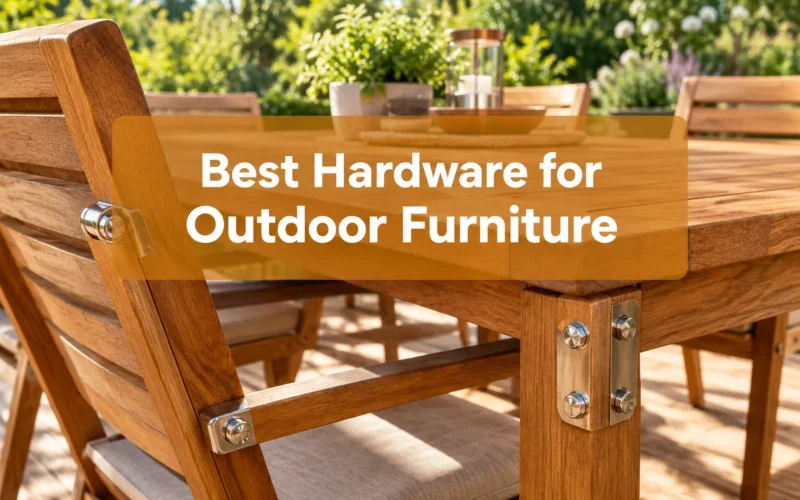
A single rusted bolt can destroy a beautiful piece of outdoor furniture. Not because the wood rots or the finish fades first, but because corrosion spreads from metal to wood grain, staining and weakening the structure from the inside out. Choosing the best hardware for outdoor furniture is one of the most overlooked decisions in any outdoor build, and getting it wrong costs far more in repairs than getting it right from the start.
This rust-proof guide covers every material, size, and situation a beginner or hobbyist woodworker needs to know before buying a single screw.
Find this useful? Add us as a preferred source on Google and more of what we publish will show up in your results.
Key Takeaways
- 316-grade stainless steel is the best all-around rust-proof hardware for outdoor furniture, especially in coastal or humid climates
- Aluminum hardware is lightweight and corrosion-free but not strong enough for structural joints under heavy load

- Regular steel or zinc-plated hardware will rust outdoors, often within one season, and should never be used for outdoor builds
- Galvanized hardware is acceptable for dry inland climates but is not reliable near salt air or standing moisture
- Silicon bronze is the top choice for teak furniture because it reacts chemically with teak’s natural oils to form a protective bond
- Hardware sizing depends on wood thickness: a general rule is to use fasteners at least twice as long as the top piece is thick
- Sealing pilot holes with exterior wood glue or sealant before driving fasteners significantly extends hardware life
- Quality rust-proof hardware typically costs two to four times more than standard hardware but lasts five to ten times longer outdoors
- Humid climates and coastal areas demand marine-grade (316) stainless steel or silicon bronze, with no exceptions
- Annual inspection and light wax application on exposed hardware heads can add years of service life
What Is the Best Rust-Proof Hardware for Outdoor Furniture
The best rust-proof hardware for outdoor furniture is 316-grade stainless steel for most applications, and silicon bronze for teak-specific builds. Both materials resist corrosion in rain, humidity, and even salt air without special coatings or treatments.
For woodworkers building outdoor chairs, tables, benches, or loungers, the hardware category includes screws, bolts, nuts, washers, hinges, brackets, and carriage bolts. Every single one of these needs to be corrosion-resistant, not just the visible ones.
Material quick-reference:
- 316 stainless steel: Best overall. Marine-grade. Handles salt air, humidity, and UV without degrading.
- 304 stainless steel: Good for inland use. Slightly less corrosion-resistant than 316 but more widely available and less expensive.
- Silicon bronze: Best for teak. Naturally corrosion-proof and chemically compatible with teak’s oils.
- Aluminum: Good for non-structural hardware like hinges or decorative brackets. Not strong enough for load-bearing joints.
- Hot-dip galvanized: Acceptable for dry inland climates only. Avoid near salt water or in consistently wet conditions.
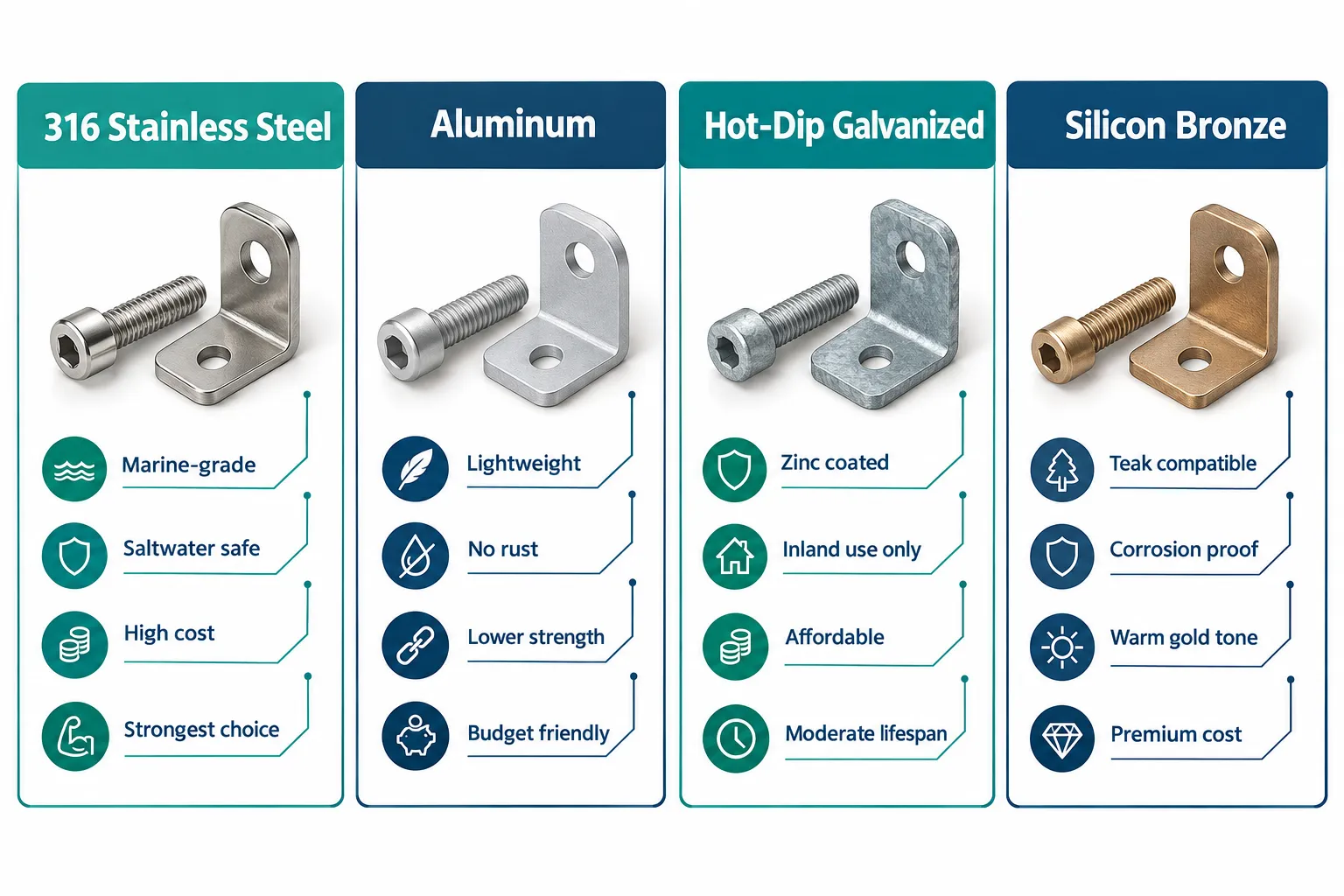
Stainless Steel vs Aluminum Outdoor Furniture Hardware: Which Is Better
Stainless steel is stronger and more durable than aluminum for outdoor furniture hardware. Aluminum is lighter and completely rust-proof, but it lacks the tensile strength needed for joints that bear weight or stress.
For structural connections, like table leg bolts, chair arm brackets, or bench seat fasteners, stainless steel wins every time. Aluminum hardware is best reserved for lightweight applications: cabinet hinges on an outdoor storage box, decorative corner brackets, or slide bolts on a gate.
When to choose stainless steel over aluminum:
- Joints that bear body weight (chairs, benches)
- Connections exposed to torque or lateral stress (table legs, armrests)
- Any hardware driven into end grain, where holding power matters most
When aluminum works fine:
- Hinges on lightweight lids or doors
- Decorative surface hardware
- Non-load-bearing brackets on planters or small shelving
One common mistake beginners make is assuming “rust-proof” means “strong enough.” Aluminum won’t rust, but it will bend or strip under stress that stainless steel handles without issue.
Can You Use Regular Bolts and Screws on Outdoor Furniture
No. Standard steel bolts and zinc-plated screws will rust outdoors, often within a single wet season. The zinc plating on common hardware-store screws is too thin to provide meaningful protection once the coating is scratched during installation.
Even screws labeled “galvanized” at a general hardware store are often electroplated, not hot-dip galvanized, and they fail quickly in outdoor conditions. The rust then bleeds into the surrounding wood, leaving dark staining that’s nearly impossible to remove without sanding deep into the surface.
The short version: if the packaging doesn’t say 304 stainless, 316 stainless, silicon bronze, or hot-dip galvanized, don’t use it outdoors.
Is Galvanized Hardware Good Enough for Outdoor Use
Hot-dip galvanized hardware is good enough for outdoor furniture in dry inland climates, but it is not the best choice for humid regions or coastal environments. The thick zinc coating on hot-dip galvanized fasteners provides solid corrosion resistance, but zinc eventually breaks down when exposed to salt air or constant moisture.
For a backyard table in Kansas or Colorado, hot-dip galvanized bolts will likely last a decade or more. For a porch in Florida or a deck in coastal Maine, they’ll show rust within two to three years.
Bottom line on galvanized hardware:
- Hot-dip galvanized: acceptable for dry climates, not for coastal or high-humidity use
- Electroplated (zinc-plated): not acceptable for any outdoor use
- Mechanically galvanized: similar performance to hot-dip, better than electroplated
What Hardware Should You Use for Teak Outdoor Furniture
Silicon bronze is the best hardware for teak outdoor furniture. Teak contains natural oils and silica that can react with stainless steel over time, sometimes causing a dark staining around fastener heads. Silicon bronze is chemically inert with teak’s oils and forms a tight, corrosion-resistant seal at the fastener hole.
316 stainless steel is also widely used for teak and performs well, particularly when pilot holes are sealed before driving screws. Many professional outdoor furniture builders use stainless steel bolts for structural connections and silicon bronze screws for surface fastening where appearance matters.
If you’re working on a teak project and want to understand wood selection more broadly, this best wood for furniture making comparison guide covers the properties that affect hardware compatibility across different species.
Best Alternatives to Stainless Steel for Outdoor Hardware
The best alternatives to stainless steel for outdoor furniture hardware are silicon bronze, hot-dip galvanized steel, and marine-grade aluminum. Each has a specific use case where it outperforms or matches stainless steel at a lower cost or with a practical advantage.
- Silicon bronze: Best for teak and cedar. More expensive than stainless but chemically superior for oily hardwoods.
- Hot-dip galvanized: Best for large structural fasteners (lag bolts, carriage bolts) where stainless steel equivalents are hard to find or very expensive.
- Coated deck screws (ACQ-rated): Acceptable for decking applications but not ideal for fine furniture joints. Look for screws rated for ACQ-treated lumber.
- Plastic or nylon hardware: Works for non-structural applications like cable guides, bumpers, or glide feet. Zero corrosion risk.
Why Is My Outdoor Furniture Hardware Rusting
Outdoor furniture hardware rusts because the fasteners were not rated for exterior use, the protective coating was damaged during installation, or the environment is more corrosive than the hardware grade can handle.
The three most common causes:
- Wrong material: Standard steel or thin-plated screws were used instead of stainless or bronze.
- Installation damage: Driving screws without pilot holes strips the coating at the entry point, exposing bare steel to moisture.
- Grade mismatch: 304 stainless was used in a coastal or high-humidity environment where only 316 performs reliably.
A fourth cause that often surprises beginners: dissimilar metals. When aluminum hardware contacts stainless steel, or when copper flashing touches galvanized fasteners, galvanic corrosion accelerates both materials. Always use hardware made from a single metal family throughout a project.
What Size Hardware Do You Need for Outdoor Chairs and Tables
The correct hardware size depends on the thickness of the wood being joined. A reliable starting rule is to use screws or bolts at least twice as long as the top piece is thick, with the fastener penetrating at least 1 inch into the receiving piece.
Common sizing guidelines for outdoor furniture:
| Application | Screw/Bolt Size | Notes |
|---|---|---|
| Seat slats to frame | #10 x 2″ or 2.5″ | Pre-drill to prevent splitting |
| Table leg to apron | 3/8″ x 3.5″ carriage bolt | Use washer and lock nut |
| Chair arm to post | #12 x 2.5″ or 5/16″ bolt | Countersink for clean finish |
| Bench legs to stretcher | 3/8″ x 4″ lag bolt | Pilot hole required |
| Hinge to frame | #8 x 1.25″ | Match screw to hinge spec |
For joinery that needs to hold tight over years of outdoor use, pairing the right fastener with the right joint makes a big difference. The guide on best joinery for table legs that won’t loosen over time is worth reading alongside this one.
Best Hardware for Outdoor Furniture in Humid Climates
In humid climates, the only reliable choices are 316 stainless steel and silicon bronze. High humidity accelerates corrosion on every other metal, including 304 stainless, galvanized steel, and aluminum alloys with low chromium content.
Coastal environments add salt to the equation, which is even more aggressive than humidity alone. Marine builders and outdoor furniture professionals in coastal regions use 316 stainless as a baseline standard, not a premium upgrade.
For woodworkers building outdoor furniture in the American Southeast, Pacific Northwest, Hawaii, or any coastal region, treat 316 stainless as the minimum acceptable grade for every structural fastener.
How to Prevent Outdoor Furniture Hardware from Corroding
Even the best hardware benefits from proper installation and basic maintenance. Corrosion prevention starts at the moment of installation, not after the furniture is finished.
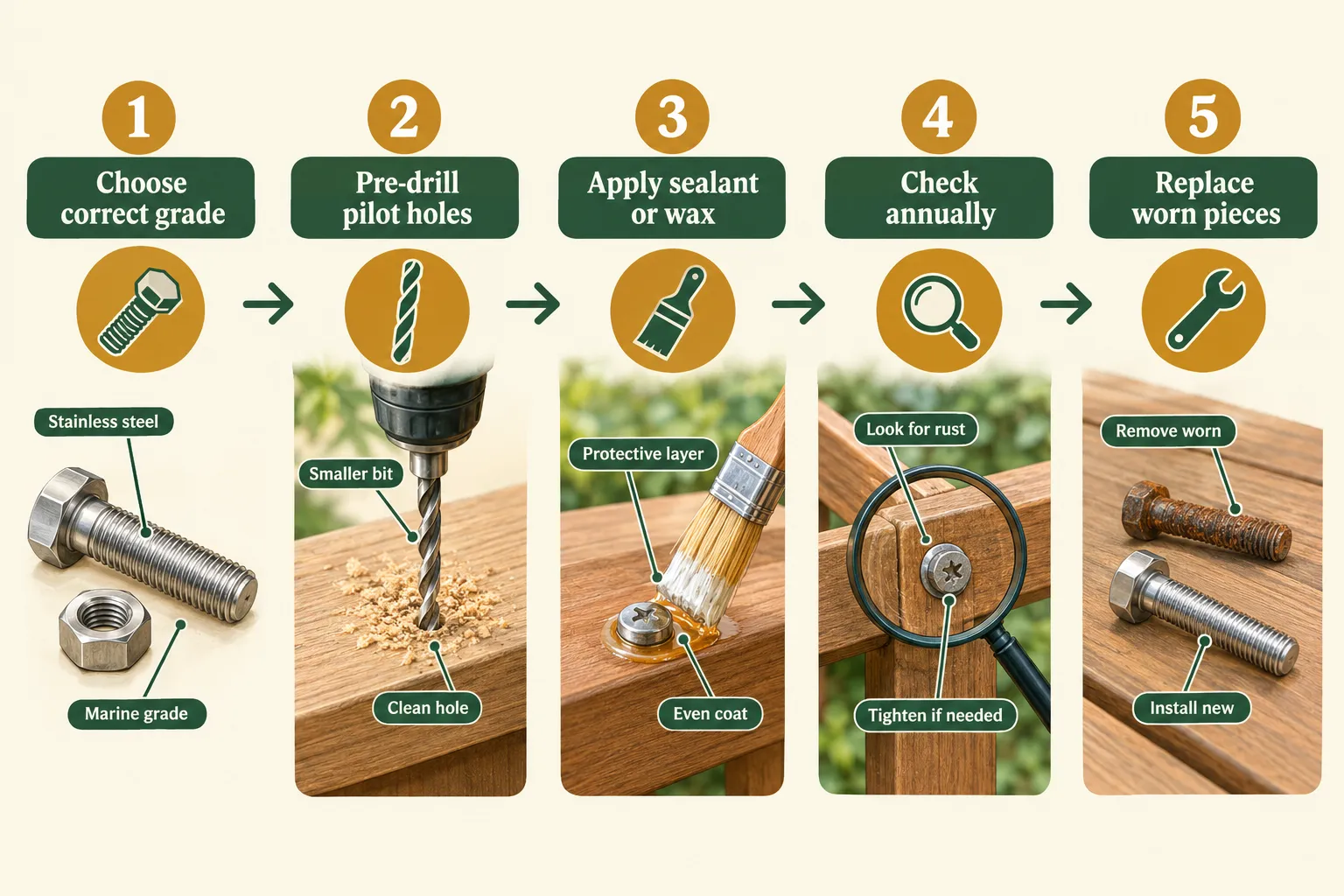
Five steps that extend hardware life significantly:
- Pre-drill pilot holes slightly smaller than the screw shank to avoid coating damage from forcing the fastener.
- Apply a small amount of paste wax or exterior sealant to the fastener threads before driving. This fills micro-gaps and slows moisture entry.
- Countersink screw heads and fill with a matching exterior wood filler or plug to reduce direct water exposure on the head.
- Inspect annually in spring before the outdoor season begins. Look for early surface rust, staining, or loose fasteners.
- Tighten or replace any fastener that shows surface oxidation before it spreads to the surrounding wood.
For projects stored in a workshop or shed between seasons, keeping hardware dry during off-season storage makes a measurable difference. If you’re setting up a proper workspace, the workshop shed insulation guide covers how to manage moisture in a backyard shop environment.
Do You Need to Treat or Seal Outdoor Hardware
For 316 stainless steel and silicon bronze, sealing is not required but is still beneficial. For galvanized hardware, a light coat of paste wax on exposed heads adds a meaningful layer of protection. For any hardware in a high-humidity or coastal environment, sealing the wood around the fastener is at least as important as the fastener itself.
Unsealed end grain around a bolt hole acts like a wick, drawing moisture directly to the fastener shank. Applying exterior wood glue, epoxy, or a penetrating oil sealer to pilot holes before driving fasteners is one of the most effective and underused techniques in outdoor furniture building.
How Long Does Rust-Proof Outdoor Hardware Last
Quality 316 stainless steel and silicon bronze hardware, properly installed, can last 20 to 30 years in most outdoor environments. In dry inland climates, the hardware often outlasts the wood it’s fastening. In coastal or tropical environments, 316 stainless typically lasts 10 to 15 years before showing any surface oxidation.
Hot-dip galvanized hardware in dry climates lasts 10 to 15 years. In humid or coastal conditions, expect 3 to 7 years before visible rust appears.
The hardware’s lifespan is also affected by the wood species. Dense, oily hardwoods like teak and ipe hold fasteners tightly and don’t absorb as much moisture as softer woods, which extends hardware life. For a deeper look at how wood species affect outdoor project durability, the oak vs. maple hardwood comparison offers useful context on density and moisture resistance.
How Much Does Quality Outdoor Furniture Hardware Cost
Quality rust-proof outdoor furniture hardware costs roughly two to four times more than standard hardware-store fasteners. A box of 100 standard zinc-plated screws might cost $8 to $12. The equivalent in 316 stainless steel typically runs $20 to $40 for the same count, depending on size and supplier.
Silicon bronze screws are the most expensive option, often $40 to $80 per 100 count for common furniture sizes. Carriage bolts and lag bolts in 316 stainless are priced per unit and can run $1 to $4 each for larger sizes.
For a typical outdoor dining table and four chairs, the total hardware cost using 316 stainless steel usually falls between $30 and $80, depending on the design complexity. That’s a small fraction of the total project cost and the single most important investment in long-term durability.
Where to Buy Quality Outdoor Furniture Hardware
Quality outdoor furniture hardware is available from specialty fastener suppliers, marine hardware stores, and select online retailers. General hardware chains like Home Depot and Lowe’s carry 304 stainless and some hot-dip galvanized options, but their selection of 316 stainless and silicon bronze is limited.
Best sources for rust-proof outdoor hardware:
- Specialty fastener suppliers (Fastenal, Bolt Depot, McFeely’s): Wide selection of grades, sizes, and materials with clear labeling
- Marine hardware suppliers (West Marine, Defender): Excellent for 316 stainless and silicon bronze, especially in coastal areas
- Online retailers (Amazon, McMaster-Carr): Good for bulk orders; always verify the grade is printed on the packaging or product listing
- Woodworking specialty stores: Often carry silicon bronze and stainless in furniture-appropriate sizes
When ordering online, look for hardware that explicitly states the alloy grade (316, 304, C655 silicon bronze) on the product listing. If the grade isn’t listed, assume it’s a lower-quality option.
For beginners putting together their first outdoor project, the beginner woodworking guide is a solid starting point for understanding tools, materials, and project planning before the build begins.
FAQ
Can I use indoor furniture hardware outside if I paint over it?
No. Paint over standard steel hardware delays rust but doesn’t prevent it. Once moisture finds a scratch or chip in the paint, corrosion starts immediately underneath. Always use hardware rated for exterior use.
What’s the difference between 304 and 316 stainless steel for outdoor furniture?
316 stainless contains molybdenum, which makes it significantly more resistant to salt and chloride corrosion than 304. For inland use, 304 is adequate. For coastal or humid environments, 316 is the correct choice.
Will stainless steel hardware stain my wood?
316 stainless steel rarely stains wood. Lower grades of stainless can leave faint marks in some species, particularly teak. Silicon bronze is the safest choice if staining is a concern.
Do I need washers with outdoor furniture bolts?
Yes. Washers distribute the clamping load across a wider area, which prevents the bolt head from pulling into the wood over time. Use stainless or bronze washers that match your fastener material.
Can I mix stainless steel and galvanized hardware on the same project?
It’s not recommended. Mixing metals creates conditions for galvanic corrosion, where one metal accelerates the deterioration of the other. Use one metal type throughout each project.
How do I remove rusted hardware from outdoor furniture without damaging the wood?
Apply a penetrating oil (like PB Blaster) and let it soak for 24 hours. Use a screw extractor or impact driver on low torque. If the head is stripped, use a rotary tool to cut a new slot. Avoid prying, which splits wood grain.
Is silicon bronze the same as regular bronze?
No. Silicon bronze (typically C655 alloy) contains copper, zinc, and silicon, which gives it superior corrosion resistance compared to standard bronze. It’s specifically used in marine and outdoor applications.
What screws should I use for pressure-treated lumber on outdoor furniture?
Use hot-dip galvanized, 316 stainless, or ACQ-rated coated screws. The chemicals in pressure-treated lumber corrode standard galvanized and most coated screws quickly.
How do I know if my hardware is really 316 stainless and not a cheaper grade?
Buy from reputable fastener suppliers that provide material certifications. Look for markings on bolt heads (A4 marking indicates 316-grade in metric hardware). Avoid unmarked bulk hardware from unknown sources.
Can I reuse outdoor hardware when I refinish or repair furniture?
Reuse hardware only if it shows no surface rust, the threads are clean and undamaged, and the coating is intact. If there’s any doubt, replace it. Hardware is far less expensive than repairing wood damage caused by failing fasteners.
Conclusion
Selecting the best hardware for outdoor furniture is not a detail to figure out after the build is designed. It’s a foundational decision that determines how long the piece lasts, how it looks after a few seasons, and how much maintenance it demands.
For most outdoor furniture projects, 316 stainless steel is the right answer. It handles humidity, rain, and salt air without special treatment, it’s widely available, and it’s strong enough for every structural application. Silicon bronze is the better choice for teak or cedar projects where chemical compatibility and appearance matter. Galvanized hardware works in dry inland climates but shouldn’t be trusted anywhere moisture is consistent.
The practical steps are straightforward: choose the right grade for the climate, pre-drill every hole, seal the wood around fasteners, and inspect annually. Those four habits, combined with quality materials, will keep outdoor furniture solid and attractive for decades.
Actionable next steps:
- Identify the climate where the furniture will live (coastal, humid, or dry inland) before buying any hardware
- Source 316 stainless steel or silicon bronze from a specialty fastener supplier rather than a general hardware store
- Pre-drill all pilot holes and seal them with exterior sealant or epoxy before driving fasteners
- Review the furniture building plans and DIY woodworking projects section for project-specific hardware guidance
- Check the best hardwoods for beginners guide to match wood species with the right fastener type
Products, Tools, and Resources
Hardware to source:
- 316 stainless steel screws and bolts: Available from Bolt Depot, McFeely’s, and Fastenal in furniture-appropriate sizes. Look for A4-marked metric bolts or explicitly labeled 316 alloy on imperial hardware.
- Silicon bronze screws: West Marine and specialty woodworking suppliers carry C655 silicon bronze in #8, #10, and #12 sizes suitable for furniture work.
- Hot-dip galvanized carriage bolts: Available at most lumber yards in 3/8″ and 1/2″ diameters for structural outdoor connections.
Tools that help:
- A quality countersink bit set makes clean, professional fastener seats that reduce water pooling around screw heads. Paired with the right driver, it’s one of the most-used tools in outdoor furniture work.
- A torque-limiting driver or drill with adjustable clutch prevents over-driving stainless screws, which strips the head and damages the protective oxide layer.
Further reading on Woodworking Guru:
- Essential equipment used in woodworking for perfect furniture covers the tools that make hardware installation cleaner and more precise
- Step-by-step guide to woodworking projects for beginners walks through complete builds where hardware selection is covered in context