
Best Outdoor Furniture Finish: Oil vs Marine Varnish Guide

Most outdoor furniture fails not because of poor construction, but because of the wrong finish. Choosing between oil and marine varnish is one of the most consequential decisions you’ll make when building or refinishing outdoor pieces, and getting it wrong means watching your hard work gray, crack, or peel within a single season. This guide breaks down the best outdoor furniture finish, oil vs. marine varnish, so you can make a confident, informed choice based on your wood type, climate, and how much maintenance you’re willing to do.
Key Takeaways
- Teak oil penetrates the wood and provides a natural, matte look with flexible protection, but needs reapplication every 6 to 12 months.

- Marine varnish forms a hard surface film with strong UV and water resistance, lasting 2 to 3 years before a full recoat is needed.
- Marine varnish is better for high-humidity and rainy climates; oil is better for a natural, low-sheen appearance.
- Teak oil works on most outdoor hardwoods, not just teak, but performs best on dense, oily species.
- You cannot apply marine varnish directly over teak oil without thorough stripping and sanding first.
- Sanding between coats is required for marine varnish; it is optional but beneficial for oil.
- Oil is generally easier for beginners to apply; marine varnish demands more preparation and technique.
- For furniture in direct sun all day, marine varnish with UV inhibitors offers more reliable long-term protection.
- Oil refinishing is less expensive upfront; marine varnish costs more initially but requires fewer applications over time.
Find this useful? Add us as a preferred source on Google and more of what we publish will show up in your results.
What Is the Difference Between Teak Oil and Marine Varnish for Outdoor Furniture
Teak oil is a penetrating finish that soaks into the wood fibers, nourishing and protecting from the inside out. Marine varnish is a film-forming finish that sits on top of the wood surface, creating a hard, protective shell. These two products work in fundamentally different ways, which is why they suit different situations.
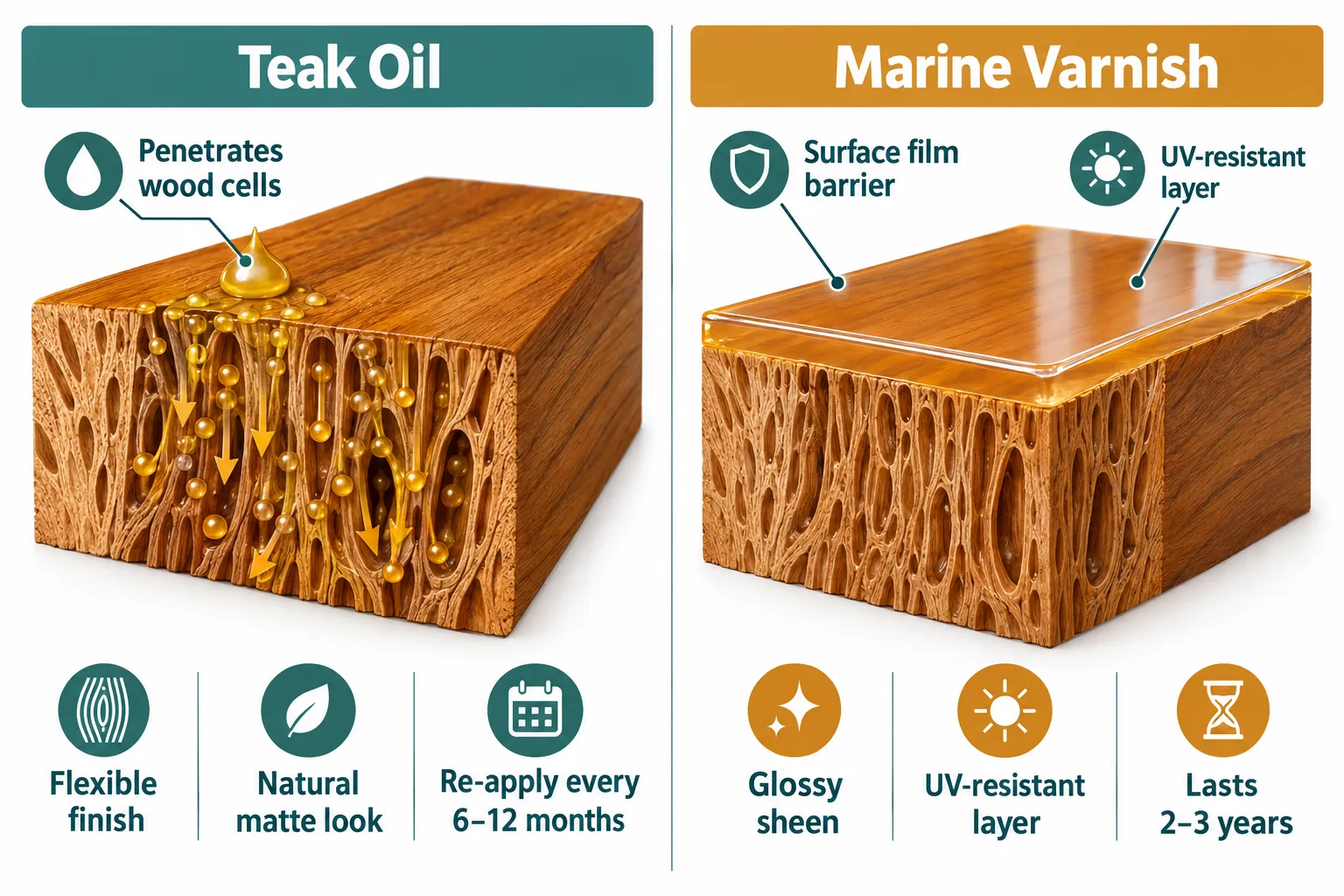
Teak oil (often a blend of linseed or tung oil with mineral spirits and drying agents) keeps wood flexible and prevents it from drying out and cracking. Because it penetrates rather than coats, it won’t peel or flake. The tradeoff is that it breaks down faster and needs more frequent reapplication.
Marine varnish, originally developed for boat hulls and decks, contains alkyd or polyurethane resins combined with UV absorbers. It builds a thick, glossy barrier that blocks moisture and UV radiation far more effectively than oil. The surface can yellow over time, however, and once it starts to fail, it peels rather than fading gracefully.
Choose teak oil if: you want a low-maintenance, natural-looking finish and don’t mind reapplying once or twice a year.
Choose marine varnish if: you want maximum weather protection and prefer a longer interval between full refinishing jobs.
How Long Does Marine Varnish Last on Outdoor Wood Compared to Oil
Marine varnish typically lasts 2 to 3 years on outdoor furniture before a full strip-and-recoat is needed, though annual light maintenance coats can extend that significantly. Teak oil, by contrast, needs reapplication every 6 to 12 months depending on sun and rain exposure.
The gap in longevity comes down to film thickness. Marine varnish builds up in layers, each coat adding to a cumulative barrier. A properly applied 4- to 6-coat system can handle years of UV exposure before the finish degrades enough to let moisture in. Teak oil, being a penetrating finish, gradually oxidizes and weathers out of the wood, leaving the surface increasingly exposed.
One practical note: a marine varnish finish that’s cracking or peeling is actually harder to maintain than oil, because you must strip the old film completely before recoating. Oil simply fades, and a light sand and fresh coat restores it quickly.
Can You Use Teak Oil on All Types of Outdoor Wood, or Just Teak
Teak oil can be used on most outdoor hardwoods, not just teak. It works well on teak, iroko, ipe, mahogany, and similar dense tropical species. It’s less effective on softwoods like pine or cedar, which absorb it unevenly and may require more frequent reapplication.
Despite the name, teak oil was not designed exclusively for teak. The name is more of a marketing convention than a technical specification. That said, teak and other naturally oily hardwoods respond particularly well to oil finishes because their existing natural oils create a compatible base. If you’re working with a more porous or resinous wood, check out our guide to best wood for furniture making to understand how wood species affect finish choices.
Edge case: Very oily woods like fresh teak or ipe can actually resist both oil and varnish finishes if not properly prepared. Wiping the surface with a solvent like acetone or naphtha before applying any finish removes surface oils and dramatically improves adhesion.
Does Marine Varnish Need to Be Reapplied, and How Often
Yes, marine varnish does need periodic maintenance, but far less often than oil. A well-maintained varnish job may only need a light scuff-sand and one or two fresh coats every 1 to 2 years to stay in good condition. A full strip and recoat is typically needed every 3 to 5 years.
The key is catching it early. When marine varnish starts to show chalking, small cracks, or lifting edges, a maintenance coat applied promptly can prevent a full refinishing job. If you let it go until the varnish is peeling in sheets, stripping back to bare wood is the only option.
A simple annual inspection in spring, before the outdoor season begins, is all it takes to stay ahead of the maintenance curve.
Which Finish Is Better for High Humidity or Rainy Climates
Marine varnish is the better choice for high-humidity and rainy climates. Its film-forming barrier actively blocks water vapor and liquid moisture from penetrating the wood, which is critical in coastal, tropical, or consistently wet environments. Teak oil, while it does offer some moisture resistance, allows more vapor exchange and breaks down faster when constantly exposed to rain.
In climates with heavy rainfall, teak oil can actually promote mildew growth if it’s not reapplied frequently enough, because the partially degraded oil creates a surface that traps moisture without fully repelling it. Marine varnish, when intact, leaves no such opportunity.
For outdoor furniture that lives year-round in a humid or rainy region, marine varnish with a quality UV-inhibitor formula is the most reliable long-term solution. Pair this with the right wood species for your climate. For a deeper look at how different hardwoods handle moisture, see our comparison of oak vs. maple hardwood and how species characteristics affect outdoor performance.
Is Teak Oil or Marine Varnish Easier to Apply Yourself
Teak oil is significantly easier for beginners to apply. You wipe it on with a cloth or brush, let it soak in for 15 to 30 minutes, then wipe off the excess. There’s minimal risk of runs, drips, or brush marks. Mistakes are easy to correct.
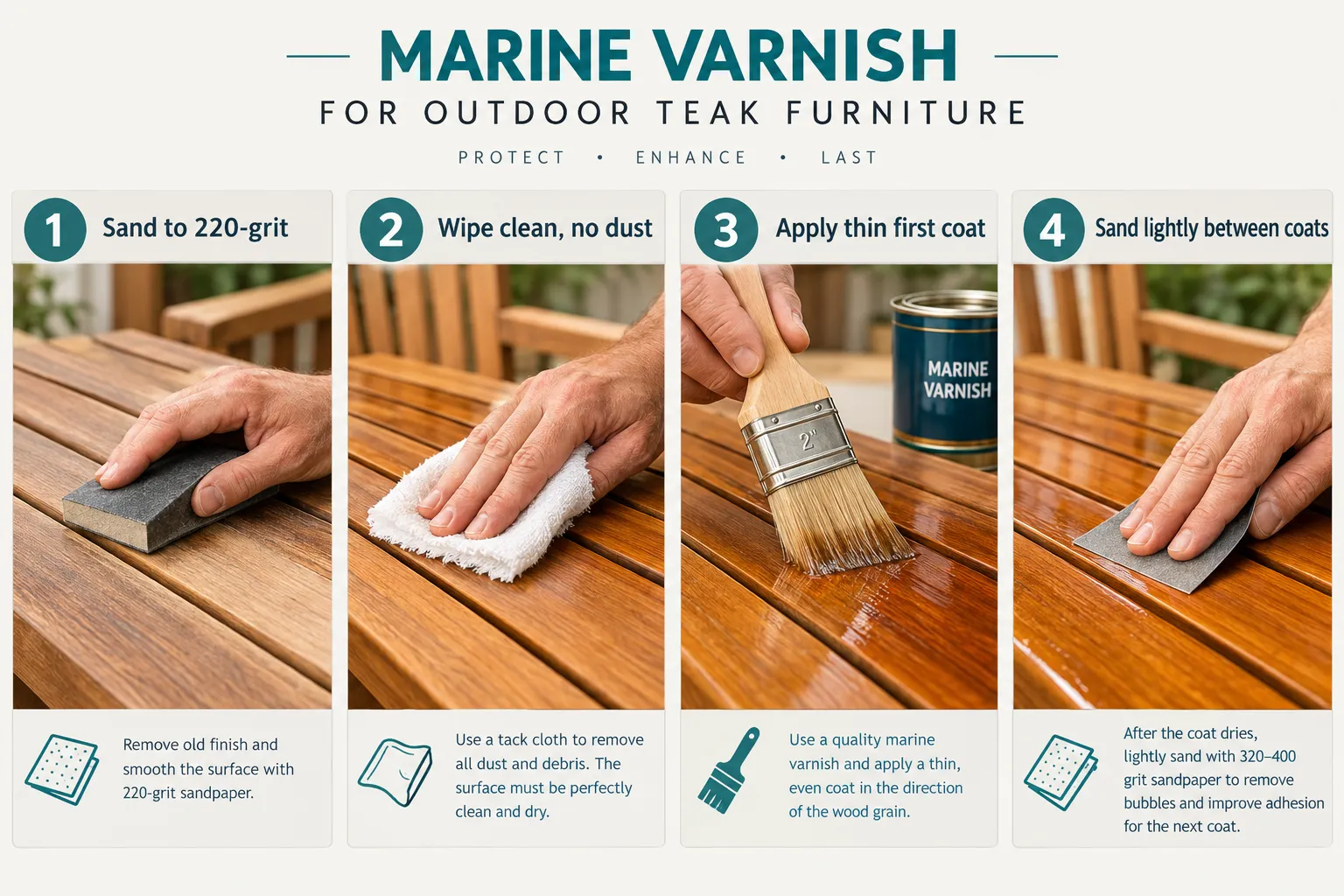
Marine varnish demands more preparation and patience. Here’s what the process typically looks like:
- Sand the bare wood to 220-grit and remove all dust with a tack cloth.
- Apply a thin first coat and allow it to cure fully (usually 24 hours).
- Lightly sand with 320-grit between every coat to improve adhesion and remove any dust nibs.
- Apply 4 to 6 coats total, sanding between each one.
- Allow the final coat to cure for at least 48 to 72 hours before use.
Brush technique matters with varnish. Working in a dust-free environment, using a quality natural-bristle brush, and applying thin coats rather than thick ones are all critical to a smooth, professional result. For those just starting out, reviewing essential equipment used in woodworking can help ensure you have the right tools before you start.
What Happens If You Mix Oil and Varnish on Outdoor Furniture
Mixing oil and varnish on the same piece of furniture creates adhesion problems and an uneven, unreliable finish. Oil-soaked wood resists film-forming finishes because the residual oil prevents the varnish from bonding properly to the wood surface.
If you apply marine varnish over a surface that still has oil in it, you’ll likely see the varnish peel or delaminate within months. The two products are fundamentally incompatible when layered in that order.
The reverse, applying oil over old varnish, is also problematic. The oil cannot penetrate through the varnish film, so it simply sits on the surface and stays tacky or washes off without providing any protection.
The rule is simple: pick one system and stick with it. If you’re switching from oil to varnish, strip the surface completely and sand back to bare wood before proceeding.
Can You Apply Marine Varnish Over Existing Teak Oil
No, you cannot apply marine varnish directly over existing teak oil and expect reliable results. The oil must be fully removed first. This means stripping the old finish, sanding thoroughly (starting at 80-grit and working up to 220-grit), and wiping the surface with a solvent to remove any residual oil before the first varnish coat goes on.
Some woodworkers attempt to shortcut this by waiting a long time for the oil to fully oxidize out of the wood. While this can work in theory, it’s difficult to judge when the wood is truly ready, and the risk of adhesion failure is high. The safest approach is always to strip and sand back to bare wood.
Is Marine Varnish Waterproof, or Does Oil Protect Better Against Water
Marine varnish provides superior waterproofing compared to teak oil. When properly applied in multiple coats, marine varnish creates a near-impermeable barrier against liquid water and water vapor. Teak oil offers moderate water resistance but allows some vapor exchange, which means moisture can still work its way into the wood over time.
For furniture that will be left outdoors through rain and morning dew, marine varnish is the more reliable moisture barrier. That said, once a varnish finish starts to fail (cracks, chips, or peeling), water can get trapped beneath the film and cause more damage than a simple oil finish would have allowed.
Oil finishes fail more gracefully. They weather slowly and evenly, and the wood can dry out naturally between wet periods. For furniture in a covered patio or one that’s brought indoors during wet seasons, oil can be entirely adequate.
How Much Does It Cost to Refinish Outdoor Furniture with Oil vs. Varnish
Oil is less expensive upfront, but the total cost over several years can be comparable to varnish when you factor in the frequency of reapplication. A quality teak oil product typically runs between $15 and $40 per quart, and a quart covers a standard dining table and chair set with one coat. Because you’re reapplying every 6 to 12 months, annual costs add up.
Marine varnish products range from $25 to $60 per quart for quality exterior-grade formulas. The higher initial cost is offset by the longer interval between full refinishing jobs. A 4- to 6-coat system on a dining set might use a full quart, but that finish could last 2 to 3 years before needing attention.
Practical cost comparison (estimates based on typical product pricing in 2026):
| Factor | Teak Oil | Marine Varnish |
|---|---|---|
| Cost per quart (approx.) | $15,$40 | $25,$60 |
| Reapplication frequency | Every 6-12 months | Every 1-3 years |
| Prep time per application | Low (light sand, wipe on) | High (full sand, multi-coat) |
| Skill level required | Beginner-friendly | Intermediate |
Which Finish Gives Outdoor Wood a More Natural Look
Teak oil gives outdoor wood a more natural appearance. It enhances the grain and color of the wood without adding a glossy film, resulting in a warm, matte finish that looks close to freshly planed or lightly oiled wood. Many woodworkers and homeowners prefer this look for garden furniture because it complements natural outdoor settings.
Marine varnish, even in satin formulations, adds a visible sheen to the surface. High-gloss marine varnish can look beautiful on a classic teak bench or a piece of garden furniture with fine joinery, but it reads as a more formal, “finished” look rather than a natural one.
If the goal is to let the wood speak for itself, oil is the clear winner aesthetically. For furniture built with careful attention to joinery and form, such as pieces from our furniture building plans collection, the natural look of an oil finish often showcases the craftsmanship better than a high-gloss varnish.
Do You Need to Sand Between Coats with Marine Varnish or Teak Oil
Yes, sanding between coats is required for marine varnish and strongly recommended for teak oil. For marine varnish, inter-coat sanding with 320-grit paper removes dust nibs, levels any brush marks, and creates a mechanical bond for the next coat. Skipping this step leads to a rough, uneven final surface and reduces adhesion between layers.
For teak oil, sanding between coats is optional but beneficial. A light pass with 400-grit after the first coat has dried helps raise and remove any grain fibers that lifted during application, resulting in a smoother final surface. Subsequent oil coats generally don’t require sanding unless the surface feels rough.
Key rule for varnish: Always sand lightly, not aggressively. The goal is to scuff the surface, not cut through to bare wood. Wipe away all dust with a tack cloth before the next coat.
What Is the Best Finish for Outdoor Furniture That Gets Direct Sun All Day
For outdoor furniture in full, direct sun all day, marine varnish with UV inhibitors is the best outdoor furniture finish available. UV radiation is the primary cause of wood degradation outdoors, causing graying, checking, and surface breakdown. A quality marine varnish formula contains UV absorbers and stabilizers that block a significant portion of this radiation.
Teak oil offers minimal UV protection on its own. Some formulations include UV inhibitors, but the protection is far less durable than a multi-coat varnish system. In a full-sun location, an oil-finished piece will gray and degrade noticeably faster than a varnished one.
If you prefer the look of oil but the furniture lives in full sun, consider a hybrid approach: use a penetrating oil with UV inhibitors for the first coat to nourish the wood, then seal with a UV-resistant exterior topcoat. This isn’t a traditional approach, but it can offer a middle ground between appearance and protection. Always test on scrap wood first.
For furniture projects built to last in demanding outdoor conditions, the quality of joinery matters as much as the finish. See our guide on best joinery for table legs to make sure the structure holds up as well as the surface.
FAQ
Can I use regular linseed oil instead of teak oil on outdoor furniture?
Raw linseed oil dries very slowly and can promote mildew outdoors. Boiled linseed oil dries faster but still lacks the UV protection of a purpose-made teak or outdoor oil. For outdoor furniture, use a product specifically formulated for exterior use.
How do I know when my teak oil finish needs reapplication?
Pour a few drops of water onto the surface. If the water beads up, the finish is still working. If it soaks in quickly and darkens the wood, it’s time to reapply. Most outdoor furniture needs a fresh oil coat at least once a year.
Can marine varnish be used on softwood outdoor furniture like pine?
Yes, marine varnish can be applied to pine and other softwoods. Softwoods are more porous, so a thinned first coat (roughly 10% mineral spirits) helps seal the surface and improve adhesion before the full-strength coats go on.
Does teak oil prevent mold and mildew?
Teak oil alone does not prevent mold. Some formulations include mildewcides, but in humid climates, any oil finish that breaks down and traps moisture can actually encourage mildew. Cleaning the furniture regularly and reapplying oil before it fully degrades is the best prevention.
How many coats of marine varnish do I need for outdoor furniture?
A minimum of 4 coats is recommended, with 5 to 6 coats being ideal for furniture in exposed locations. Each coat should be thin and sanded lightly before the next one goes on.
Will marine varnish turn yellow over time?
Some oil-based marine varnishes do amber or yellow slightly over time, especially in areas with limited sun exposure. Water-based exterior varnishes tend to stay clearer but may not be as durable. For outdoor use, the slight ambering of oil-based varnish is generally acceptable and often enhances the warmth of the wood.
Is it worth stripping old varnish to switch to an oil finish?
It depends on the condition of the existing varnish. If the varnish is still mostly intact, stripping it is a significant amount of work for a finish that needs more frequent reapplication. If the varnish is already failing and needs to be stripped anyway, switching to oil is a reasonable choice for lower-maintenance upkeep going forward.
Can I apply teak oil with a brush or do I need a cloth?
Both work. A cloth or foam applicator gives you more control and makes it easier to wipe off the excess before it gets tacky. A brush works fine for flat surfaces but can leave streaks in tight areas. Always wipe off any oil that hasn’t soaked in within 20 to 30 minutes to avoid a sticky residue.
What grit sandpaper should I use to prep bare wood before applying either finish?
For oil, finish sanding at 180- to 220-grit is sufficient. For marine varnish, 220-grit for the initial prep and 320-grit between coats is the standard approach. Going finer than 220 on bare wood before varnish can actually reduce adhesion by closing the grain too much.
Does the color of the wood change with oil versus varnish?
Both finishes deepen and enrich the natural wood color. Oil tends to produce a warmer, more amber tone. Marine varnish, especially high-gloss formulas, makes colors appear richer and more saturated. The difference is subtle on most woods but more noticeable on pale or light-colored species.
Conclusion
The best outdoor furniture finish, oil vs. marine varnish, comes down to three things: your climate, your maintenance commitment, and the look you want. Oil is the right choice for woodworkers who want a natural appearance, an easy application process, and don’t mind a seasonal maintenance routine. Marine varnish is the better investment for furniture in harsh, wet, or high-UV environments where long-term protection matters more than a quick annual wipe-down.
For beginners building their first outdoor pieces, starting with a quality teak oil is a practical and forgiving way to learn. As your skills grow and your projects become more ambitious, marine varnish opens up a higher level of protection and longevity.
Whatever finish you choose, proper wood preparation is non-negotiable. Sand thoroughly, remove all dust, and apply thin, even coats. The finish can only perform as well as the surface beneath it allows.
Recommended products and resources for 2026:
- STAR BRITE Premium Golden Teak Oil, a widely available, beginner-friendly penetrating oil with good UV protection for outdoor hardwoods.
- Liquitex Professional High Gloss Varnish, Lightweight, non-toxic; Dries to a non-tacky, hard, flexible surface; Non-yellowing and water-resistant when dry.
- Rust-Oleum Marine Varnish, a more accessible marine varnish option with strong UV inhibitors, well-suited for outdoor furniture projects.
- 3M Tack Cloth, essential for removing sanding dust between varnish coats.
- Wooster Chinex FTP Brush, a quality natural-bristle brush that minimizes brush marks when applying varnish.
For more guidance on choosing the right materials for your builds, explore our guide to best hardwoods for beginners to work with and browse our popular woodworking products for home improvement to find tools and supplies suited to your skill level.
Build with confidence. Finish with intention.