
Best Beginner Woodworking Tool Kits for Small Projects & Furniture
Most beginners spend more money than they need to on their first tool kit, or they buy the wrong tools entirely and lose motivation before finishing a single project. The best beginner woodworking tool kits are not about owning everything at once. They are about having the right small set of tools that lets you practice real skills, complete real projects, and build confidence that lasts.
Key Takeaways
- A solid beginner woodworking kit needs fewer than 10 tools to get started on most small projects.
- Hand tools are a better starting point than power tools for most beginners, especially those in apartments or small spaces.

- Budget kits under $100 can be genuinely effective if you prioritize quality on cutting and measuring tools.
- DeWalt and Makita both offer reliable beginner-friendly power tool options, but brand matters less than matching the tool to your project type.
- Buying tools individually as you need them often beats buying a full kit, unless the kit is specifically designed for woodworking.
- Common beginner mistakes include buying too many tools upfront, skipping safety gear, and underestimating the importance of measuring tools.
- If you want to build furniture, your starter kit looks different from one designed for small crafts or decorative pieces.
- A good warranty and accessible customer support are worth factoring into your first purchase decisions.
What Tools Do You Actually Need to Start Woodworking
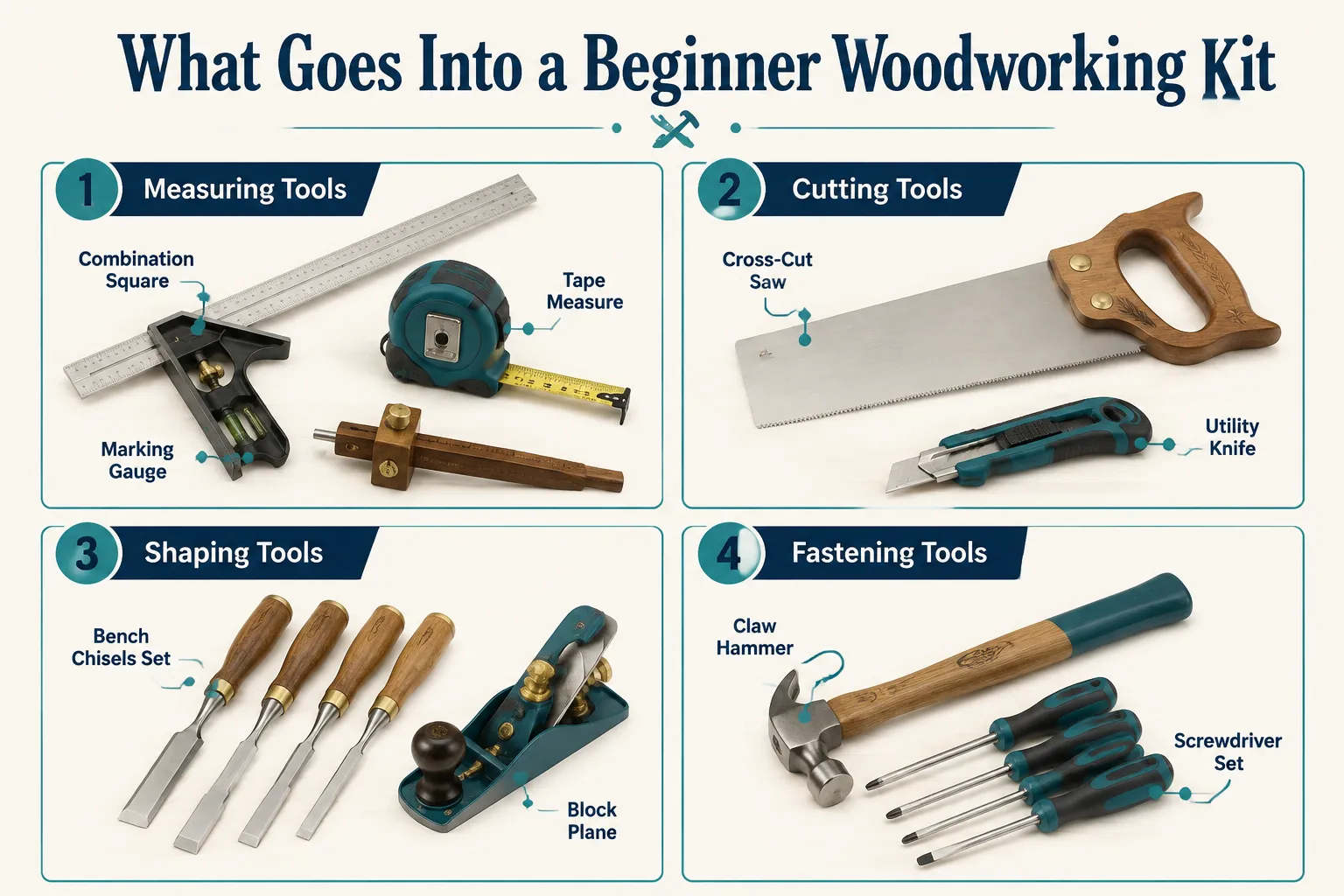
For most beginners, a workable starter kit comes down to six core tools: a tape measure, a combination square, a hand saw, a set of bench chisels, a claw hammer, and sandpaper in multiple grits. These tools cover measuring, marking, cutting, shaping, and finishing, which are the five fundamental actions in almost every beginner woodworking project.
Here is a practical breakdown of the essentials:
- Tape measure (25 ft): Used on every single project. Do not skip this.
- Combination square: Marks 90-degree and 45-degree angles accurately. Far more useful than a basic ruler.
- Hand saw (cross-cut): A 15-inch cross-cut saw handles most cuts beginners need to make.
- Bench chisels (set of 4): Sizes 1/4″, 1/2″, 3/4″, and 1″ cover the majority of joinery and cleanup work.
- Claw hammer: A 16 oz hammer is the standard starting weight.
- Sandpaper assortment: Grits 80, 120, and 220 cover rough shaping through final finishing.
- Safety glasses and hearing protection: Non-negotiable from day one.
A mallet, a marking gauge, and a block plane are excellent additions once you have the core six covered. For a deeper look at how each of these tools works and why it matters, the various tools used for woodworking beginner’s guide breaks it down in plain language.
What’s Included in a Basic Woodworking Starter Kit
A basic woodworking starter kit typically includes measuring tools, at least one cutting tool, a fastening tool, and some form of finishing supplies. The quality of what is included varies significantly between kits marketed as “woodworking” kits and general home improvement tool sets.
Watch for these differences when evaluating kits:
- Woodworking-specific kits usually include chisels, a marking tool, and a hand saw with a fine tooth count suited for wood.
- General tool sets often include pliers, wrenches, and utility knives, which are useful around the house but not particularly relevant to woodworking.
- Power tool starter kits from brands like DeWalt or Makita typically include a cordless drill, a circular saw, and batteries, but rarely include measuring or hand tools.
The best starter tool kits for woodworking beginners combine hand tools with at least one quality measuring instrument. If a kit does not include a combination square or a dedicated marking tool, that is a gap worth filling separately.
Best Woodworking Starter Kit Under $100
A beginner can build a genuinely capable hand tool kit for under $100 by being selective. The key is to spend the most on the tools that touch the wood directly, specifically the saw and chisels, and save on accessories.
A realistic under-$100 build:
- Stanley FatMax tape measure (25 ft): roughly $15-$20
- Empire combination square (12 in): roughly $15-$18
- Irwin Tools cross-cut hand saw: roughly $20-$25
- Narex bench chisel set (4-piece): roughly $30-$40
- Sandpaper assortment pack: roughly $8-$12
That comes to approximately $88-$95, leaving a small buffer. Narex chisels in particular are well-regarded in the woodworking community for their edge retention at an entry-level price point.
What you should not do at this budget is buy a large general-purpose tool kit from a discount retailer and assume it covers woodworking. Those kits often include 40 or more tools, most of which have nothing to do with working wood.
DeWalt vs. Makita: Which Beginner Power Tool Kit Is Better
For beginners moving into power tools, both DeWalt and Makita produce reliable starter kits, and the honest answer is that either brand will serve a beginner well. The more important question is which battery platform makes sense for the long term.
DeWalt 20V MAX starter kits are widely available at major retailers, and the 20V battery platform is one of the most common in North America. Replacement batteries and compatible tools are easy to find. DeWalt kits tend to be slightly more affordable at the entry level.
Makita 18V LXT kits are known for their motor longevity and ergonomics. The 18V LXT platform has one of the largest tool ecosystems in the industry, which matters if you plan to expand your shop over time.
A practical decision rule: choose DeWalt if you want the widest retail availability and lower upfront cost. Choose Makita if you prioritize long-term tool ecosystem investment and slightly better ergonomics for extended use.
Neither brand is a poor choice. What matters more at the beginner level is buying a kit that includes a cordless drill and a circular saw at minimum, along with two batteries so you are never waiting for a charge.
Can You Start Woodworking With Just Hand Tools
Yes, and for most beginners it is actually the better approach. Hand tools teach you to understand wood grain, cutting direction, and joinery in a way that power tools do not. They are also quieter, safer to learn on, and require no electricity.
The case for starting with hand tools:
- Mistakes happen more slowly, which means more time to correct them.
- Setup and cleanup time is minimal compared to power tool use.
- Hand tools are sufficient for a wide range of beginner and intermediate projects.
- The skill transfer to power tools later is significant. Woodworkers who learn hand tools first tend to use power tools more accurately.
The one limitation is efficiency on larger projects. If your goal is to build a full dining table in your first month, hand tools alone will feel slow. For smaller projects like shelves, boxes, cutting boards, and wall-mounted organizers, hand tools are completely capable. The beginner woodworking guide covering tools, projects, and tips goes further into how to plan your first months in the shop.
Woodworking Starter Kit for Small Apartments and Limited Spaces
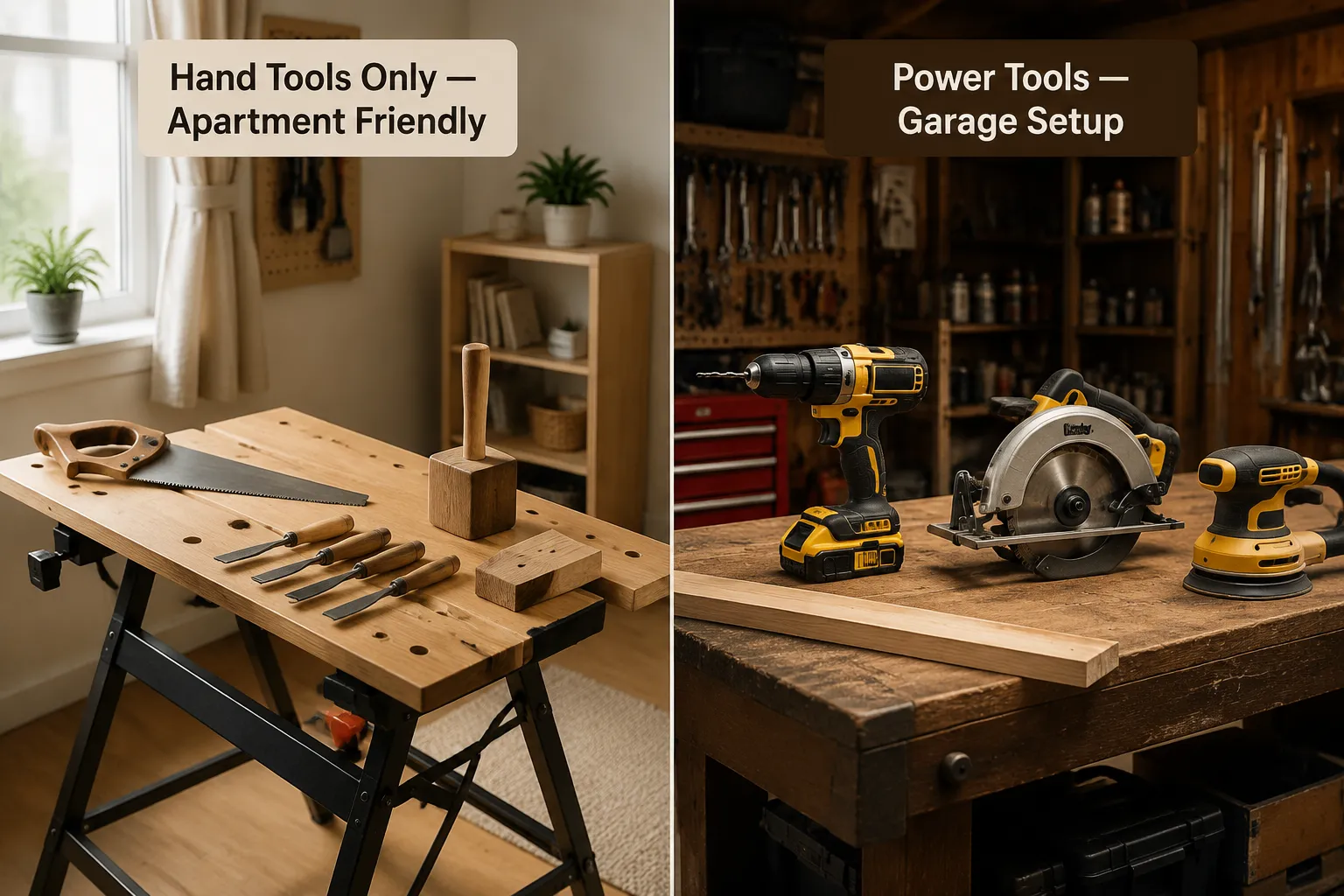
Beginners in apartments or small living spaces can absolutely do woodworking, but the tool selection needs to reflect the space constraints. A hand-tool-only kit is the most practical approach here, combined with a portable workbench.
Key considerations for small-space woodworking:
- A folding workbench (like the Black+Decker Workmate) replaces a stationary bench and stores flat against a wall.
- No power saws: A hand saw produces no dust cloud and generates far less noise than a circular saw or jigsaw.
- A low-angle block plane is quieter than a power sander for smoothing surfaces.
- A shop vac with a fine dust filter is worth the investment even for hand tool work.
- Work near a window or use a portable air filter to manage fine dust particles.
Projects well-suited to apartment woodworking include small shelves, wooden boxes, picture frames, and decorative items. For project ideas scaled to limited space and beginner skill levels, the step-by-step guide to woodworking projects for beginners is a practical starting point.
How to Choose Between Power Tools and Hand Tools as a Beginner
The right starting point depends on three factors: your workspace, your project goals, and your learning style. Neither approach is universally better, but they suit different situations.
Choose hand tools if:
- You are working in a small space or apartment.
- You are new to woodworking and want to develop foundational skills first.
- Noise is a concern (neighbors, children, time of day).
- Your budget is under $100.
Choose power tools if:
- You have a dedicated garage or workshop space.
- Your projects involve larger lumber or repeated cuts.
- You want to move quickly to furniture-scale projects.
- You are comfortable with tool safety protocols.
A hybrid approach works well for many beginners: start with a hand tool kit for measuring, marking, and detail work, then add a cordless drill and a jigsaw as your first power tools. Those two additions cover the vast majority of beginner projects without requiring a full workshop setup. The beginner woodworking tools and equipment guide covers this progression in detail.
Best Starter Kit for Small Projects vs. Furniture Building
The best starter tool kits for woodworking beginners look different depending on whether you want to make small crafts or build actual furniture. This distinction matters more than most beginners realize before their first purchase.
For small projects (boxes, frames, decorative items, cutting boards):
- Hand saw, chisels, combination square, tape measure, sandpaper
- Optional: a small router for edge work
- Budget: $60-$120 for a solid hand tool kit
For furniture building (shelves, tables, chairs, cabinets):
- Cordless drill, circular saw or jigsaw, pocket hole jig, clamps (at least 4), tape measure, combination square
- A pocket hole jig (Kreg makes the most popular beginner model) dramatically simplifies furniture joinery
- Budget: $200-$400 to cover the essentials properly
Clamps deserve a specific mention for furniture work. Most beginners underestimate how many clamps they need. A minimum of four 6-inch bar clamps or F-clamps is a realistic starting point for any glue-up work. If you are planning furniture projects, the furniture building plans and DIY woodworking projects guide is worth reading before you finalize your tool list.
Should You Buy a Full Kit or Individual Tools
For most beginners, buying individual tools as needed produces better results than purchasing a complete kit. The reason is simple: bundled kits often include tools you will not use for months, while skimping on the tools you need immediately.
The exception is when a kit is specifically designed for woodworking and offers a meaningful discount over buying the same tools separately. That does happen, particularly with power tool combo kits from DeWalt or Makita, where two tools plus two batteries can cost less bundled than purchased individually.
A practical approach: buy the six core hand tools individually to ensure quality on each one, then evaluate power tool combo kits when you are ready to expand. This way your most-used tools are the best quality your budget allows.
Woodworking Starter Kits With Good Warranty and Customer Support
Warranty coverage matters more for power tools than hand tools, but it is worth understanding what you are buying in both cases.
- DeWalt: Offers a 3-year limited warranty on most power tools, with a 1-year free service contract and 90-day money-back guarantee. Customer support is accessible through major retailers and a direct service network.
- Makita: Offers a 3-year limited warranty on most tools. Known for responsive warranty service, particularly through authorized service centers.
- Stanley: Their hand tools carry a lifetime warranty on most products, which is one of the best in the industry for the price point.
- Irwin Tools: Saws and cutting tools carry a limited lifetime warranty. Good customer support reputation for replacement blades and parts.
When buying from smaller or lesser-known brands, check whether the warranty requires shipping the tool back at your expense. That detail changes the real value of the coverage significantly.
What If You Already Have Some Basic Tools at Home
If you already own a tape measure, a hammer, and a set of screwdrivers, you are closer to a starter kit than you might think. The gap for most people who have basic home tools is usually in the woodworking-specific category: a combination square, a cross-cut hand saw, and a set of bench chisels.
Do an honest audit before buying anything:
- Check what you already have against the six core tools listed earlier.
- Identify the specific gaps.
- Buy only what is missing, prioritizing the cutting and measuring tools first.
This approach often means a beginner can complete their starter kit for $40-$60 rather than $100 or more. There is no value in buying a new tape measure when the one in your kitchen drawer is perfectly accurate.
How Much Should You Spend on Your First Woodworking Tool Kit
A beginner can start woodworking effectively for $60-$150 in hand tools, or $200-$400 if power tools are part of the plan from the start. Spending more than that upfront is rarely justified until you have confirmed that woodworking is a hobby you want to continue.
A tiered spending guide:
- $60-$100: Core hand tool kit (saw, chisels, square, tape measure, sandpaper). Suitable for small projects and skill-building.
- $100-$200: Core hand tools plus a cordless drill and a basic workbench. Covers most beginner and intermediate projects.
- $200-$400: Full beginner kit including power tools, clamps, a pocket hole jig, and safety gear. Ready for furniture-scale work.
Avoid the temptation to spend $500 or more before you have completed your first five projects. Tools are only as useful as the skills behind them, and those skills take time to develop regardless of what you spend. For guidance on building those skills systematically, the woodworking online training complete beginner’s guide is a useful resource.
Common Mistakes Beginners Make With Starter Tool Kits
The most common mistake is buying too many tools before developing a clear sense of what you actually want to build. The second most common is buying cheap measuring tools while spending more on cutting tools, when it should be the other way around.
Other mistakes worth knowing before you buy:
- Skipping clamps: Clamps are the most underestimated tool in woodworking. You can never have too many.
- Ignoring sharpening: Even new chisels and hand plane blades benefit from honing before first use. A basic sharpening stone ($15-$25) is a worthwhile early addition.
- Buying the wrong saw: A general-purpose saw from a hardware store is often designed for rough carpentry, not woodworking. Look for a saw with at least 10 TPI (teeth per inch) for cleaner cuts in wood.
- No safety gear: Safety glasses and hearing protection are not optional. Eye injuries from wood chips are a real and preventable risk.
- Underestimating wood costs: Your tool kit budget is only part of the picture. Factor in lumber costs for your first few projects.
Understanding how to read and use woodworking plans before you start a project also prevents a significant amount of frustration and wasted material. The how to read and use woodworking plans beginner’s guide is worth bookmarking early.
Frequently Asked Questions
Do I need a workbench before I can start woodworking?
A dedicated workbench is helpful but not required to start. A folding workbench like the Black+Decker Workmate is a practical and affordable alternative. Many beginners start on a sturdy kitchen table with a sacrificial board underneath their work.
What is the single most important tool in a beginner woodworking kit?
A combination square. Accurate measuring and marking is the foundation of every clean cut and tight joint. Beginners who skip this tool tend to produce work that never quite fits together.
Are woodworking tool kits from Amazon reliable?
Some are, but many are not. Look for kits from established brands (Stanley, Irwin, Narex, Estwing) rather than unbranded bundles. Check reviews specifically for edge retention on chisels and blade quality on saws.
Can children learn woodworking with a beginner kit?
Yes, with supervision and age-appropriate tools. Hand tools are safer for young learners than power tools. A rubber mallet, a small cross-cut saw, and a set of beginner chisels are appropriate starting points for older children and teenagers.
How long does a beginner tool kit last?
Quality hand tools from reputable brands can last decades with basic maintenance. Power tools have a shorter lifespan under heavy use, but for a hobbyist using tools a few hours per week, a good cordless drill should last five to ten years or more.
Is it worth buying used woodworking tools?
Often yes, especially for hand tools. Vintage chisels, hand planes, and saws can be excellent quality at low cost if you know what to look for. Avoid used power tools unless you can test them first and verify the battery health.
What wood should a beginner start with?
Pine and poplar are the most forgiving and affordable options for beginners. Both are soft enough to work easily with hand tools and widely available at hardware stores. Avoid hardwoods like oak or maple until you have developed consistent cutting and joinery skills.
Do I need a special kit to make cutting boards?
No. A basic hand tool kit with a saw, sandpaper, and food-safe finish is sufficient for simple cutting boards. A hand plane helps achieve a flat glue-up surface, but it is not strictly required for a first cutting board project.
What is a pocket hole jig and do beginners need one?
A pocket hole jig (most commonly the Kreg Jig) drills angled holes that allow screws to join two pieces of wood at a right angle without visible fasteners. It is not essential for hand tool work, but it is one of the most useful additions for beginners building furniture with power tools.
Should I buy a kit or take a class first?
Both are valuable, but if budget is a constraint, buying a basic hand tool kit and working through beginner projects on your own is a reasonable starting point. A class or structured online course accelerates skill development significantly and reduces the frustration of learning entirely by trial and error.
Conclusion
Woodworking is a skill that rewards patience, and the best starter tool kits for woodworking beginners reflect that truth. Start with fewer tools than you think you need. Prioritize quality on the tools that touch the wood directly. Match your kit to the projects you actually want to build, not the ones you might want to build someday.
A $80-$100 hand tool kit is enough to start building real things today. Add power tools when your projects demand them, not before. Learn to sharpen your tools early. And build something small and useful before you invest more.
The satisfaction of finishing even a simple project with your own hands is what keeps most woodworkers coming back to the bench. That feeling does not require an expensive kit. It requires the right tools, used with intention.
Recommended next steps:
- Review the various tools used for woodworking complete beginner’s guide to understand each tool’s function before buying.
- Browse the step-by-step woodworking projects for beginners to choose your first project before finalizing your tool list.
- Consider structured learning through the woodworking online training guide to accelerate your progress.
Products and Tools Referenced
- Stanley FatMax 25 ft tape measure: reliable, widely available, strong locking mechanism
- Empire 12-inch combination square: accurate, durable, good value at the entry level
- Irwin Tools 15-inch cross-cut hand saw: clean cuts, comfortable handle, good TPI for woodworking
- Narex 4-piece bench chisel set: excellent edge retention for the price, a favorite in the beginner community
- Kreg Jig R3 pocket hole system: the most beginner-friendly joinery tool for furniture projects
- Black+Decker Workmate 425 folding bench: practical for small spaces, holds work securely
- DeWalt DCK240C2 20V MAX 2-tool combo kit: drill and circular saw, a solid entry-level power tool pairing
- Makita CT225R 18V LXT 2-piece combo kit: compact, reliable, good ergonomics for smaller hands