She-Shed vs Man-Cave Shed: Design, Costs & Ideas Compared

A 2023 survey by the American Institute of Architects found that dedicated backyard hobby and retreat spaces ranked among the top five most-requested home additions, and the debate over she-shed vs. man-cave shed design ideas is at the center of that trend. Whether you’re carving out a personal sanctuary or a weekend hangout, the shed you build says a lot about how you plan to use it.
This guide breaks down everything you need to know when comparing she-shed vs. man-cave shed design ideas, from layout and decor to costs, permits, and insulation. If you’re a beginner or hobbyist woodworker thinking about building one yourself, this is the practical starting point you need.
Key Takeaways
- She-sheds and man-cave sheds serve the same core purpose, a private retreat away from the main house, but differ mainly in decor style, intended use, and atmosphere.
- Both types typically need a shed footprint of at least 100-120 square feet to feel comfortable for a single person.
- Building costs for either style range from roughly $1,500 for a basic DIY build to $15,000 or more for a fully finished, insulated, and wired space.
- Most localities require a building permit for any shed over 120 square feet or any structure with electrical work, always check local codes first.
- Insulation and a heating source are non-negotiable if you want to use the space year-round in most climates.
- The same shed shell can serve as either a she-shed or man-cave with different interior finishes, the structure itself doesn’t change.
- Small-space she-sheds (under 100 sq ft) work well for reading, crafting, or yoga; man-cave sheds in that size range are better suited to gaming or a single hobby station.
- Common mistakes include underestimating electrical needs, skipping vapor barriers, and choosing a size that feels too small once furniture goes in.
What Is the Difference Between a She-Shed and a Man-Cave Shed
A she-shed is a backyard shed designed as a personal retreat, creative studio, or relaxation space, typically decorated with softer textures, natural light, and a cozy, cottage-like feel. A man-cave shed leans toward entertainment, sports, gaming, or workshop themes, often with darker finishes, heavier furniture, and tech-forward setups. The structural difference between the two is essentially zero. What separates them is purely interior design and intended use.
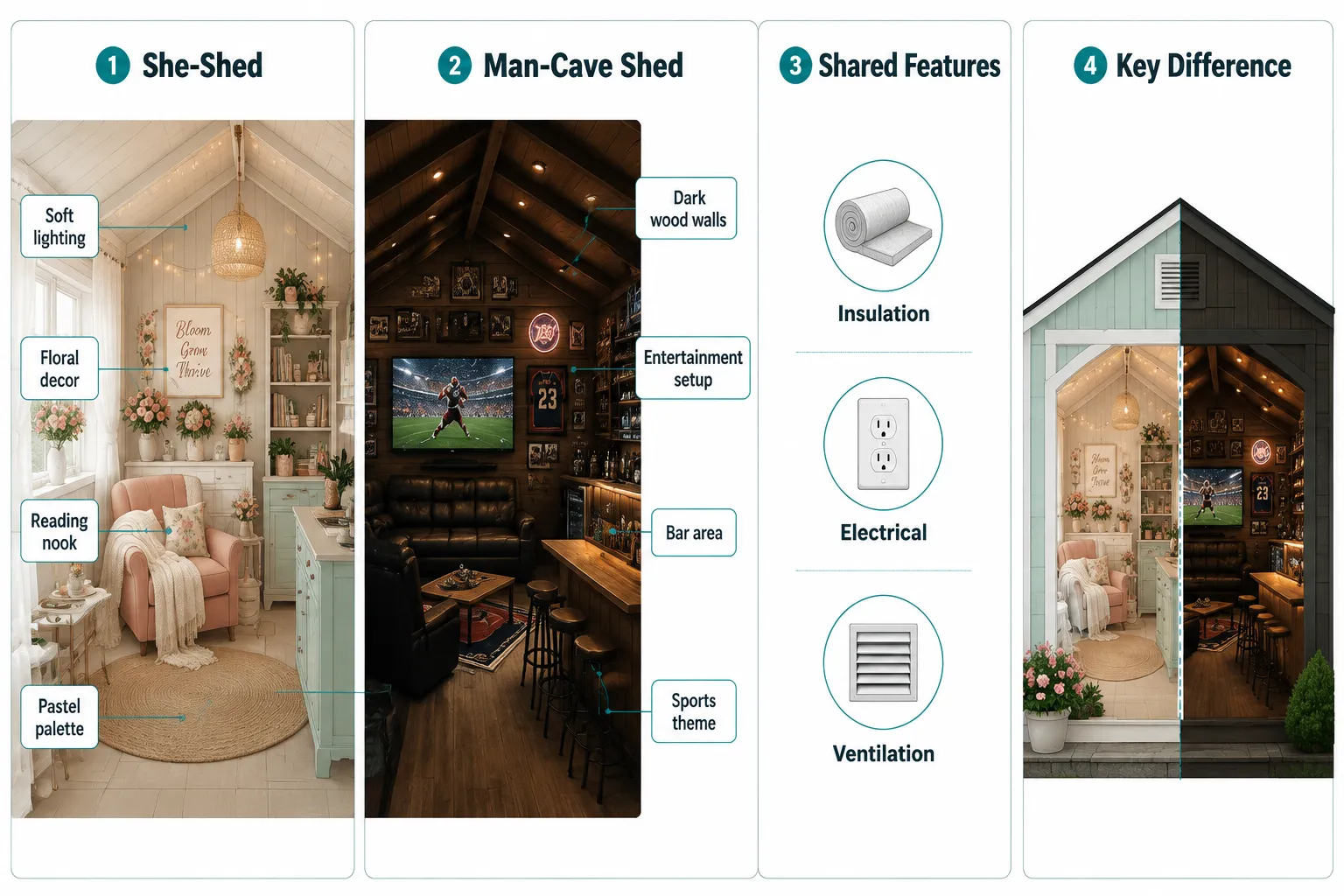
Both are outbuildings placed on a residential property. Both need a solid foundation, weatherproofing, and (in most cases) electrical access. The “label” matters mainly for planning your layout and choosing your finishes.
She-shed hallmarks:
- Soft, layered lighting (fairy lights, pendant lamps, natural light through French doors or skylights)
- Pastel, neutral, or botanical color palettes
- Comfortable seating: armchairs, window seats, or a small daybed
- Craft tables, bookshelves, or a potting bench
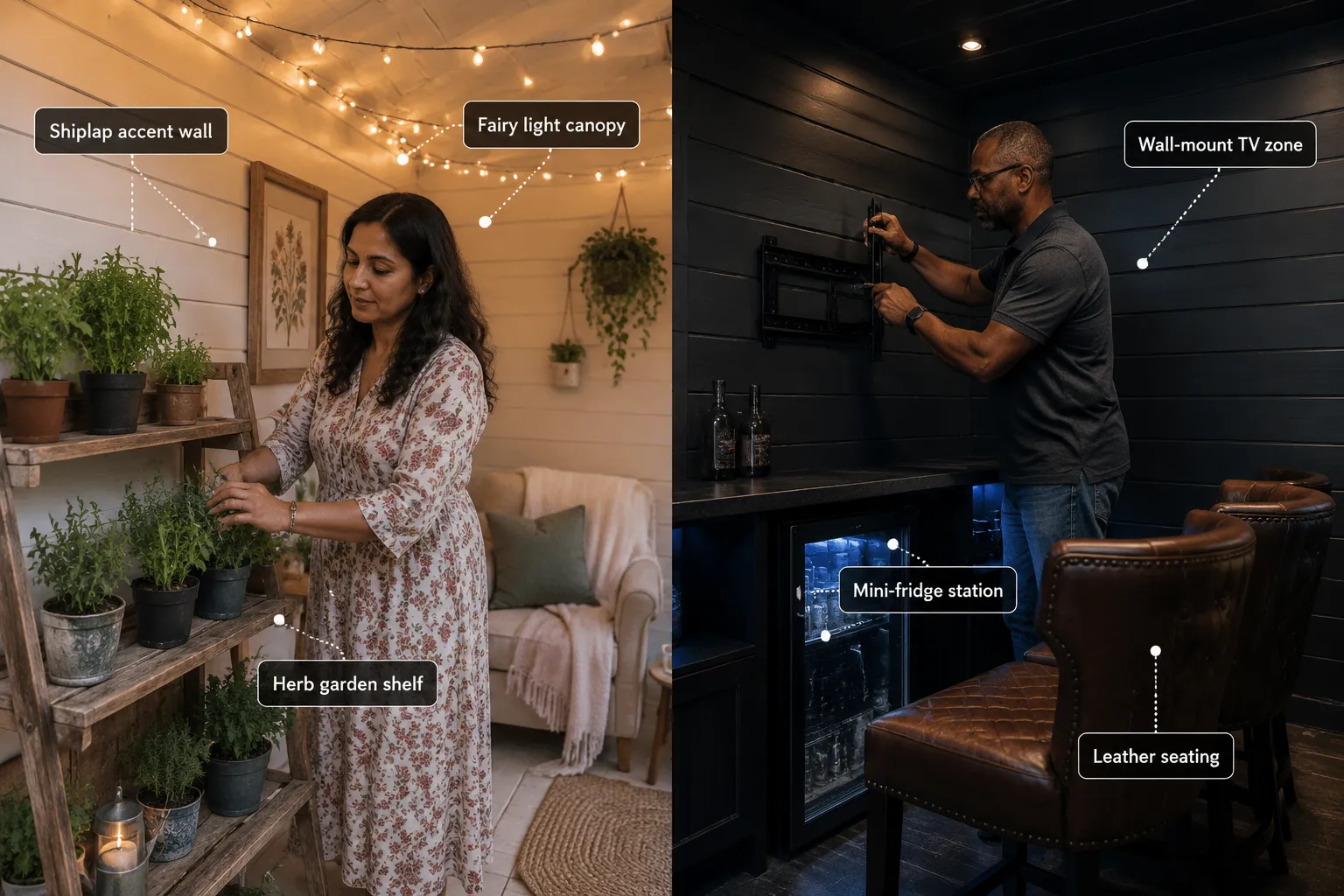
- Decorative touches: shiplap walls, floral accents, vintage furniture
Man-cave shed hallmarks:
- Dark wood paneling, concrete board, or industrial finishes
- Entertainment-focused: wall-mounted TV, gaming setup, or projector screen
- Bar area, mini-fridge, or kegerator
- Sports memorabilia, neon signs, or themed decor
- Workshop bench or tool storage if the space doubles as a hobby shop
For a deeper look at how these compare to studio and office sheds, see Compare She-Shed, Studio Shed And Office Shed: Which Fits Your Needs?.
How Much Does It Cost to Build a She-Shed vs. Man-Cave Shed
Costs for both types land in roughly the same range because the structure is identical, what changes is the interior finish budget. A basic DIY shell (no insulation, no electrical) can cost as little as $1,500,$3,000 for a 10×12 shed. A fully finished, insulated, and wired space typically runs $8,000,$15,000 or more depending on your region and material choices.
| Build Level | She-Shed Est. Cost | Man-Cave Est. Cost | Key Variables |
|---|---|---|---|
| Basic DIY shell | $1,500,$3,500 | $1,500,$3,500 | Size, lumber prices, foundation type |
| Insulated + electrical | $4,000,$8,000 | $4,500,$9,000 | Panel size, HVAC, wiring complexity |
| Fully finished interior | $8,000,$15,000+ | $9,000,$18,000+ | AV equipment, bar setup, custom cabinetry |
Man-cave sheds often run slightly higher at the finished end because entertainment tech (TVs, sound systems, gaming rigs) and bar setups add cost quickly. She-sheds can also climb in price if custom built-ins, skylights, or high-end flooring are included.
For a detailed breakdown of what drives shed construction costs, the DIY Shed Building Cost Comparison: Hire Help Vs. Go Solo guide walks through the numbers clearly. You can also check How Much Does It Cost To Build A Small Shed? for a baseline.
She-Shed Design Ideas and Decor Inspiration
A well-designed she-shed feels like a room that was built specifically for one person’s comfort. The best she-shed ideas start with a clear purpose, reading retreat, art studio, yoga space, or garden room, and then layer in the decor from there.
Popular she-shed themes in 2026:
- Cottage garden room: Whitewashed shiplap, potted herbs on open shelving, a farmhouse sink if plumbing is added, and a bistro table for morning coffee
- Art and craft studio: North-facing window for even light, a large worktable, pegboard tool storage, and sealed concrete or vinyl plank flooring for easy cleanup
- Wellness and yoga retreat: Bamboo flooring, a wall mirror, minimal furniture, a small essential oil diffuser, and blackout curtains for meditation
- Reading nook shed: Built-in bookshelves flanking a window seat, warm Edison bulb lighting, a plush area rug, and a small electric fireplace for cold months
The key to any she-shed design is layered lighting. Overhead lighting alone makes a small space feel clinical. Combine a ceiling fixture with task lighting and ambient accent lights for a space that feels genuinely inviting.
Man-Cave Shed Setup and Themes
A man-cave shed works best when the layout is planned around the primary activity first. Entertainment-focused setups need wall space for screens and acoustic treatment for sound. Workshop-style man-caves need good overhead lighting, durable flooring, and proper ventilation for dust or fumes.
Popular man-cave shed themes in 2026:
- Sports bar setup: Dark-stained wood paneling, a wall-mounted TV (or two), a mini-fridge and bar counter, bar stools, and team memorabilia
- Gaming den: Soundproofing panels, a dedicated gaming desk, cable management, LED strip lighting behind monitors, and blackout blinds
- Retro arcade room: Vintage game machines, neon signs, checkered floor tiles, and a popcorn machine
- Woodworking and hobby shop: Workbench along one wall, pegboard tool storage, a dust collection system, and bright LED shop lighting
One practical tip: run more electrical circuits than you think you need. Entertainment setups draw significant power, and adding circuits after the walls are finished is expensive. Plan for at least two 20-amp circuits minimum, plus a dedicated circuit if you’re adding a mini-fridge or power tools.
If you’re planning a woodworking-focused man-cave shed, the Beginner Woodworking Guide: Tools, Projects and Tips To Start Today is a solid resource for setting up your first shop space.
What Size Shed Do You Need for a She-Shed or Man-Cave
For a single-person retreat, a 10×12 (120 sq ft) shed is the practical minimum. It fits a small seating area, a worktable or entertainment unit, and still leaves walking room. A 12×16 (192 sq ft) is the sweet spot for most people, enough space to move freely without feeling like you’re building a second house.
Size guide by use:
- Reading/yoga/meditation: 8×10 to 10×12 is sufficient
- Craft or art studio: 10×14 or larger for table space and storage
- Entertainment/sports bar: 12×16 minimum; 12×20 if you want a pool table or multiple seating areas
- Woodworking shop: 12×20 or larger to safely operate power tools and store lumber
For suburban lots with limited yard space, the Best Shed Size For Suburban Lots: Complete Comparison Guide covers how to match shed size to your available footprint without violating setback rules.
Can You Use the Same Shed for Both a She-Shed and a Man-Cave
Yes, the same shed shell works for both. The structure, foundation, and framing are identical. What changes is the interior finish, furniture, and decor. A shared-use or convertible shed is a practical option for couples or families who want a flexible backyard space.
How to design a shared-use shed:
- Choose neutral wall finishes (white shiplap, light gray paint, or natural wood) that work with any decor direction
- Install flexible lighting with dimmer switches, bright for work, warm for relaxation
- Use modular furniture that can be rearranged or swapped out
- Plan electrical outlets on every wall so any corner can become a workstation or entertainment zone
- Add built-in storage that serves multiple purposes (closed cabinets hide clutter regardless of the theme)
The honest trade-off is that a truly shared space rarely feels as personal as one designed for a single person. If budget allows, building two smaller sheds is often more satisfying than one compromised shared space.
Best She-Shed Ideas for Small Spaces
Small she-sheds (under 100 sq ft) can still feel spacious with the right design choices. The goal is to maximize vertical space and minimize visual clutter.
- Mount shelves high on the walls to keep the floor clear
- Use a fold-down wall desk instead of a freestanding table
- Choose a lofted sleeping nook or storage loft if ceiling height allows (minimum 8 ft for a usable loft)
- Install a skylight or transom windows to bring in light without sacrificing wall space
- Use mirrors strategically to make the space feel larger
A 8×10 she-shed with a loft, a fold-down desk, and well-placed windows can function as a craft studio, reading retreat, and nap space all at once.
Man-Cave Shed Ideas on a Budget
A budget man-cave shed doesn’t have to look cheap, it just requires prioritizing the right elements. The structure and electrical work are where to spend money. Decor and furniture can be sourced affordably.
Budget-friendly man-cave shed ideas:
- Pallet wood accent wall: Free or near-free material, distinctive look, easy for a beginner to install
- Secondhand bar stools and furniture: Thrift stores and online marketplaces regularly have solid wood bar stools and leather chairs for a fraction of retail
- Projector instead of a large TV: A decent 1080p projector costs less than a 75-inch TV and creates a more immersive experience on a white painted wall
- DIY bar counter: A simple plywood top with a waterproof finish and a store-bought base looks professional and costs under $200 in materials
- LED strip lighting: Inexpensive, easy to install, and dramatically changes the atmosphere of any room
The Custom Vs. Standard Shed Designs: What’s Worth The Upgrade? article is worth reading before you decide where to put your money.
How to Insulate and Heat a She-Shed or Man-Cave Shed
Insulation is the single most important upgrade for any shed you plan to use year-round. Without it, the space is unusable in winter and sweltering in summer. Both she-sheds and man-cave sheds benefit from the same insulation approach.
Recommended insulation approach:
- Walls: R-13 fiberglass batt insulation between 2×4 studs is the standard choice for most climates. Rigid foam board adds an extra R-value layer if the budget allows
- Ceiling/roof: R-19 to R-30 depending on your climate zone, heat rises, so the ceiling matters more than the walls
- Floor: Rigid foam under a plywood subfloor, or a thick area rug over a sealed concrete slab as a minimum
Heating and cooling options:
- Mini-split heat pump: The best all-in-one solution for both heating and cooling. Costs $700,$2,500 installed, but runs efficiently and doesn’t require ductwork
- Electric space heater: Cheapest upfront, but expensive to run for extended sessions
- Propane or wood-burning stove: Works well for occasional use; requires proper venting and fire clearances
- Window AC unit: Adequate for cooling in mild climates; combine with a space heater for winter
Always add a vapor barrier on the warm side of the insulation in humid climates to prevent moisture buildup inside the wall cavity.
Do You Need Permits to Build a She-Shed or Man-Cave Shed
In most U.S. jurisdictions, a permit is required for any shed over 120 square feet, any shed with electrical wiring, or any structure closer than the required setback distance from property lines. Rules vary significantly by city, county, and state, always check with your local building department before breaking ground.
Common permit triggers:
- Shed footprint over 120 sq ft (some areas set the threshold at 100 or 200 sq ft)
- Any electrical work, including running a subpanel from the main house
- Plumbing additions
- Structures within setback zones (typically 5-10 feet from property lines)
- Sheds on a permanent foundation (concrete slab or piers)
Skipping a required permit can result in fines, forced removal, or complications when selling your home. The permit process for a simple shed is usually straightforward, a basic site plan and a standard application form are often all that’s needed.
Common Mistakes When Building a She-Shed
The most common she-shed mistakes are about underestimating practical needs before focusing on aesthetics. A beautiful space that’s cold, dark, or cramped won’t get used.
- Skipping electrical planning: Even a relaxation-focused she-shed needs outlets for lighting, a small heater, and device charging. Plan circuits before the walls are closed
- Choosing the wrong size: A 8×8 shed feels romantic in photos but claustrophobic in person with furniture inside. Always mock up furniture placement on paper first
- Ignoring drainage: A shed placed in a low spot of the yard will have moisture problems. Grade the site so water drains away from the foundation
- Forgetting ventilation: Craft supplies, paint, and even potted plants create humidity. A small exhaust fan prevents mold
- Overloading with decor before testing the space: Move in, use the space for a few weeks, then decorate. You’ll learn what you actually need
She-Shed vs. Man-Cave Shed: Which Is More Popular
Search trend data from Google Trends consistently shows that “she shed” outpaces “man cave shed” as a search term, particularly since 2016 when the concept entered mainstream culture (partly driven by a well-known insurance commercial). In 2026, both terms remain popular, but she-shed searches tend to spike in spring and early summer, likely tied to home improvement season.
That said, “popularity” doesn’t determine which is right for your property. The better question is which design serves your actual lifestyle. Both spaces deliver real value: a dedicated retreat increases how much you use your backyard and, according to real estate professionals, can add perceived value to a property when well-built and finished.
FAQ
What is the main difference between a she-shed and a man-cave shed?
The structure is the same, both are backyard outbuildings. The difference is in interior design and purpose. She-sheds typically focus on relaxation, crafting, or wellness with softer decor. Man-cave sheds lean toward entertainment, sports, or hobbies with a more rugged or tech-forward aesthetic.
How big should a she-shed be?
A 10×12 shed (120 sq ft) is the comfortable minimum for most uses. A 12×16 gives more flexibility. Anything under 8×10 starts to feel tight once furniture is added, especially if you plan to spend extended time there.
Can a man-cave shed double as a workshop?
Yes, and it’s one of the most practical combinations. A workshop-style man-cave shed pairs a hobby workbench and tool storage with a small TV or sound system. The key is planning the layout so the work area and relaxation area don’t interfere with each other.
Do I need electricity in a she-shed or man-cave shed?
Not strictly required, but strongly recommended. Even a simple retreat needs lighting, a heater or fan, and device charging. Running a subpanel from the main house during the build is far cheaper than adding it later.
What flooring works best in a backyard shed retreat?
Luxury vinyl plank (LVP) is the most practical choice, it handles moisture, looks good, and is easy to install over a plywood subfloor. For a she-shed, a large area rug over LVP adds warmth. For a man-cave, sealed concrete or rubber flooring works well for workshop or entertainment setups.
How long does it take to build a she-shed or man-cave shed?
A basic shell can go up in a weekend with two people and a clear plan. A fully finished, insulated, and wired shed typically takes 2-4 weekends of work spread over several weeks, accounting for inspections, drying time, and material delivery.
Is a she-shed or man-cave shed a good investment?
A well-built, finished shed adds usable square footage to your property and generally appeals to buyers. An unfinished or poorly built structure can have the opposite effect. Focus on quality construction first, then interior finishing.
What’s the easiest she-shed idea for a beginner woodworker?
A simple garden room or reading nook shed is the most beginner-friendly approach. Start with a standard 10×12 gable-roof shed kit or plan, add basic insulation and a single electrical circuit, then focus on interior finishing with paint, shelving, and furniture.
Can I convert an existing storage shed into a she-shed or man-cave?
Absolutely. Many people convert existing sheds by adding insulation, drywall or shiplap, flooring, and electrical. The main considerations are whether the existing structure is sound (check for rot, level foundation, and roof condition) and whether the size is workable.
What permits do I need for a she-shed?
Permit requirements vary by location. Most areas require a permit for sheds over 120 sq ft or any shed with electrical work. Check with your local building department before starting, the permit process is usually simple and worth the peace of mind.
Conclusion
When weighing she-shed vs. man-cave shed design ideas, the most important thing to remember is that the structure itself is the same. What you’re really choosing is how you want to feel when you step inside. Both types of backyard retreats deliver genuine value, a private space to create, relax, entertain, or build, and both are achievable for beginner woodworkers willing to plan carefully and build with patience.
Actionable next steps:
- Decide your primary use before you design anything. A yoga retreat and a sports bar need completely different layouts and electrical plans.
- Check your local permit requirements before purchasing materials.
- Size up, not down. A shed that feels slightly too big is far more enjoyable than one that feels cramped.
- Plan your electrical circuits during the framing stage, it’s the most cost-effective time to do it.
- Build the shell first, then finish the interior over time. A weathertight shell with good insulation is the foundation everything else depends on.
For a full walkthrough of the building process, The Complete Guide To Building Your Own Backyard Shed covers every stage from foundation to roof. If you’re choosing between roof styles for your build, Best Shed Roof Style: Lean-To, Gable, Or Barn, Which To Choose? is a practical guide to making that decision.
Products, Tools, and Resources
Building a backyard retreat, whether a she-shed or man-cave shed, calls for reliable tools and materials from the start. A few recommendations based on practical experience:
- Framing nailer: A pneumatic or cordless framing nailer makes wall and roof framing significantly faster and more consistent than hand-nailing. Brands like DeWalt and Paslode are well-regarded for durability.
- Circular saw: Essential for breaking down sheet goods and cutting framing lumber. A 7-1/4-inch blade handles everything a shed build requires.
- Rigid foam insulation boards: For floor and wall insulation, 1.5-inch or 2-inch polyiso or XPS boards are easy to cut and install without special tools.
- LVP flooring: Available at most home improvement stores, luxury vinyl plank is the most beginner-friendly flooring for a shed, it clicks together without adhesive and handles humidity well.
- Mini-split heat pump: For year-round comfort, a 9,000-12,000 BTU mini-split is the right size for most 10×12 to 12×16 sheds. Brands like Mitsubishi, Daikin, and Pioneer are commonly recommended.
If you’re new to woodworking and want to build custom interior elements like shelving, a workbench, or a bar counter, the Step-by-Step Guide To Woodworking Projects For Beginners is a practical place to start building those skills before tackling the interior of your shed.