Best Windows for a Home Office Shed Conversion
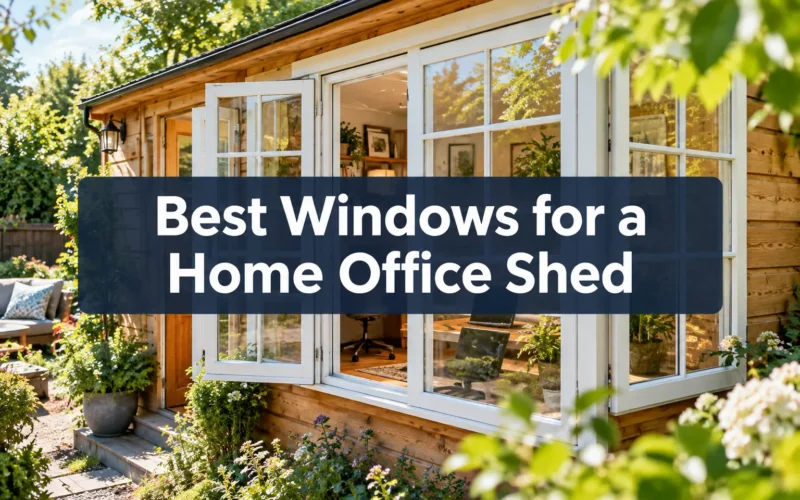
The Best Windows for a Home Office Shed Conversion are double-pane casement or double-hung windows with low-E glass coatings. They deliver strong insulation, reliable ventilation, and enough natural light to make a shed feel like a proper workspace. For most small sheds, two to three windows placed on south- or east-facing walls will cover both light and airflow needs.
Key Takeaways
- Double-pane windows with low-E glass are the gold standard for shed office conversions because they control heat loss in winter and heat gain in summer.
- Casement windows offer the best ventilation per square foot, making them the top choice for small sheds where air circulation matters.
- Standard residential windows work perfectly well in shed conversions; you do not need specialty shed windows.
- South- and east-facing placements maximize natural daylight without creating afternoon glare on a monitor screen.
- For a shed under 120 square feet, two operable windows plus one fixed picture window is a practical, cost-effective combination.
- Condensation is the most common window problem in shed offices and is almost entirely preventable with double-pane glass and proper ventilation.
- Skylights are a strong secondary option for sheds with limited wall space, but they require careful flashing and a quality blind to manage heat.
- Window installation for a shed conversion typically runs between $150 and $600 per window, depending on size, glazing, and labor.
Find this useful? Add us as a preferred source on Google and more of what we publish will show up in your results.
What Makes a Good Window for a Shed Home Office
A good shed office window balances four things: insulation, natural light, ventilation, and weather resistance. A window that excels at only one of these will create problems in the others.
For a workspace specifically, natural light quality matters more than it does in a storage shed. Glare on a monitor screen is a real productivity killer, so the placement and glass type are just as important as the frame material. A window that floods the room with light at 9 a.m. but creates an unusable glare by 2 p.m. is a poor choice, regardless of its energy rating.
Key qualities to look for:
- Double-pane or triple-pane glazing for thermal performance
- Low-E (low-emissivity) glass coating to reflect infrared heat while letting visible light through
- Weatherstripped frames in vinyl, fiberglass, or wood composite
- An operable sash (casement, double-hung, or awning) so you can control airflow
- Tempered or laminated glass if the window sits close to a door or at ground level
If you’re still planning the overall shed build, reviewing best shed plans for beginners early will help you factor window rough openings into the framing from the start rather than cutting them in later.
Best Window Types for Shed Conversions: Insulation and Light
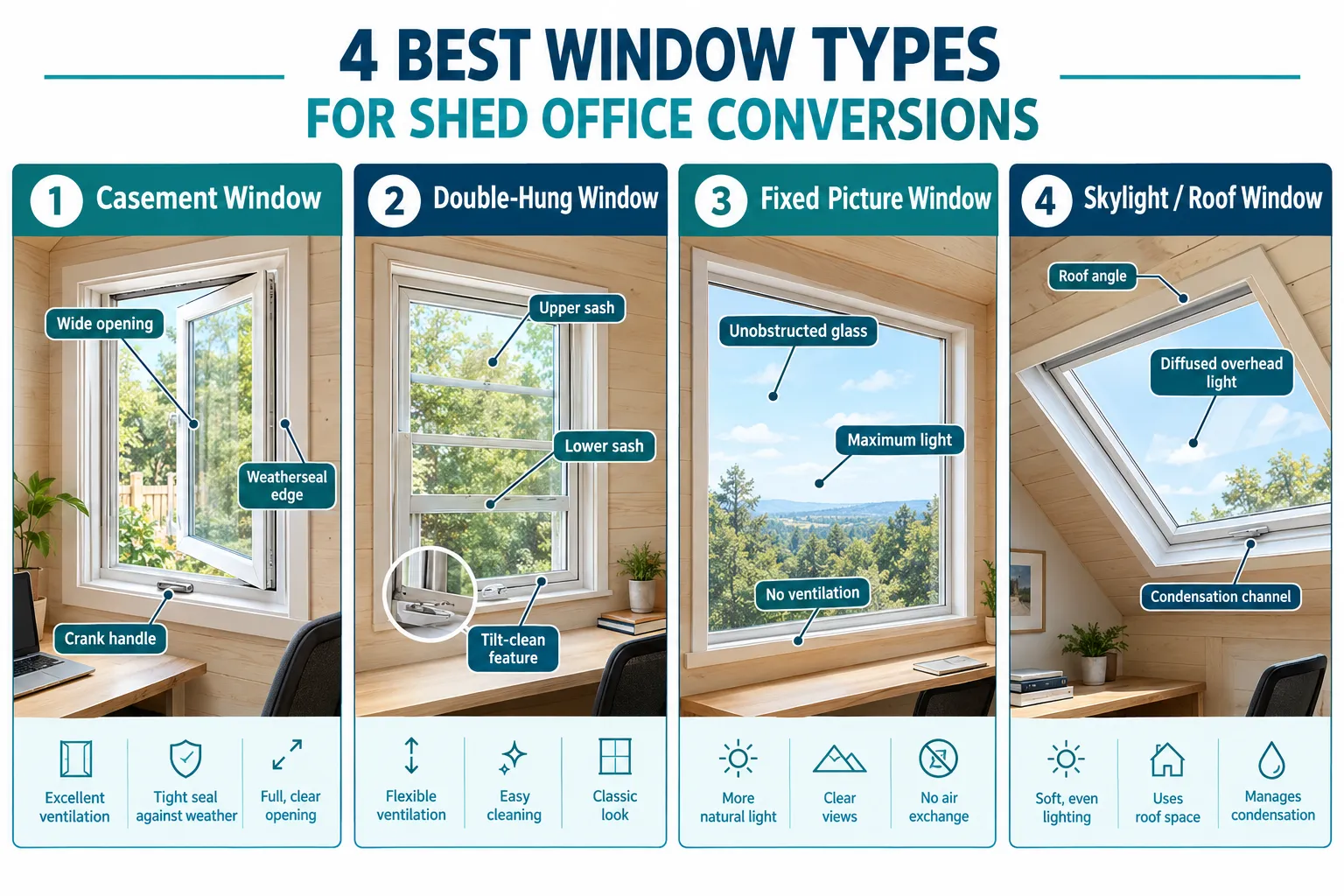
Casement windows are the best all-around choice for shed office conversions. They open fully on a hinge, which means the entire sash area becomes ventilation, and they seal tightly when closed because the sash presses against the frame under compression. Double-hung windows are a close second and are easier to source at standard sizes.
Here is a practical breakdown of the main window types:
| Window Type | Best For | Ventilation | Insulation | Cost Range |
|---|---|---|---|---|
| Casement | Small sheds, side walls | Excellent | Excellent | Moderate |
| Double-Hung | Standard walls, easy sourcing | Good | Good | Low, Moderate |
| Fixed/Picture | Light without ventilation | None | Excellent | Low |
| Awning | Rainy climates, high walls | Good | Good | Moderate |
| Skylight/Roof | Limited wall space | Moderate | Moderate, Good | High |
| Sliding | Wide openings | Moderate | Moderate | Low, Moderate |
Choose casement if your shed is small and airflow is a priority. Choose fixed picture windows alongside an operable window when you want maximum light on one wall without the cost of a large operable unit. Choose awning windows if your shed is in a wet climate, because they can stay open during light rain.
Can You Use Regular Windows in a Shed, or Do You Need Special Ones
Standard residential windows work perfectly in shed conversions. There are no special “shed windows” required by building codes in most jurisdictions. The key is that the window must be properly flashed and sealed into the wall framing, regardless of whether it came from a home improvement store or a specialty supplier.
The only scenario where you might need something different is if local building codes classify your shed conversion as a habitable space (which triggers residential building standards). In that case, egress window requirements may apply, meaning at least one window must meet minimum opening dimensions for emergency exit. Check with your local building department before purchasing.
Practical sourcing options:
- New residential windows from big-box stores (most affordable, wide size selection)
- Salvaged windows from architectural salvage yards (cost-effective, but verify seal integrity on double-pane units)
- Custom-order windows for non-standard rough openings
- Shed kit windows (often single-pane; upgrade these if you plan year-round use)
Double-Pane vs. Single-Pane Windows for Shed Offices
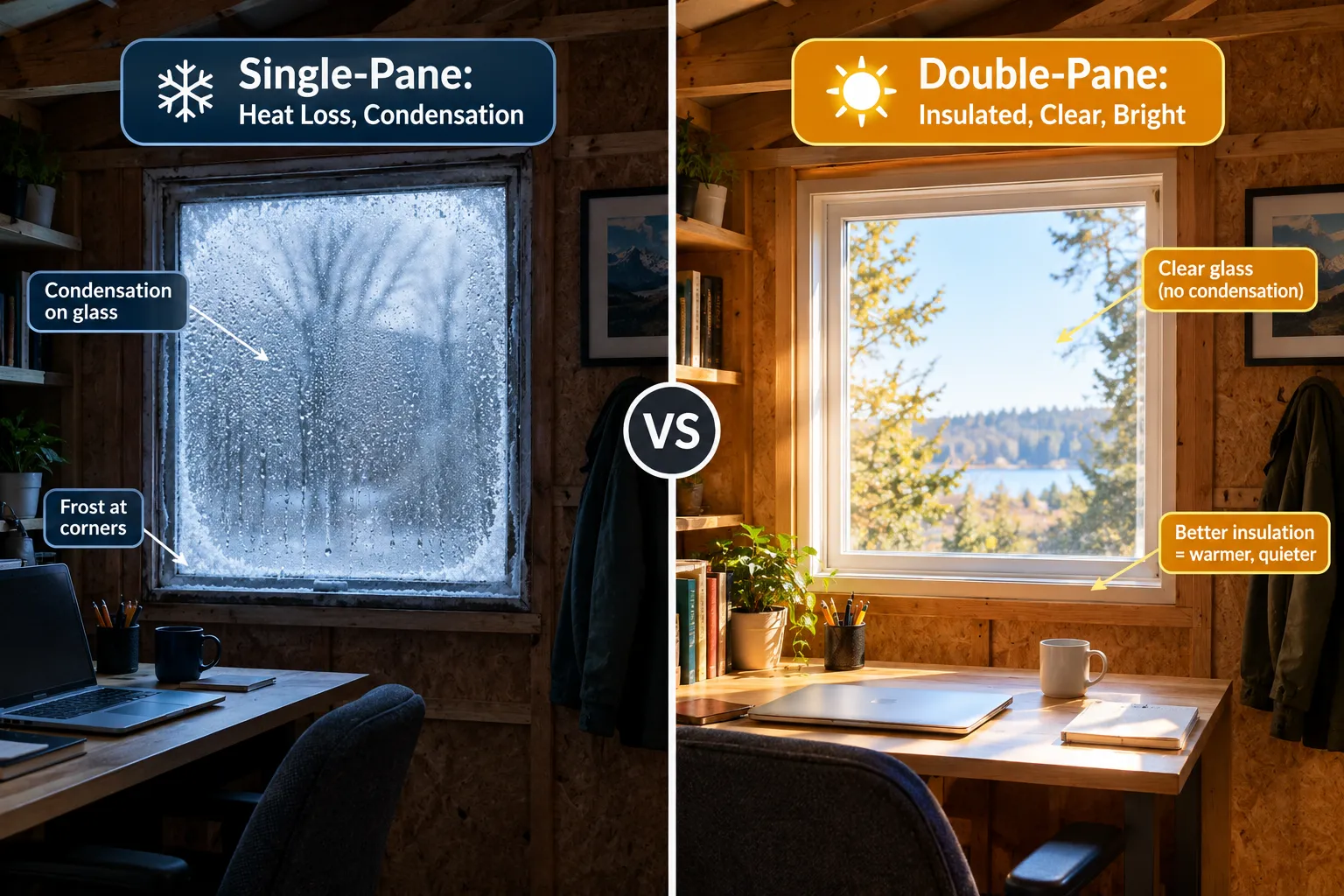
Double-pane windows are strongly recommended for any shed used as a year-round home office. Single-pane windows lose heat rapidly in winter and allow significant heat gain in summer, making the space uncomfortable and expensive to condition.
The difference comes down to the insulating air (or gas) gap between the two panes. Double-pane units typically use argon gas fill between the panes, which slows heat transfer considerably compared to a single sheet of glass. When combined with a low-E coating, double-pane windows can reduce heat loss through the glass by roughly 50% compared to single-pane alternatives, according to the U.S. Department of Energy’s guidance on residential windows.
Single-pane is acceptable only if:
- The shed is used seasonally (spring and fall only)
- You have a separate, powerful heating and cooling solution
- Budget is severely constrained, and you plan to upgrade later
For a deeper look at how insulation choices work together across your shed build, the workshop shed insulation guide covers R-values and material choices that pair directly with window selection.
How Many Windows Should a Home Office Shed Have
Most shed offices work well with two to four windows. The right number depends on shed size, wall orientation, and how much natural light you actually want at a desk.
A general rule used by residential designers is that window area should equal roughly 10% of the floor area for adequate natural light. For a 10×12 shed (120 square feet), that works out to about 12 square feet of glass, which two standard 3×2-foot windows and one 2×3-foot fixed panel would cover comfortably.
More windows are not always better. Each window is a potential weak point in the building envelope, and too much glass on a west-facing wall creates afternoon glare and heat buildup in summer.
Recommended starting configuration for a standard shed office:
- Two operable windows (casement or double-hung) on the primary work wall for cross-ventilation
- One fixed picture window on the wall opposite the desk for ambient light
- Optional: one skylight or roof window if wall space is limited
For reference on sizing your overall shed footprint, the best shed size for suburban lots guide is a useful companion resource.
Best Window Placement for Natural Light in a Shed Office
South-facing windows deliver the most consistent natural light throughout the day in the Northern Hemisphere, while east-facing windows provide bright morning light that avoids afternoon glare on screens. North-facing windows give soft, diffused light with no direct sun, which is actually ideal for monitor-based work.
West-facing windows are the most problematic for a desk-based workspace because afternoon sun comes in low and directly into the line of sight. If your shed’s west wall is the only viable option, use a deep overhang or a quality cellular blind to manage the glare.
Placement tips by wall:
- South wall: Best overall light; use a roof overhang to block high summer sun while allowing lower winter sun
- East wall: Good for morning workers; light fades by midday
- North wall: Consistent, glare-free light; ideal for screen-heavy work
- West wall: Avoid for primary desk placement; use only for ambient light with shading
Also consider the view from the desk. A window at eye level directly in front of the monitor creates contrast that strains the eyes. Placing windows to the side of the primary work surface is almost always more comfortable.
What Size Windows Work Best for Small Sheds
For sheds under 150 square feet, windows in the 24×36-inch to 30×36-inch range are the most practical. They provide meaningful light and ventilation without consuming so much wall space that structural integrity or insulation continuity becomes a concern.
Very large windows (anything over 4 feet wide) in a small shed require a properly sized header in the framing to carry the load above the opening. This is straightforward carpentry, but it’s worth planning during the framing stage rather than retrofitting. If you’re working from existing 8×10 shed plans, check the framing details to confirm header sizing before ordering windows.
Common window sizes for small shed offices:
- 24×24 inches: Good for ventilation in tight spaces, limited light
- 24×36 inches: A solid all-purpose size for most shed walls
- 30×36 inches: The sweet spot for light and airflow in a standard shed
- 36×48 inches: Best for a dedicated light wall; requires proper header framing
Do Shed Office Windows Need to Be Weatherproof
Yes, all windows in a shed office conversion need to be weatherproof. This means proper flashing at the head and sill, a continuous weatherstrip seal around the sash, and caulking at the exterior frame-to-siding joint.
A window that leaks air or water will cause wood rot in the framing, mold growth in the wall cavity, and a workspace that’s cold and damp in winter. These problems are far more expensive to fix than doing the installation correctly the first time.
Weatherproofing checklist for shed office windows:
- Install a self-adhering flashing membrane around the rough opening before setting the window
- Apply a bead of exterior-grade sealant between the window flange and the sheathing
- Flash the head (top) of the window with a drip cap
- Check that the sill slopes outward to drain water away from the frame
- Verify the weatherstrip compresses evenly when the window is closed
How to Prevent Condensation in Shed Office Windows
Condensation on shed office windows is caused by warm, humid interior air contacting a cold glass surface. The fix is twofold: reduce interior humidity and improve the thermal performance of the glass.
Double-pane windows with low-E glass stay warmer on the interior surface, which dramatically reduces condensation compared to single-pane units. Beyond the glass choice, ventilating the shed for 10 to 15 minutes daily (or running a small dehumidifier) keeps interior humidity below the threshold where condensation forms.
If condensation appears between the panes of a double-pane window, the insulating seal has failed and the unit needs replacing. No amount of ventilation or dehumidification will fix a broken seal.
Are Skylights or Roof Windows Good for Shed Offices
Skylights are a genuinely useful option for shed offices with limited wall space, particularly for sheds with a gable or gambrel roof that creates usable ceiling height. They bring in roughly three times more light per square foot than a vertical wall window, according to general daylighting design principles.
The downsides are real, though. Skylights are harder to install correctly, more prone to leaks if flashing is done poorly, and they can cause significant heat gain in summer. A quality cellular skylight blind is almost mandatory for a desk-based workspace.
Choose a skylight if:
- Wall space is genuinely limited (small footprint shed, lots of shelving)
- You want overhead diffused light rather than directional side light
- You’re comfortable with the more involved installation
Stick with wall windows if:
- You’re a first-time shed builder
- Your roof pitch is low (under 3:12), which makes flashing difficult
- Budget is a primary concern
Casement vs. Sliding Windows for Shed Offices: Which Is Better
Casement windows are better than sliding windows for most shed office applications. A casement opens fully, meaning 100% of the sash area becomes ventilation. A sliding window opens to only 50% of its total area because one sash is always fixed.
Casements also seal more tightly when closed because the sash compresses against the frame. Sliding windows rely on a brush or foam seal along the sliding track, which degrades faster and allows more air infiltration over time.
When sliding windows make sense:
- The window is in a location where a swinging casement would be obstructed (near a walkway or fence)
- You need a very wide, low-profile opening
- Cost is the primary driver (sliding windows are typically less expensive)
Common Mistakes People Make with Shed Office Windows
The most common mistake is installing too few windows, then adding more later at significantly higher cost and effort. Plan the window layout before framing, not after.
Other frequent mistakes:
- Using single-pane windows to save money and then spending more on heating and cooling year-round
- Placing the primary window directly in front of the desk, which creates monitor glare and eye strain
- Skipping proper flashing, which leads to water infiltration and wood rot within a few seasons
- Buying windows before confirming rough opening sizes, resulting in windows that don’t fit standard framing dimensions
- Ignoring local permit requirements, particularly if the shed conversion qualifies as habitable space under local codes
- Choosing windows purely for aesthetics without checking the U-factor and solar heat gain coefficient (SHGC) ratings
For anyone planning a full shed conversion from scratch, the complete guide to building your own backyard shed covers the sequencing of decisions that makes window planning much easier.
How Much Do Shed Office Windows Cost to Install
Window costs for a shed office conversion typically range from $150 to $600 per window installed, depending on size, glazing type, and whether you hire a contractor or do the work yourself. A basic 24×36-inch double-pane vinyl window from a home improvement store runs $80 to $200 for the unit alone; installation labor adds $100 to $400 per window depending on your region.
Cost factors that move the number up:
- Triple-pane glazing (adds 20-40% over double-pane)
- Low-E coating with argon fill (adds $30,$80 per unit)
- Custom sizes outside standard dimensions
- Contractor labor in high-cost metro areas
- Structural modifications needed for large openings
Ways to reduce cost without sacrificing quality:
- Source standard-size windows to avoid custom pricing
- Install windows yourself if you’re comfortable with basic carpentry
- Use salvaged double-pane windows in good condition (verify seal integrity first)
- Combine one or two operable windows with a less expensive fixed picture window
For a broader look at how windows fit into the total shed build budget, the DIY shed building cost comparison breaks down where money goes across the full project.
FAQ
Do I need a building permit to add windows to a shed conversion?
It depends on your local jurisdiction. If the shed is being converted to a habitable space (a home office counts in many areas), a permit is often required. Check with your local building department before starting work.
What is a U-factor and why does it matter for shed windows?
The U-factor measures how quickly a window loses heat. Lower numbers mean better insulation. For a year-round shed office, look for a U-factor of 0.30 or lower.
What does SHGC mean on a window label?
Solar Heat Gain Coefficient measures how much solar heat passes through the glass. A lower SHGC (under 0.25) is better in hot climates; a higher SHGC can be useful in cold climates where passive solar warming is welcome.
Can I install a window in a shed myself?
Yes. Window installation is a manageable DIY task for anyone comfortable with basic framing and caulking. The critical steps are cutting the rough opening to the correct size, installing flashing properly, and sealing the exterior joint completely.
How do I stop my shed office windows from fogging up inside?
Fogging on the interior glass surface is condensation caused by high indoor humidity. Run a small dehumidifier, ventilate daily, and make sure your windows are double-pane. Fogging between the panes means the seal has failed and the window needs replacing.
Are vinyl window frames better than wood for a shed office?
Vinyl frames require no painting or sealing, resist moisture well, and cost less than wood. Wood frames look better and can be repaired more easily but need regular maintenance. For a shed, vinyl or fiberglass composite frames are the more practical choice.
What is the minimum window size for an egress requirement?
Most residential codes require an egress window to have a minimum net clear opening of 5.7 square feet, with a minimum height of 24 inches and a minimum width of 20 inches. Confirm the exact requirement with your local building department.
Should I use tinted glass in a shed office window?
Lightly tinted glass can reduce glare and solar heat gain, but it also reduces visible light transmission. A better solution for most shed offices is a low-E coating, which manages heat without significantly reducing daylight.
Can I add a window to an existing shed without rebuilding the wall?
Yes. You can cut a rough opening in an existing shed wall, install a properly sized header, and fit a standard window. It’s more work than planning the opening during the original build, but it’s entirely doable with basic carpentry skills.
How long do shed office windows last?
Quality double-pane vinyl windows typically last 20 to 25 years before the insulating seal begins to fail. The frame itself can last much longer. Proper installation and keeping the exterior caulk in good condition are the biggest factors in longevity.
Conclusion
Choosing the best windows for a home office shed conversion comes down to a few decisions that compound on each other: glazing type, window style, placement, and quantity. Get those four right and the workspace becomes comfortable, well-lit, and energy-efficient year-round. Get them wrong, and you’ll spend money correcting problems that were avoidable from the start.
The practical path forward is straightforward. Start with double-pane, low-E casement or double-hung windows in the 24×36 to 30×36-inch range. Place two operable windows on the south or east wall for light and cross-ventilation, add a fixed picture window for ambient light, and flash every opening properly. That combination works for the vast majority of shed office builds without overcomplicating the project.
If you’re still in the planning phase, take the time to compare your shed design options using the she-shed, studio shed, and office shed comparison guide to confirm the right footprint before committing to a window layout.
Products and Tools Worth Considering
For anyone tackling this as a DIY project, a few tools and materials make the window installation process significantly smoother:
- A quality oscillating multi-tool for cutting through existing wall sheathing cleanly when adding windows to a built shed
- Self-adhering window flashing tape (brands like Huber ZIP System or 3M 8067 are widely trusted) for weatherproofing the rough opening
- Exterior-grade polyurethane sealant for the final caulk bead around the window flange
- A digital hygrometer to monitor interior humidity and catch condensation problems before they become mold problems
- Cellular (honeycomb) blinds cut to size for any south- or west-facing windows where glare management is needed
These are not expensive additions to the project, and each one addresses one of the most common failure points in shed office window installations. Build it right the first time, and the workspace will serve you well for years.