Best Wood for Furniture Making: A Comparison Guide
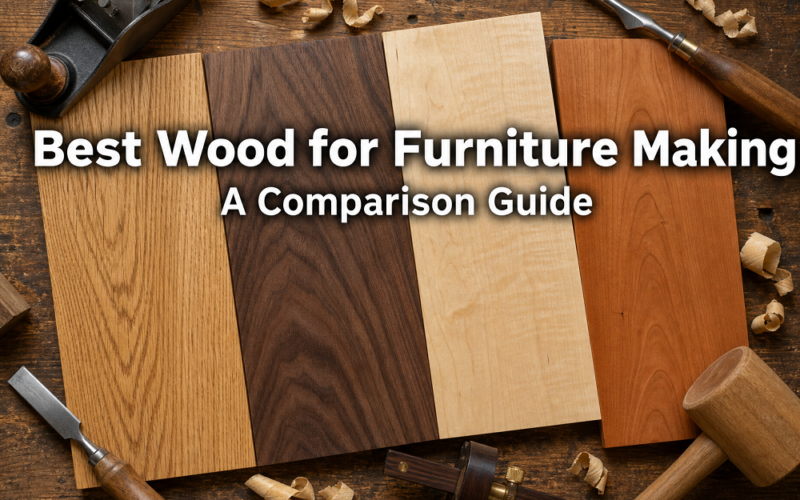
Find this useful? Add us as a preferred source on Google and more of what we publish will show up in your results. Good furniture wood balances four qualities: hardness, workability, stability, and appearance. No single species is perfect across all four, which is why choosing the right wood starts with knowing what your project actually demands.
Here’s what each quality means in practical terms:
Hardness is measured on the Janka hardness scale, which tests the force required to embed a steel ball halfway into a wood sample. Higher numbers mean more resistance to dents and scratches. For furniture that takes daily punishment (dining tables, chairs, benches), you want a Janka rating above 1,000 lbf. Hard maple sits at around 1,450 lbf. Red oak lands near 1,290 lbf. Walnut comes in around 1,010 lbf. Cherry is softer at roughly 950 lbf.
Workability covers how the wood responds to hand tools, power tools, and joinery. Some species, like walnut and cherry, cut cleanly and sand smoothly without much fuss. Others, like hard maple, can burn under a router bit if you move too slowly, and they dull tool edges faster.
Stability refers to how much the wood moves as humidity changes. All wood expands and contracts across the grain seasonally. Species with lower movement rates (like quartersawn oak or walnut) are less likely to cause joint problems or surface cracking over time. According to Wagner Meters, properly managing moisture content before and during a build is one of the most important factors in long-term furniture performance.
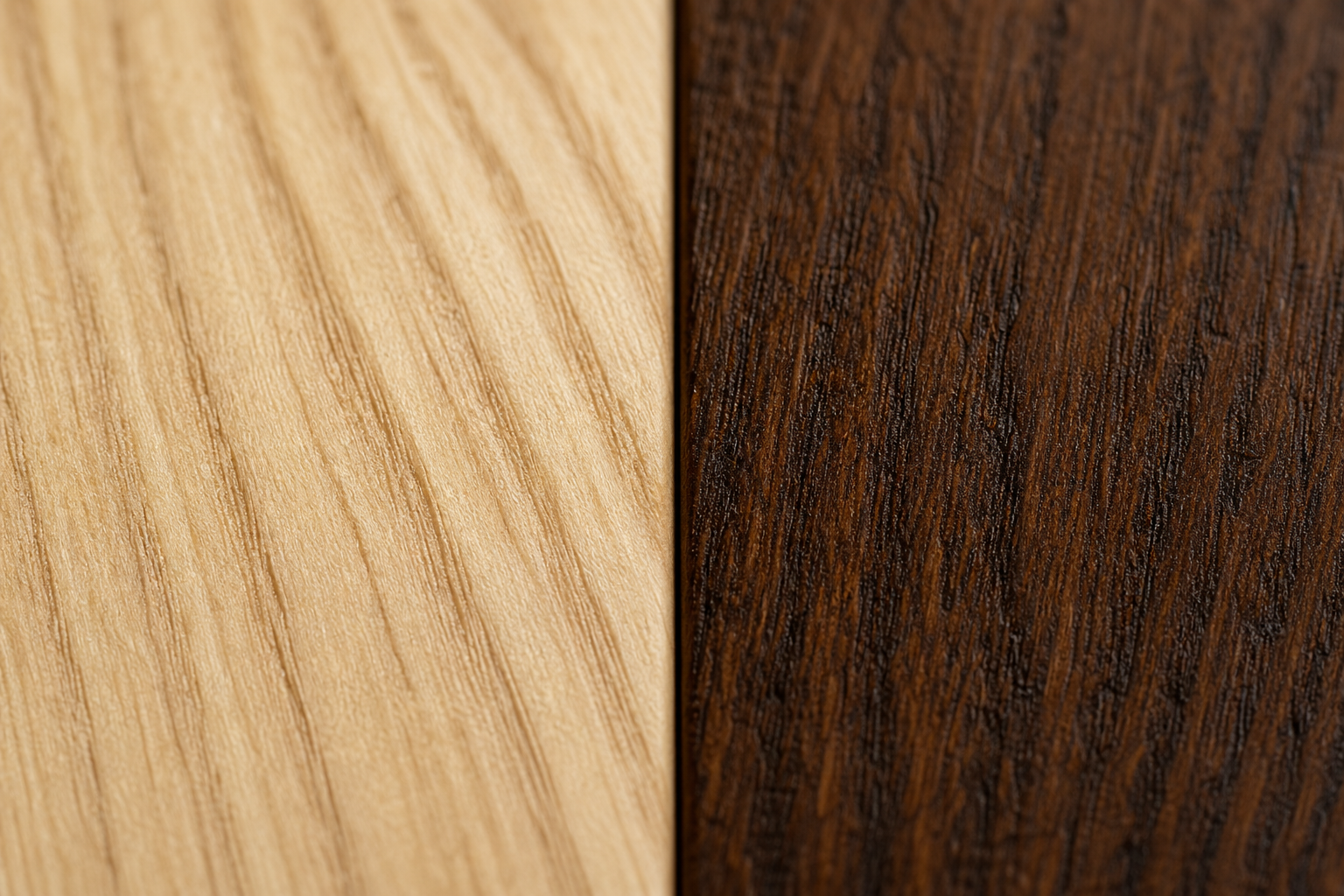
Appearance is subjective, but grain pattern, natural color, and how a species responds to finish all matter. Open-grained woods like oak show more texture. Tight-grained woods like maple look smoother and more uniform.
Choose a wood that scores well on the qualities your specific project needs most, not the one that sounds most impressive.
For most furniture projects, hardwood is the better choice. Hardwoods are denser, more resistant to dents and scratches, and hold joinery (screws, mortises, dovetails) more securely than softwoods. That said, softwoods have a real place in furniture making when used correctly.
The terms “hardwood” and “softwood” are botanical categories, not literal descriptions of density. Hardwoods come from deciduous trees (oak, maple, walnut, cherry). Softwoods come from conifers (pine, cedar, fir). Most hardwoods are denser than most softwoods, but there are exceptions: balsa is technically a hardwood, and some pines are harder than certain hardwoods.
According to research covered by Cutlistor, hardwoods generally outperform softwoods in furniture applications because of their tighter grain structure, which resists wear and holds finishes more evenly. For dining tables, chairs, cabinets, and bed frames, hardwood is almost always the right call.
Softwoods do work well for:
The mistake beginners make is assuming softwood is always easier to work with. Pine, for example, can be gummy and prone to blotching. It also dents easily in high-traffic applications. If you’re building a coffee table that will see daily use, pine is a compromise. If you’re building a decorative shelf or a painted storage bench, it’s perfectly fine.
These three species cover most of what furniture builders need, but they serve different purposes. Oak is the workhorse. Maple is the precision choice. Walnut is the showpiece.
Here’s a direct comparison:
Choose oak if: You want durable, stainable furniture on a moderate budget. Oak’s open grain takes most stains well (with a grain filler for very dark colors) and it holds up to decades of daily use. It’s the default choice for dining tables and chairs for good reason.
Choose maple if: You’re painting the piece, building a kitchen cabinet, or making a cutting board. Maple’s tight, almost featureless grain is ideal for paint adhesion and food-safe surfaces. Avoid dark stains on maple without a pre-stain conditioner, as it blotches unpredictably.
Choose walnut if: Budget allows and you want a piece that looks stunning with minimal finishing effort. Walnut’s rich chocolate tone and straight grain are naturally beautiful. A simple oil or oil-varnish blend brings it to life without complex finishing steps. As noted by A to Z Wood Company, walnut remains one of the most in-demand domestic hardwoods for premium furniture precisely because it combines visual impact with genuine workability.
Choose cherry if: You’re building a piece meant to age gracefully. Cherry’s transformation from pale pinkish-tan to deep reddish-brown over years of light exposure is something no stain can replicate convincingly. Many builders finish cherry with nothing more than a clear coat and let time handle the rest.
For a dining table that resists everyday scratches and dents, oak and hard maple are the top choices. Both score above 1,200 lbf on the Janka scale, which means they hold up well to plates, utensils, and the general abuse a dining surface takes over years.
Red oak is the most popular dining table wood among hobbyist builders for several reasons: it’s widely available at most hardwood dealers and big-box stores, it accepts a broad range of stains, and it’s priced reasonably for its performance. The open grain does show scratches slightly more than tight-grained species, but it also hides minor surface wear better than you’d expect because the grain texture draws the eye.
Hard maple is the choice if you want a cleaner, more contemporary look. Its tight grain resists scratches well and gives the surface a smooth, almost glassy quality under a film finish. The tradeoff is that maple is harder to stain evenly, so most maple dining tables are either painted or finished with a clear or lightly tinted topcoat.
Walnut makes a beautiful dining table, but at its price point and with a Janka rating just above 1,000 lbf, it’s slightly more susceptible to surface denting than oak or maple. That doesn’t disqualify it, especially if you’re using a hard film finish like conversion varnish or a quality polyurethane. It just means walnut dining tables are better suited to households that treat furniture with some care.
For the finish itself, a hard film finish (polyurethane, conversion varnish, or catalyzed lacquer) provides significantly more scratch resistance than oil or wax finishes on any species.
Poplar is the most recommended starting wood for beginner furniture makers. It’s inexpensive, widely available, easy to cut and sand, and forgiving of minor technique mistakes. It’s not the most beautiful wood in natural form, but it takes paint exceptionally well, which makes it ideal for learning joinery and construction before moving to more expensive species.
Soft maple (as opposed to hard maple) is another strong beginner option. It machines and hand-tools more easily than hard maple, costs less, and still offers reasonable hardness for furniture applications. Many beginners use soft maple as a step up from poplar when they want a wood that looks good with a natural finish.
Here’s a practical beginner progression:
If you’re just getting your shop set up, start with the essential woodworking tools before worrying too much about species selection. The right tools matter as much as the right wood, especially for beginners.
For project ideas matched to beginner skill levels, the beginner woodworking projects guide is a useful starting point.
Pine can absolutely be used for furniture. It’s too soft for some applications, but it’s a legitimate choice for others. The key is matching the species to the project.
Eastern white pine has a Janka rating of around 380 lbf, which is genuinely soft. It dents easily and scratches with regular use. That makes it a poor choice for dining tables or chairs that take daily impact. But for bookshelves, storage pieces, decorative furniture, or anything with a rustic aesthetic, pine works well and costs significantly less than hardwoods.
Southern yellow pine is a different story. With a Janka rating around 1,225 lbf (depending on the specific species), it’s harder than many hardwoods and holds up well in furniture applications. It’s widely used in workbenches and utilitarian furniture for exactly this reason.
The main challenges with pine for furniture:
Paint solves most of pine’s cosmetic problems. Painted pine furniture (especially in farmhouse or cottage styles) is a popular and practical choice. If you’re staining pine to look like a hardwood, expect to do extra prep work and accept that the result won’t be as clean as staining oak or cherry.
Solid wood furniture is made from boards cut directly from a log. Veneer furniture uses a thin layer of real wood (typically 0.6mm to 6mm thick) bonded to an engineered core like plywood, MDF, or particleboard. Both can be high quality or low quality depending on how they’re made.
The common assumption is that solid wood is always better. That’s not entirely accurate. High-quality veneer furniture built on a plywood core can be more dimensionally stable than solid wood in some cases, because plywood resists seasonal movement better than wide solid panels. Many high-end furniture makers intentionally use veneered plywood for large flat surfaces like cabinet doors and tabletops for exactly this reason.
Where veneer falls short is durability over time. A solid wood surface can be sanded and refinished multiple times over decades. A thin veneer (especially the 0.6mm variety common in budget furniture) can only be refinished once or twice before the veneer layer is gone. Particleboard-core veneer furniture is the weakest version: it doesn’t hold screws well, swells when exposed to moisture, and can’t be repaired meaningfully once damaged.
How to tell the difference when buying or evaluating furniture:
As Bassett Furniture’s complete wood guide notes, the quality of the core material in veneer furniture is just as important as the veneer itself. Plywood-core veneer furniture is a legitimate high-quality option. Particleboard-core veneer is generally a budget compromise.
Furniture wood costs vary significantly by species, grade, and region. As a general benchmark for domestic hardwoods in the United States in 2026, expect to pay roughly:
These are rough estimates for FAS (Firsts and Seconds) grade lumber from a hardwood dealer. Big-box store pricing is often higher per board foot for the same species, and the selection is more limited. Local sawmills and hardwood dealers typically offer better value, especially if you’re buying in volume.
A board foot is a volume measurement: 1 inch thick, 12 inches wide, 12 inches long. A simple dining table top might require 20 to 30 board feet of material. A full dining table project (top, aprons, and legs) typically uses 40 to 60 board feet depending on design.
For a complete dining table build in red oak, budget roughly $250 to $400 in lumber at current prices. The same table in walnut could easily run $600 to $1,200 depending on board width and figure.
Warping in wood furniture is almost always caused by uneven moisture exchange. Wood absorbs and releases moisture from the surrounding air. When one face of a board dries faster than the other, or when wood is used before it’s properly dried, the differential movement causes cupping, bowing, or twisting.
The most common causes of warping in furniture:
Wagner Meters recommends acclimating lumber in your shop for at least a week (longer for thicker stock) before milling and building. A basic moisture meter costs $30 to $60 and is one of the most useful investments a furniture builder can make at any skill level.
For outdoor furniture, the best wood choices are teak, white oak, cedar, and black locust. These species either contain natural oils that resist moisture and rot, or they have a tight grain structure that slows water penetration.
Teak is the gold standard for outdoor furniture. Its high natural oil content makes it exceptionally resistant to moisture, rot, and insects without any treatment. The tradeoff is cost: teak is one of the most expensive furniture woods available. Plantation-grown teak is a more sustainable and slightly more affordable option than old-growth.
White oak (not red oak) has closed tyloses in its pores, which makes it naturally water-resistant. It’s widely used in boat building for exactly this reason, and it performs well in outdoor furniture applications when properly finished. Red oak lacks this feature and should not be used outdoors.
Western red cedar is a softwood, but its natural oils give it strong rot resistance. It’s lighter than hardwoods, easy to work, and holds up well in outdoor settings. It’s softer than teak or oak, so it dents more easily, but for Adirondack chairs, garden benches, and patio furniture, it’s a practical and affordable choice.
Black locust is less commonly discussed but worth knowing about. It has exceptional rot resistance (comparable to teak in some studies) and is very hard, but it’s harder to source and can be difficult to work with due to its density and tendency to split.
For any outdoor wood furniture, the finish matters as much as the species. Even rot-resistant species benefit from a penetrating oil or exterior-grade finish that’s reapplied every one to two years. Leaving wood untreated outdoors accelerates weathering, even for naturally durable species.
Some woods are genuinely problematic for furniture, either because of workability issues, durability limitations, or health concerns. Knowing what to avoid saves time, money, and frustration.
Woods to avoid or approach carefully:
According to Sierra Living Concepts, matching wood species to the intended application is the most fundamental decision in furniture making. Using the wrong species for a project doesn’t just affect appearance. It affects how long the piece lasts and how much work it takes to build.
Real solid wood furniture and engineered wood furniture (veneer over MDF or particleboard) look similar at a glance, but there are reliable ways to tell them apart.
Check the edges and corners. Solid wood shows natural grain running through the full thickness at cut edges. MDF-core furniture has a smooth, dense, uniform edge with no grain. Particleboard shows a coarse, granular texture at the edge.
Look at the grain pattern on large panels. Solid wood panels show natural variation in grain direction and figure. Veneer sheets are often book-matched (mirrored), creating a symmetrical pattern that looks almost too perfect.
Feel the weight. Solid hardwood furniture is noticeably heavy. A solid oak dining table feels substantially different from an MDF-core table of the same size. If a piece feels surprisingly light, it’s likely engineered wood.
Look for grain consistency across joints. In solid wood furniture, the grain pattern flows naturally from one board to the next (or shows a deliberate glue-up). In veneer furniture, you may see the grain pattern abruptly stop at a seam where the veneer sheet ends.
Ask directly. Reputable furniture makers and retailers will tell you exactly what a piece is made from. Vague answers like “wood composite” or “wood materials” typically mean engineered wood with a veneer face.
This matters most when you’re buying furniture with the intention of refinishing it later. Solid wood can be sanded back and refinished repeatedly. Thin veneer over MDF gives you one, maybe two refinishing cycles before the veneer is gone.
Yes, significantly. Wood species is one of the primary factors determining how long a piece of furniture lasts and how well it holds up to daily use. Hardness, stability, and natural resistance to moisture and insects all vary by species and directly affect real-world durability.
A dining table built from hard maple with proper joinery and a quality finish can realistically last 50 to 100 years or more with normal care. The same table built from soft pine might show significant wear within a decade of daily use.
According to Cardinal Patio Furniture’s 2026 furniture standards guide, wood species selection, moisture management, and finish quality are the three variables that most consistently determine furniture lifespan in both indoor and outdoor applications.
That said, construction quality matters as much as species. A well-built piece in cherry will outlast a poorly built piece in hard maple. Mortise-and-tenon joints, proper wood movement allowances, and quality finish application all contribute to longevity in ways that species selection alone can’t compensate for.
For a deeper look at joinery techniques that extend furniture life, the woodworking joinery and techniques guide covers the fundamentals well.
Poplar is the cheapest genuinely good-quality furniture wood for painted or utility pieces. For natural-finish furniture, red oak offers the best combination of durability, appearance, and affordability among domestic hardwoods.
Here’s a practical cost-to-value breakdown for budget-conscious builders:
Poplar ($2 to $4 per board foot): Best for painted furniture, practice projects, and jigs. It’s not attractive with a natural finish, but it’s stable, easy to work, and takes paint beautifully. Widely available at big-box stores.
Red oak ($5 to $8 per board foot): The best value among stainable hardwoods. It’s durable, widely available, and works with most standard tools without excessive wear. The open grain requires a filler for very smooth finishes, but for most furniture applications it’s ideal.
Alder ($4 to $7 per board foot): Less common in the eastern US but widely used on the West Coast. It has a fine, uniform grain similar to cherry, takes stain evenly, and is easy to work. Often used as a cherry substitute at lower cost.
Soft maple ($3 to $6 per board foot): More workable than hard maple, less expensive, and a good natural-finish option. It lacks the dramatic figure of hard maple but is a solid, affordable choice for furniture that needs to look good without breaking the budget.
If you’re looking for woodworking plans that are designed around affordable domestic species, starting with projects sized for standard lumber dimensions reduces waste and keeps costs down significantly.
What is the single best wood for furniture making overall? Is oak or maple better for a dining table? Why is walnut so much more expensive than oak? Can I use construction lumber (2x4s) for furniture? What wood is easiest for a complete beginner to work with? Does cherry really change color over time? What’s the best wood for a coffee table that gets heavy use? Is teak worth the cost for indoor furniture? How do I know if lumber is dry enough to use? What wood is best for painted furniture? Can softwood be used for outdoor furniture? What’s the difference between red oak and white oak for furniture? Choosing the best wood for furniture making comes down to matching the species to the job. Oak handles daily use without complaint and stains predictably. Maple is the right call for painted pieces and surfaces that need to stay smooth. Walnut delivers a natural beauty that’s hard to match when budget isn’t the primary constraint. Cherry rewards patience with a patina that genuinely improves with age.
For beginners, the most important thing isn’t starting with the “best” wood. It’s starting with a wood that’s forgiving enough to let you learn without expensive mistakes. Poplar and soft maple fill that role well. Once you’ve built a few pieces and understand how wood moves, how finishes behave, and how joinery holds up over time, the more demanding species become much less intimidating.
The species matters. But so does the plan, the joinery, the finish, and the care you put into the build. A well-executed piece in red oak will outlast a careless build in walnut every time.
Getting the most out of any furniture wood starts with having the right tools and information. A few honest recommendations based on practical experience:
Moisture meter: A basic pin-type moisture meter (the Wagner MMC220 or the General Tools MMD4E are commonly recommended entry-level options) is one of the most useful tools a furniture builder can own. At $30 to $60, it pays for itself the first time it saves you from building with wood that wasn’t ready.
Pre-stain wood conditioner: If you’re working with maple, pine, or cherry and want to apply a stain, Minwax Pre-Stain Wood Conditioner or General Finishes Pre-Stain are widely used and reliable. Apply before any stain to reduce blotching.
Finishing oil for walnut: Walnut and cherry look exceptional with a simple penetrating oil finish. Rubio Monocoat and Osmo Polyx-Oil are two well-regarded options that are durable enough for furniture surfaces and easy to apply.
Sharp blades and bits: Oak and hard maple are tough on cutting edges. Keeping your table saw blade, router bits, and hand tools sharp makes a noticeable difference in cut quality and reduces tear-out. Freud and Amana are reliable brands for router bits. Diablo makes well-regarded table saw blades at reasonable price points.
For tool setup guidance, the woodworking tools and equipment overview covers what you actually need to get started without overbuilding your shop.
If you’re ready to start building, the furniture building plans hub has cut lists and joinery details matched to specific species and skill levels. For those interested in expanding their skills more formally, woodworking online training resources offer structured learning paths that go well beyond what a single article can cover.
The wood is waiting. Pick the right species for your project, get it properly dried, and build something that lasts.
Key Takeaways

What Makes a Wood Good for Furniture?
Hardwood vs. Softwood for Furniture: Which Is Better?
Oak vs. Walnut vs. Maple for Furniture: Which Should You Choose?
Species
Janka Hardness
Workability
Relative Cost (per bd ft)
Best For
Red Oak
~1,290 lbf
Moderate
$5 to $8
Dining tables, benches, heavy-use furniture
Hard Maple
~1,450 lbf
Moderate to difficult
$5 to $9
Painted cabinets, cutting boards, floors
Black Walnut
~1,010 lbf
Easy
$10 to $20
Statement pieces, fine detail work
Cherry
~950 lbf
Easy
$7 to $12
Classic furniture, heirloom pieces
Best Wood for a Dining Table That Won’t Scratch
Best Wood for Beginners in Furniture Making
Can You Use Pine for Furniture, or Is It Too Soft?
What’s the Difference Between Solid Wood and Veneer Furniture?
How Much Does Quality Furniture Wood Cost?
Why Is My Wood Furniture Warping, and How Do I Prevent It?
Best Wood for Outdoor Furniture That Lasts
What Wood Should You Avoid for Furniture Making?
How to Tell If Furniture Wood Is Real or Engineered
Does Wood Type Affect Furniture Durability and Lifespan?
Cheapest Good-Quality Wood for Furniture Projects
Frequently Asked Questions
Red oak is the most practical all-around choice for most furniture builders. It’s durable, widely available, reasonably priced, and works well with standard tools and finishes. Walnut is the best choice when appearance is the top priority and budget allows.
Oak is generally the better dining table choice for most builders. It takes dark stains more predictably, its open grain hides minor surface wear, and it’s slightly easier to work than hard maple. Maple is better if you want a painted table or a very smooth, contemporary natural finish.
Black walnut grows more slowly than oak or maple and is in consistently high demand for premium furniture. That combination keeps walnut priced at roughly 2 to 3 times the cost of comparable oak or maple per board foot. Wide, clear walnut boards command an even higher premium.
You can, but it’s a compromise. Construction lumber is typically kiln-dried to around 19 percent moisture content, which is too high for indoor furniture. It also contains more knots and defects than furniture-grade hardwood. If you use it, let it acclimate in your shop for several weeks and select the straightest, clearest boards you can find.
Poplar is the most forgiving wood for beginners. It’s soft enough to work easily with basic tools, inexpensive enough that mistakes aren’t costly, and stable enough to produce good results with proper technique. Soft maple is a step up once you’re comfortable with the basics.
Yes, and dramatically so. Cherry starts as a pale pinkish-tan and deepens to a rich reddish-brown over months and years of light exposure. The transformation is driven by UV light and oxidation. Most builders finish cherry with a clear coat specifically to let this natural aging process happen without interference from stain.
Hard maple or white oak are the best choices for a high-use coffee table. Both score above 1,200 lbf on the Janka scale and hold up well to daily contact. Pair either with a hard film finish (polyurethane or conversion varnish) for maximum surface protection.
Teak’s main advantage is its natural oil content, which makes it exceptional for outdoor use. For indoor furniture, that premium is harder to justify. You can achieve similar or better visual results with walnut or cherry at lower cost. Teak makes more sense for indoor pieces that will also see occasional outdoor or wet-environment use.
Use a moisture meter. Indoor furniture wood should read 6 to 8 percent moisture content. Wood above 10 percent has a meaningful risk of warping or causing joint problems after the piece is built and placed in a climate-controlled interior.
Maple and poplar are the top choices for painted furniture. Both have tight, uniform grain that doesn’t telegraph through paint. Maple is harder and more durable. Poplar is cheaper and easier to work. MDF is also commonly used for painted furniture panels because it’s perfectly smooth and doesn’t expand and contract seasonally.
Yes, with the right species. Western red cedar and redwood are the best softwood choices for outdoor furniture because of their natural rot resistance. Pressure-treated pine is another option, but it requires specific finishes and hardware compatible with the treatment chemicals.
Both are strong, durable furniture woods, but white oak has closed pores (tyloses) that make it water-resistant, which is why it’s used in boat building and outdoor applications. Red oak has open pores and should not be used outdoors. For indoor furniture, both perform similarly, though white oak has a slightly finer, more even grain and is often preferred for contemporary styles.
Conclusion
Products, Tools, and Resources
References