10 Easy Woodworking Projects for First-Timers
Most people who quit woodworking after one project didn’t fail because they lacked talent. They failed because their first build was too ambitious: a dresser, a dining table, a built-in bookshelf, long before they’d learned to cut a straight line or square a corner. The fix isn’t more talent. It’s starting smaller.
This guide walks through 10 easy woodworking projects for first-timers that are genuinely finishable in a weekend or two, using basic tools, inexpensive lumber, and joints that forgive small mistakes. Along the way, it answers the practical questions every beginner asks before picking up a saw: what tools you actually need, what wood to buy, how much it costs, and where people usually go wrong.
Find this useful? Add us as a preferred source on Google and more of what we publish will show up in your results.
Key Takeaways
- The best beginner projects use flat boards, simple joints, and forgive minor measurement errors.
- A basic hand-tool kit (saw, square, clamps, sandpaper, drill) is enough to finish most starter builds, a table saw is not required.

- Most first projects cost between $15 and $60 in materials, depending on wood species and hardware.
- Pine and plywood are the two most beginner-friendly materials; each suits different project types.
- A dedicated workbench helps but isn’t mandatory, a sturdy table with clamps works for small builds.
- The most common first-timer mistakes are skipping measurements, using dull blades, and buying warped wood.
- Butt joints and pocket-hole joints are the easiest to learn and the most forgiving for beginners.
- Basic eye protection, hearing protection, and a dust mask cover most of what a beginner actually needs.
What Woodworking Projects Can Beginners Actually Finish?
Beginners realistically finish projects that involve four or fewer board pieces, straight cuts, and one simple joint type. A coaster, a shelf, or a small stool checks every one of those boxes; a chest of drawers does not.
The projects that get completed share a few traits:
- Flat, pre-surfaced lumber (no need to plane or joint boards by hand)
- Square cuts instead of angled or curved ones
- A single fastening method, glue, screws, or pocket holes, rather than mixed joinery
- A finish size small enough to fit on a kitchen table while you work
If a plan calls for a miter saw set to a compound angle or a router table on your first attempt, that’s a sign to pick a different project. For a broader library of starter-friendly builds once you’ve finished your first few, this step-by-step guide to woodworking projects for beginners is a useful next stop.
The 10 Easy Woodworking Projects for First-Timers to Build First
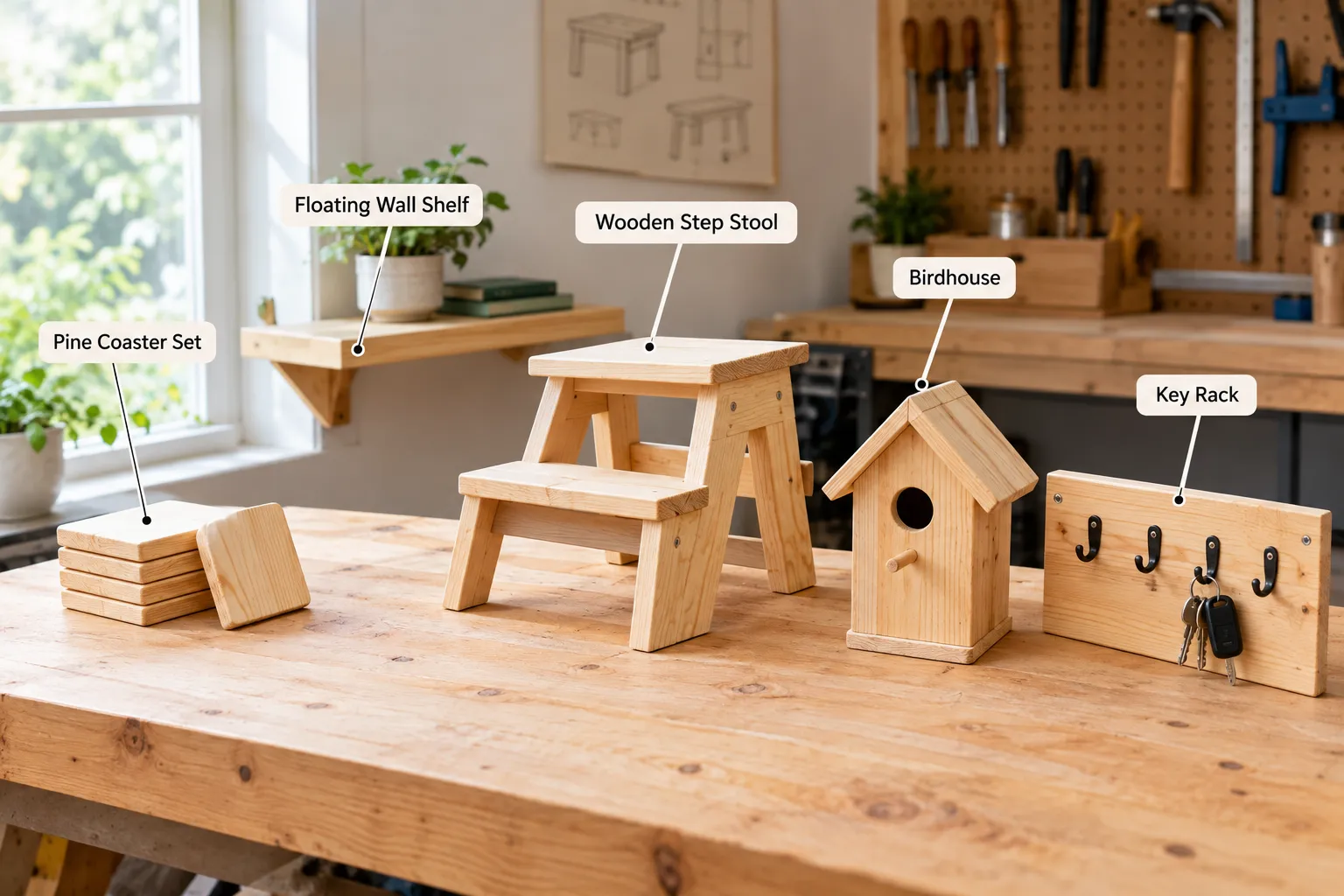
These 10 easy woodworking projects for first-timers are ranked roughly from simplest to slightly more involved, and all of them can be built with a hand saw or a basic circular saw.
- Wooden coaster set, four to six square blanks, sanded and finished. No joinery at all.
- Simple picture frame, four mitered or butt-jointed strips glued into a square.
- Floating wall shelf, one board with hidden cleat support, mounted to a wall.
- Step stool, two side panels and a top, joined with screws or pocket holes.
- Wooden tool tote, a box with a dowel handle, held together with glue and brad nails.
- Birdhouse, six flat panels, butt-joined, with one drilled entry hole.
- Key rack, a single board with hooks screwed into pre-drilled holes.
- Small side table, four legs and an apron, assembled with pocket-hole joinery.
- Garden planter box, simple butt-jointed sides with a slatted bottom.
- Cutting board, edge-glued strips of hardwood, sanded and food-safe finished.
| Project | Primary Joint | Rough Build Time | Minimum Tools |
|---|---|---|---|
| Coaster set | None (glue only) | 1 hour | Saw, sander |
| Picture frame | Butt or miter | 1-2 hours | Miter saw, clamps |
| Floating shelf | Cleat/screw | 1 hour | Drill, level |
| Step stool | Screw or pocket hole | 2-3 hours | Drill, pocket-hole jig |
| Tool tote | Glue + brad nail | 2 hours | Saw, brad nailer |
| Birdhouse | Butt joint | 2-3 hours | Saw, drill |
| Key rack | Screw | 30 minutes | Drill |
| Small side table | Pocket hole | 3-4 hours | Pocket-hole jig, drill |
| Planter box | Butt joint | 2 hours | Saw, drill |
| Cutting board | Edge glue | 2 hours (plus drying) | Clamps, sander |
For full dimensioned versions of these builds, the woodworking projects library breaks each one down with cut lists, and learning to read a plan properly first will save you wasted lumber, this guide to reading and using woodworking plans is worth ten minutes before your first cut.
Do You Need Expensive Tools or a Workbench to Start Woodworking?
No. Every project on this list can be built with a hand saw, a drill, clamps, sandpaper, and a square, none of which require a major investment. A dedicated workbench helps but isn’t mandatory for small builds.
What actually matters more than tool price is accuracy. A $20 combination square that holds a true 90 degrees is more useful than an expensive miter saw that’s slightly out of calibration. For a first kit, look at a beginner woodworking tool kit built for small projects rather than buying tools piecemeal.
On the workbench question specifically: a sturdy kitchen table protected with a scrap board, paired with two or three clamps, is enough to hold most coaster, frame, and shelf builds steady. Once you move into table-and-stool-size projects, a simple workbench, even a flat-pack one, makes clamping and squaring noticeably easier. If you’re setting up a permanent space, this home woodshop setup planning guide covers layout for small rooms and garages.
Common mistake: buying a full table saw before finishing a single project. Most first-timers never use it enough in year one to justify the cost or the learning curve.
How Much Does It Cost to Build a Beginner Woodworking Project?
Most beginner projects cost between $15 and $60 in materials, depending on the wood species chosen and whether hardware like hinges or hooks is needed. A coaster set might run under $10; a pocket-hole side table can climb toward $60 once you add screws, glue, and finish.
Rough cost breakdown for the 10 projects above:
- Pine board stock: $3 to $8 per linear foot at most hardware stores
- Plywood sheet (half or quarter sheet): $15 to $30
- Wood glue, sandpaper, finish: $10 to $15 total, reusable across projects
- Hardware (hinges, hooks, dowels): $2 to $10 depending on the build
Tools are the bigger expense, but they’re a one-time cost spread across every future project. A full breakdown of what beginners typically spend getting started, not just per project, is covered in this real cost breakdown for starting woodworking.
What’s the Difference Between Pine and Plywood for Starter Projects?
Pine is a solid softwood that’s easy to cut and sand by hand, while plywood is a layered sheet material that resists warping and holds screws better in thin sections. Choose pine for shelves, stools, and furniture frames; choose plywood for boxes, totes, and anything with large flat panels.
Quick decision rule:
- Choose pine if the project needs visible edges, simple joinery, or a natural wood-grain look.
- Choose plywood if the project needs wide flat panels (like a tool tote bottom or a drawer box) where warping would ruin the fit.
Pine is softer and dents more easily, so it’s forgiving for beginners learning to control a saw, but it also shows tool marks faster. Plywood edges need to be covered or sanded carefully since the layered edge grain doesn’t finish as cleanly. For a deeper comparison across more species, the wood types and material selection guide is a good reference before your next trip to the lumberyard.
Can You Do Woodworking in a Small Apartment or Garage?
Yes. All 10 projects in this guide can be built in a space as small as a balcony, a kitchen table, or a single-car garage bay, since none require stationary power equipment. The main constraints are ventilation, a flat work surface, and a place to store lumber flat.
For apartment woodworking specifically:
- Use hand tools or battery-powered tools to avoid noise complaints and breaker overloads.
- Work near an open window or door when sanding or finishing to manage dust and fumes.
- Store project pieces flat, not leaned against a wall, to prevent warping before assembly.
Edge case: if you’re in a garage without climate control, extreme humidity swings can warp thinner plywood between build sessions. Finish projects in fewer, longer sittings rather than stretching them over many weeks in a damp space.
How Long Does It Take to Complete a Beginner Woodworking Project?
Most beginner projects take between 30 minutes and 4 hours of hands-on build time, not counting glue drying or finish curing, which can add a day or two. A key rack might take 30 minutes; a small side table with pocket-hole joinery usually takes 3 to 4 hours spread across one or two sessions.
Three factors that stretch build time for first-timers:
- Measuring and re-measuring cuts (expected and worth the slowdown)
- Waiting on glue or finish between steps rather than rushing assembly
- Sanding, which beginners consistently underestimate by 15 to 30 minutes per project
What Mistakes Do First-Time Woodworkers Make?
The most common first-timer mistakes are skipping the measuring step, using dull or wrong-size blades, and buying warped or low-grade lumber without checking it first. Each of these is avoidable with a five-minute check before cutting.
| Mistake | Why it happens | Fix |
|---|---|---|
| Cutting before measuring twice | Excitement to get started | Mark, measure, then cut, in that order, every time |
| Using a dull blade | Blades aren’t replaced often enough | Replace or sharpen before starting a new project |
| Buying warped boards | Not sighting down the board at the store | Hold each board at eye level and check for bow before buying |
| Overtightening clamps | Assuming more pressure means a stronger joint | Snug is enough; over-tightening can squeeze out too much glue |
| Skipping sanding grits | Jumping straight to a fine grit | Work through grits in order (80, then 120, then 220) |
Easiest Wood Joints for Beginners to Learn
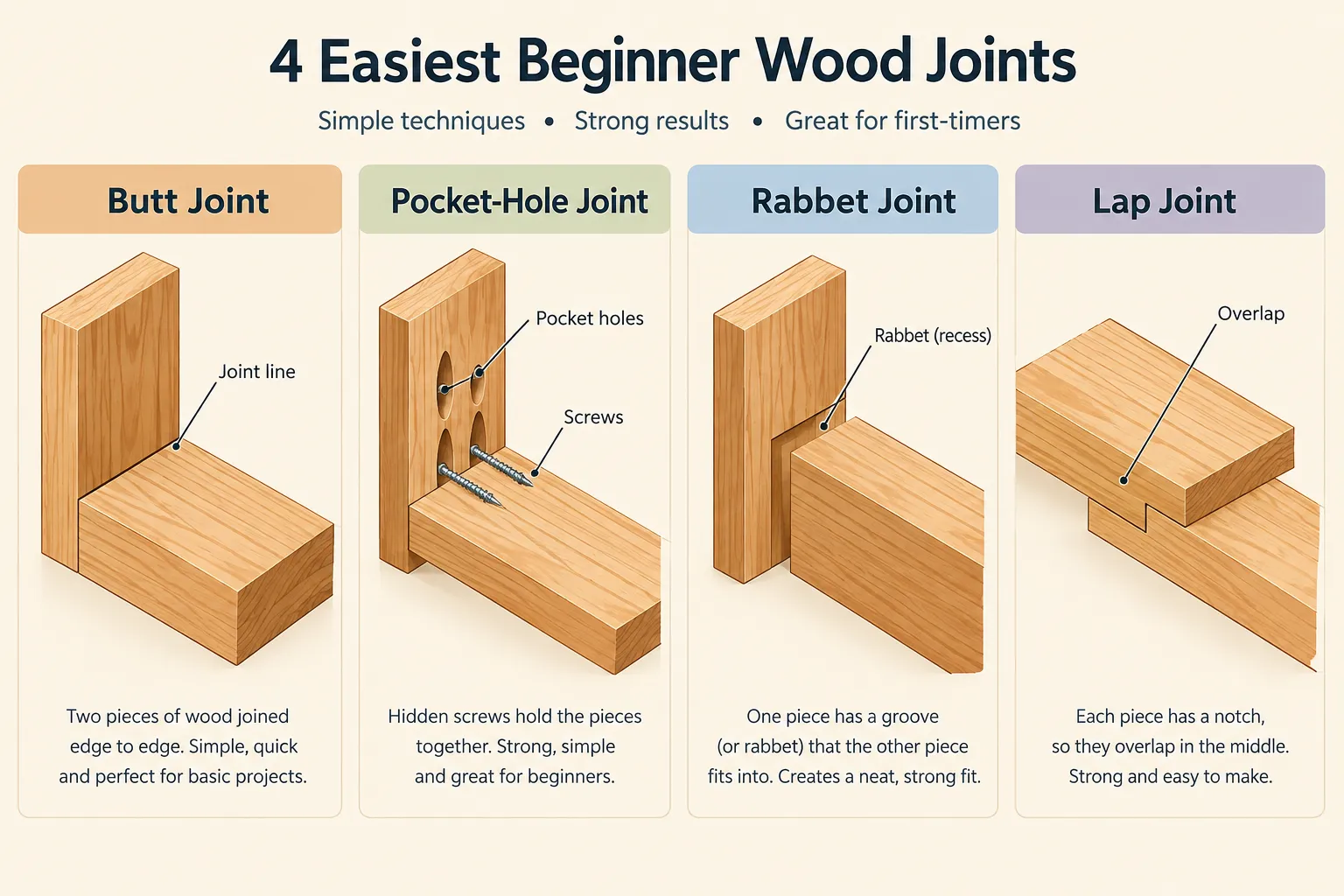
The two easiest joints for beginners are the butt joint and the pocket-hole joint, since both rely on straight cuts and simple hardware rather than precise hand-cut interlocking pieces. A butt joint is two flat pieces glued or screwed at a right angle; a pocket-hole joint uses an angled screw hole drilled with a jig for extra strength.
Start with these two before attempting anything more advanced:
- Butt joint, best for boxes, frames, and shelves; reinforce with glue and a few finish nails or screws.
- Pocket-hole joint, best for furniture frames like the step stool or side table; a basic jig costs under $40 and dramatically improves joint strength.
Once those feel comfortable, rabbet and lap joints are the logical next step. The ultimate woodworking joints guide compares every joint type in detail if you want to plan your skill progression ahead of time.
Woodworking Projects That Don’t Require a Table Saw
None of the 10 projects in this guide require a table saw. A hand saw, a circular saw with a straight edge guide, or even a hardware-store cut service can handle every cut needed for coasters, shelves, totes, stools, and small tables.
If you don’t own a saw at all, most lumber yards and home improvement stores will make straight cuts for a small fee or free with purchase, a practical workaround while you decide whether to invest in your own.
Is Woodworking a Good Hobby for Kids or Teens?
Yes, with the right project selection and supervision. Woodworking teaches measurement, patience, and spatial reasoning, and simple builds like coasters, birdhouses, and key racks are appropriate starting points for kids as young as 8 to 10 with adult supervision on any cutting steps.
Age-appropriate guidance:
- Younger kids (8-12): sanding, gluing, and assembly with pre-cut pieces
- Teens (13+): supervised use of a hand saw or cordless drill on simple butt-joint projects
- Any age: full-time adult supervision around blades, even hand saws
Where Can You Get Affordable Wood for Beginner Projects?
The most affordable wood for beginner projects usually comes from home improvement stores, local lumber yards, and the cut-off or scrap bins many of them keep near the lumber section. Big-box stores offer consistent pine and plywood at predictable prices, while local yards often have better hardwood deals for cutting boards and small furniture.
Other low-cost sources worth checking:
- Scrap and cut-off bins at lumber yards (often free or heavily discounted)
- Pallet wood, if cleaned and de-nailed carefully (free, but more prep work)
- Online marketplace listings for leftover renovation lumber
What Safety Gear Do You Actually Need When Starting Woodworking?
Beginners need three core pieces of safety gear: safety glasses, hearing protection for any powered tool, and a basic dust mask for sanding and cutting. Nothing beyond that is strictly necessary for the 10 projects in this guide.
- Safety glasses, wear for every cut, every time, no exceptions
- Hearing protection, needed for drills, circular saws, and sanders, not for hand tools
- Dust mask or respirator, essential when sanding, especially with plywood, which contains adhesives
Push sticks, feather boards, and kickback-prevention gear matter once you move to a table saw, but they’re not relevant to hand-tool starter projects. For a broader rundown of what belongs in a first tool kit, including safety basics, see this beginner hand tool woodworking kit guide.
Frequently Asked Questions
Do I really need to buy a full tool set before starting?
No. Start with a saw, square, clamps, sandpaper, and a drill. Add tools as specific projects demand them.
What if my first cut isn’t perfectly straight?
Minor imperfections sand out or get hidden by glue and finish on most beginner projects. Precision improves with practice, not with better tools alone.
Can I use reclaimed or pallet wood for these projects?
Yes, as long as it’s clean, dry, and free of embedded nails or chemical treatment. Check for a stamp indicating heat treatment rather than chemical fumigation.
How do I know if a board is warped before buying it?
Hold it at eye level and sight down its length. A slight bow often flattens under clamps; a severe twist usually won’t.
Is it normal for a first project to look rough?
Yes. Visible tool marks and slightly uneven edges are common on first builds and typically disappear with sanding and practice on the next one.
Should I start with hand tools or power tools?
Either works for this list. Hand tools teach more control; power tools finish faster. Many beginners mix both, using a hand saw for small cuts and a drill for assembly.
What’s the single biggest reason beginners abandon a project?
Choosing a build that’s too large or too complex for a first attempt, then losing momentum when early steps feel overwhelming.
Conclusion
Finishing a first woodworking project comes down to choosing something small enough to complete in one or two sittings, then repeating that success a few times before scaling up. Every project on this list, from a coaster set to a pocket-hole side table, is designed to build real, transferable skill: measuring accurately, cutting straight, and joining two pieces of wood so they hold.
Start with one project this week. Pick the coaster set or the key rack if time is tight, or the step stool if you want practice with a real joint. Once it’s finished, move to the next item on the list rather than jumping straight to furniture. Skill compounds faster through repetition on small builds than through one ambitious failure.
Products, Tools, and Resources Worth Having
A short list of what actually earns a place in a beginner’s first toolbox, based on what these 10 projects require:
- A combination square and a tape measure that hold true measurements, accuracy matters more than brand
- A basic clamp set (two to four clamps) for gluing and holding pieces square during assembly
- A pocket-hole jig, useful starting at project four on this list and every furniture build after
- 80, 120, and 220 grit sandpaper, enough to cover sanding on every project here
- Safety glasses and a dust mask, non-negotiable from the first cut onward
If you want a curated starting point rather than piecing a kit together, the best beginner woodworking tool kits for small projects and furniture guide compares a few solid options, and the broader beginner woodworking guide is worth bookmarking as you move from these 10 projects into more advanced builds.