
Nursery Furniture Building Guide: What Regulations You Must Follow
Every year, the U.S. Consumer Product Safety Commission (CPSC) receives reports of infant injuries and fatalities linked to furniture that failed to meet basic safety standards. Some of those pieces were store-bought. Others were handmade with nothing but good intentions. This nursery furniture building guide covers what regulations you must follow so that every joint, finish, and dimension you choose protects the baby who will depend on that furniture from day one.
Key Takeaways
- The CPSC enforces mandatory federal safety standards for cribs, bassinets, and play yards under 16 CFR Parts 1219, 1220, and 1221.

- ASTM International publishes the voluntary technical standards (such as ASTM F1169) that the CPSC references in its mandatory rules.
- Homemade cribs cannot be certified under CPSC rules, which means they legally cannot be sold or given away for use by an infant.
- Safe materials for baby furniture include solid hardwoods, formaldehyde-free plywood, and water-based or natural oil finishes with no added lead or VOCs.
- Lead content in surface coatings on children’s products must not exceed 90 parts per million (ppm) under CPSC regulations.
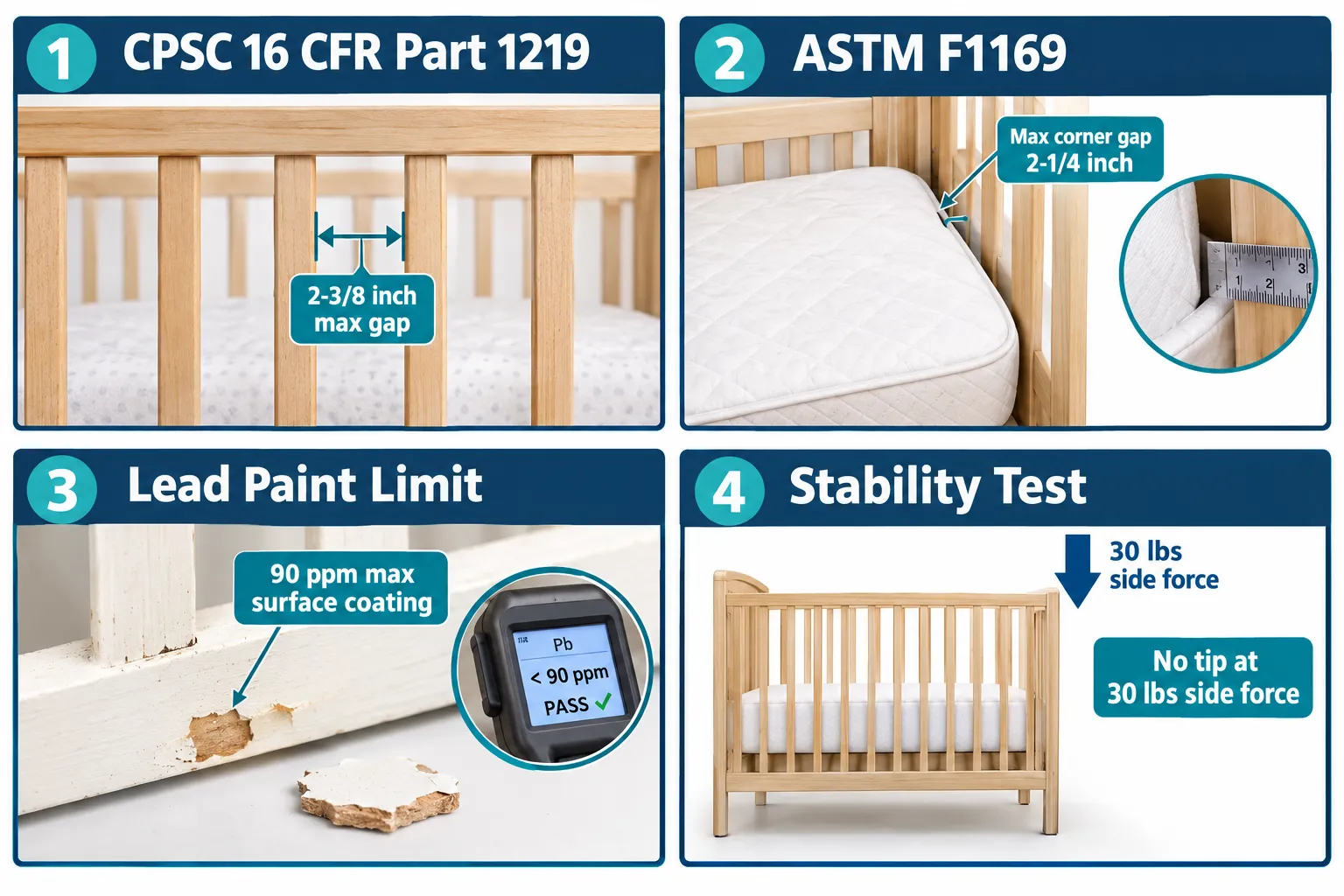
- Crib slat spacing must not exceed 2-3/8 inches (6 cm) to prevent head entrapment.
- Stability testing, hardware torque checks, and mattress-fit verification are the three most critical DIY safety tests before placing a baby in any handmade piece.
- Selling or commercially distributing non-compliant nursery furniture can result in significant federal penalties.
- Regulations differ by country: Canada follows Health Canada’s SOR/2016-152, and the UK/EU follow EN 716 and EN 1130 standards.
Find this useful? Add us as a preferred source on Google and more of what we publish will show up in your results.
What Safety Standards Apply to Building Nursery Furniture
The primary safety standards for nursery furniture in the United States come from two sources: the CPSC and ASTM International. The CPSC sets mandatory federal regulations, while ASTM publishes the voluntary technical benchmarks that those regulations incorporate by reference.
Here is a breakdown of the key standards:
| Furniture Type | CPSC Regulation | ASTM Standard |
|---|---|---|
| Full-size cribs | 16 CFR Part 1219 | ASTM F1169 |
| Non-full-size cribs | 16 CFR Part 1220 | ASTM F406 |
| Bassinets/cradles | 16 CFR Part 1218 | ASTM F2194 |
| Play yards | 16 CFR Part 1221 | ASTM F406 |
| Changing tables | 16 CFR Part 1234 | ASTM F2388 |
These standards cover dimensional requirements (slat spacing, mattress support height), structural integrity tests (drop tests, torque tests), and labeling requirements. If a piece of furniture falls into any of these categories, those standards apply regardless of whether it was factory-made or built in a home workshop.
Common mistake: Many beginners assume safety standards only apply to commercial manufacturers. In practice, the standards define what “safe” means for any piece of furniture a baby will use, homemade or otherwise.
CPSC Regulations for Homemade Baby Furniture
The CPSC does not offer a certification pathway for individual hobbyist woodworkers. This is the most important regulatory fact in this entire nursery furniture building guide on what regulations you must follow.
What this means practically:
- A homemade crib cannot carry a CPSC certification mark because certification requires third-party laboratory testing by a CPSC-accepted lab.
- A homemade crib can still be built to meet the dimensional and structural requirements of the applicable standard, which is the responsible approach for personal use.
- A homemade crib cannot legally be sold, donated, or given away for infant use under the Consumer Product Safety Improvement Act (CPSIA) of 2008, because it lacks third-party certification.
The practical takeaway: build to the standard’s specifications for your own family’s use, but never transfer a homemade crib to another household. The liability and safety risk are both too significant.
Difference Between CPSC and ASTM Standards for Cribs
The CPSC issues the law; ASTM writes the technical recipe. Understanding the difference helps woodworkers know exactly which document to consult when designing a crib.
- CPSC (16 CFR Part 1219): A federal regulation with the force of law. It mandates that full-size cribs sold or distributed in the U.S. must comply with ASTM F1169. It also bans drop-side cribs entirely.
- ASTM F1169: A technical standard that specifies exact measurements, test methods, and performance requirements. It is updated periodically by ASTM’s committee on juvenile furniture.
For a woodworker, ASTM F1169 is the document to read and build from. It specifies:
- Maximum slat spacing: 2-3/8 inches (no more, no exceptions)
- Mattress support height adjustments and load capacity
- Corner post height limits to prevent clothing entrapment
- Hardware torque and pull-force requirements
- Mattress fit: no gap larger than 1 inch between the mattress and any crib side
The CPSC regulation is what makes compliance mandatory for commercial products. The ASTM standard is the engineering blueprint that tells you how to achieve it.
Can You Build Your Own Crib, or Does It Have to Be Store-Bought
You can build your own crib for personal use in your own home, but it comes with serious responsibilities. The CPSC does not prohibit a parent from building a crib for their own child; it prohibits the sale or commercial distribution of uncertified cribs.
Before placing any infant in a homemade crib, a responsible builder should:
- Obtain and read the current version of ASTM F1169 (available for purchase from ASTM International).
- Build to every dimensional specification in that standard.
- Conduct all structural tests described in the standard, including slat pull tests and mattress support load tests.
- Have a knowledgeable second person review the finished piece before use.
For beginners who are newer to furniture construction, reviewing a beginner woodworking guide covering tools, projects, and foundational skills before attempting a crib build is strongly recommended. A crib is not a first project.
What Materials Are Safe for Baby Furniture
Safe baby furniture starts with materials that have no toxic off-gassing, no lead, and no sharp or splinter-prone surfaces. Material selection is one area where this nursery furniture building guide on what regulations you must follow gets very specific.
Wood choices:
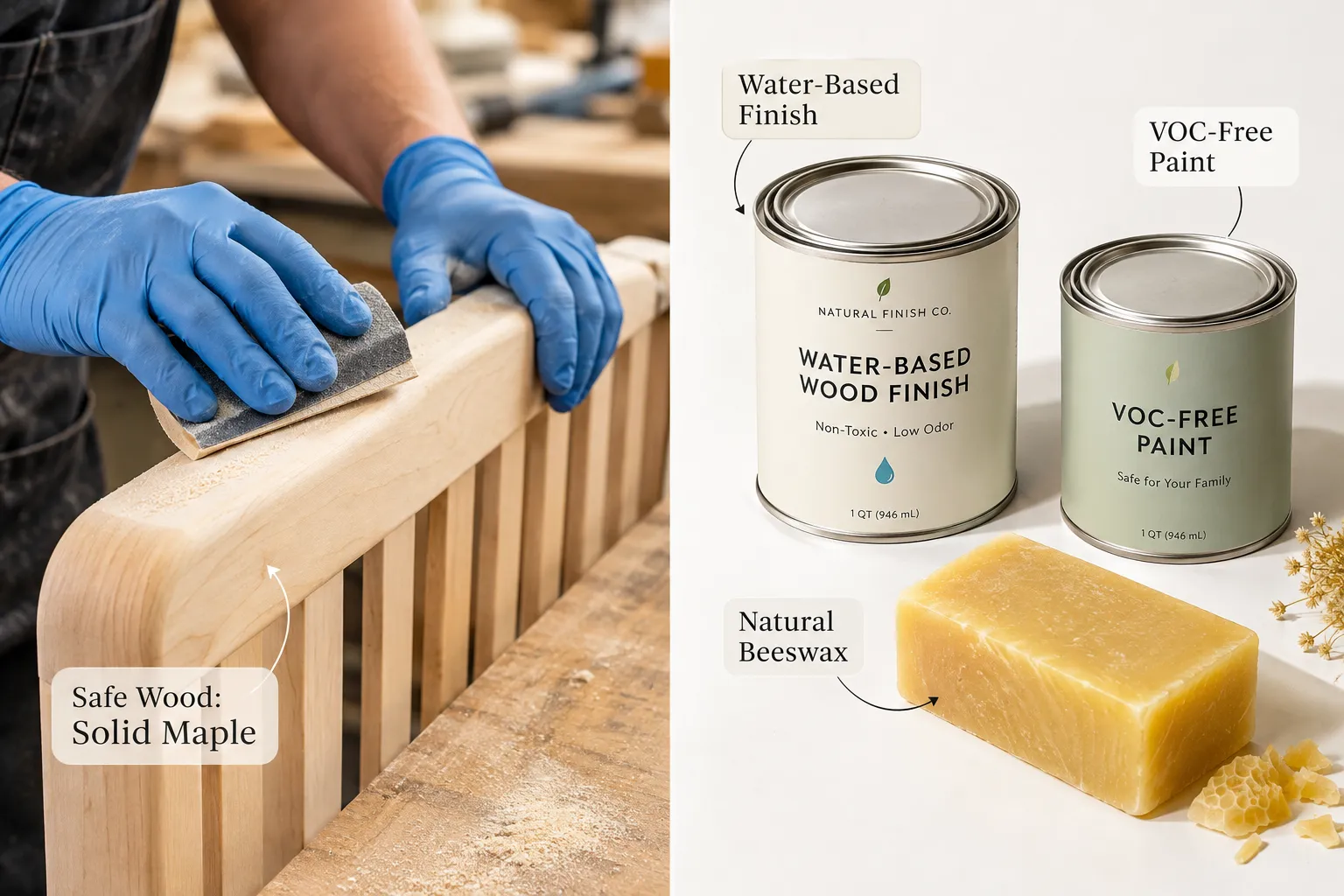
- Solid hardwoods (maple, birch, beech) are the gold standard. They are dense, smooth, and durable. See the best wood for furniture making comparison guide for a full breakdown.
- Avoid softwoods like pine for structural crib components because they dent and splinter more easily.
- If using plywood, choose CARB Phase 2-compliant or TSCA Title VI-compliant panels, which have certified low formaldehyde emissions.
- Never use particleboard or MDF for structural crib components.
Finish choices:
- Water-based polyurethane or water-based acrylic finishes labeled “non-toxic when dry” are widely used.
- Pure tung oil and food-grade mineral oil are natural alternatives.
- Avoid oil-based paints and finishes with high VOC content.
- Never use paint that is not certified lead-free on any children’s furniture.
For a deeper look at how hardwood species compare for furniture projects, the oak vs. maple hardwood comparison guide is a useful reference.
Lead Paint Testing Requirements for Nursery Furniture
Under the CPSIA, the maximum allowable lead content in surface coatings on children’s products is 90 ppm. This applies to any paint, stain, or finish applied to furniture intended for children under 12.
What woodworkers need to know:
- Buy finishes that are explicitly labeled “lead-free” and certified to ASTM D4236 (standard for art and craft materials) or equivalent.
- Do not use vintage or reclaimed paint cans, even if they appear unused. Pre-1978 paints in the U.S. may contain lead.
- If refinishing older furniture for nursery use, test the existing finish with an XRF analyzer or a certified lab test before proceeding.
- Consumer lead test swabs (available at hardware stores) can detect lead above roughly 600 ppm but are not sensitive enough to confirm compliance with the 90 ppm limit. For definitive testing, use a certified laboratory.
Common Mistakes People Make When Building Baby Furniture
Even experienced woodworkers make avoidable errors when building for infants. The stakes are higher than with any other furniture category.
The most common mistakes:
- Slat spacing eyeballed instead of measured: The 2-3/8 inch maximum is strict. Use a spacer jig cut to exactly that width for every slat gap.
- Using decorative corner posts: Corner posts taller than 1/16 inch above the crib end panel can catch infant clothing and cause strangulation. Keep them flush.
- Skipping hardware torque tests: All bolts and screws on a crib must resist loosening under repeated use. Test with a torque wrench to the values specified in ASTM F1169.
- Choosing the wrong finish: Oil-based finishes with high VOC content off-gas for weeks. Water-based finishes cure faster and are safer for enclosed nursery spaces.
- Mattress fit not verified: A gap larger than 1 inch between the mattress and crib side is a suffocation hazard. Test with the actual mattress you plan to use, not an approximation.
- No load testing on the mattress support: The support must hold a minimum static load without deflecting beyond the standard’s limits.
Understanding woodworking joinery and techniques that produce tight, rattle-free joints is essential for crib construction, where loose hardware is a direct safety risk.
Which Nursery Furniture Items Have the Strictest Regulations
Cribs have the strictest regulations of any nursery furniture category, followed closely by bassinets and play yards. Dressers, wardrobes, and changing tables have their own standards but are generally less complex to meet.
Regulation intensity by item:
- Full-size cribs (16 CFR Part 1219 / ASTM F1169): Most complex. Covers slat spacing, mattress fit, hardware, structural integrity, and labeling.
- Non-full-size cribs and portable cribs (16 CFR Part 1220): Similar requirements, adapted for folding or travel designs.
- Bassinets and cradles (16 CFR Part 1218 / ASTM F2194): Covers stability, fabric lining requirements, and load capacity.
- Changing tables (16 CFR Part 1234 / ASTM F2388): Focuses on restraint systems, guardrail height, and load capacity.
- Dressers and storage (ASTM F2057 for tip-over resistance): Requires anti-tip hardware and stability testing.
For dressers and storage pieces, the primary concern is tip-over prevention. ASTM F2057 specifies that a drawer fully extended while loaded should not cause the unit to tip. This is testable in a home shop without specialized equipment.
How to Test Homemade Furniture for Stability and Safety
Testing is not optional. Before any infant uses a handmade piece of nursery furniture, three categories of tests should be completed.
1. Stability test (tip-over resistance)
Apply a 30-pound lateral force to the top of the unit with all drawers open and loaded. The piece should not tip. If it does, add a wall anchor bracket as a minimum safeguard.
2. Slat and component pull test (for cribs)
Grip each slat and apply a firm outward pull. No slat should deflect more than the standard allows or show signs of joint failure. Check every connection point.
3. Mattress fit verification
Place the intended mattress in the crib. Run a finger along all four sides. Any gap larger than the width of two adult fingers (approximately 1 inch) is a hazard requiring correction.
4. Hardware torque check
Tighten all bolts and screws to the manufacturer’s specified torque, then check them again after 24 hours. Repeat after one week of simulated use (gentle rocking and loading).
5. Surface inspection
Run bare hands over every surface the infant can contact. No splinters, no sharp edges, no protruding hardware. Sand to at least 220-grit on all contact surfaces.
Reviewing how to read and use woodworking plans before starting a crib build ensures the dimensional specifications from ASTM F1169 are translated accurately into the build.
Is It Cheaper to Build or Buy Nursery Furniture
Building is often less expensive for storage pieces like dressers and bookshelves, but the cost advantage narrows significantly for cribs once you account for materials, hardware, and the time investment.
Rough cost comparison (2026 estimates, U.S. market):
- A compliant store-bought crib from a reputable brand: $150 to $600, already certified.
- Materials for a hardwood DIY crib (maple or birch lumber, hardware, finish): $150 to $350, plus 20 to 40 hours of skilled labor.
- ASTM F1169 standard document: approximately $60 to $80 from ASTM International.
The real value of building is not cost savings on a crib. It is the ability to match a specific aesthetic, use heirloom-quality materials, or build storage pieces (dressers, bookshelves, toy chests) that would cost significantly more to buy at equivalent quality. For those projects, the furniture building plans resource for DIY woodworking projects offers a practical starting point.
Do Handmade Nursery Pieces Need Certification
Handmade nursery furniture built for personal use in your own home does not require third-party certification. However, any piece that is sold, donated, or transferred to another household for infant use legally requires CPSC certification under the CPSIA.
This distinction matters:
- Personal use only: No certification required, but building to ASTM specifications is strongly recommended for safety.
- Gifting or donating: Legally, this constitutes “distribution in commerce” under CPSIA and requires certification. In practice, many people are unaware of this, but the legal and moral liability remains.
- Selling: Requires third-party testing by a CPSC-accepted laboratory and a Children’s Product Certificate (CPC). No exceptions.
If there is any possibility a piece will leave your home, consult the CPSC’s website directly for current guidance on small batch manufacturers and cottage industry exemptions, which have specific eligibility criteria.
What Happens If Nursery Furniture Doesn’t Meet Regulations
For commercial sellers, the consequences of non-compliant nursery furniture are significant. The CPSC can issue mandatory recalls, impose civil penalties up to $15 million per violation series (as of recent CPSIA amendments), and pursue criminal charges in cases of knowing violations.
For individual builders, the consequences are primarily safety-related rather than immediately legal for personal use. But if a homemade piece causes injury and was built below standard specifications, civil liability in a personal injury case is a real risk.
The deeper consequence is the one that matters most: an infant can be seriously harmed or killed by furniture that fails. That reality is why this nursery furniture building guide on what regulations you must follow treats compliance as non-negotiable, not optional.
Are There Different Rules for Different Countries Building Baby Furniture
Yes, regulations differ significantly by country, and builders should always apply the standards of the country where the furniture will be used.
- United States: CPSC mandatory standards (16 CFR Parts 1218-1221), incorporating ASTM standards.
- Canada: Health Canada’s Cribs, Cradles and Bassinets Regulations (SOR/2016-152) govern crib safety, with similar slat spacing and structural requirements to U.S. standards.
- United Kingdom / European Union: EN 716 covers children’s cots and folding cots; EN 1130 covers cribs and cradles. These are harmonized European standards with CE marking requirements for commercial products.
- Australia/New Zealand: AS/NZS 2172 covers cots for household use.
The dimensional requirements across these standards are broadly similar (slat spacing, mattress fit), but the test methods and labeling requirements differ. Always obtain the current version of the applicable national standard before beginning a build.
FAQ
Can I use reclaimed wood for a baby crib?
Reclaimed wood can be used if it is structurally sound, free of lead paint, and free of chemical treatments. Test any reclaimed wood for lead before using it in a nursery. Old barn wood, railroad ties, or pallets are generally not appropriate due to chemical exposure history.
What is the maximum slat spacing allowed in a crib?
The maximum slat spacing is 2-3/8 inches (approximately 6 centimeters) under both ASTM F1169 and CPSC 16 CFR Part 1219. This dimension prevents infant head entrapment.
Are drop-side cribs legal to build?
No. The CPSC banned drop-side cribs in the United States in 2011. Building a drop-side crib for infant use, even for personal use, is strongly inadvisable and would not comply with current ASTM F1169 requirements.
What finish is safest for a baby crib?
Water-based polyurethane or water-based acrylic finishes labeled non-toxic when cured are the most practical safe choices. Pure tung oil and food-grade mineral oil are natural alternatives. All finishes should be fully cured before the crib is used.
Do I need to buy the ASTM standard to build a crib?
Technically, you can build without purchasing it, but it is strongly recommended. The ASTM F1169 document contains the exact dimensional tolerances and test procedures you need. It costs approximately $60 to $80 and is available directly from ASTM International.
Can I give a handmade crib to a family member?
Legally, transferring a crib to another household constitutes distribution in commerce under CPSIA, which requires certification. Most people are unaware of this rule, but the legal and safety liability is real. A safer alternative is to help the family member build their own, or contribute to the purchase of a certified commercial crib.
What wood species is best for a baby crib?
Hard maple and birch are the most commonly recommended species. They are dense, smooth, and resist denting. Both sand to a very fine finish and hold hardware well. For a full comparison of furniture-grade hardwoods, see the hardwoods for beginners guide.
Does a changing table need to meet safety standards?
Yes. ASTM F2388 and CPSC 16 CFR Part 1234 cover changing tables. Key requirements include guardrail height (at least 2 inches on all sides), a restraint system, and a load capacity of at least 30 pounds on the changing surface.
How do I know if my plywood is safe for nursery use?
Look for CARB Phase 2 or TSCA Title VI compliance on the panel label. These certifications confirm the adhesive resins meet low-formaldehyde emission standards. Avoid imported plywood without clear certification markings.
Is it worth building nursery furniture as a beginner woodworker?
A crib is not a beginner project. Dressers, bookshelves, and toy chests are more appropriate starting points because their safety requirements are less complex. Build confidence on simpler projects first, then approach a crib build with a solid foundation of skills.
Conclusion
Building nursery furniture is one of the most meaningful projects a woodworker can take on. It is also one of the most regulated, and for very good reason. The standards exist because infants cannot protect themselves from furniture that fails.
The core message of this nursery furniture building guide on what regulations you must follow is straightforward: build to ASTM specifications, choose safe materials, test every structural element before use, and never sell or transfer a homemade crib without understanding the legal requirements.
Actionable next steps:
- Download or purchase the current version of ASTM F1169 from ASTM International before designing a crib.
- Choose a CARB Phase 2-compliant hardwood or solid hardwood like maple or birch.
- Select a water-based, lead-free finish and allow full cure time before use.
- Build and test a non-crib piece first (dresser, bookshelf, toy chest) to develop precision joinery skills.
- Conduct all five safety tests described above before placing any infant in a handmade piece.
Products, Tools, and Resources
A few practical items support a safe nursery furniture build:
- Torque wrench: Essential for verifying hardware meets the pull and torque specifications in ASTM F1169. A basic 3/8-inch drive torque wrench handles most crib hardware.
- Slat spacing jig: Cut a piece of scrap wood to exactly 2-3/8 inches and use it as a physical spacer for every slat gap. No measuring tape required, no margin for error.
- XRF lead analyzer or certified lab test kit: If using any reclaimed material or pre-mixed paint, this is the only reliable way to confirm lead content below 90 ppm.
- Water-based polyurethane (non-toxic formula): Brands that explicitly label their products as non-toxic when cured and compliant with ASTM D4236 are the practical standard for nursery finishes.
- ASTM F1169 standard document: Available from ASTM International. This is the single most important reference document for anyone building a full-size crib.
For woodworkers who want to build skill before tackling nursery furniture, the step-by-step guide to woodworking projects for beginners is an excellent place to start. Precision, patience, and the right knowledge are what separate a beautiful piece from a safe one.