
Best Wood Joints for Storage Furniture That Holds Weight

A poorly jointed storage cabinet doesn’t fail slowly. It fails all at once, usually when it’s fully loaded. Choosing the best wood joints for storage furniture that holds weight is one of the most practical decisions a woodworker makes, and getting it wrong costs time, materials, and confidence.
This guide covers every major joint type used in weight-bearing storage builds, explains when each one is the right call, and helps beginners avoid the mistakes that cause furniture to rack, sag, or pull apart.
Key Takeaways

- Mortise and tenon joints are among the strongest options for frames and legs in heavy storage furniture
- Dovetail joints excel at resisting pull-out forces, making them ideal for drawer boxes and cabinet carcasses
- Pocket hole joinery is fast and adequate for light-to-medium loads, but it’s not the best choice for maximum weight-bearing applications
- Dowels and biscuits add alignment and modest strength, but neither replaces a mechanical joint under heavy loads
- Corner blocks, glue, and proper grain orientation dramatically improve the strength of any joint
- Plywood storage benefits most from rabbet joints, dado joints, and pocket screws combined with glue
- The wood species and grain direction matter as much as the joint type itself
- Screws alone, without a mechanical joint or glue, are the most common cause of storage furniture failure
Find this useful? Add us as a preferred source on Google and more of what we publish will show up in your results.
What Are the Strongest Wood Joints for Heavy Storage
The strongest wood joints for heavy storage are the mortise-and-tenon, the dovetail, and the box joint. Each one creates a mechanical interlock between two pieces of wood, meaning the joint resists force even before glue is applied. For storage furniture that carries consistent or heavy loads, mechanical interlocking joints outperform fastener-only connections every time.
Here is how the top contenders rank for weight-bearing storage applications:
| Joint Type | Mechanical Lock | Best Use | Skill Level |
|---|---|---|---|
| Mortise and Tenon | Yes | Frames, legs, face frames | Intermediate |
| Dovetail | Yes | Drawers, carcass corners | Intermediate-Advanced |
| Box Joint (Finger Joint) | Yes | Carcass corners, boxes | Beginner-Intermediate |
| Dado / Rabbet | Partial | Shelves, cabinet backs | Beginner |
| Pocket Hole | No | Light frames, face frames | Beginner |
| Dowel | No | Alignment, light loads | Beginner |
| Butt Joint + Screws | No | Rough builds only | Beginner |
For a deeper look at joinery techniques and when to apply each one, the Woodworking Joinery and Techniques: Build Skills That Last guide is a solid starting point.
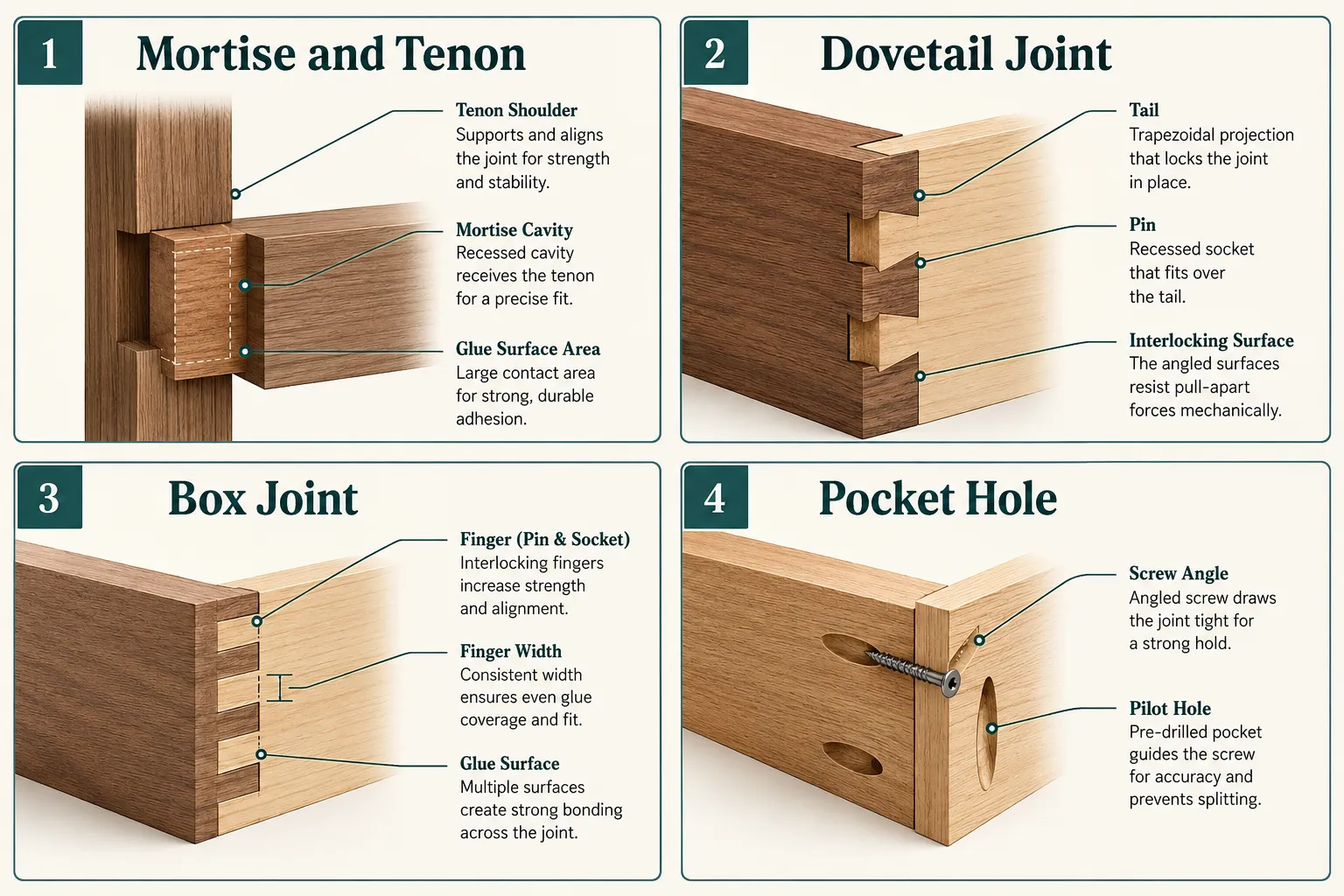
Mortise and Tenon vs Dovetail Joints: What Is the Difference
Mortise and tenon joints resist shear and racking forces, making them the go-to choice for structural frames. Dovetail joints resist pull-out tension, which makes them better suited for drawer boxes and the corners of cabinet carcasses. Both are excellent, but they solve different problems.
Mortise and Tenon works by inserting a rectangular tongue (the tenon) into a matching cavity (the mortise). The shoulder of the tenon bears against the face of the mating piece, distributing load across a large surface area. This is why it has been used in furniture frames for centuries.
Dovetail joints use angled, trapezoidal tails that lock mechanically against matching pins. The geometry means the joint cannot be pulled apart along one axis without destroying the wood itself. For storage drawers that get yanked open under load, that resistance matters.
Choose mortise and tenon if you are building a storage bench frame, a cabinet face frame, or any leg-and-rail structure. Choose dovetail if you are building drawer boxes or the corner joints of a carcass that will hold significant weight.
How Much Weight Can Different Wood Joints Hold
There is no single universal weight rating for wood joints because load capacity depends on wood species, grain orientation, glue type, and the size of the joint itself. That said, general patterns hold true across most builds.
A well-cut mortise and tenon joint in a hardwood like oak or maple, glued with PVA wood glue, can withstand hundreds of pounds of shear force. A butt joint held only by screws in pine may begin to loosen under as little as 50 to 75 pounds of repeated dynamic load, particularly if the screws are driven into end grain.
Key factors that affect how much weight a joint holds:
- Glue surface area: More surface contact means a stronger bond. Dovetails and box joints win here.
- Grain direction: Screws and dowels driven into end grain hold roughly 60 to 70 percent less than those driven into face grain, according to general woodworking engineering principles.
- Wood species: Hardwoods (oak, maple, walnut) hold joints significantly better than softwoods (pine, cedar).
- Joint fit: A loose joint filled with excess glue is weaker than a snug joint with a thin, even glue line.
For guidance on choosing the right lumber species for your project, see Wood Types and Material Selection: Choose the Right Lumber for Any Project.
Best Joints for Shelving That Won’t Sag
Dado joints are the best choice for shelving that resists sag. A dado is a channel cut across the grain of a side panel, into which the shelf sits. This means the shelf’s weight is supported by the wood below it, not by fasteners pulling through the material.
For fixed shelves in a storage cabinet or bookcase:
- Through dado: The shelf runs the full depth of the cabinet side. Simple to cut, very strong.
- Stopped dado: The channel stops before the front edge, hiding the joint from view. Slightly more work, cleaner appearance.
- Rabbet joint: Used at the top and bottom of a cabinet carcass, where a shelf meets the corner.
Avoid relying on shelf pins alone for heavy loads. Shelf pins work well for adjustable shelving under moderate weight, but they concentrate stress at four small points. A fixed dado shelf distributes that load across the entire width of the panel.
Pocket Hole Joinery vs Traditional Joints for Storage
Pocket hole joinery is fast, beginner-friendly, and perfectly adequate for face frames, light cabinet assembly, and furniture that won’t carry heavy static loads. For storage furniture that holds significant weight, traditional mechanical joints are stronger and more reliable.
Pocket hole screws work by driving at an angle through one board and into the face grain of another. The connection is decent in shear but has limited resistance to pull-out forces and racking. Under heavy, repeated loading, the screw holes can elongate over time.
When pocket holes are a reasonable choice:
- Face frame assembly on a cabinet
- Light-duty storage benches with a plywood top
- Connecting secondary components like back panels
When to use traditional joints instead:
- Any joint that will bear direct, sustained weight
- Drawer box corners
- Leg-to-rail connections on a storage bench or cabinet base
Pocket holes combined with wood glue perform noticeably better than pocket holes alone. If you are using pocket hole joinery in a storage build, always add glue to the joint face.
Do Dowels or Biscuits Add Enough Strength for Heavy Furniture
Dowels and biscuits are alignment tools first, and strength aids second. Neither creates a true mechanical interlock, so neither should be the primary joint in a weight-bearing storage build.
Dowels add some shear resistance and increase the glue surface area, which helps. In edge-to-edge panel glue-ups, dowels are a reliable choice. In frame joints under heavy load, they are a supplement, not a substitute for a proper joint.
Biscuits are primarily alignment aids. They swell slightly when glue is applied, which locks them in place, but the biscuit itself contributes very little structural strength. Biscuit joints are appropriate for aligning cabinet panels during assembly, not for carrying weight.
Use dowels or biscuits to improve alignment and add modest reinforcement. Do not rely on them as the sole joint in any storage build that needs to hold real weight.
How to Reinforce Wood Joints for Maximum Strength
Reinforcing wood joints is often the difference between furniture that lasts decades and furniture that loosens within a few years. The most effective reinforcement methods are corner blocks, proper glue application, and mechanical fasteners used alongside a mechanical joint.
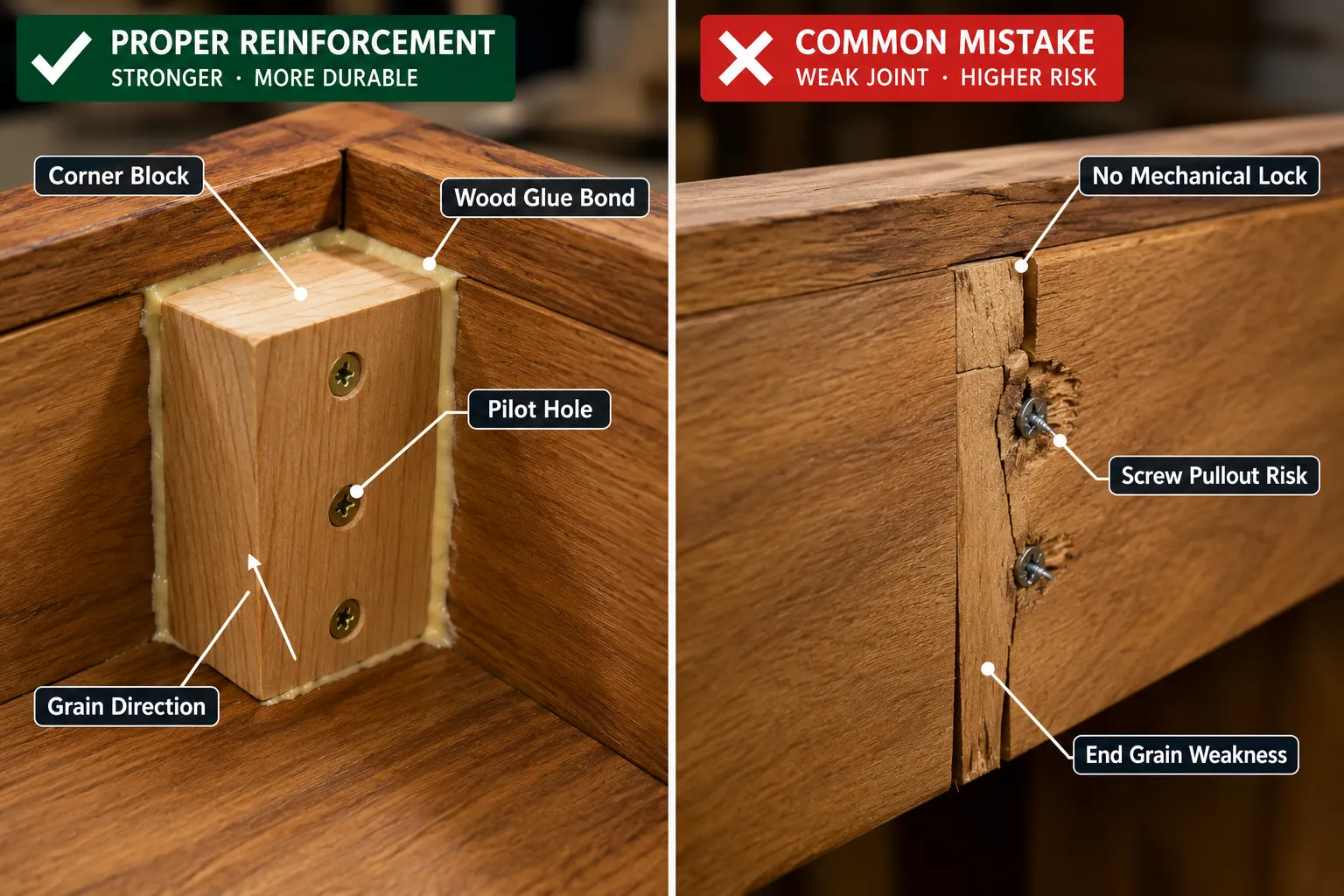
Corner blocks are triangular or square pieces of wood glued and screwed into the inside corners of a frame. They dramatically increase the rigidity of a joint by triangulating the connection. On a storage bench or cabinet base, corner blocks are one of the simplest and most effective upgrades a beginner can make.
Step-by-step reinforcement checklist for storage furniture joints:
- Cut joints to a snug fit before applying any glue
- Apply PVA wood glue evenly to both mating surfaces
- Clamp firmly and allow full cure time (typically 24 hours for PVA)
- Add corner blocks at all inside frame corners
- Drive screws or dowels through the corner block into both frame members
- Check for square before the glue sets
Also consider the wood itself. Orienting grain so that load runs along the length of the fiber (not across it) keeps joints from splitting under stress. This is a detail that separates solid builds from ones that crack under load.
For a full overview of the tools needed to cut and fit these joints accurately, the Essential Equipment Used in Woodworking for Perfect Furniture resource is worth reviewing.
What Joint Should You Use for a Storage Bench
A storage bench needs joints that handle both the weight of a person sitting on it and the contents stored inside. The best combination is mortise and tenon for the leg-to-rail connections and dado or rabbet joints for the bottom panel that holds the storage contents.
For a beginner building their first storage bench:
- Use mortise and tenon or pocket holes with glue for the side frame rails connecting to the legs
- Use a dado joint or rabbet joint for the bottom panel
- Add corner blocks at every inside corner of the base frame
- Use plywood for the seat lid and bottom panel rather than solid wood panels glued edge-to-edge, which can expand and contract with humidity
A storage bench is actually one of the best first projects for learning weight-bearing joinery because it combines several joint types in a single build. If you are looking for structured project guidance, the Step-by-Step Guide to Woodworking Projects for Beginners covers foundational builds in detail.
Can You Use Screws Instead of Joints for Storage Furniture
Screws alone are not a reliable substitute for proper wood joints in storage furniture that carries weight. Screws driven into end grain are especially weak, holding roughly 60 to 70 percent less than screws driven into face grain. Under sustained or dynamic loads, screw holes enlarge and the joint loosens.
That said, screws are not useless. They work well when:
- Combined with wood glue on a properly fitted joint
- Driven into face grain or long grain, not end grain
- Used to attach corner blocks, back panels, or secondary components
- Used in pocket hole joinery for light-duty applications
The common mistake is treating screws as a shortcut that replaces joinery. Screws are fasteners. Joints are structures. The best storage furniture uses both.
Which Joints Work Best for Plywood Storage
Plywood is the most common material in storage furniture builds, and it responds differently to joints than solid wood does. The best joints for plywood storage are rabbet joints, dado joints, and pocket holes combined with glue.
Plywood has no continuous grain direction, so traditional mortise and tenon joints are difficult to cut cleanly in plywood, and the joint faces don’t hold glue as well as solid wood. However, plywood’s layered construction makes it very stable and resistant to splitting, which is an advantage.
Best joinery approach for plywood storage cabinets:
- Dado joints for fixed shelves (cut a channel in the side panel, drop the shelf in)
- Rabbet joints for top, bottom, and back panel connections
- Pocket holes with glue for face frame attachment
- Confirm that screws hit the inner plies, not just the face veneer
Avoid nails as the primary fastener in plywood storage. Nails pull out under load far more easily than screws, and they offer no resistance to racking.
Common Mistakes When Building Weight-Bearing Furniture
The most common mistake in weight-bearing storage builds is using fasteners without mechanical joints. The second most common is ignoring grain direction. Both lead to the same outcome: joints that loosen, rack, or fail under load.
Other mistakes worth knowing before you build:
- Skipping glue: Even a well-cut joint loses significant strength without glue. Always glue mechanical joints.
- Cutting loose joints: A joint with visible gaps is weaker than a snug joint. Take the time to fit joints properly.
- Using the wrong wood: Softwoods like pine are fine for light storage, but for heavy-duty builds, choose a hardwood or quality plywood.
- Ignoring racking forces: Storage furniture gets pushed, pulled, and loaded unevenly. Joints that only resist vertical load will fail when lateral force is applied. Corner blocks and back panels prevent racking.
- Overloading shelf pins: Shelf pins are convenient, but they are not designed for heavy, sustained loads. Use fixed dado shelves where weight is a concern.
For beginners who want to build foundational skills before tackling storage projects, the Beginner Woodworking Guide: Tools, Projects and Tips to Start Today is a practical resource.
Do Corner Blocks Help Strengthen Furniture Joints
Corner blocks are one of the most underused reinforcement methods in beginner woodworking, and they genuinely work. A corner block glued and screwed into the inside corner of a frame creates a triangulated connection that resists racking, twisting, and joint separation.
On a storage bench or cabinet base, corner blocks at each inside corner can transform a wobbly frame into a rigid one. The block distributes stress across two faces of the joint rather than concentrating it at a single point.
For maximum effectiveness:
- Cut corner blocks from the same wood species as the frame
- Glue all contact surfaces before screwing
- Drive at least two screws per face of the block
- Use corner blocks at every inside corner, not just the ones that feel loose
Corner blocks are not a substitute for proper joints, but they are an excellent addition to any storage build, especially for beginners working with pocket hole joinery who want to add extra rigidity.
How to Know If Your Wood Joint Will Hold Weight
A joint that fits snugly, uses the right glue, runs with the grain, and includes a mechanical interlock will hold weight reliably. A joint that wobbles before glue is applied, relies on end-grain fastening, or has no mechanical interlock is a risk under load.
Before committing to a joint in a weight-bearing build, ask these questions:
- Does the joint create a mechanical interlock, or does it rely entirely on fasteners or glue?
- Are fasteners going into face grain or end grain?
- Is the joint snug enough that it holds together without clamps before glue is applied?
- Is the wood species appropriate for the load?
- Have corner blocks or secondary reinforcement been added at stress points?
If the answer to the first question is “no,” reconsider the joint type. If the answer to the others is “yes,” the joint will likely perform well.
For project planning and selecting the right build approach from the start, Furniture Building Plans: DIY Woodworking Projects for Every Room provides structured plans that incorporate appropriate joinery for each furniture type.
Best Wood Joint for a Heavy-Duty Cabinet
The best wood joint for a heavy-duty cabinet combines dado joints for the shelves, rabbet joints for the carcass corners, and mortise-and-tenon or box joints for any face frame or structural frame elements. This combination covers vertical load (dado shelves), corner rigidity (rabbet carcass), and frame stability (mortise and tenon).
For a beginner building a heavy-duty storage cabinet:
- Build the carcass using rabbet joints at the top and bottom corners, glued and nailed or screwed
- Cut dado joints for all fixed shelves
- Attach the face frame using mortise and tenon or pocket holes with glue
- Add a plywood back panel, glued and nailed into a rabbet, to prevent racking
- Install corner blocks at the base frame corners
The back panel is often overlooked, but it is one of the most important structural elements in a cabinet. A properly fitted and glued back panel prevents the entire carcass from racking under load.
FAQ: Best Wood Joints for Storage Furniture That Holds Weight
What is the single strongest wood joint for storage furniture?
The mortise-and-tenon joint is widely considered the strongest option for structural frames in storage furniture. It creates a large glue surface area and a mechanical interlock that resists shear, racking, and pull-out forces simultaneously.
Can a beginner cut a mortise and tenon joint?
Yes, with the right tools and practice. A basic mortise and tenon can be cut with a chisel, a mallet, and a hand saw or table saw. It takes patience to fit well, but it is not beyond a motivated beginner. A pocket chisel set and a marking gauge make the process much more manageable.
Is pocket hole joinery strong enough for a storage bench?
Pocket holes with wood glue are adequate for a light-to-medium-duty storage bench. For a bench that will regularly support an adult sitting on it, add corner blocks at all inside frame corners and use pocket holes as a supplement to, not a replacement for, structural reinforcement.
Why do my cabinet shelves sag even though they look well-built?
Sagging shelves are almost always caused by shelves that span too wide without support, or by relying on shelf pins instead of fixed dado joints. For spans over 24 inches carrying significant weight, use a fixed dado shelf or add a center support.
Does wood glue alone hold weight-bearing joints?
Wood glue on a well-fitted joint with good face-grain contact is very strong, often stronger than the wood itself. However, glue alone on a butt joint or end-grain connection is not reliable under heavy load. Glue works best when it reinforces a mechanical joint, not when it is the only thing holding two pieces together.
What is the best joint for drawer boxes in storage furniture?
Dovetail joints are the traditional and strongest choice for drawer boxes because they mechanically resist the pull-out force applied every time a drawer is opened under load. Box joints (finger joints) are a close second and easier for beginners to cut with a jig.
Do I need a dado joint for every shelf, or just heavy ones?
Fixed dado joints are most important for shelves that will carry consistent or heavy loads. For light-duty adjustable shelving, shelf pins are acceptable. A good rule: if the shelf will hold more than about 30 to 40 pounds consistently, use a dado.
What glue should I use for weight-bearing wood joints?
PVA wood glue (yellow carpenter’s glue) is the standard choice for most storage furniture joints. It is strong, affordable, and easy to work with. For outdoor storage furniture, use a waterproof PVA or polyurethane glue. Avoid using construction adhesive as a substitute for proper wood glue on joinery.
Can I use a Kreg jig for building a heavy-duty cabinet?
A Kreg jig (pocket hole jig) is a useful tool for cabinet face frames and light carcass assembly. For maximum strength in a heavy-duty cabinet, combine pocket holes with wood glue and add dado joints for shelves and a plywood back panel for racking resistance.
What happens if I ignore grain direction in my joints?
Ignoring grain direction leads to joints that split, fasteners that pull out prematurely, and wood movement that cracks glue lines over time. Always orient structural members so that load runs along the length of the grain, and avoid driving fasteners into end grain wherever possible.
Conclusion
The best wood joints for storage furniture that holds weight are not complicated to understand, but they do require intentional choices. Mortise and tenon for frames. Dado and rabbet for shelves and carcasses. Dovetail for drawers. Corner blocks and glue to reinforce every connection. Pocket holes are where convenience matters, and loads are moderate.
The single most important shift a beginner can make is to stop thinking of fasteners as structure and start thinking of joints as structure. Screws and nails hold things together during assembly. Joints, glue, and grain direction are what keep furniture solid for years.
Start with a simple project, such as a storage bench or a basic cabinet carcass, and practice cutting one joint type well before moving to the next. Skill compounds quickly in woodworking, and every joint you cut teaches you something the next one benefits from.
For further reading and project inspiration, explore Furniture Building Plans: DIY Woodworking Projects for Every Room and Best Popular Woodworking Products for Home Improvement to find tools and plans suited to storage builds at every skill level.