Table Saw vs. Circular Saw: Which Do You Need First?
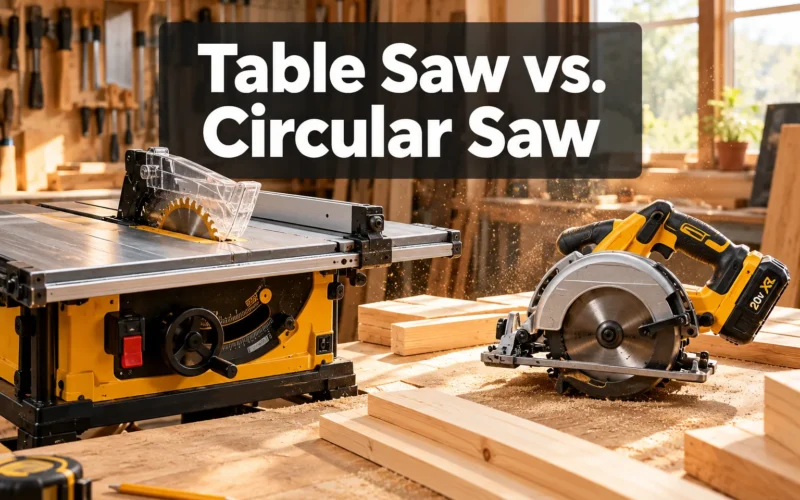
For beginners deciding between a table saw and a circular saw, start with a circular saw—it’s more affordable, portable, and versatile for most projects. A table saw excels in precision and repetitive rip cuts but requires more space and experience, making it the ideal next purchase as your skills and project demands grow. Our guide: Table Saw vs. Circular Saw: Which Do You Need First? Help you choose based on your current project needs, budget, and workspace availability.
Key Takeaways
- A circular saw is almost always the better first purchase for beginners because it costs less, takes up no floor space, and handles a wide range of cuts.

- A table saw excels at repetitive, precise rip cuts and is the right next step once your projects demand consistent, high-volume cutting.
- A circular saw with a good straight-edge guide can substitute for a table saw in many beginner scenarios, though not all.
- Table saws generally cost two to four times more than a quality entry-level circular saw.
- The two tools are not true substitutes for each other, they each have tasks where they clearly win.
- Space is a real factor: a table saw requires a dedicated footprint in your shop, while a circular saw can be stored in a drawer.
- Neither tool is inherently “safer”, both demand respect, proper technique, and protective gear.
- Most hobbyist woodworkers eventually own both, but the order in which you buy them matters for your budget and skill development.
Find this useful? Add us as a preferred source on Google and more of what we publish will show up in your results.
What Is the Difference Between a Table Saw and a Circular Saw?
A table saw is a stationary power tool with a circular blade mounted beneath a flat table surface. The workpiece moves across the table into the blade. A circular saw is a handheld tool in which the blade moves across a stationary workpiece. Both cut wood using a spinning toothed blade, but the way you use them, and what they do best, is quite different.
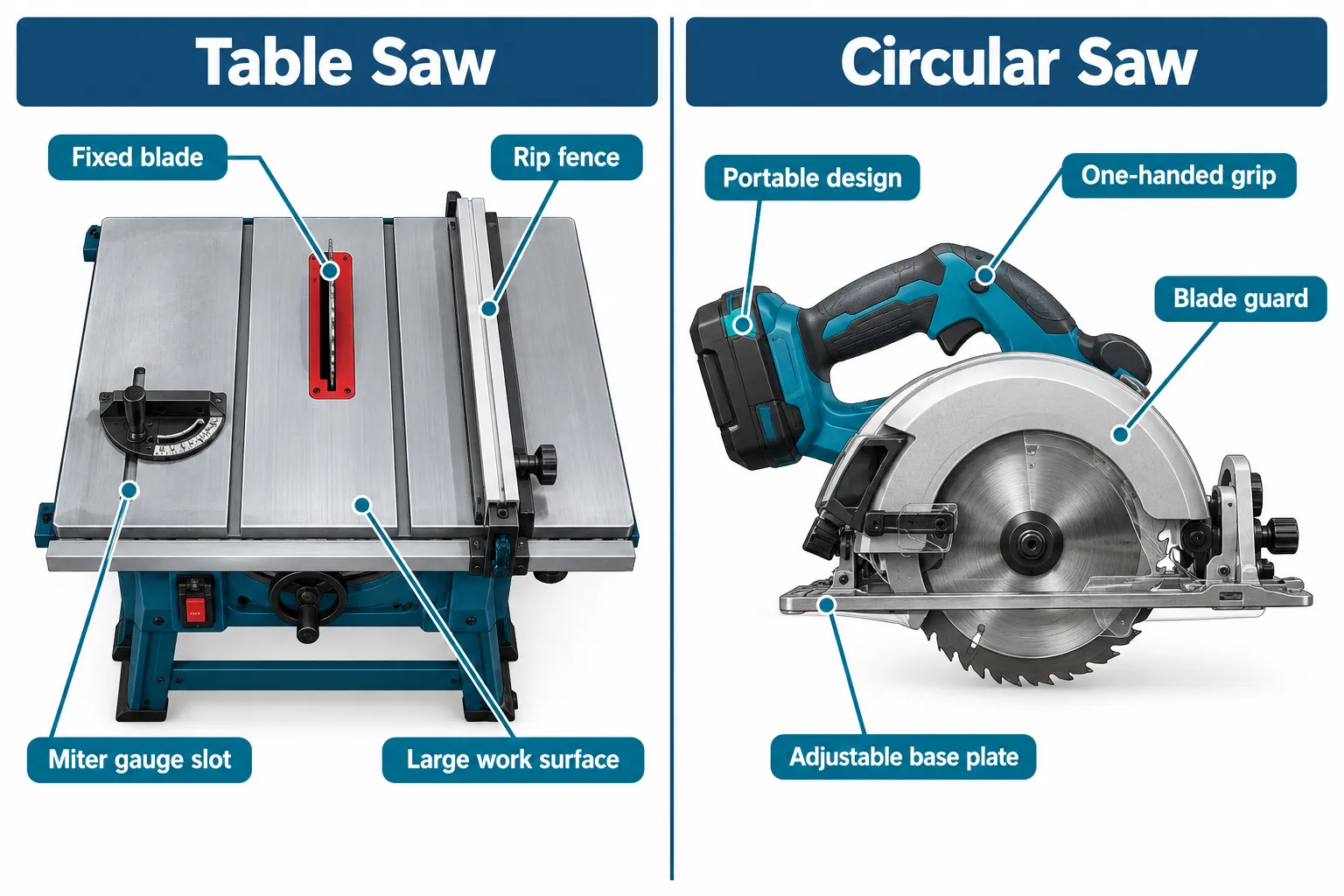
Table Saw at a Glance
- Stationary, bench-mounted or floor-standing
- Blade height and angle are adjustable
- Uses a rip fence for parallel cuts and a miter gauge for crosscuts
- Best for long rip cuts, repeated cuts to the same dimension, and dado cuts
- Typical weight: 45 to 300+ lbs depending on type (jobsite vs. cabinet)
Circular Saw at a Glance
- Handheld and fully portable
- Blade guard, adjustable base plate, and depth-of-cut settings
- Can crosscut, rip, bevel cut, and even cut sheet goods on sawhorses
- Best for breaking down large panels, framing cuts, and on-site work
- Typical weight: 7 to 15 lbs
The core distinction comes down to this: a table saw brings the work to the blade with precision and repeatability, while a circular saw brings the blade to the work with flexibility and portability.
Table Saw vs. Circular Saw: Which Should a Beginner Buy First?
For most beginners, a circular saw is the smarter first purchase. It costs less, stores easily, and handles the majority of cuts needed in early woodworking projects. A table saw is a powerful upgrade, but it demands more space, more money, and a steeper learning curve that can frustrate someone who is still developing fundamental skills.
That said, the right answer depends on what you plan to build:
- Building furniture, cabinets, or boxes, start with a circular saw, then add a table saw when your projects require consistent rip cuts.
- For framing, decking, or construction work, a circular saw is likely all you need for a long time.
- Primarily cutting sheet goods (plywood, MDF), a circular saw with a straight-edge guide is excellent here and often easier than feeding large sheets through a table saw alone.
- For small parts, molding, or repetitive dimension cuts, this is where a table saw pays off quickly.
If the budget allows only one tool, choose the circular saw. It will grow with your skills and keep your options open.
For a broader look at what tools belong in a beginner’s shop, the Beginner Woodworking Tools & Equipment: What You Need and Why guide is a solid starting point.
Can a Circular Saw Do Everything a Table Saw Does?
No, but it can do more than most beginners expect. A circular saw can make rip cuts, crosscuts, bevel cuts, and plunge cuts. With a quality straight-edge guide or a clamped fence, it can produce surprisingly accurate results on plywood and dimensional lumber.
What a circular saw can do reasonably well:
- Breaking down full sheets of plywood or MDF
- Crosscutting lumber to length
- Bevel cuts for trim and framing
- Rough rip cuts on boards
What a circular saw cannot reliably replicate:
- Consistent, repeatable rip cuts to a precise width on multiple boards
- Dado cuts (grooves across or along the grain)
- Very narrow rip cuts on thin stock (dangerous without a proper fence system)
- High-volume production cutting with minimal setup time
The honest answer: a circular saw is a capable substitute for a table saw in beginner and hobbyist work, but there’s a ceiling. Once you’re building furniture that requires 20 identical parts cut to the same dimension, that ceiling becomes obvious fast.
Table Saw vs. Circular Saw for Crosscutting and Ripping
For crosscutting (cutting across the grain to shorten a board), both tools work well, though a miter saw is actually the preferred tool for that task. For ripping (cutting along the grain to narrow a board), the table saw wins clearly.
Crosscutting comparison:
- Circular saw: fast, portable, good for rough crosscuts; a speed square or miter guide improves accuracy
- Table saw with miter gauge: accurate but awkward for long boards that need support on both sides
Ripping comparison:
- Circular saw: possible with a clamped fence or straight-edge guide, but requires careful setup every time
- Table saw: the rip fence locks in a dimension once and holds it for every single cut, this is where the table saw is genuinely irreplaceable for production work
If ripping boards to consistent widths is central to your projects (think table legs, drawer sides, shelf boards), a table saw will save you significant time and frustration. For a project like building a table, precise and consistent cuts matter a great deal. See Best Joinery for Table Legs That Won’t Loosen Over Time for context on why dimensional accuracy affects the whole build.
How Much Does a Good Table Saw Cost Compared to a Circular Saw?
Entry-level circular saws from reputable brands typically range from $60 to $180. A mid-range cordless model with a good battery platform runs $150 to $250. These prices make a circular saw accessible to almost any budget.
Table saws span a much wider range:
- Jobsite/contractor table saws: $300 to $600, portable, lighter, adequate for most hobbyists
- Hybrid table saws: $600 to $1,200, more power and precision, suited for a dedicated home shop
- Cabinet table saws: $1,500 and up, professional-grade, heavy, and built for daily use
For a beginner, a jobsite table saw in the $350 to $500 range offers a good balance of capability and cost. But that’s still two to five times the price of a solid circular saw setup. Factor in a quality blade, a crosscut sled, and any accessories, and the table saw investment grows quickly.
The practical takeaway: Buy a quality circular saw first, use it to fund your early projects, and save toward a table saw when your work consistently demands it.
Is a Circular Saw Safer Than a Table Saw?
Neither saw is inherently safer than the other; both are serious tools that cause injuries when used carelessly. However, the nature of the risks differs.
Table saw risks:
- Kickback (the most common cause of serious table saw injuries), when wood binds against the blade and is thrown back toward the operator
- Blade contact during fence adjustments or when reaching over the blade
- Requires a firm, stable setup; a wobbly workpiece creates unpredictable results
Circular saw risks:
- Blade binding mid-cut, causing the saw to kick back toward the user
- Cutting freehand without proper support
- Awkward body positioning when cutting large sheets on the floor
Both tools become significantly safer with proper technique, blade guards in place, push sticks (for the table saw), and consistent use of eye and ear protection. Beginners often find the circular saw slightly more intuitive to start with because the motion, moving the tool across the wood, feels natural. The table saw requires learning to feed stock steadily and confidently, which takes practice.
What Can You Only Do With a Table Saw?
Some cuts are genuinely difficult or impractical without a table saw. These include:
- Dado cuts and rabbet joints, using a dado stack blade set, a table saw cuts the grooves used in cabinet construction and box joints
- Precise, repeatable rip cuts, the rip fence system makes this fast and consistent in a way no handheld tool can match
- Resawing thin strips, cutting a board into multiple thin pieces requires the stability of a table saw fence
- Tapering jigs, cutting tapered legs for furniture is far more controlled on a table saw with a tapering jig
If your woodworking goals include building cabinets, furniture with joinery, or any project requiring many identical parts, a table saw eventually becomes essential. For step-by-step guidance on beginner projects that will help you identify which tool you actually need, the Step-by-Step Guide to Woodworking Projects for Beginners is worth reading before you spend money on tools.
Circular Saw Alternatives to a Table Saw for Ripping
When a table saw isn’t available, several setups can improve a circular saw’s accuracy for rip cuts:
- Straight-edge guide / ripping guide: A long aluminum straightedge clamped to the workpiece gives the circular saw’s base plate a consistent edge to ride against. This is the most common and effective substitute.
- Circular saw track system: Products like the Festool or Makita track saw systems use a dedicated guide rail that locks the saw to a precise cutting line. Track saws are essentially a hybrid between a circular saw and a table saw for sheet goods.
- Rip fence attachment: Many circular saws include a small rip fence accessory that screws into the base plate. It works for narrow rips but is less reliable over long distances.
- Panel cutting jig: A shop-made jig built from plywood and a straight factory edge can guide a circular saw for repeatable sheet cuts.
None of these fully replace a table saw for production work, but they’re practical solutions for hobbyists who aren’t ready to invest in one yet.
Table Saw vs. Circular Saw for Small Spaces and Home Workshops
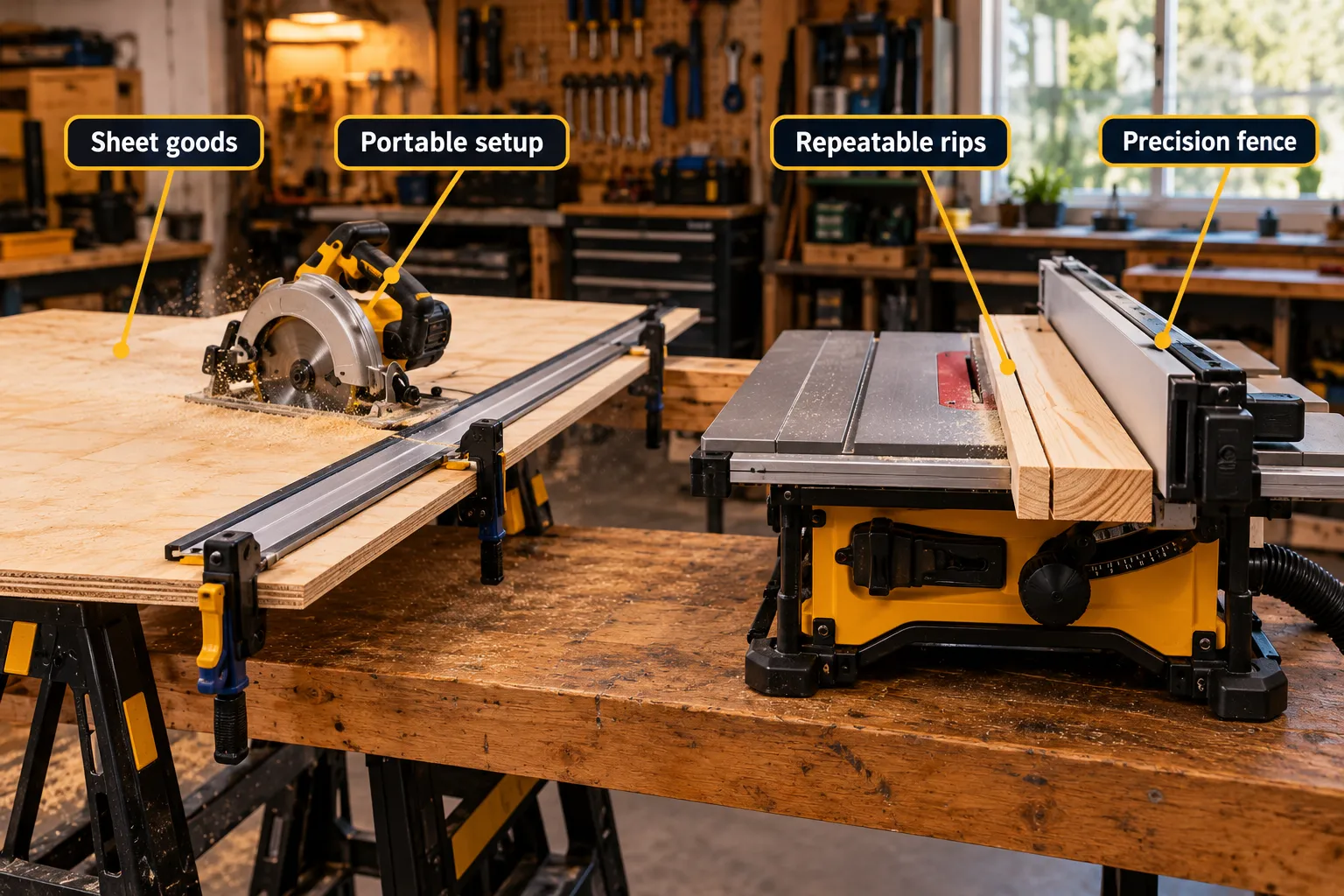
Space is one of the most underrated factors in this decision. A table saw requires a permanent or semi-permanent footprint; even a compact jobsite saw needs clear space on all four sides to feed and receive lumber safely. In a small garage or basement shop, that’s a real constraint.
A circular saw, by contrast, is stored on a shelf or in a cabinet and comes out only when needed. Work happens on sawhorses, a workbench, or even the floor with proper support.
Choose a circular saw if:
- Your shop is under 200 square feet
- You share your garage with a car or other equipment
- You work on-site or in multiple locations
- Your projects are occasional rather than regular
Consider a table saw if:
- You have a dedicated workshop space with room to maneuver 8-foot boards
- You build regularly and value speed and repeatability over portability
- You’re ready to invest in a proper outfeed table or support system
For anyone building or planning a dedicated workshop shed, thinking through the layout before buying large stationary tools is smart. Resources like Compare She-Shed, Studio Shed and Office Shed: Which Fits Your Needs? Can help you think through dedicated workshop space options.
Common Mistakes People Make When Choosing Between These Saws
Mistake 1: Buying a table saw first because it “looks more serious.”
Many beginners assume a table saw signals commitment to the craft. In reality, it often sits unused because early projects don’t require it, and the learning curve discourages use.
Mistake 2: Buying the cheapest circular saw available.
A low-quality circular saw with a poor blade will produce ragged cuts and create frustration. A mid-range saw from a reputable brand with a quality blade is worth the modest extra cost.
Mistake 3: Ignoring the blade.
Both saws cut only as well as the blade installed. A quality combination blade or a dedicated rip/crosscut blade makes a bigger difference than most beginners expect.
Mistake 4: Assuming a table saw is always more accurate.
A table saw with a cheap fence or a warped table can produce worse results than a circular saw with a good straight-edge guide. Setup and technique matter more than the tool category.
Mistake 5: Not accounting for accessories.
A table saw without a crosscut sled, a reliable fence, and push sticks is an incomplete setup. Budget for these when calculating the real cost of entry.
Table Saw vs. Circular Saw: Which Is Better for a Home Workshop?
For a home workshop, the circular saw wins as the starting tool, and the table saw wins as the most important upgrade. They serve different roles, and most dedicated hobbyists end up owning both.
The circular saw handles variety and portability. The table saw handles precision and production. Together, they cover the vast majority of cuts a home woodworker will ever need.
If you’re choosing just one for a home workshop right now, the circular saw gives you more flexibility per dollar spent. When your projects grow in complexity and you find yourself making the same rip cut over and over, that’s the signal to add a table saw.
Do You Really Need Both a Table Saw and a Circular Saw?
Eventually, yes, most hobbyist woodworkers find they use both tools regularly. But “eventually” is the key word. There’s no rush to own both at once, especially early in your woodworking journey.
A practical progression for most beginners:
- Start with a quality circular saw and a good blade
- Add a miter saw for clean crosscuts (this is often more useful than a table saw for the first year)
- Add a table saw when your projects consistently require precision rip cuts or joinery work
This sequence builds skills progressively and avoids a situation where expensive tools sit idle because your current projects don’t need them. The goal is to let your projects drive your tool purchases, not the other way around.
Can You Use a Circular Saw on a Table for Precision Cuts?
Yes, with the right setup. A circular saw mounted upside-down in a shop-made table (sometimes called a “poor man’s table saw”) can handle basic rip cuts, though this setup has real limitations and safety considerations.
More practically, a track saw system (a circular saw paired with a dedicated guide rail) is a legitimate precision tool used by professional cabinetmakers. It’s particularly effective for sheet goods and can produce cuts as clean as a table saw for many applications.
For most beginners, the simplest precision upgrade for a circular saw is a quality straight-edge guide clamped to the workpiece, not a full table conversion. It’s safer, faster to set up, and more than adequate for hobbyist work.
Table Saw Learning Curve vs. Circular Saw Difficulty
A circular saw has a shorter learning curve for basic cuts. Most beginners can make safe, functional crosscuts within their first session. Rip cuts take a bit more practice, but the fundamentals are straightforward.
A table saw requires more deliberate learning:
- Understanding kickback and how to prevent it
- Learning to use a rip fence accurately
- Feeding stock at a consistent pace
- Using push sticks and featherboards safely
- Setting blade height correctly for different cuts
This doesn’t mean a table saw is too difficult for beginners; it means it rewards proper instruction. Watching quality video tutorials, reading the manual thoroughly, and starting with simple cuts on scrap wood are all important steps. The investment in learning pays off quickly once the fundamentals click.
Woodworking jigs can also dramatically improve accuracy and safety on both tools. The Top Types of Woodworking Jigs Every Woodworker Needs guide covers several jigs that make both saws more capable and consistent.
FAQ
Which saw should I buy first as a complete beginner?
Buy a circular saw first. It’s more affordable, portable, and versatile enough to handle most beginner projects. A table saw is a valuable upgrade later, once your projects demand consistent, precise rip cuts.
Can a circular saw replace a table saw entirely?
For occasional hobby work, yes, especially with a straight-edge guide or track system. For production work, furniture with joinery, or dado cuts, a circular saw cannot fully replace a table saw.
What’s the biggest safety difference between the two?
Both carry kickback risk. A table saw’s kickback is typically more violent and harder to control because the workpiece is thrown toward the operator. A circular saw’s kickback moves the saw rather than the wood, which is easier to manage with proper technique.
Is a track saw the same as a circular saw?
A track saw is a circular saw designed to run on a guide rail system. It’s more precise than a standard circular saw and is an excellent alternative to a table saw for sheet goods, but it costs more than a basic circular saw.
How much should I spend on my first circular saw?
A budget of $100 to $180 for a corded model, or $150 to $250 for a quality cordless model, covers reputable options from brands like DeWalt, Makita, or Milwaukee. Avoid the cheapest options, blade quality and motor consistency matter.
Do I need a table saw to build furniture?
Not necessarily for simple furniture, but it becomes very helpful for anything requiring consistent board widths, dados, or multiple identical parts. Many beginner furniture projects are entirely achievable with a circular saw and miter saw.
What type of table saw is best for a beginner home workshop?
A jobsite or contractor table saw in the $350 to $600 range is the most practical starting point. It’s portable enough to move if needed, powerful enough for most hobby work, and significantly less expensive than hybrid or cabinet saws.
Can I use both saws on the same project?
Absolutely, and most experienced woodworkers do. A circular saw breaks down large sheet goods into manageable pieces, and the table saw then cuts those pieces to final dimensions. They complement each other well.
Which saw is quieter?
Both are loud and require hearing protection. A circular saw in brief use generates slightly less sustained noise than a table saw running continuously, but neither is quiet enough to skip ear protection.
What blade should I buy for a beginner circular saw?
A 40-tooth combination blade handles both crosscuts and rip cuts well for general use. Upgrade to a 60-tooth blade for cleaner cuts in plywood and sheet goods.
Conclusion
The table saw vs. circular saw question doesn’t have a single right answer for everyone, but for most beginners, the circular saw is the clear first step. It’s affordable, portable, and capable enough to carry you through your first year of projects without feeling like a compromise.
The table saw earns its place in the shop when your work grows in complexity and volume. When you find yourself making the same rip cut repeatedly, or when your furniture projects start requiring joinery that demands precision, that’s when a table saw transforms from “nice to have” into “essential.”
Build your skills with a circular saw first. Let your projects tell you when it’s time to add a table saw. That sequence will serve you far better than buying the most impressive-looking tool on day one.
Actionable next steps:
- If you don’t own either tool yet, start by reading the Beginner Woodworking Tools & Equipment: What You Need and Why guide to understand your full tool needs before spending money.
- Choose a quality circular saw from a reputable brand, pair it with a 40-tooth combination blade, and pick up a straight-edge guide for accurate rip cuts.
- Start with beginner-friendly projects that build your cutting skills. The Step-by-Step Guide to Woodworking Projects for Beginners has solid options.
- When you’re ready to add a table saw, budget for a jobsite model plus a quality blade, a crosscut sled, and push sticks before you make your first cut.
Products, Tools, and Resources
Circular Saws Worth Considering
- DeWalt DWE575SB is a reliable corded circular saw with a lightweight magnesium shoe and a good out-of-the-box blade. A consistent performer for beginners and experienced woodworkers alike.
- Milwaukee M18 FUEL Circular Saw: A top-tier cordless option if you’re already in the Milwaukee battery ecosystem. Strong motor, smooth cuts, and a durable build.
- Makita 5007MGA is a well-balanced corded saw with a magnesium construction that makes long cutting sessions less tiring.
Table Saws Worth Considering
- DeWalt DWE7485 is one of the most popular jobsite table saws for home workshops. Solid fence system, good power, and a rolling stand that makes storage manageable in a small space.
- BOSCH GTS18V-08N PROFACTOR, A compact, well-built jobsite saw with a gravity-rise stand. Excellent for hobbyists who need portability without sacrificing cutting quality.
Accessories That Matter More Than You’d Expect
- A quality combination blade (Freud or Diablo are reliable brands) makes a bigger difference than most beginners anticipate on both saws.
- A straight-edge guide or aluminum ripping guide for your circular saw is a low-cost upgrade that dramatically improves accuracy.
- For the table saw, a shop-made crosscut sled is one of the most valuable additions you can build, and it’s a great early project in itself.