
How to Start and Grow a Successful Woodworking Business from Home
Hey there! Some links on this page may be affiliate links, which means that if you choose to make a purchase, I may earn a commission at no extra cost to you. I greatly appreciate your support!
Starting a woodworking business means turning your existing craft skills into a structured, income-generating operation, whether part-time from a home garage or as a full-time workshop. The most successful beginners start by picking one or two product niches, pricing their work correctly from day one, and selling through a combination of local markets and online platforms like Etsy or Facebook Marketplace. You do not need a formal license in most U.S. states to sell handmade wood products, but you will need a basic business registration and, ideally, liability insurance before you take your first paid order.
Key Takeaways
- A home-based woodworking business is one of the most accessible craft businesses to start, with startup costs ranging from roughly $500 to $5,000 depending on the tools you already own.

- Choosing a specific product niche (such as custom furniture, wooden toys, or home decor) makes marketing easier and helps you build a recognizable portfolio faster.
- Pricing correctly is the single most common mistake new woodworking business owners make. Undercharging destroys profitability and devalues the craft.
- You can run a woodworking business part-time and still generate meaningful supplemental income, especially if you focus on high-margin, repeatable products.
- Selling online through Etsy, your own website, or social media significantly expands your customer base beyond your local area.
- Business registration, basic liability insurance, and an understanding of your tax deductions are non-negotiable steps before you start taking money from customers.
- Quality materials and consistent craftsmanship protect your reputation, which is your most valuable long-term asset in this business.
How to Start a Woodworking Business From Home
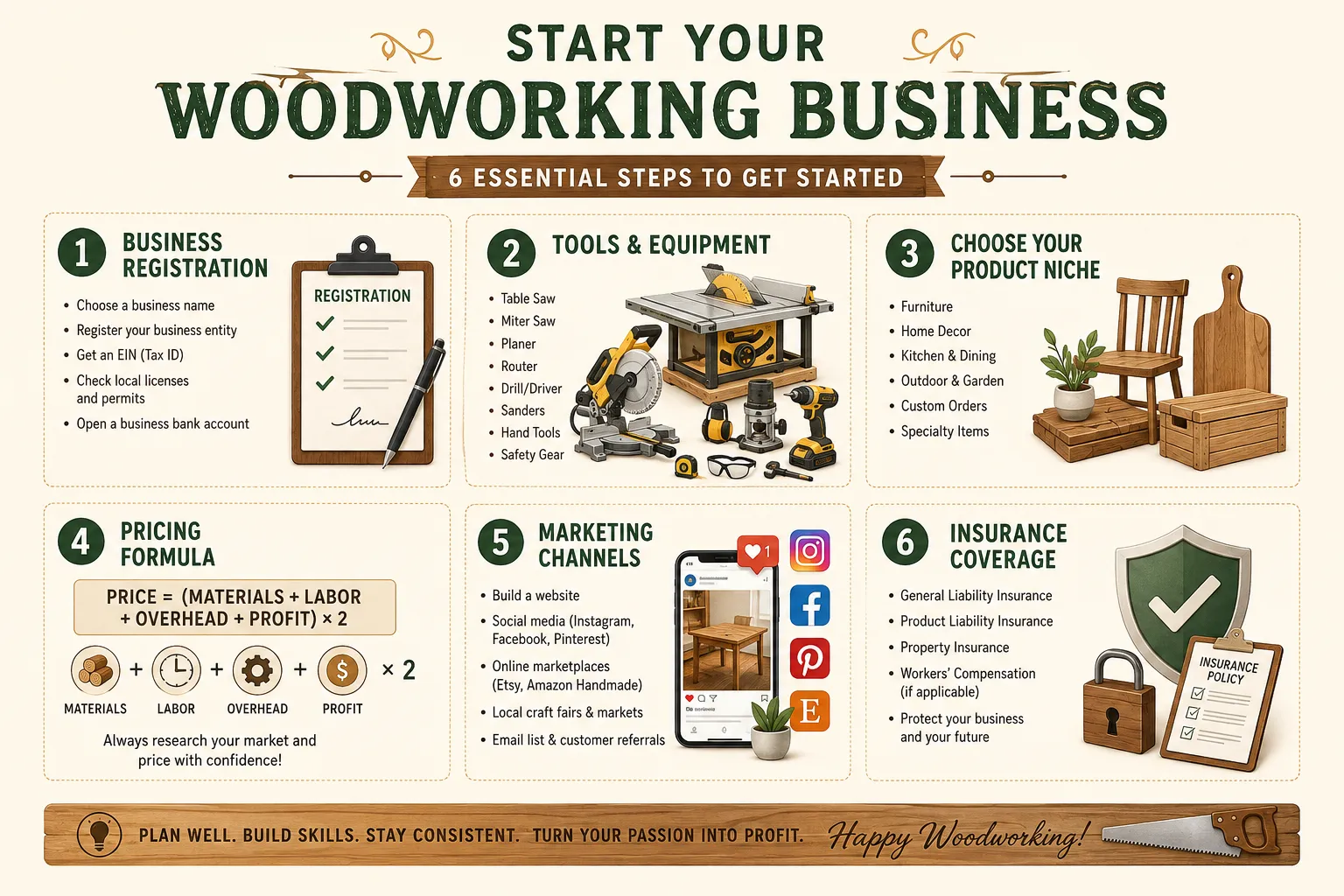
Starting a woodworking business from home is straightforward if you approach it as a real business from the beginning, not just a hobby that occasionally makes money. The core steps are: define your product focus, set up a safe and functional workspace, register your business, price your work properly, and start building a visible portfolio.
Here is a practical starting sequence for beginners:
- Define your niche. Decide what you will make and sell. Custom furniture, cutting boards, wooden toys, shelving units, and home decor items are all viable starting points. Picking one or two products lets you refine your process and build a recognizable style.
- Assess your workspace. A one-car garage or a dedicated shed is enough to start. You need adequate ventilation, proper lighting, and enough floor space to work safely. Fire safety and dust management are not optional.
- Register your business. At a minimum, register as a sole proprietor or LLC with your state. This protects your personal assets and makes it easier to open a business bank account.
- Source your materials. Identify local lumber yards, hardwood dealers, and online suppliers. Buying in bulk as your volume grows will reduce material costs meaningfully.
- Build a portfolio before you market heavily. Make five to ten strong pieces, photograph them well, and use those images across every sales channel you open.
If you want to explore popular woodworking project ideas before settling on a niche, that research is worth doing early. It helps you understand what sells and what the market already has plenty of.
Woodworking Business Startup Costs and Equipment Needed
Startup costs for a home woodworking business typically fall between $500 and $5,000 for a beginner, depending heavily on what tools you already own. A more serious workshop setup with professional-grade machinery can run $10,000 or more, but that level of investment is not necessary to start generating income.
Essential tools for a beginner woodworking business:
- Circular saw or table saw (a table saw is more versatile for production work)
- Miter saw for accurate crosscuts
- Router and router table for edge work and joinery
- Random orbital sander
- Drill and driver set
- Measuring and marking tools (squares, tape measures, marking gauges)
- Clamps (you will always need more than you think)
- Safety equipment: hearing protection, eye protection, dust mask or respirator
Estimated startup cost breakdown (rough estimates for planning purposes):
- Basic tool set if starting from scratch: $1,500 to $3,000
- Lumber and raw materials for first batch of products: $200 to $500
- Business registration and insurance: $200 to $600 per year
- Website and basic marketing materials: $100 to $300
- Packaging and shipping supplies (if selling online): $100 to $200
For a detailed look at what equipment you actually need at each stage, the guide on equipment used in woodworking breaks this down by skill level and production volume. You can also review various tools used for woodworking to understand which tools serve which purposes before you spend anything.
Common mistake: Buying too much equipment too soon. Start with the tools your chosen products actually require, then add as your orders grow.
How Much Can You Make Starting a Woodworking Business?
Income from a woodworking business varies widely based on your product type, pricing, volume, and sales channels. A part-time woodworker selling at local markets or on Etsy can realistically earn $500 to $2,000 per month in their first year. A full-time operation with custom furniture orders, a strong online presence, and repeat customers can generate $50,000 to $100,000 or more annually, though this takes time to build.
A few factors that directly affect your earning potential:
- Product margin. A cutting board made from $15 of material and two hours of labor can sell for $60 to $90. A custom dining table made from $400 of hardwood and 20 hours of work can sell for $1,500 to $3,000. Higher-ticket items take longer to sell but generate more per transaction.
- Volume and repeatability. Products you can make in batches (small decor items, serving boards, wooden signs) generate steadier cash flow than one-off custom pieces.
- Your pricing discipline. Woodworkers who undercharge consistently earn far less than their skill level warrants. Pricing correctly from the start is the single biggest lever on your income.
- Sales channel. Selling directly through your own website or at craft fairs keeps more margin than selling through a retailer or consignment shop.
Woodworking Business Ideas for Beginners
The best woodworking business ideas for beginners are products that are in consistent demand, require a manageable skill level, and can be made with a modest tool set. You do not need to build custom staircases to run a profitable woodworking business.
Strong beginner product ideas:
- Cutting boards and charcuterie boards. High demand, relatively fast to make, and customers pay well for quality hardwood versions.
- Wooden toys. Parents and grandparents actively seek handmade, non-toxic wooden toys. This is a reliable niche with strong repeat customers.
- Floating shelves and wall-mounted storage. Functional home items that sell consistently year-round.
- Custom signs and personalized gifts. Weddings, housewarmings, and holidays drive steady demand. A router or CNC machine expands your options here.
- Small furniture pieces. Side tables, step stools, and benches are approachable for intermediate beginners and command good prices.
- Plant stands and garden decor. Trending strongly in home decor markets and relatively simple to produce.
Browsing woodworking projects for inspiration is a practical way to identify what other makers are building and where gaps in the market might exist.
Do I Need a License to Sell Woodworking Projects?
In most U.S. states, you do not need a specific woodworking license to sell handmade wood products. However, you do need a basic business license or seller’s permit in most jurisdictions, and you must collect and remit sales tax on applicable transactions.
Here is what most beginners actually need before their first sale:
- Business registration: Register as a sole proprietor (simplest) or an LLC (more protection) with your state. Cost is typically $50 to $200.
- Seller’s permit / sales tax license: Required in most states if you are selling physical goods. Usually free or low-cost to obtain through your state’s revenue department.
- Home occupation permit: If you are operating from a residential property, some municipalities require this. Check with your local zoning office.
- EIN (Employer Identification Number): Free from the IRS. Useful for opening a business bank account and filing taxes separately from your personal return.
If you plan to sell at farmers markets or craft fairs, the event organizer will often specify what documentation you need to participate. Requirements vary by state and county, so verify with your local small business development center if you are unsure.
Woodworking Business vs. Carpentry: What Is the Difference?
A woodworking business typically focuses on crafting finished wood products, such as furniture, decor, and gifts, that are sold directly to consumers or through retail channels. Carpentry is a trade that involves structural and installation work, such as framing houses, installing trim, or building cabinetry on-site. The two overlap, but they are different business models.
Key differences at a glance:
- Woodworking businesses sell products. Carpentry businesses sell labor and installation services.
- Woodworking is typically done in a workshop. Carpentry work happens on job sites.
- Woodworking income comes from product sales and custom commissions. Carpentry income comes from hourly or project-based service fees.
- Licensing requirements differ significantly. Carpenters often need contractor licenses. Woodworkers selling products generally do not.
Some people run both, making furniture in their shop and doing on-site installation or custom built-in work for clients. That hybrid model can be very profitable, but it requires managing two different types of client relationships and workflows.
Best Woodworking Products to Sell Online
The best woodworking products to sell online are items that photograph well, ship without excessive cost or complexity, and appeal to buyers who are already searching for handmade alternatives to mass-produced goods.
Top-performing categories on platforms like Etsy and Amazon Handmade:
- Personalized cutting boards and serving boards
- Wooden signs (wedding, family name, inspirational quotes)
- Jewelry boxes and keepsake boxes
- Wooden phone stands and desk organizers
- Small decorative shelves and wall art
- Wooden kitchen utensils and spice racks
- Custom wooden toys and puzzles
What makes a product sell well online:
- It solves a specific problem or fills a gift-giving occasion
- It can be personalized (personalization consistently commands a price premium)
- It ships in a standard box without requiring freight
- It photographs beautifully in natural light
Studying woodworking plans for popular product categories helps you understand construction time, which feeds directly into accurate pricing.
Where to Sell Handmade Woodworking Projects
You can sell handmade woodworking projects through a mix of online platforms, local venues, and direct channels. Most successful small woodworking businesses use at least two or three of these simultaneously.
Online channels:
- Etsy: The most established marketplace for handmade goods. High buyer intent, but competitive and subject to platform fees.
- Your own website: More work to set up and drive traffic to, but you keep more margin and own the customer relationship.
- Facebook Marketplace and Instagram Shops: Excellent for local sales and building a following without shipping complexity.
- Amazon Handmade: Larger audience than Etsy but more restrictive application process.
Local and in-person channels:
- Farmers markets and craft fairs
- Local furniture and home decor boutiques (wholesale or consignment)
- Interior designers and home stagers (B2B relationships that can generate large, recurring orders)
- Word of mouth and referrals from satisfied customers
Starting locally and online simultaneously tends to work well for beginners. Local sales build your confidence and your portfolio. Online sales extend your reach beyond your zip code.
How to Market a Small Woodworking Business
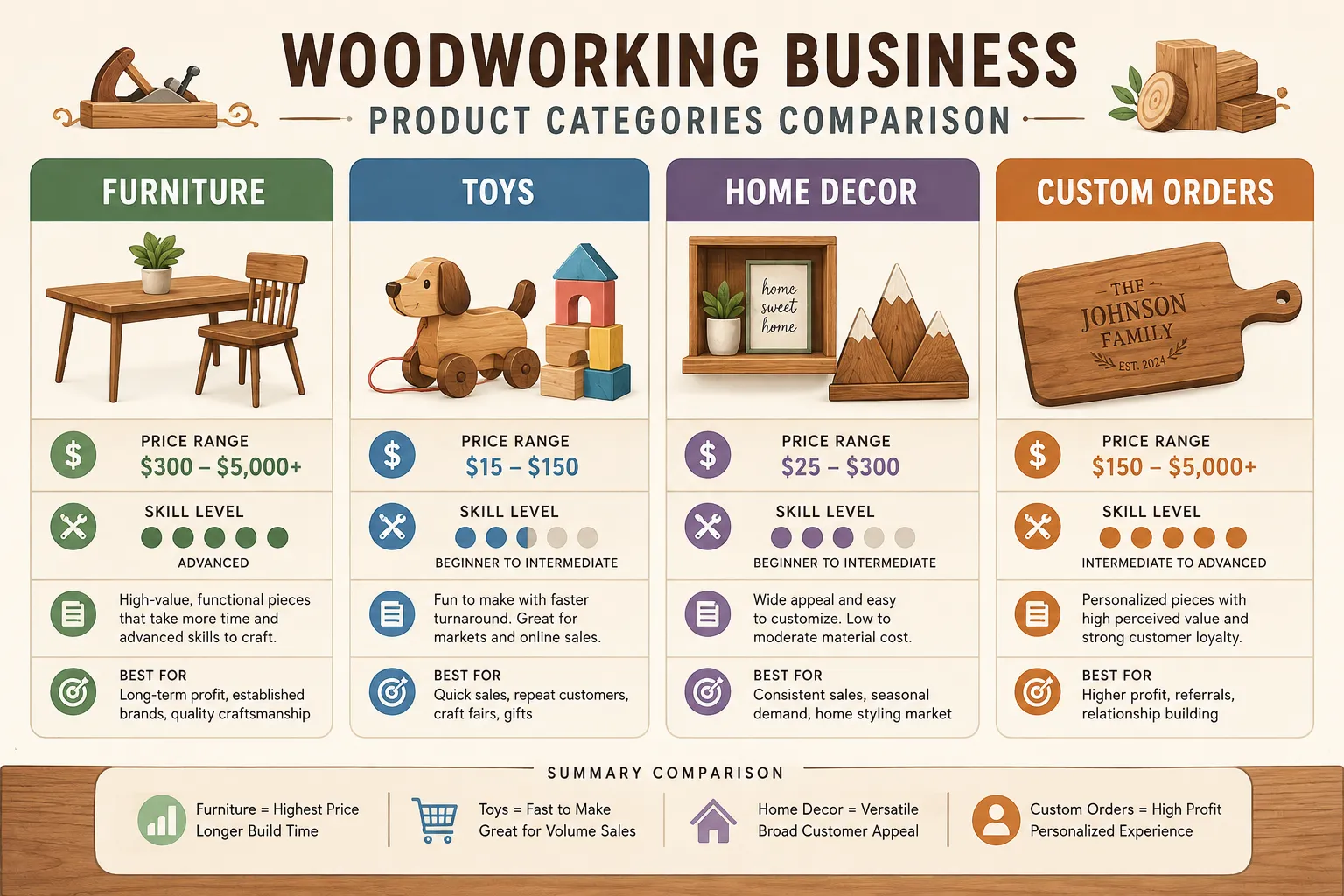
Marketing a small woodworking business comes down to making your work visible to the right people consistently. You do not need a large budget. You need good photography, a clear message, and a few well-chosen channels.
Practical marketing approaches that work for small woodworking businesses:
- Instagram and Pinterest: Visual platforms where handmade wood products perform extremely well. Post process photos and finished pieces regularly.
- Google Business Profile: Free to set up and critical for local search visibility. Customers searching “custom wood furniture near me” will find you here.
- Your own website with basic SEO: A simple site with product photos, a contact form, and a few well-written pages targeting local and product-specific search terms will drive organic traffic over time.
- Email list: Collect emails from every customer and interested visitor. A small, engaged email list is more valuable than a large social following.
- Craft fairs and markets: In-person selling builds trust faster than any digital channel and often leads to repeat orders and referrals.
- Newspaper and local community boards: Still effective in smaller markets and towns where local publications have loyal readerships.
Advertising your woodworking business through newspapers, as the original advice suggested, remains a valid tactic in local markets. But pairing it with a well-maintained social presence and a functional website gives you far more reach for the same investment.
Woodworking Business Insurance and Liability
Every woodworking business needs at least basic liability insurance before taking paid orders. This is not optional, and it is not expensive. A general liability policy for a small home-based woodworking operation typically costs $400 to $800 per year (estimate based on typical small craft business rates, which vary by state and coverage level).
Coverage types worth understanding:
- General liability insurance: Covers bodily injury or property damage claims if a customer is injured by your product or visits your workshop. This is the baseline policy every woodworking business should carry.
- Product liability insurance: Specifically covers claims arising from a product you made and sold. Often included in general liability policies, but confirm with your insurer.
- Home-based business endorsement: If you are running the business from home, your standard homeowner’s policy likely does not cover business-related losses. A home-based business endorsement or a separate business owner’s policy fills that gap.
- Tool and equipment coverage: Protects your tools and machinery against theft or damage. Especially worth considering if you have invested significantly in equipment.
Contact a local independent insurance agent who works with small businesses or tradespeople. They can bundle coverage efficiently and make sure you are not paying for what you do not need.
Woodworking Business Pricing: How Much to Charge
Pricing is where most beginner woodworking businesses fail. Charging too little is the norm, and it leads to burnout, resentment, and an unsustainable operation. A simple formula helps:
Basic pricing formula:
Price = (Material Cost x 2) + (Hourly Rate x Hours Worked) + Overhead Contribution + Profit Margin
For example: A cutting board made with $20 of walnut, taking 1.5 hours at a $25 per hour labor rate, with $5 in overhead (finishing supplies, electricity, packaging), would calculate to:
($20 x 2) + ($25 x 1.5) + $5 = $40 + $37.50 + $5 = $82.50 base price
Rounding to $85 or $90 is reasonable for a quality handmade walnut cutting board. Many makers charge $70 to $120 for comparable pieces, so this is market-aligned.
Pricing rules to follow:
- Never price based on what you “think someone will pay.” Price based on your actual costs and labor.
- Research what comparable handmade pieces sell for on Etsy and at local craft fairs, but do not race to the bottom.
- Factor in platform fees (Etsy charges approximately 6.5% transaction fee plus listing fees as of 2026), shipping materials, and your time spent on communication and packaging.
- Raise your prices as your reputation and portfolio grow. Established makers charge more, and customers expect it.
Can You Run a Woodworking Business Part Time?
Yes, running a woodworking business part-time is not only possible, it is how most successful woodworking businesses start. Many woodworkers build their business on evenings and weekends for one to three years before transitioning to full-time.
Part-time woodworking works best when you:
- Focus on a small number of repeatable, high-margin products rather than custom one-offs that require constant client communication
- Set clear boundaries on order volume so you are not overwhelmed alongside a full-time job
- Use the part-time phase to build your portfolio, refine your pricing, and grow your customer base before making any larger financial commitments
The risk of part-time operation is underinvesting in the business side (marketing, pricing, legal structure) because it feels casual. Treat it like a real business from the first sale, even if you are only making a few pieces per month.
Woodworking Business Tax Deductions: What Can I Write Off?
A registered woodworking business can deduct a meaningful range of business expenses, which reduces your taxable income. Keep receipts and records for everything from the day you open.
Common deductible expenses for a woodworking business:
- Lumber, hardware, finishes, and other raw materials
- Tools and equipment (may be deducted in full in the year of purchase under Section 179, or depreciated over time)
- Workshop rent or a home office/workshop deduction (if the space is used exclusively for business)
- Utilities attributable to the workshop (electricity, heating)
- Business insurance premiums
- Marketing and advertising costs (website, photography, craft fair fees, paid ads)
- Shipping and packaging materials
- Business mileage for supply runs and deliveries
- Professional development, including woodworking online training courses and books
Work with a CPA or tax professional who has experience with small product-based businesses. The home workshop deduction, in particular, has specific IRS rules around exclusive use, and getting it wrong can trigger scrutiny.
Common Mistakes New Woodworking Business Owners Make
Most beginner woodworking businesses make the same handful of mistakes. Knowing them in advance saves you time, money, and frustration.
The most common ones:
- Underpricing. Already covered above, but worth repeating. It is the number one business killer in this space.
- Skipping business registration and insurance. Operating informally feels fine until a customer makes a claim or a tool gets stolen.
- Neglecting photography. Poor product photos kill online sales. Natural light, a clean background, and multiple angles are non-negotiable for any online selling.
- Taking every custom order. Early on, it is tempting to say yes to every request. Custom work that falls outside your skill set or takes far longer than estimated destroys your hourly rate and your confidence.
- Ignoring material quality. Using substandard wood or cheap hardware to save money on a product that will be used daily is a reputation risk. One bad review on Etsy can cost you far more than the money you saved.
- Not tracking time accurately. If you do not know how long your products actually take to make, you cannot price them correctly or know which ones are worth making.
- Trying to sell everything to everyone. A focused niche builds a stronger brand and makes marketing far easier.
FAQ: Running a Woodworking Business
Is woodworking a profitable business?
Yes, woodworking can be profitable, particularly for makers who price correctly, focus on high-margin products, and build a consistent sales channel. Profitability depends more on business discipline than raw craft skill.
How much does it cost to start a woodworking business from home?
A basic home woodworking business can be started for $500 to $2,000 if you already own some tools. Starting from scratch with a full tool set typically costs $3,000 to $5,000 before you factor in materials and business registration.
Do I need a business license to sell wood crafts?
In most U.S. states, you need a basic business registration and a seller’s permit, but not a specialized woodworking license. Requirements vary by state and municipality, so check with your local government or small business development center.
What is the best platform to sell handmade wood products?
Etsy is the most popular starting point for handmade woodworking products due to its built-in buyer audience. Pairing Etsy with your own website and Instagram gives you the best combination of reach and margin control.
How do I price my woodworking projects?
Use a formula that covers material costs (doubled), your hourly labor rate, and overhead, then add a profit margin. Never price based on what you think someone will pay without first calculating your actual costs.
Can I make a full-time income from woodworking?
Yes, but it typically takes two to four years of consistent effort to build the customer base and reputation needed for a full-time income. Many woodworkers transition from part-time to full-time after proving the model works at a smaller scale.
What woodworking products sell best at craft fairs?
Cutting boards, personalized signs, small shelves, wooden toys, and decorative home items tend to sell consistently at craft fairs. Price points between $20 and $80 move fastest in most markets.
Do I need insurance for a home woodworking business?
Yes. At minimum, you need general liability insurance, and you should add a home-based business endorsement to your homeowner’s policy. Your standard homeowner’s insurance will not cover business-related losses or liability.
What wood is best for beginners to work with?
Pine and poplar are affordable and easy to work with for beginners. As your skills grow, hardwoods like oak, maple, and walnut produce more premium-looking products that command higher prices.
How do I get my first woodworking customers?
Start with your personal network, then list products on Etsy and Facebook Marketplace. Attend one or two local craft fairs to build visibility. Ask every satisfied customer for a review or referral.
What taxes do I owe on woodworking income?
You owe income tax on your net profit and self-employment tax (approximately 15.3% in the U.S. as of 2026) on that same net profit. Keeping accurate records of all deductible expenses reduces both. Consult a CPA for your specific situation.
How important is a website for a woodworking business?
A website is not strictly required to start, but it becomes increasingly important as you grow. It gives you a professional home base, helps with local search visibility, and lets you sell without paying platform fees to Etsy or others.
Conclusion
A woodworking business is one of the most grounded, tangible ways to turn a skill you already have into a real source of income. The path from hobbyist to business owner is not complicated, but it does require treating the business side with the same care you give your craft. Price your work honestly, protect yourself legally and financially, build your portfolio before you scale your marketing, and focus on quality over volume, especially early on.
The demand for handmade, high-quality wood products is genuine and durable. Customers who find a woodworker they trust tend to come back, refer friends, and pay fair prices for good work. That kind of reputation takes time to build, but it is the foundation of a woodworking business that lasts.
Start small, stay focused, and build from there.
Recommended Tools, Resources, and Further Reading
Tools and Equipment
Getting your tool setup right from the beginning saves money and frustration. The guide on woodworking machinery covers what different machines are actually used for, which helps you prioritize purchases. For precision work and repeatability, understanding woodworking jigs early on will improve your consistency and speed significantly.
Plans and Project Ideas
Before committing to a product niche, spend time with solid woodworking plans to understand construction complexity and material requirements. Exploring woodworking patterns is also useful if you plan to offer decorative or personalized pieces.
Business and Skills Development
If you want to sharpen specific techniques or learn new ones without a formal class, woodworking online training options have expanded considerably and are worth exploring before you invest in equipment for a technique you have not tried yet.
More on Running Your Business
For a deeper look at the operational side of things, “WoodProfits — The Woodworking Business Blueprint” covers additional considerations for scaling beyond the startup phase.