Essential Woodworking Machinery for Efficient Woodwork
Hey there! Some links on this page may be affiliate links, which means that if you choose to make a purchase, I may earn a commission at no extra cost to you. I greatly appreciate your support!
Woodworking machinery covers the power-driven tools used to cut, shape, smooth, and join wood, including table saws, band saws, planers, jointers, drill presses, and spindle molders. For beginners, a table saw, a band saw, and a benchtop planer cover the vast majority of projects. Budget around $800 to $2,000 for a solid starter setup, and always pair any machinery purchase with proper dust collection and hearing protection.
Key Takeaways
- A table saw is the single most versatile piece of woodworking machinery for beginners and should be your first major purchase.
- A jointer flattens a face or edge; a planer makes the opposite face parallel to the first. You need both for dimensioning rough lumber properly.

- A band saw excels at rip cuts and curved cuts; a miter saw handles crosscuts and angles. They are not interchangeable.
- Beginner-friendly brands with strong value include DeWalt, Jet, Powermatic, and Ridgid, depending on your budget tier.
- Dust collection is not optional. Fine wood dust is a serious respiratory hazard, and most shop vacuums are not adequate substitutes.
- You absolutely need hearing protection. Prolonged exposure to machinery noise above 85 dB causes permanent hearing damage, and most woodworking machinery operates between 90 and 105 dB.
- Small-space woodworkers should prioritize benchtop and portable versions of core machines before committing to full-size stationary equipment.
- Buying used machinery from reputable brands often beats buying new machinery from budget brands.
- Common buying mistakes include purchasing too many machines at once, ignoring dust port compatibility, and skipping the fence quality check on table saws.
- Woodworking machinery is designed for wood. Using it on metal without specific metal-cutting setups can damage blades and create serious safety hazards.
What Is Woodworking Machinery and Why Does It Matter?
Woodworking machinery refers to any motor-driven equipment used to cut, mill, shape, or finish wood. Before electric-powered tools became widely available, every joint, every flat surface, and every smooth edge was produced by hand with chisels, hand planes, and manual saws. That work was skilled, slow, and physically demanding.
Modern woodworking machinery changed the equation entirely. A task that once took a craftsman an hour with a hand plane now takes seconds with a thickness planer. That efficiency doesn’t just save time. It opens the craft to people who might never have had the patience or physical endurance to work entirely by hand.
For beginners and hobbyists especially, the right machinery makes the difference between a rewarding project and a frustrating one. Understanding what each machine does, and more importantly what it doesn’t do, is the foundation of building a shop that actually works for you. You can explore various tools used for woodworking to get a broader picture before committing to any single purchase.
What’s the Difference Between a Table Saw and a Miter Saw?
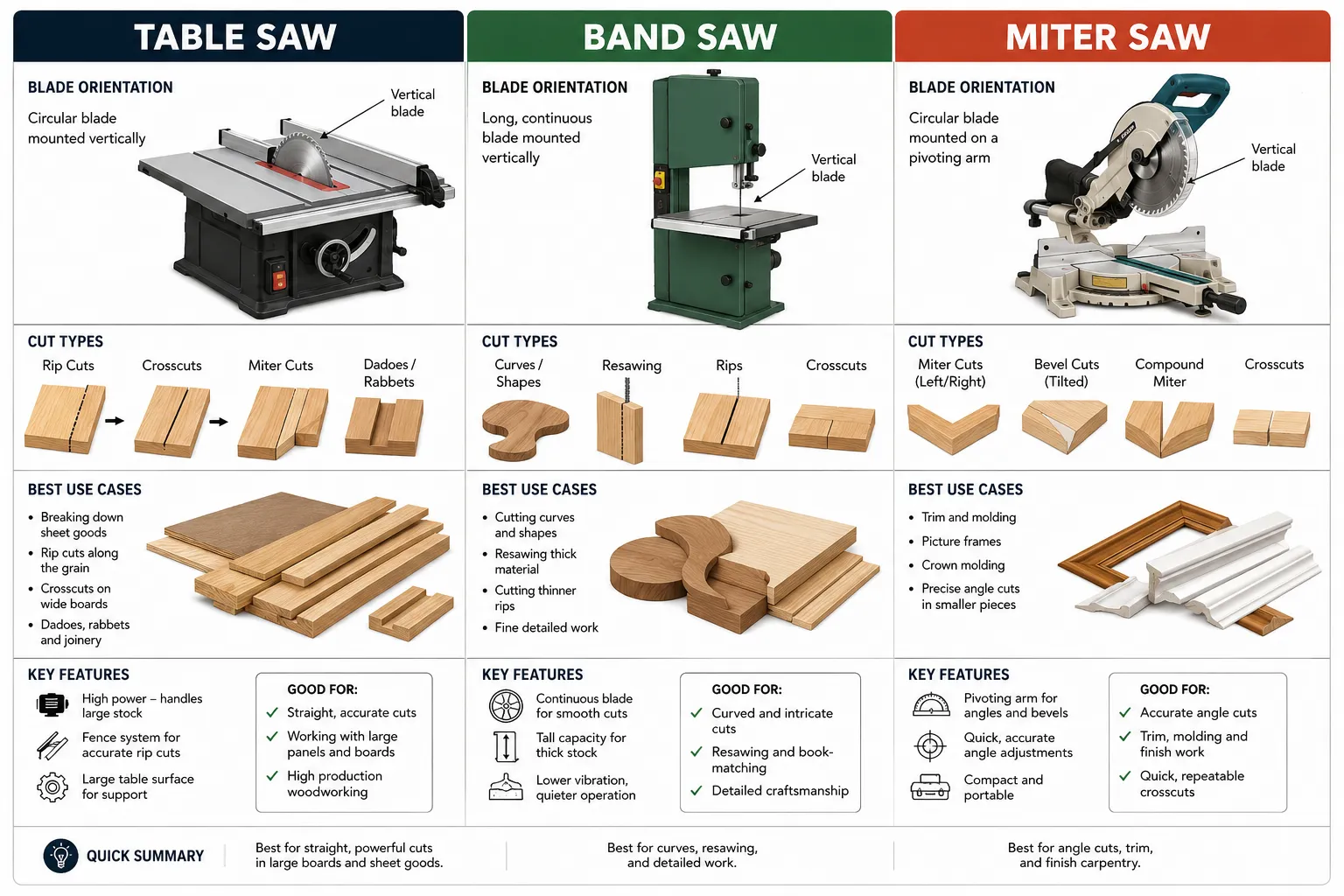
A table saw makes rip cuts (cuts running along the grain, parallel to the board’s length), while a miter saw makes crosscuts (cuts across the grain) and angled cuts. They solve different problems, and most serious woodworkers eventually own both.
The table saw is the workhorse of any woodworking shop. A flat table surface surrounds a circular blade that protrudes upward through a slot. Wood is fed into the blade, guided by a rip fence for parallel cuts or a miter gauge for angled crosscuts. Table saws come in three main configurations:
- Contractor saws: Portable, relatively affordable ($300 to $700), good for beginners.
- Hybrid saws: Midrange machines ($700 to $1,500) that balance portability with cabinet-saw performance.
- Cabinet saws: Heavy, precise, and expensive ($1,500 to $5,000+), designed for serious hobbyists and professionals.
A miter saw, by contrast, is a dedicated crosscutting tool. The blade swings down onto the wood rather than the wood being fed into the blade. Sliding compound miter saws can handle wider boards and cut compound angles, making them useful for trim work, framing, and furniture components.
Choose a table saw if you’re breaking down sheet goods or ripping boards to width. Choose a miter saw if you’re cutting parts to length or working with molding and trim. If you can only buy one first, the table saw is more versatile.
What’s the Difference Between a Jointer and a Planer?
A jointer creates a flat reference face and a square reference edge. A planer uses that reference to create a second face that is parallel to the first, bringing the board to a consistent thickness. You need both machines to properly dimension rough-sawn lumber, and they are used in sequence, not interchangeably.
Here’s the workflow that makes this clear. Rough lumber from a sawmill is rarely flat. It may be cupped, twisted, or bowed. Running it through a planer first won’t fix that because the planer simply copies the shape of the bottom face onto the top. The jointer goes first, creating one flat face. Then the planer takes over, producing a board that is flat, parallel, and the thickness you want.
The jointer also squares up edges for glue-up joints. A well-tuned jointer produces edges so clean that two boards can be glued face-to-face without any gaps, which is exactly what you need when building furniture from plans.
Common mistake: Buying a planer without a jointer and wondering why boards still come out warped. The planer is not a substitute for the jointer.
Best Woodworking Machinery for Beginners on a Budget
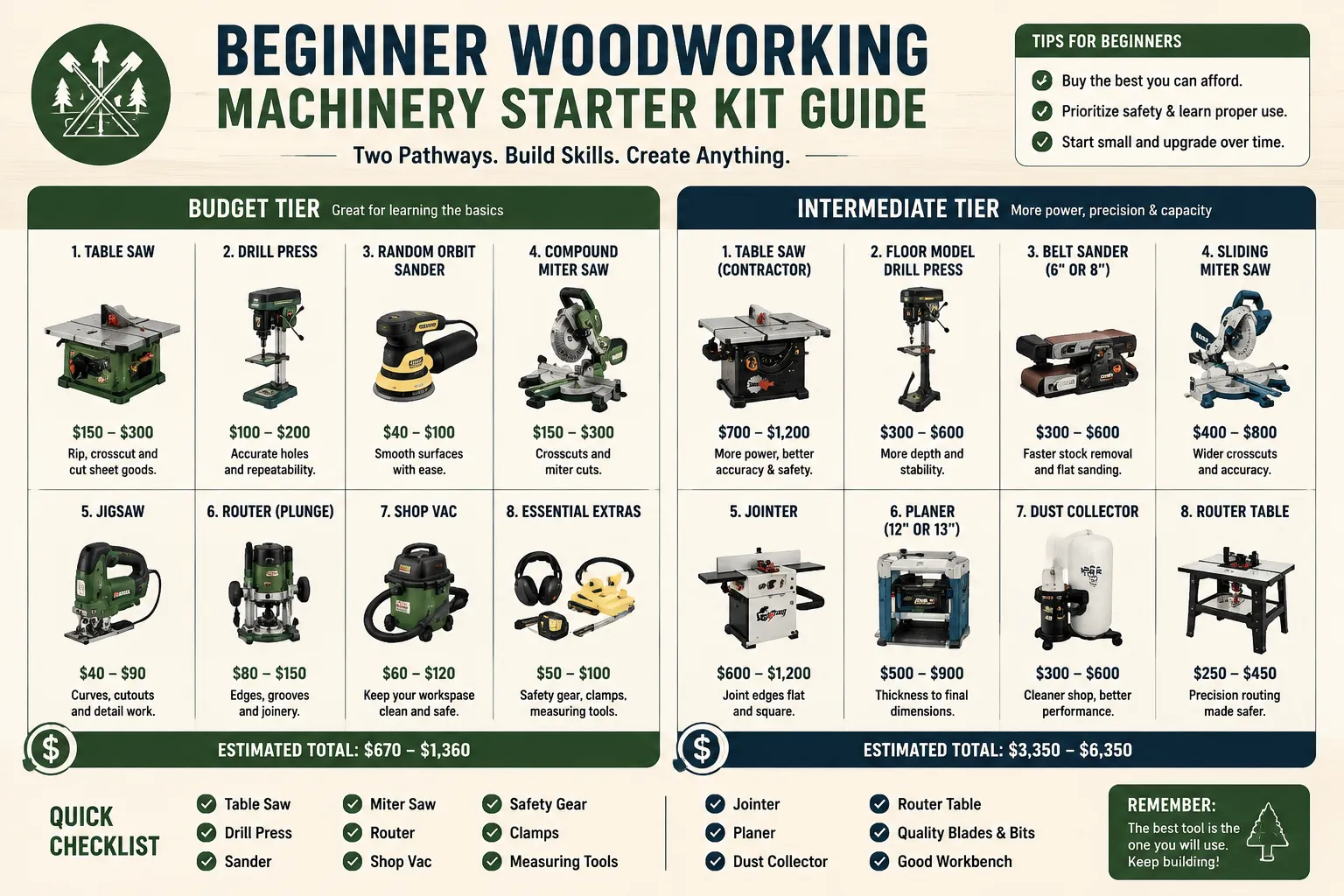
For most beginners, a three-machine starter setup covers the majority of projects: a contractor table saw, a benchtop thickness planer, and a band saw. This combination handles ripping, dimensioning, and curved cuts without overwhelming your budget or your floor space.
A realistic budget breakdown for a beginner setup (new tools, mid-tier brands, as of 2026):
- Contractor table saw: $350 to $650
- Benchtop thickness planer: $300 to $500
- Band saw (14-inch): $400 to $700
- Dust collector (single-stage): $150 to $300
- Total estimate: $1,200 to $2,150
If that’s too much at once, start with just the table saw and a good dust collector. Add the planer next, then the band saw. A drill press is a useful addition later, especially for woodworking projects that require precise, repeatable holes.
Buying used is a legitimate strategy. A used Jet or Powermatic machine in good condition will outperform a new budget-brand machine at the same price. Check local classifieds, estate sales, and woodworking forums for deals.
How Much Does a Good Woodworking Machinery Setup Cost?
The cost of a woodworking machinery setup ranges from about $800 for a minimal beginner shop to $10,000 or more for a fully equipped hobbyist shop with professional-grade stationary tools. Where you land depends on what you’re building and how often you’re building it.
Here’s a rough tier breakdown:
Entry level ($800 to $2,000): Contractor table saw, benchtop planer, basic band saw, shop vacuum with dust separator. Good for furniture projects, small boxes, and learning fundamentals.
Intermediate ($2,000 to $6,000): Hybrid table saw, 6-inch jointer, 13-inch planer, 14-inch band saw, drill press, dedicated dust collector. Handles most hobby and small-business projects comfortably.
Advanced ($6,000 to $15,000+): Cabinet saw, 8-inch jointer, 15-inch planer, 17-inch band saw, spindle molder, wide-belt sander, two-stage dust collection. This is the territory of serious hobbyists and those running a woodworking business.
Don’t forget consumables and accessories in your budget: blades, dado sets, push sticks, featherboards, and safety gear add up quickly.
Woodworking Machinery for Small Spaces and Apartments
Small-space woodworking is absolutely possible with the right machine choices. The key is prioritizing benchtop versions of core tools and choosing machines that can be stored when not in use.
The best options for small shops and apartments:
- Benchtop table saw: Models like the DeWalt DWE7485 fold for storage and perform well for their size.
- Benchtop planer: The DeWalt DW734 and Ridgid R4331 are compact, capable, and easy to move.
- Compact band saw: A 9-inch or 10-inch band saw takes up minimal floor space.
- Benchtop drill press: Occupies about 1 square foot of bench space.
- Track saw: A circular saw paired with a guide rail replaces a table saw for sheet goods and stores flat against a wall.
Noise and dust are the bigger challenges in apartment settings. A track saw with a connected shop vacuum is significantly quieter and cleaner than a table saw. Many apartment woodworkers work outdoors or in shared spaces and bring only the tools they need for each session.
Do I Need a Dust Collector with My Woodworking Tools?
Yes, you need dust collection. This is not a luxury item. Wood dust, particularly from hardwoods like oak, walnut, and cherry, is classified as a respiratory hazard. Fine dust particles (below 10 microns) penetrate deep into the lungs and are not visible to the naked eye. A standard shop vacuum captures larger chips but allows fine dust to pass through or recirculate.
A dedicated single-stage dust collector with a 1-micron bag or a two-stage system with a cyclone separator is the minimum for a shop where you’re running a planer, jointer, or sander regularly. Connect it to each machine using 4-inch dust ports and flexible hose.
For very small shops, a shop vacuum paired with a Thien baffle separator (a DIY cyclone separator) is a budget-friendly starting point. But upgrade to a proper dust collector as soon as your budget allows.
Can You Use Woodworking Machinery Without Hearing Protection?
No. Running woodworking machinery without hearing protection causes permanent, cumulative hearing damage. Most woodworking machines operate between 90 and 105 decibels. According to OSHA guidelines, exposure to 95 dB for more than one hour per day without protection puts hearing at risk. A table saw running for 20 minutes in a reflective garage can easily exceed safe exposure limits.
Foam earplugs (NRR 29 to 33) are the minimum. Earmuff-style hearing protectors rated NRR 25 or higher are more comfortable for longer sessions. Many woodworkers use both simultaneously when running especially loud machinery like routers or thickness planers.
The damage is irreversible. No amount of regret fixes hearing loss from years of unprotected shop time.
What Woodworking Machinery Do You Actually Need vs. Nice to Have?
Most hobbyist projects require far fewer machines than beginners expect. Here’s an honest breakdown:
Actually need:
- Table saw (or track saw for small spaces)
- Thickness planer
- Random orbital sander
- Drill/driver
- Dust collection
Very useful but not day-one purchases:
- Jointer
- Band saw
- Drill press
- Router table
Nice to have once you’re serious:
- Spindle molder
- Sliding table saw
- Wide-belt or drum sander
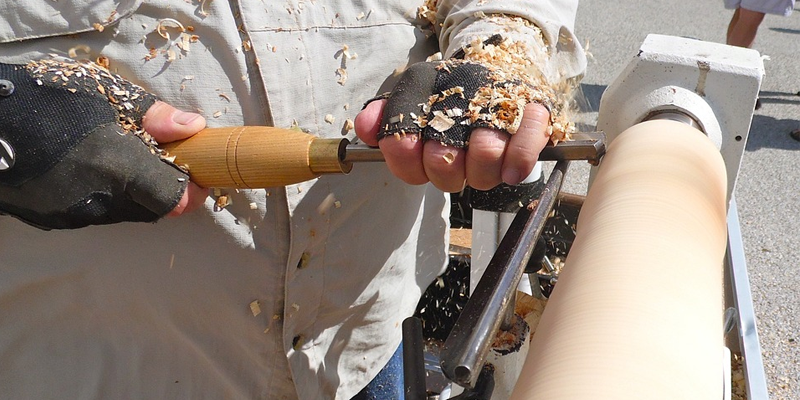
- Lathe (if you’re doing turning)
The jointer is the machine most beginners regret not buying sooner. Once you start working with rough lumber, you’ll feel its absence on every project.
How to Set Up Woodworking Machinery Safely in a Garage
Safe garage shop setup comes down to four factors: machine placement, electrical capacity, dust management, and lighting. Getting these right before you start cutting prevents most common accidents and frustrations.
Machine placement: Leave at least 3 feet of clearance on all feed sides of stationary machines. A table saw needs clear outfeed space equal to the longest board you plan to cut. Position machines so you’re not feeding one into the back of another.
Electrical: Most stationary woodworking machinery requires a dedicated 20-amp circuit. A table saw, dust collector, and shop lights running simultaneously can easily trip a standard 15-amp circuit. If your garage has only one circuit, consult an electrician before adding machinery.
Dust management: Position your dust collector centrally with short, direct runs to each machine. Longer hose runs reduce suction. Keep the floor clear of chips so you’re not slipping while operating machinery.
Lighting: Shadows on a workpiece near a spinning blade are dangerous. Use overhead LED shop lights and add a task light near the table saw fence if needed.
Safety gear storage: Keep hearing protection, safety glasses, and push sticks within arm’s reach of each machine. If you have to walk across the shop to get your ear protection, you’ll skip it.
You can also explore equipment used in woodworking for a more detailed look at shop setup considerations.
Why Is My Band Saw Blade Breaking So Much?
Band saw blade breakage is almost always caused by one of four things: blade tension set too low, blade guides misaligned, feeding the wood too fast, or using the wrong blade for the material thickness. Each of these puts stress on the blade at a single point until it fatigues and snaps.
Here’s how to diagnose and fix each cause:
- Low tension: The blade should deflect no more than about 1/4 inch when pushed sideways with a finger. Increase tension until it feels firm.
- Misaligned guides: The blade guides (both the thrust bearing and the side guides) should be set within 1/64 inch of the blade without touching it while the blade is at rest.
- Feed rate too fast: Let the blade do the work. Forcing the wood through creates lateral stress on the blade.
- Wrong blade: Use a blade with 3 to 6 teeth per inch (TPI) for thick stock and 10 to 14 TPI for thin stock or detail work. Using a fine blade on thick lumber causes the gullets to clog and the blade to buckle.
Also check that the blade is tracking properly on the wheels and that the tires (the rubber coating on the wheels) are not cracked or worn flat.
Common Mistakes People Make When Buying Woodworking Machinery
The biggest mistake is buying too much too soon. Many beginners purchase five or six machines at once, run out of budget for quality blades and dust collection, and end up with a shop full of mediocre tools that frustrate rather than inspire.
Other common mistakes worth knowing before you spend:
- Ignoring the fence quality on a table saw. A cheap, wobbly fence makes accurate rip cuts nearly impossible. Test the fence before buying or budget for an aftermarket upgrade.
- Buying the smallest planer available. A 10-inch benchtop planer limits you to boards under 10 inches wide. A 13-inch model costs only slightly more and handles most furniture stock.
- Skipping dust port compatibility checks. Some machines use 2.5-inch ports, others use 4-inch. Mismatched ports mean improvised adapters and poor suction.
- Choosing a brand based on price alone. A $200 band saw from an unknown brand will cost you more in frustration and replacement blades than a $500 Jet or Rikon.
- Not accounting for accessories. A table saw without a good dado set, a push stick, and a crosscut sled is a limited machine. Budget for accessories from day one.
Woodworking Machinery Brands That Are Actually Worth It
Brand reputation in woodworking machinery matters more than in many other tool categories because quality control, parts availability, and customer support directly affect how long a machine lasts and how much it costs to maintain.
For beginners on a budget:
- Ridgid: Solid contractor-grade tools with a lifetime service agreement on many models.
- DeWalt: Reliable benchtop tools, particularly the DW735 planer and DWE7485 table saw.
For intermediate hobbyists:
- Jet: Consistently good quality across their full lineup, especially their jointers and band saws.
- Rikon: Strong reputation for band saws and lathes at fair prices.
For serious hobbyists and small shops:
- Powermatic: American-designed, well-built machines with excellent resale value.
- SawStop: The industry leader in table saw safety technology, with a flesh-detection brake system that stops the blade on contact with skin.
Brands to approach carefully: very low-price imports with no established dealer network often have poor parts availability, which means a broken fence bracket can sideline your machine indefinitely.
How to Maintain and Care for Woodworking Machinery
Regular maintenance keeps woodworking machinery accurate, safe, and running for decades. Most of it takes less than 15 minutes per session.
After every use:
- Clear dust and chips from the table surface, blade guards, and dust ports.
- Check that blade guards are intact and functioning.
- Wipe cast iron table surfaces with a dry cloth to prevent rust.
Monthly (or every 10 to 15 hours of use):
- Apply paste wax or a dedicated cast iron conditioner (like TopCote or Bostik) to table surfaces. This reduces friction and prevents rust.
- Check blade or cutter alignment. Table saw blades should be parallel to the miter slots within 0.005 inches.
- Inspect blades and cutters for dullness, missing teeth, or cracks. Replace as needed.
- Lubricate moving parts (blade height mechanisms, fence rails) with dry PTFE lubricant or paste wax.
Annually:
- Check and adjust belt tension on belt-driven machines.
- Inspect power cords for cracks or fraying.
- Clean motor vents with compressed air.
- Recalibrate all fences and stops.
A well-maintained machine also produces better results. A dull blade or a misaligned fence introduces errors that no amount of skill can fully compensate for. Pairing good maintenance habits with solid woodworking jigs will noticeably improve your accuracy and consistency.
Woodworking Machinery for Metal vs. Wood Only
Most woodworking machinery is designed exclusively for wood and wood-based materials. Using a standard woodworking table saw or band saw to cut metal is dangerous and will damage the machine. The blade speeds, tooth geometry, and feed rates required for metal are fundamentally different from those for wood.
That said, some crossover exists in specific situations:
- A metal-cutting band saw uses a much slower blade speed (typically 100 to 300 feet per minute vs. 3,000+ for wood) and a fine-tooth bi-metal blade. Some band saws have variable speed settings that allow both wood and metal cutting.
- A drill press can drill both wood and metal with the appropriate bit and a slower speed setting for metal.
- A router should never be used on metal.
If your projects involve both wood and metal (furniture with steel legs, for example), budget for a dedicated metal-cutting tool rather than trying to adapt woodworking machinery. The safety risks and blade damage costs are not worth the savings.
FAQ: Woodworking Machinery
What woodworking machine should I buy first as a complete beginner?
Start with a contractor table saw. It handles the widest range of cuts, works with both solid wood and sheet goods, and forms the foundation of most woodworking workflows. Add a dust collector at the same time.
Can I learn woodworking without buying any machinery?
Yes. Hand tools (chisels, hand planes, hand saws) can produce excellent work and cost far less. Many beginners start with hand tools to learn fundamentals before investing in machinery. Woodworking online training can help you decide which path suits your goals.
How much space do I need for a basic woodworking shop?
A one-car garage (roughly 12 by 20 feet) is workable for a starter shop with a table saw, planer, and band saw. The critical factor is outfeed space, not just the machine footprint.
Is a used table saw safe to buy?
Yes, if you inspect it carefully. Check that the blade guard and riving knife are present and functional, the fence locks solidly, the blade arbor has no wobble, and the motor runs without unusual noise. Avoid machines with missing safety components that are no longer available.
What’s the safest woodworking machine for a beginner?
A drill press is generally considered the safest stationary woodworking machine for beginners. A SawStop table saw is the safest option if you’re starting with a table saw, due to its flesh-detection braking system.
Do I need a jointer if I only buy pre-dimensioned lumber from the hardware store?
Not immediately. Pre-dimensioned (S4S) lumber from a hardware store is already flat and square. A jointer becomes essential when you start buying rough-sawn lumber from a sawmill, which is cheaper and offers more species options.
How often should I replace band saw blades?
A quality bi-metal band saw blade used for general woodworking should last 6 to 18 months with regular use. Replace it when you notice burning, the need to force the cut, or visible missing teeth.
What’s the difference between a single-stage and two-stage dust collector?
A single-stage collector pulls everything (chips and fine dust) directly into one bag. A two-stage system uses a cyclone separator to drop heavy chips into a bin before the fine dust reaches the filter, extending filter life and improving suction over time.
Can I run woodworking machinery on a standard household outlet?
Many benchtop tools run on standard 120V/15-amp outlets. Larger stationary machines (cabinet saws, wide-belt sanders, large dust collectors) often require 240V dedicated circuits. Always check the machine’s power requirements before purchase.
What’s the best woodworking machinery brand for resale value?
Powermatic and SawStop hold their value best in the used market. Jet also resells well. Budget-brand machines depreciate quickly and are harder to sell.
Is a spindle molder worth it for a hobbyist?
Probably not as an early purchase. A router table handles most of the same tasks at a fraction of the cost. A spindle molder makes sense once you’re producing high volumes of molded profiles or running a production shop.
What’s the quietest woodworking machine for a shared space?
A scroll saw is the quietest powered woodworking tool and produces very little dust. For general woodworking, a track saw with a connected vacuum is significantly quieter than a table saw and better suited to shared or noise-sensitive environments.
Conclusion
Woodworking machinery is not about owning every tool available. It’s about having the right tools for the work you actually want to do, set up safely, maintained properly, and used with intention. For most beginners, that means starting small: a table saw, a planer, and a dust collector cover an enormous range of projects. From there, you add machines as your projects demand them, not before.
The craft rewards patience. A shop built gradually, with quality tools chosen thoughtfully, will serve you far better than a rushed collection of machines you don’t yet know how to use. Take the time to learn each tool before adding the next. Understand what it does, what it can’t do, and how to keep it in good working order.
The fundamentals haven’t changed. Good machinery, sharp blades, proper safety habits, and a clear woodworking plan before you start cutting are still the ingredients that separate satisfying projects from expensive mistakes.
Recommended Products, Tools, and Resources
These are tools and resources worth considering based on the topics covered in this guide. They represent genuine value at their respective price points, not just popular names.
Table Saws
The DeWalt DWE7485 is a compact contractor saw that punches above its price point for beginners with limited space. The SawStop Contractor Saw is the safest table saw available for home shops and worth the premium if you’re working alone.
Thickness Planers
The DeWalt DW735X (13-inch, two-speed) is the most consistently recommended benchtop planer in its price range. The Powermatic PM2244 is the step up for serious hobbyists who want a machine that lasts decades.
Band Saws
The Rikon 10-310 (10-inch) is an excellent entry-level band saw. The Jet JWBS-14DXPRO (14-inch) is the go-to recommendation for intermediate woodworkers.
Dust Collection
The Oneida Air Systems Dust Deputy cyclone separator paired with a standard shop vacuum is the most cost-effective dust management upgrade for a small shop. The Jet DC-1100VX is a solid single-stage collector for a dedicated shop space.
Learning Resources
For structured skill-building, woodworking online training offers guided courses that cover both hand tools and machinery fundamentals. If you’re ready to start building, woodworking plans provide project blueprints scaled to beginner and intermediate skill levels.