Free vs Paid Shed Plans: Find the Best Option for Your Project
Most backyard shed projects stall not because of budget or skill, but because the builder started with the wrong set of plans. The question of free vs. paid shed plans is one of the most common dilemmas beginners face, and the answer depends less on cost than on what you actually need to succeed.
Key Takeaways
- Free shed plans can work well for simple builds, but they often lack materials lists, cut lists, and step-by-step instructions.
- Paid shed plans typically cost between $10 and $50 and include detailed diagrams, exploded views, and full lumber lists.
- Beginners benefit most from paid plans because the extra detail reduces costly mistakes and wasted materials.
- Free plans from reputable sources (government extension sites, established woodworking blogs) tend to be more reliable than random forum posts.
- Always verify local permit requirements before you build, regardless of which type of plan you use.
- A good set of plans, free or paid, should include a foundation layout, framing diagram, roofing details, and a complete materials list.
- The real cost of free plans is not the download price but the time and material waste that comes from filling in the gaps yourself.
What Is the Difference Between Free and Paid Shed Plans?
Free shed plans are publicly available blueprints you can download or print at no cost. Paid plans are professionally designed packages you purchase, usually as a PDF or printed booklet. The core difference is not the design itself but the level of detail and support built into the document.
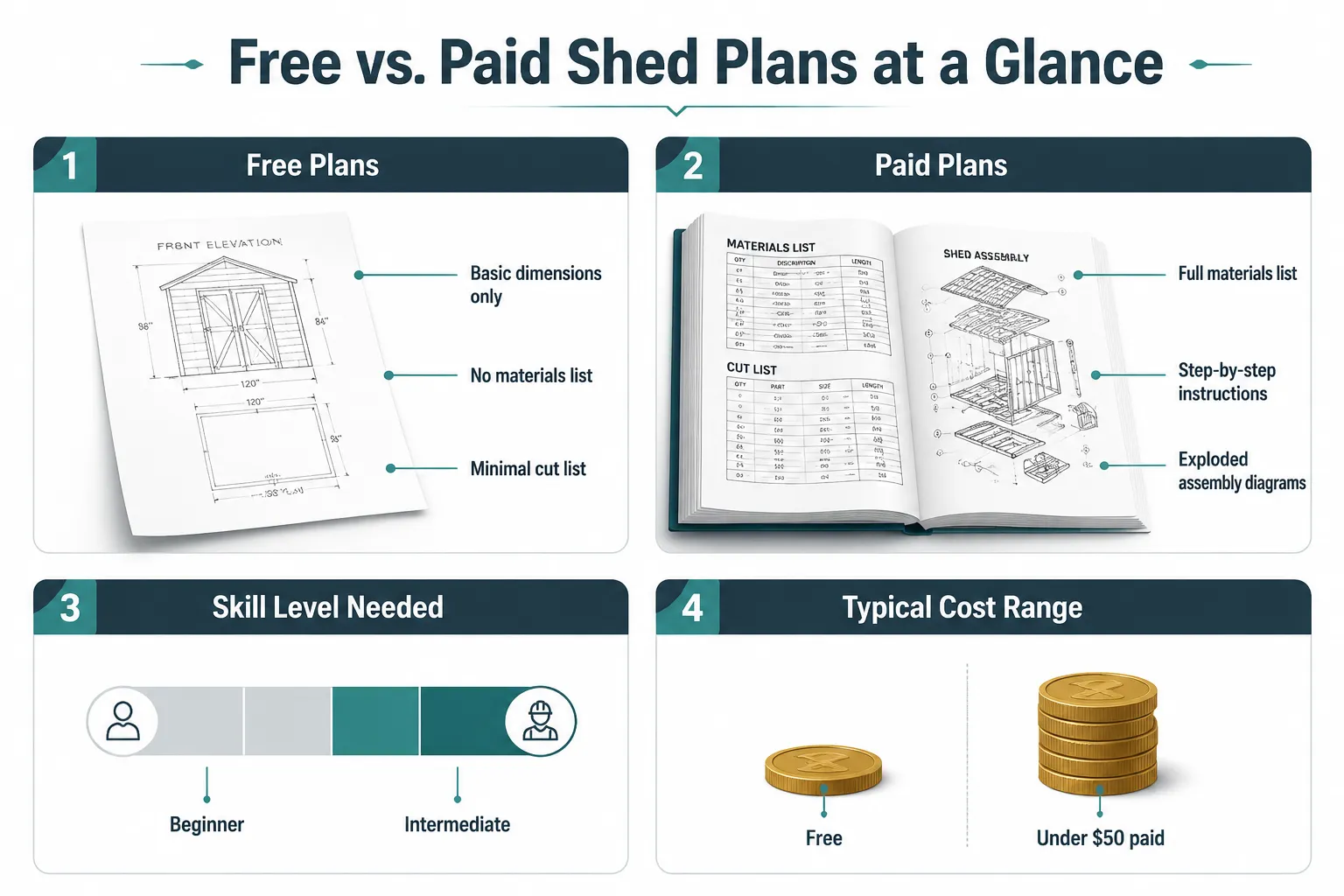
Here is what that difference looks like in practice:
Free plans typically include:
- A basic floor plan with rough dimensions
- One or two elevation drawings
- A general materials overview (sometimes)
- Little to no step-by-step guidance
Paid plans typically include:
- Detailed floor plan, elevation, and section drawings
- Exploded assembly diagrams showing how each component connects
- A complete, itemized materials list with lumber dimensions and quantities
- A cut list so you can prep all pieces before assembly begins
- Step-by-step written instructions, often with photos
- Foundation and anchoring details
- Roofing and siding specifications
For a deeper look at how to read and interpret any set of plans before you build, see this beginner’s complete guide to reading and using woodworking plans.
Are Free Shed Plans Actually Any Good?
Some free shed plans are genuinely useful, but quality varies enormously. A well-maintained free plan from a university agricultural extension program or an established woodworking publication can be perfectly adequate for a basic 8×10 gable-roof storage shed. A random PDF pulled from a forum post, on the other hand, may have missing dimensions, incorrect lumber specs, or no materials list at all.
The honest answer: free plans are good enough when you already understand framing basics and can fill in the gaps. For true beginners, the gaps in a free plan often lead to expensive mistakes.
Signs a free plan is worth using:
- It includes a complete materials list with lumber dimensions
- Dimensions are shown on every view (floor plan, front elevation, side elevation)
- The source is a recognizable woodworking site, university extension, or established publication
- It specifies the foundation type (concrete piers, gravel pad, skid foundation)
- It notes which building codes or standards it was designed to meet
Red flags in a free plan:
- Dimensions only on one view
- No materials or cut list
- No foundation detail
- No author or source information
- Outdated lumber sizing that does not match current dimensional lumber standards
How Much Do Quality Paid Shed Plans Cost?
Most quality paid shed plans fall in the $10 to $50 range, with the majority priced between $15 and $35. Premium plan packages that include multiple shed sizes, 3D renderings, and contractor-grade detail can run up to $75 to $100, but those are rarely necessary for a DIY backyard project.
Here is a rough breakdown of what you get at each price tier:
| Price Range | What to Expect | Best For |
|---|---|---|
| Free | Basic dimensions, limited detail | Experienced builders, simple builds |
| $10,$20 | Materials list, basic step-by-step | Confident beginners |
| $20,$50 | Full cut list, exploded diagrams, photos | Most DIY beginners and hobbyists |
| $50,$100 | Multiple sizes, 3D views, premium detail | Complex builds, permit submissions |
For a full picture of what a shed project will cost beyond the plans themselves, the cost to build a small shed guide breaks down materials, labor, and hidden expenses.
What Do Paid Shed Plans Include That Free Ones Don’t?
The biggest advantage of paid plans is completeness. Beyond the extra drawings, the most valuable additions are the materials list and the cut list. These two documents alone can save a beginner several trips to the lumber yard and hundreds of dollars in over-purchasing or under-purchasing materials.
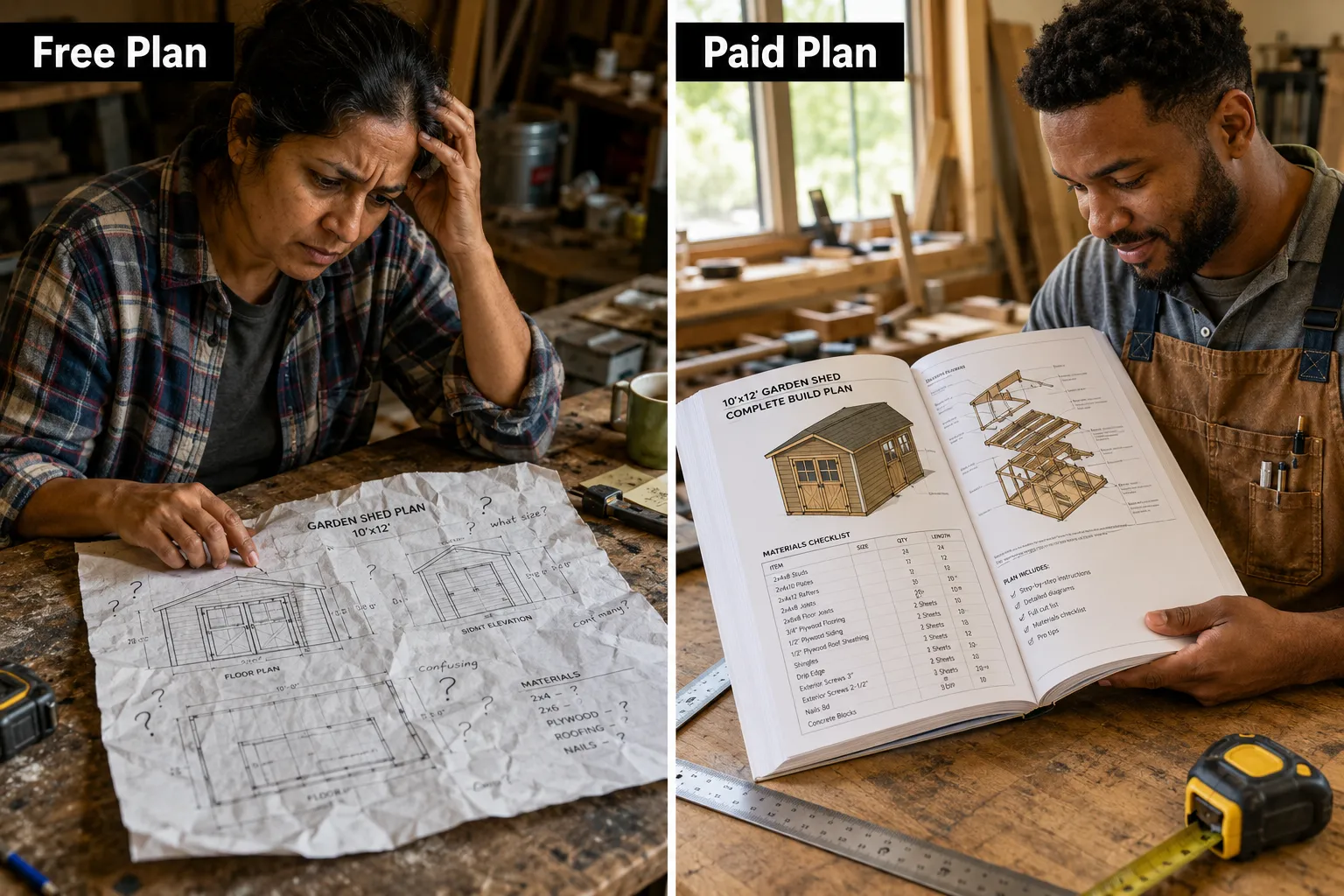
The elements most often missing from free plans:
- Cut list: A cut list tells you exactly how many pieces to cut, at what length, and from which board size. Without it, you are doing math from scratch on every component.
- Exploded assembly diagrams: These show how parts fit together in a 3D-style view. They are especially helpful when framing walls or assembling roof trusses for the first time.
- Foundation detail: Many free plans skip this entirely, leaving you to figure out whether you need a concrete slab, skid foundation, or deck block layout.
- Hardware schedule: Paid plans often list every fastener, hinge, and connector by size and quantity.
- Roofing detail: Sheathing, underlayment, drip edge, and ridge cap are frequently absent from free plans. For help choosing the right roof structure, see this guide to shed roof styles including lean-to, gable, and barn options.
Can You Build a Shed from Free Plans Online?
Yes, you can build a perfectly functional shed from free plans, and many people do. The key is knowing where to find reliable ones and what to verify before you start cutting lumber.
Where to find reliable free shed plans:
- University cooperative extension programs (land-grant universities in the U.S. often publish free agricultural building plans)
- Ana White’s woodworking site (anawhite.com), known for detailed free plans with materials lists
- Family Handyman and similar established publications, frequently publish free plans with reasonable detail
- The Spruce Crafts, offers beginner-friendly free plans with photos
What to do before building from a free plan:
- Print all pages and verify that dimensions are consistent across views.
- Create your own materials list by counting every piece shown in the drawings.
- Check that the plan matches your local snow load, wind load, and setback requirements.
- Confirm the foundation type suits your site conditions.
- Cross-reference the framing layout with a trusted source if the plan lacks step-by-step instructions.
Common Mistakes People Make with Free Shed Plans
The most common mistake is treating a free plan as complete when it is not. Builders assume the plan accounts for everything, start purchasing materials, and discover mid-project that critical details are missing.
Other frequent mistakes:
- Skipping the materials takeoff: Buying lumber without a verified list almost always results in multiple extra trips to the store and budget overruns.
- Ignoring foundation requirements: A shed built on an uneven or inadequate foundation will rack, shift, and develop door alignment problems within a season or two.
- Using plans from a different climate: A plan designed for a mild Pacific Northwest climate may not specify the rafter sizing needed for heavy Midwest snow loads.
- Not checking for permit requirements: Many builders assume a small shed does not need a permit. That assumption can lead to fines or a forced tear-down.
- Scaling plans incorrectly: If you print a PDF plan at anything other than 100%, all dimensions become wrong. Always print at actual size and verify with a ruler.
Where Can I Find Reliable Free Shed Plans?
Reliable free shed plans come from sources with editorial accountability, meaning someone with construction knowledge reviewed them before publishing. University extension programs, long-established woodworking publications, and well-known DIY bloggers with verifiable track records are the safest bets.
For community-sourced recommendations, woodworking forums and subreddits (such as r/DIY and r/woodworking) regularly feature threads where members share their experiences with specific free plan sources. The consensus in those communities generally favors Ana White, Family Handyman, and extension service publications for free plans that actually hold up in the field.
Shed Plans for Beginners: Free or Paid?
For beginners, paid plans are almost always the better starting point. The extra $15 to $35 spent on a complete plan set pays for itself quickly in avoided mistakes, fewer wasted materials, and a less frustrating build experience.
That said, a beginner can succeed with a free plan if they supplement it with a reliable how-to resource. The complete guide to building your own backyard shed can fill in many of the procedural gaps that free plans leave out.
Choose paid plans if you:
- Have never built a structure before
- Are working with a tight material budget and cannot afford waste
- Need the plans to support a permit application
- Are building anything larger than a basic 8×8 storage box
Free plans may work if you:
- Have built decks, fences, or framed walls before
- Are comfortable doing your own materials takeoff
- Are building a simple lean-to or small storage unit
- Have access to a knowledgeable mentor who can review the plan with you
If you are still deciding on the size and layout of your project, the shed size guide for suburban lots is a practical place to start before you commit to any plan.
Do You Need a Permit for a Shed Built from Plans?
Permit requirements vary by municipality, but most jurisdictions require a building permit for any shed over a certain size, typically 100 to 200 square feet, or any structure with a permanent foundation. Some areas also require permits for sheds above a certain height, regardless of footprint.
General guidelines (always verify with your local building department):
- Sheds under 100 sq ft are permit-exempt in many U.S. jurisdictions, but not all.
- Sheds on permanent foundations (concrete slabs) almost always require a permit.
- Sheds within a certain distance of property lines (setbacks) may be restricted regardless of size.
- HOA rules can be stricter than local code and apply independently.
A permit application typically requires a site plan showing the shed’s location on the property, a floor plan, and at least one elevation drawing. This is one area where paid plans earn their cost back quickly, since they usually include permit-ready drawings.
Paid Shed Plans vs. Hiring a Contractor
Paid plans and contractor-built sheds serve different needs entirely. Plans, whether free or paid, are for the builder who wants to do the work themselves. A contractor handles design, permitting, and construction but costs significantly more.
For a detailed comparison of the cost and effort involved in doing it yourself versus hiring help, the DIY shed building cost comparison breaks down both paths honestly.
The middle ground worth considering: purchase paid plans, pull your own permit, and hire a framing carpenter for one or two days to help with the structural work. This approach keeps costs reasonable while reducing the risk of structural errors.
FAQ: Free vs Paid Shed Plans
Are free shed plans safe to build from?
Free plans can be structurally sound, but safety depends on the source and your ability to verify the design. Plans from university extension programs or established publications are generally reliable. Always cross-check framing dimensions against your local building code for wind and snow loads.
What is the best free shed plan site for beginners?
Ana White’s site is frequently recommended by the DIY community for its clear free plans that include materials lists and step-by-step photos. Family Handyman also publishes beginner-friendly free plans with reasonable detail.
How do I know if a paid shed plan is worth buying?
Look for plans that include a cut list, exploded assembly diagrams, a complete materials list, and foundation details. Read reviews or look for sample pages before purchasing. If the seller only shows a cover image and no sample drawings, that is a warning sign.
Can I modify a free shed plan to fit my space?
Yes, but modifying plans requires understanding how structural changes affect framing. Changing width or length affects rafter span, floor joist sizing, and wall stud layout. If you are not comfortable with those calculations, a paid plan designed for your target size is a safer choice.
What size shed can I typically build without a permit?
In many U.S. jurisdictions, sheds under 100 to 120 square feet on non-permanent foundations are permit-exempt, but this varies widely. Always check with your local building or zoning department before starting any structure.
Do paid shed plans come with customer support?
Some do. Larger plan retailers and woodworking plan publishers often provide email support or community forums where buyers can ask questions. This is worth checking before you buy, especially for complex builds.
Is it legal to use free shed plans for a commercial project?
Most free plans are licensed for personal use only. If you are building sheds to sell or for a client, review the plan’s licensing terms carefully. Paid commercial-use licenses are available from most professional plan providers.
What is the difference between a shed plan and a shed kit?
A shed plan is a set of drawings and instructions you use to build from raw materials. A shed kit is a pre-cut package of materials (sometimes pre-assembled panels) that you assemble on-site. Kits cost more than plans but reduce cutting time and material sourcing.
Can I use shed plans to build a she-shed or studio shed?
Standard shed plans can be adapted for specialty uses, but purpose-built plans for a she-shed, studio, or office shed will account for insulation, electrical rough-in, and interior finishing details that a basic storage shed plan skips. See the comparison of she-shed, studio shed, and office shed options for guidance on specialty builds.
How detailed are free shed plans compared to paid ones?
Free plans typically provide enough information to understand the general structure but leave out the cut list, hardware schedule, and step-by-step assembly sequence. Paid plans are designed to be self-contained: a builder should be able to complete the project using only what is in the package.
Conclusion
The free vs. paid shed plans debate comes down to one honest question: how much detail do you need to build successfully? For experienced builders who are comfortable with framing and can generate their own materials list, a quality free plan from a reputable source is a perfectly reasonable starting point. For beginners and hobbyists building their first structure, the $15 to $35 investment in a complete paid plan set is almost always worth it.
The goal of any shed project is to end up with a structure that is square, solid, and built to last. The plans you start with set the foundation for everything that follows.
Actionable next steps:
- Decide on your shed size and style before evaluating any plan. The custom vs. standard shed designs guide can help you clarify what you actually need.
- Check your local permit requirements before purchasing or downloading plans.
- If you choose free plans, verify the source, print at 100%, and create your own materials list before buying a single board.
- If you choose paid plans, look for a sample page before purchasing to confirm the level of detail matches your skill level.
- Budget realistically for materials using the cost to build a small shed as a reference point.
Recommended resources and tools:
- A quality combination square and tape measure are essential for verifying plan dimensions in the field before you cut.
- A framing square helps confirm wall layouts match the plan’s specified angles.
- For reading and interpreting any plan format, the beginner’s complete guide to reading and using woodworking plans is a practical companion to keep open alongside your shed plans during the build.
- If you decide to scale up to furniture or interior projects after your shed build, furniture building plans for every room is a natural next step.
Good plans, combined with careful preparation, make the difference between a frustrating project and one you are proud to show off for years.